 Somalia
Feedback welcome
Our aim is to use the best data to inform our analysis. See our Technical page for information on the IFs forecasting platform. We appreciate your help and references for improvements via our feedback form.
This page explores Somalia’s long-term trajectory across key social, economic and governance dimensions. The assessment discusses current trends in population growth, economic performance, poverty and human wellbeing. The analysis also highlights how policy choices across sectors could shape Somalia’s future pathway.
For more information about the International Futures modelling platform we use to develop the various scenarios, please see the Technical page.
Executive Summary
We begin this page with an introductory assessment of the country’s context, focusing on current population distribution, social structure, climate and topography.
- Somalia is located in the Horn of Africa along the Gulf of Aden and the western Indian Ocean. With more than 3 000 km of coastline, the longest on mainland Africa, it occupies a strategically important position along major maritime trade routes. It borders Djibouti, Ethiopia and Kenya.
- The collapse of Siad Barre’s regime in 1991 led to the fragmentation of the central state and prolonged conflict. Since 2012, Somalia has operated as a federal republic under a Provisional Constitution, comprising the Federal Government and several federal member states. However, relations between federal and regional authorities remain contested, and the constitutional settlement is incomplete. Territorial fragmentation persists, most notably in Somaliland, which declared independence in 1991 and functions as a de facto state but lacks international recognition.
- Security remains the most immediate constraint on state consolidation. The federal government does not exercise full territorial control, and al-Shabaab continues to operate in parts of the countryside. International and regional support, therefore, remains central to the security sector, including African Union missions and bilateral training and assistance to Somali security forces.
- Somalia remains a low-income and institutionally fragile state. Poverty is widespread, the economy is largely informal, and public services remain limited and uneven. Although macroeconomic reforms enabled Somalia to reach the completion point of the Heavily Indebted Poor Countries Initiative in 2023 and secure significant debt relief, state capacity and revenue collection remain constrained.
- The population is predominantly Somali and organised around clan-based social structures that continue to shape politics and access to resources. Somali and Arabic are the official languages, and almost all Somalis follow Sunni Islam of the Shāfiʿī school. Pastoralism and agropastoralism remain central to livelihoods in the country’s largely arid environment.
- Somalia has recently sought deeper regional integration, joining the East African Community in 2023 and ratifying the African Continental Free Trade Area in 2025.
This section is followed by an analysis of the Current Path for Somalia, which informs the country’s likely current development trajectory to 2043. It is based on current geopolitical trends and assumes that no major shocks would occur in a ‘business-as-usual’ future.
- Despite decades of conflict and fragility, Somalia’s population more than doubled from 7.1 million in 1990 to 18.4 million in 2023 and is projected to reach 33.7 million by 2043. This is driven by persistently high fertility, which remains at 6.1 births per woman and is expected to remain well above replacement level. The population is overwhelmingly young, with nearly three-quarters under 30 and almost half under 15, a share that will decline only slightly by 2043. As a result, dependency ratios will remain structurally high, particularly in rural and nomadic areas, sustaining intense pressure on education, health systems and job creation, and reinforcing spatial inequality and development strain over the coming decades.
- Economic growth remains modest, uneven and structurally shallow, constrained by insecurity, weak institutions, dollarisation and heavy aid dependence that finances much of public spending. Although HIPC debt relief in 2023 reduced external debt, and GDP will rise from US$8.6 billion in 2023 to US$20.8 billion by 2043, the growth model remains externally supported and insufficiently diversified, limiting its ability to generate jobs, absorb demographic pressures or drive sustained structural transformation.
- Somalia’s GDP per capita, at US$1 466 in 2023, remains among the lowest in Africa and will reach only US$2 644 by 2043, still far below the average for its low-income peers. Persistent income gaps reflect rapid population growth, entrenched informality, weak human capital development and a narrow, low-productivity services base. Urbanisation, remittances and incremental stabilisation support modest gains, but without structural transformation and sustained job creation, significant improvements in living standards will remain challenging.
- Poverty in Somalia is widespread and structurally entrenched, with 54% of the population living below the national poverty line (US$2.06 per day) and little progress in recent years due to weak per capita growth and recurrent climatic shocks. Poverty is deepest among nomadic and rural communities and geographically concentrated in Central and Southern regions, although rapid urbanisation means most poor people now live in towns and cities. At the international poverty line for low-income countries at US$3.00 per day, 73% of the population (13.4 million people) were poor in 2023. On the Current Path, this rate will decline to 41% by 2043. However, the absolute number will increase to 13.7 million due to population growth. Multidimensional poverty is even more severe, affecting roughly two-thirds of the population and over 80% of nomadic groups, driven primarily by deficits in living standards and education.
- Since the mid-2010s, Somalia has rebuilt its national planning architecture, progressing from NDP 8 and NDP 9, which tied recovery to governance reform, macroeconomic stabilisation and debt relief, to the more ambitious National Transformation Plan 2025–2029 and the longer-term Centennial Vision 2060. The NTP serves as Somalia’s medium-term development framework, aimed at strengthening state institutions and governance while accelerating sustainable economic and social development. It prioritises building transparent and accountable governance systems, fostering macroeconomic stability and economic diversification, expanding critical infrastructure, investing in human capital and social services, and strengthening resilience to environmental and climate shocks, while mainstreaming gender equality and inclusion across development policies. This evolution reflects a gradual shift from a focus on stabilisation towards structural transformation, with greater emphasis on state capacity, federal coordination, human capital development and resilience. Implementation, however, remains constrained by limited administrative reach, uneven federal authority and persistent insecurity.
The next section compares progress on the Current Path with eight sectoral scenarios. These are Demographics and Health; Agriculture; Education; Manufacturing; the African Continental Free Trade Area (AfCFTA); Large Infrastructure and Leapfrogging; Financial Flows; and Governance. Each scenario is benchmarked to set an ambitious yet reasonable aspiration for that sector.
- In 2023, Somalia’s infant mortality rate stood at 62 deaths per 1 000 live births, more than double the Sustainable Development Goal target of fewer than 25 deaths per 1 000 live births by 2030. On the Current Path, the rate will decline to 31 deaths per 1 000 live births in 2043, indicating substantial improvement but still falling short of the global benchmark. Under the Demographics and Health scenario, however, infant mortality could fall further to 26 deaths per 1 000 live births, bringing the country close to achieving the SDG target. Life expectancy will improve from 65 years in 2023 to 74 years in 2043 (2 years more than the Current Path projection).
- In the Current Path, the agricultural trade deficit increases from almost 8% of demand in 2023 to 11.4% by 2043, reflecting rising food demand driven by rapid population growth and limited gains in domestic production. The Agriculture scenario will improve this outlook. Higher crop yields, expanded irrigation and reduced agricultural losses will slightly reduce reliance on imports. As a result, the agricultural trade deficit will decline to around 10.4% of demand by 2043. However, these gains are not sufficient to eliminate structural food import dependence. Continued population growth and climate vulnerability will continue to put pressure on domestic food systems. Without sustained productivity improvements and diversification beyond rain-fed agriculture, particularly through irrigation expansion, stronger livestock value chains and fisheries development, Somalia is likely to remain reliant on food imports over the next two decades.
- Mean years of schooling for 15 to 24-year-olds increase only modestly on the Current Path, from 4.6 to 5.5 years by 2043, reflecting persistent bottlenecks across the pipeline. In the Education scenario, stronger intake, retention, vocational expansion, improved quality and gender parity will raise this to 8.3 years, signalling a more substantial shift in human capital accumulation. However, without parallel job creation and economic diversification, even accelerated education gains may struggle to translate into broad-based transformation.
- By 2043, manufacturing value added will increase from approximately US$2.5 billion in the Current Path to US$2.7 billion in the Manufacturing scenario, an improvement of around US$200 million. While this reflects measurable industrial deepening in absolute terms, manufacturing’s share of GDP will remain at 11% in 2043. The limited impact highlights persistent structural constraints in Somalia. Industrial expansion remains closely tied to improvements in energy reliability, transport infrastructure, access to finance, skills development and institutional coherence. Without broader system-wide reforms in these enabling conditions, manufacturing growth does not generate strong backward and forward linkages or significant spillovers into higher-productivity employment.
- Somalia’s trade deficit will decline significantly from 51.1% of GDP in 2023 to 19.4% by 2043 on the Current Path. In the AfCFTA scenario, the deficit will remain slightly higher at 20% of GDP in 2043. The limited gains reflect Somalia’s current trade structure. Exports are heavily concentrated in Gulf markets and dominated by low-value primary commodities, while the country remains highly dependent on imports of food, fuel and manufactured goods. As a result, reduced intra-African trade barriers do not immediately translate into large export gains. Over the longer term, however, AfCFTA could support the diversification of export markets and the development of the manufacturing and agro-processing sectors, provided complementary reforms strengthen domestic productive capacity and trade facilitation.
- In the Current Path, households using traditional cookstoves will increase from 1.6 million in 2023 to 2.1 million by 2043. In the Large Infrastructure and Leapfrogging scenario, the number of households using traditional cookstoves will be about 200 000 fewer than the Current Path forecast for 2043, indicating a modest acceleration in the shift away from biomass. This shift is reflected in modern fuel uptake. By 2043, 1.7 million people will use modern fuels in the Current Path, compared to 1.9 million in the Large Infrastructure and Leapfrogging scenario. The gains are tangible but limited.
- Government revenue will increase from US$3.6 billion in 2023 to US$14.1 billion by 2043 on the Current Path. In the Financial Flows scenario, revenues will rise further to US$15.6 billion over the same period. As a share of the economy, government revenue stood at 35.2% of GDP in 2023 and will decline slightly to 34.8% by 2043 on the Current Path. In the Financial Flows scenario, improved financial inflows and strengthened fiscal capacity will raise government revenue to 37.3% of GDP by 2043.
- Somalia’s governance performance remains weak but shows gradual improvement over time. The overall governance index will rise from 0.35 in 2023 to 0.41 by 2043 on the Current Path, while governance reforms will increase the score further to 0.49. Security remains a major challenge. Somalia’s security score of 0.41 in 2023 is well below regional averages (0.67 in East Africa and 0.63 for low-income Africa). Improvements are modest on the Current Path, reaching 0.46 by 2043, but reforms under the Governance scenario will raise the score more substantially to 0.57. State capacity is the weakest aspect of governance. With a score of 0.12 in 2023, it will improve only slowly to 0.21 by 2043 on the Current Path, and 0.25 in the Governance scenario, reflecting the long process of rebuilding core institutions after decades of state collapse. Inclusion performs comparatively better. The inclusion score will increase from 0.52 in 2023 to 0.55 by 2043 on the Current Path, and to 0.66 in the Governance scenario. However, broader political participation does not necessarily translate into stronger institutions or improved service delivery.
In the fourth section, we compare the impact of each of these eight sectoral scenarios with one another and subsequently with a Combined scenario (the integrated effect of all eight scenarios). In our forecasts, we measure progress on various dimensions such as economic size (in market exchange rates), gross domestic product per capita (in purchasing power parity), extreme poverty, carbon emissions, the changes in the structure of the economy, and selected sectoral dimensions such as progress with mean years of education, life expectancy, the Gini coefficient or reductions in mortality rates.
- Across individual scenarios, GDP per capita improves in every case relative to the Current Path, but the strongest gains come from Education (+US$182), Governance (+US$153) and AfCFTA (+US$142) by 2043. Education will deliver the largest uplift because Somalia’s human capital base is exceptionally low; even moderate improvements raise productivity, earnings and female labour force participation. Governance follows closely, reflecting how insecurity, weak institutions and regulatory uncertainty suppress investment and distort public spending. AfCFTA will generate meaningful gains by expanding market access and strengthening trade integration in a small, import-dependent economy. When reforms are combined, effects compound: coordinated implementation will add US$170 in synergy gains, lifting GDP per capita to US$3 547 by 2043, compared to US$2 654 on the Current Path. The evidence is clear, systemic reform outperforms isolated interventions.
- Poverty trends reinforce this conclusion. On the Current Path, the poverty rate will decline, but the absolute number of people in poverty will rise due to population growth. Under the Combined scenario, the poverty rate will fall from 73% in 2023 to 23% by 2043, reducing the number of people living below US$3.00 per day from a projected 13.7 million to 7.6 million, 6.1 million fewer than on the Current Path. Education will drive the strongest poverty reduction among single-sector scenarios, followed by Financial Flows and Governance, underscoring the interaction between human capital, institutional quality and income dynamics.
- GDP (MER) will rise to US$59.5 billion by 2043 in the Combined scenario, US$18.9 billion above the Current Path. The structure of the economy will shift, agriculture’s share will decline to 24.9%, while services will exceed 54% of GDP. Manufacturing will expand in absolute terms but will remain modest as a share of output, signalling a gradual rather than classic industrial take-off. Informality will fall sharply, with informal employment declining from 68.7% of the labour force in 2023 to 30.5% by 2043 under the Combined scenario, compared to 49.3% on the Current Path, indicating deeper formalisation and productivity gains.
- Human development outcomes will also improve. Life expectancy will rise from 65 years in 2023 to 75 years by 2043 in the Combined scenario, three years higher than the Current Path. However, faster growth will bring higher energy demand and emissions. Carbon emissions will increase from 0.31 million tons in 2023 to 6.3 million tons by 2043 in the Combined scenario, above the Current Path, reflecting expanded industrial and infrastructure activity. Energy demand will grow faster than domestic production, putting upward pressure on supply unless generation capacity expands significantly.
- Overall, the modelling suggests that Somalia’s trajectory can shift meaningfully, but only through coordinated reforms that simultaneously strengthen institutions, human capital, trade integration, and infrastructure. Incremental progress is possible sector by sector. Structural transformation will require alignment across them.
We end this page with a summarising conclusion offering key recommendations for decision-making. Somalia’s development challenge is fundamentally one of fragility, low state capacity and limited structural transformation. Decades of conflict have weakened institutions, constrained service delivery and reduced the state’s ability to convert policy intent into implementation. At the same time, low human capital, rapid population growth, repeated climate shocks, a narrow export base and weak infrastructure continue to trap much of the economy in low-productivity activities. The result is a development trajectory in which progress remains possible, but slow, uneven and highly vulnerable to disruption. The analysis shows that Somalia is unlikely to achieve meaningful and sustained development through piecemeal reform. The Combined scenario reveals that substantial development improvements in economic growth, living standards and poverty reduction are achievable by 2043. Education and governance scenarios are among the most powerful levers for development in Somalia, generating the largest gains in GDP per capita while also accelerating poverty reduction. At the same time, Somalia must reduce structural economic vulnerabilities. Exports will remain heavily concentrated in livestock and reliant on a small number of Gulf markets, exposing the economy to demand shocks and policy changes. Diversifying trade through the African Continental Free Trade Area, alongside improvements in competitiveness, customs efficiency and trade logistics, can help broaden markets and strengthen resilience. More broadly, Somalia will need to diversify its economy by strengthening agriculture, agro-processing and manufacturing, supported by improvements in energy access, transport infrastructure and digital connectivity.
All charts for Somalia Development Futures
- Chart 1: Political map of Somalia
- Chart 2: Population structure in the Current Path, 1990–2043
- Chart 3: Population distribution map, 2023
- Chart 4: Urban and rural population in the Current Path, 1990-2043
- Chart 5: GDP (MER) and growth rate in the Current Path, 1990–2043
- Chart 6: Size of the informal economy in the Current Path, 2020-2043
- Chart 7: GDP per capita in Current Path, 1990–2043
- Chart 8: Extreme poverty in the Current Path, 2020–2043
- Chart 9: National Transformation Plan of Somalia
- Chart 10: Relationship between Current Path and scenarios
- Chart 11: Mortality distribution in the Current Path, 2023 and 2043
- Chart 12: Infant mortality rate in Current Path and Demographics and Health scenario, 2020–2043
- Chart 13: Demographic dividend in the Current Path and the Demographics and Health scenario, 2020–2043
- Chart 14: Crop production and demand in the Current Path, 1990-2043
- Chart 15: Import dependence in the Current Path and Agriculture scenario, 2020–2043
- Chart 16: Progress through the education funnel in the Current Path, 2023 and 2043
- Chart 17: Mean years of education in the Current Path and Education scenario, 2020–2043
- Chart 18: Value-added by sector as % of GDP in the Current Path, 2022 and 2043
- Chart 19: Value-add by the manufacturing sector in the Current Path and Manufacturing scenario, 2022–2043
- Chart 20: Exports and imports as % of GDP in the Current Path, 2000-2043
- Chart 21: Trade balance in the Current Path and AfCFTA scenario, 2020–2043
- Chart 22: Electricity access: urban, rural and total in the Current Path, 2000-2043
- Chart 23: Cookstove usage in the Current Path and Large Infra/Leapfrogging scenario, 2020–2043
- Chart 24: Access to mobile and fixed broadband in the Current Path and the Large Infra/Leapfrogging scenario, 2020–2043
- Chart 25: FDI, foreign aid and remittances as % of GDP in the Current Path and in the Financial Flows scenario, 1990-2043
- Chart 26: Government revenue in the Current Path and Financial Flows scenario, 2020–2043
- Chart 27: Government effectiveness score in the Current Path, 2002-2043
- Chart 28: Composite governance index in the Current Path and Governance scenario, 2023 and 2043
- Chart 29: GDP per capita in the Current Path and scenarios, 2020–2043
- Chart 30: Poverty in the Current Path and scenarios, 2020–2043
- Chart 31: GDP (MER) in the Current Path and Combined scenario, 2020–2043
- Chart 32: GDP per capita in the Current Path and Combined scenario, 2023-2043
- Chart 33: Value-add by sector in the Current Path and Combined scenario, 2023 and 2043
- Chart 34: Informal sector in the Current Path and Combined scenario, 2020–2043
- Chart 35: Poverty in the Current Path and Combined scenario, 2023 and 2043
- Chart 36: Life expectancy in the Current Path and Combined scenario, 2020–2043
- Chart 37: Carbon emissions in the Current Path and Combined scenario, 2020–2043
- Chart 38: Energy demand and production by type in the Current Path and Combined scenario, 2020-2043
- Chart 39: Policy recommendations
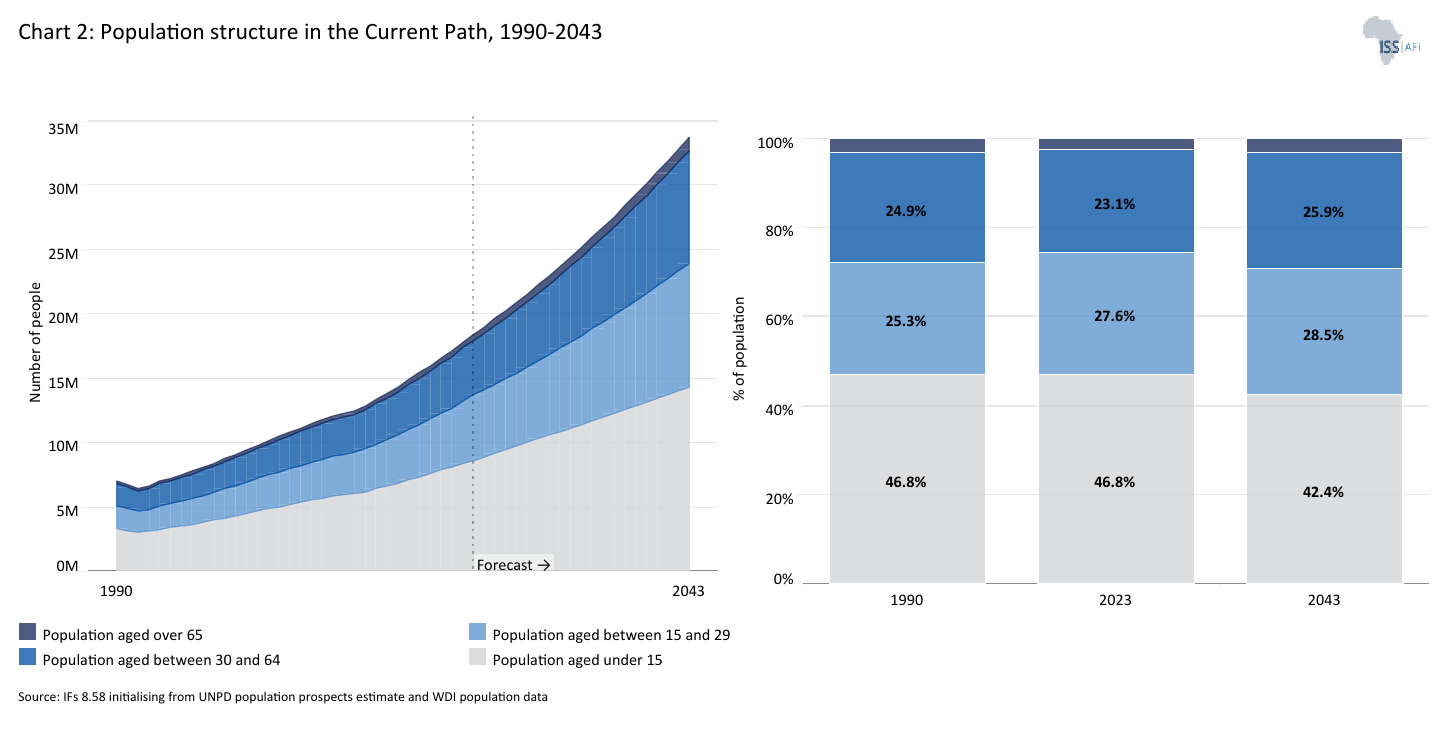
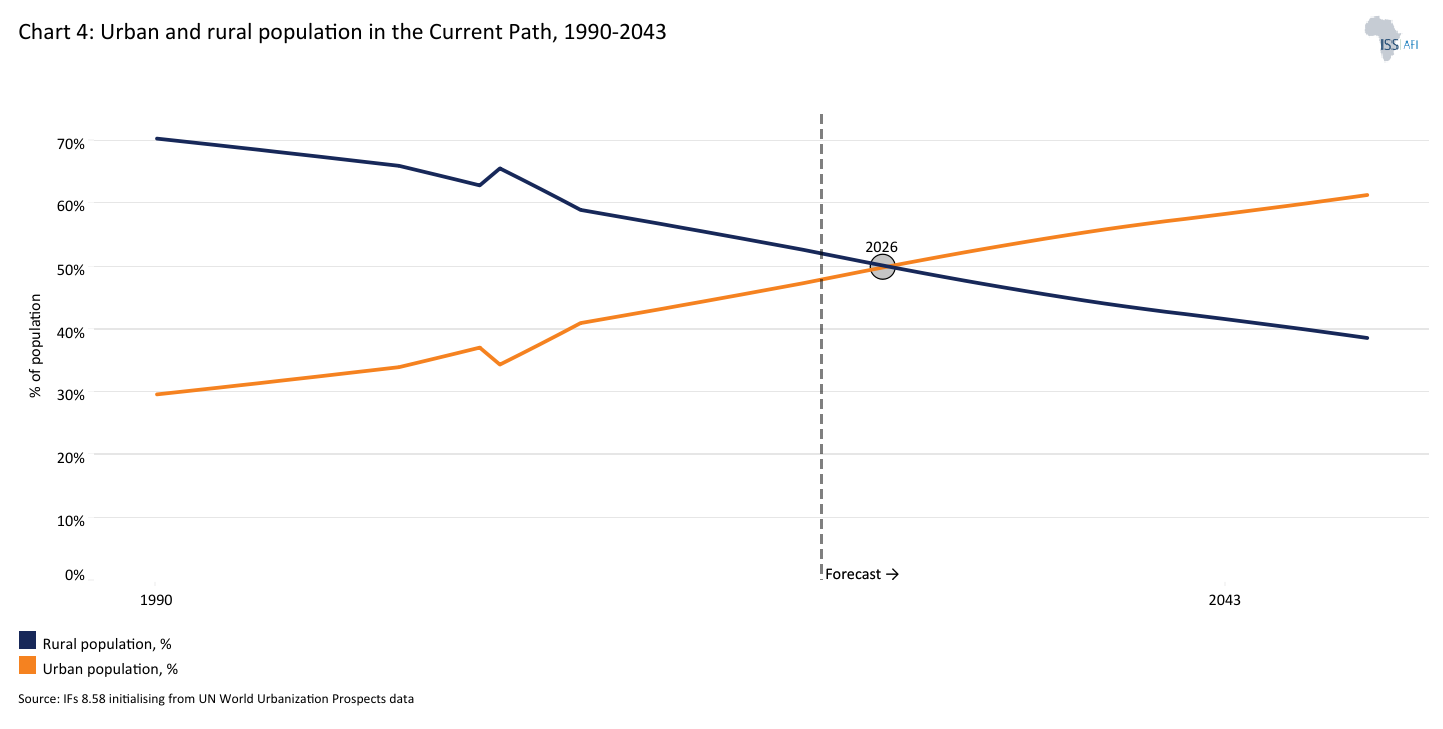
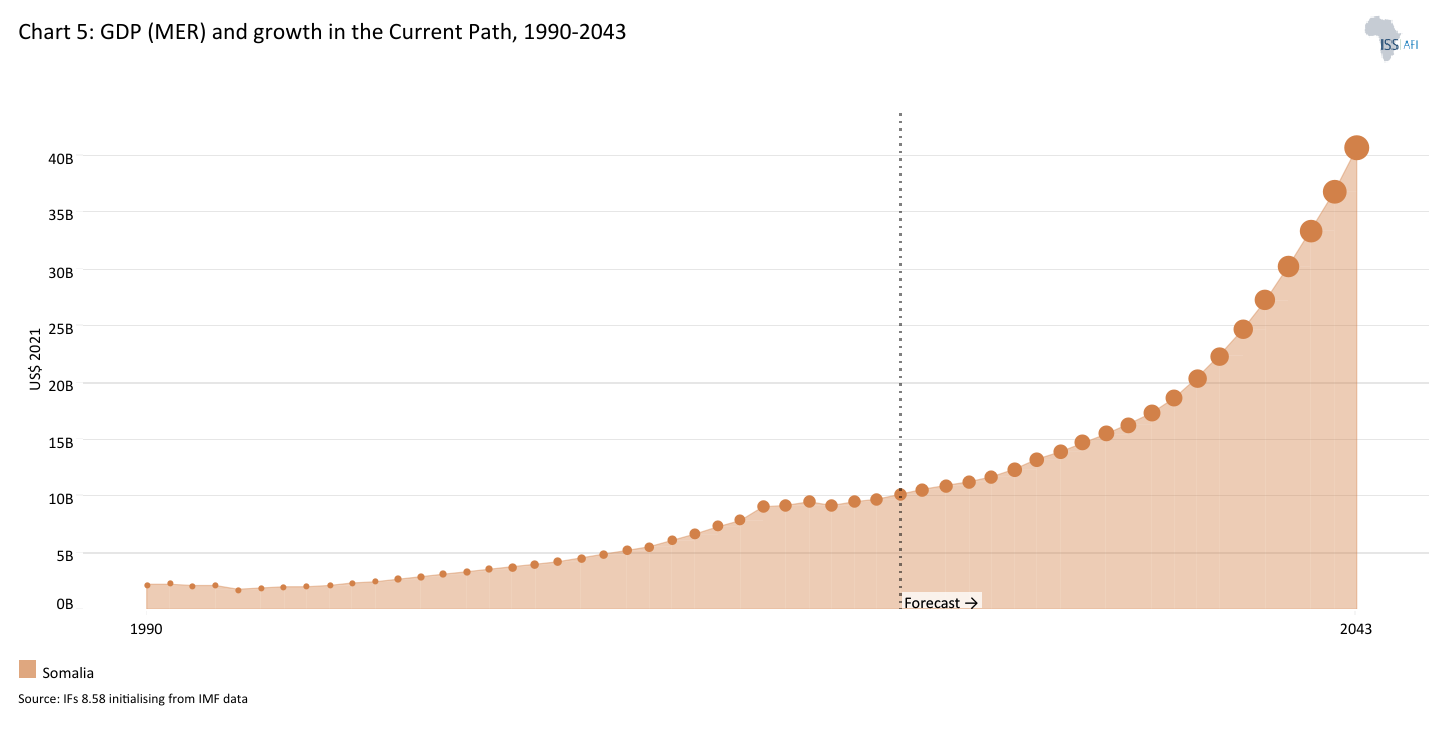
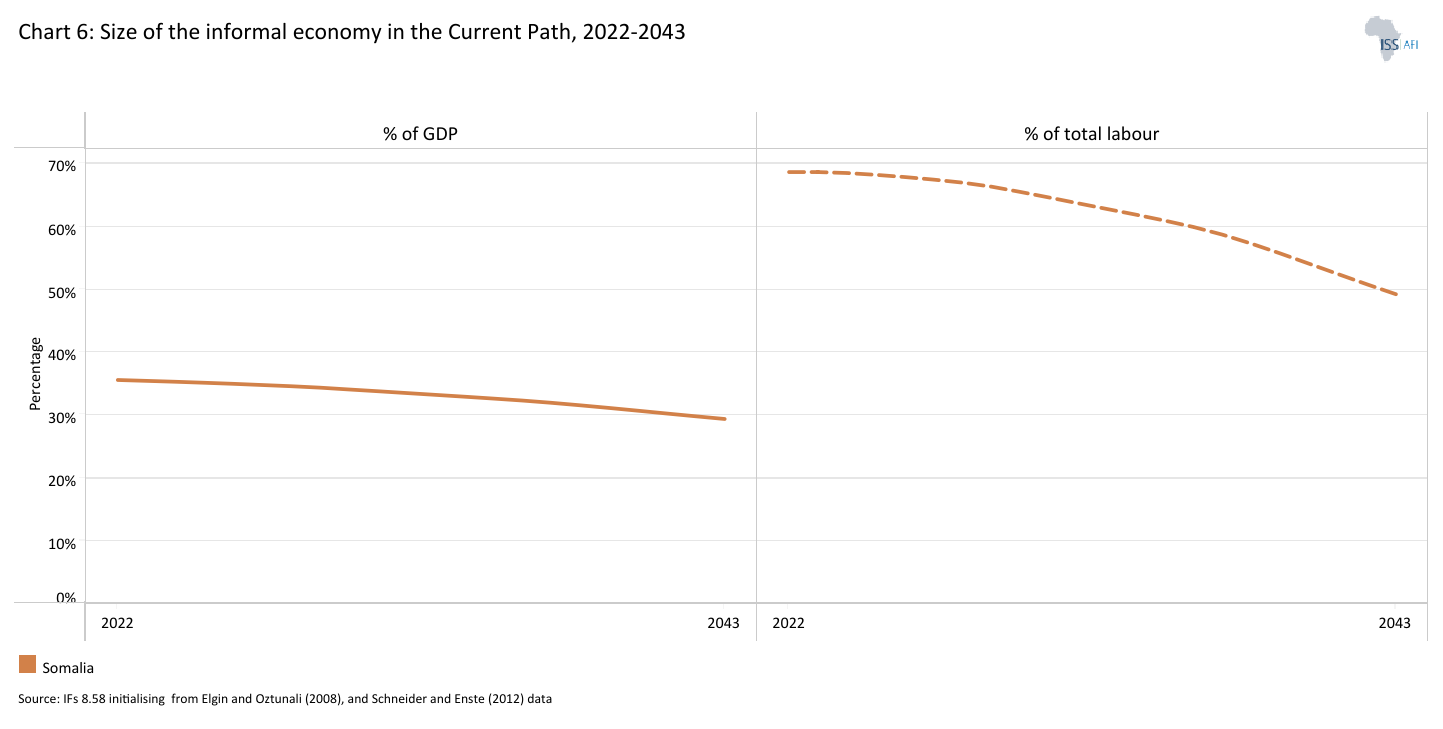
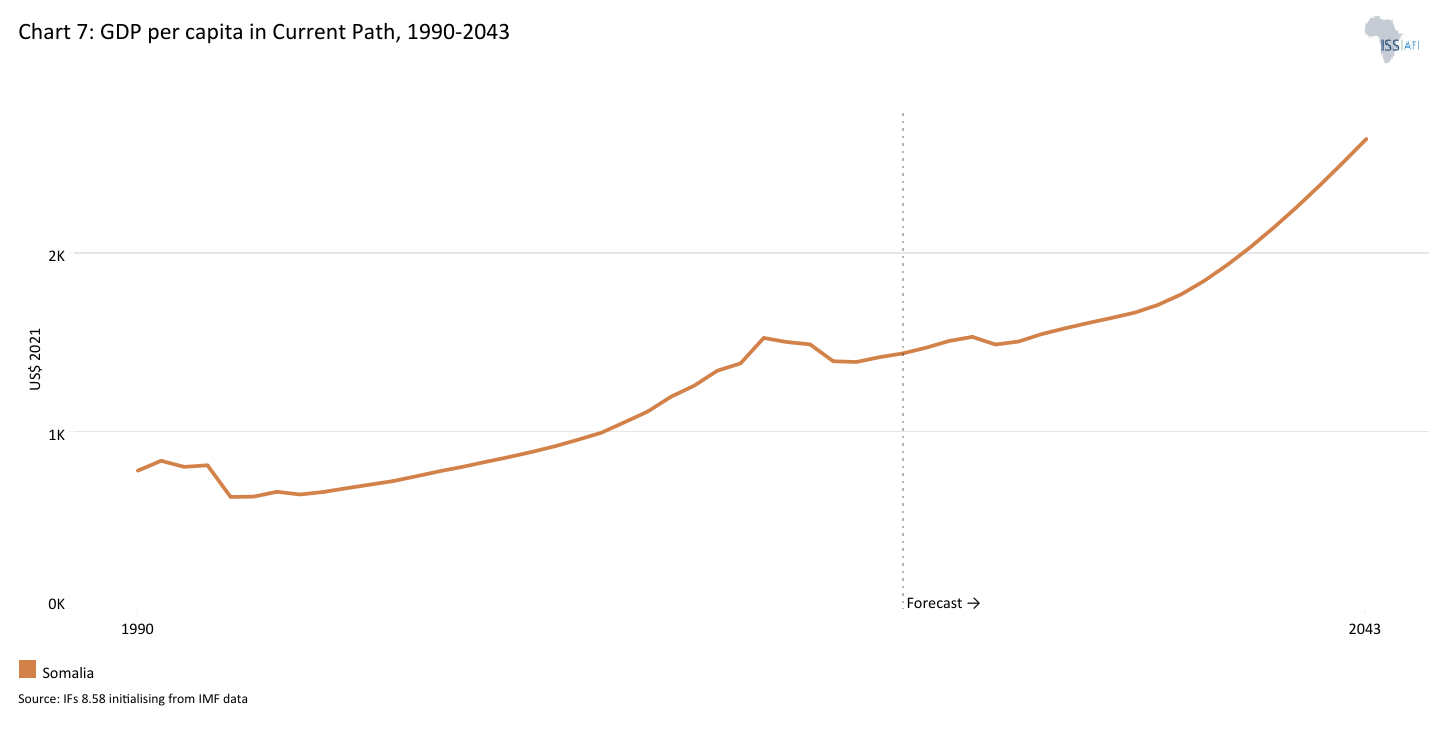
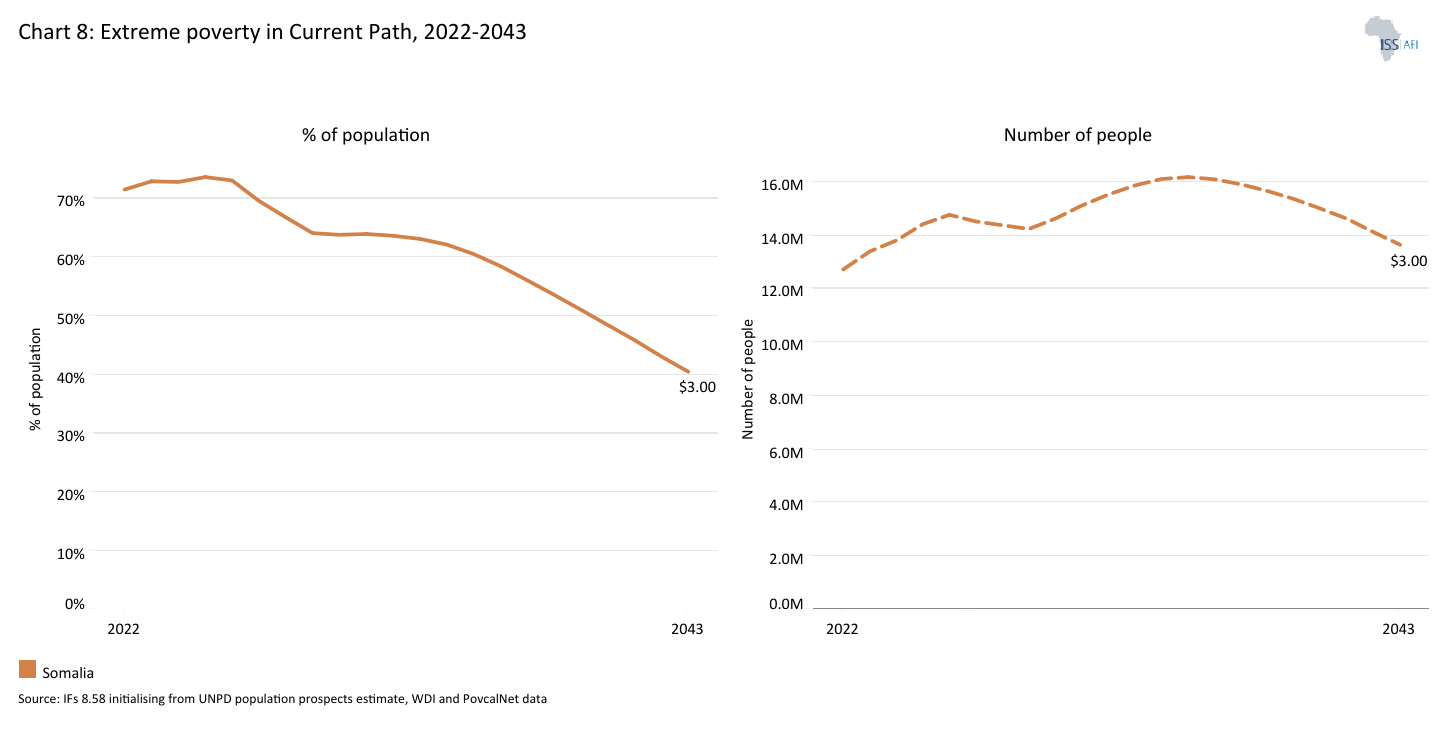
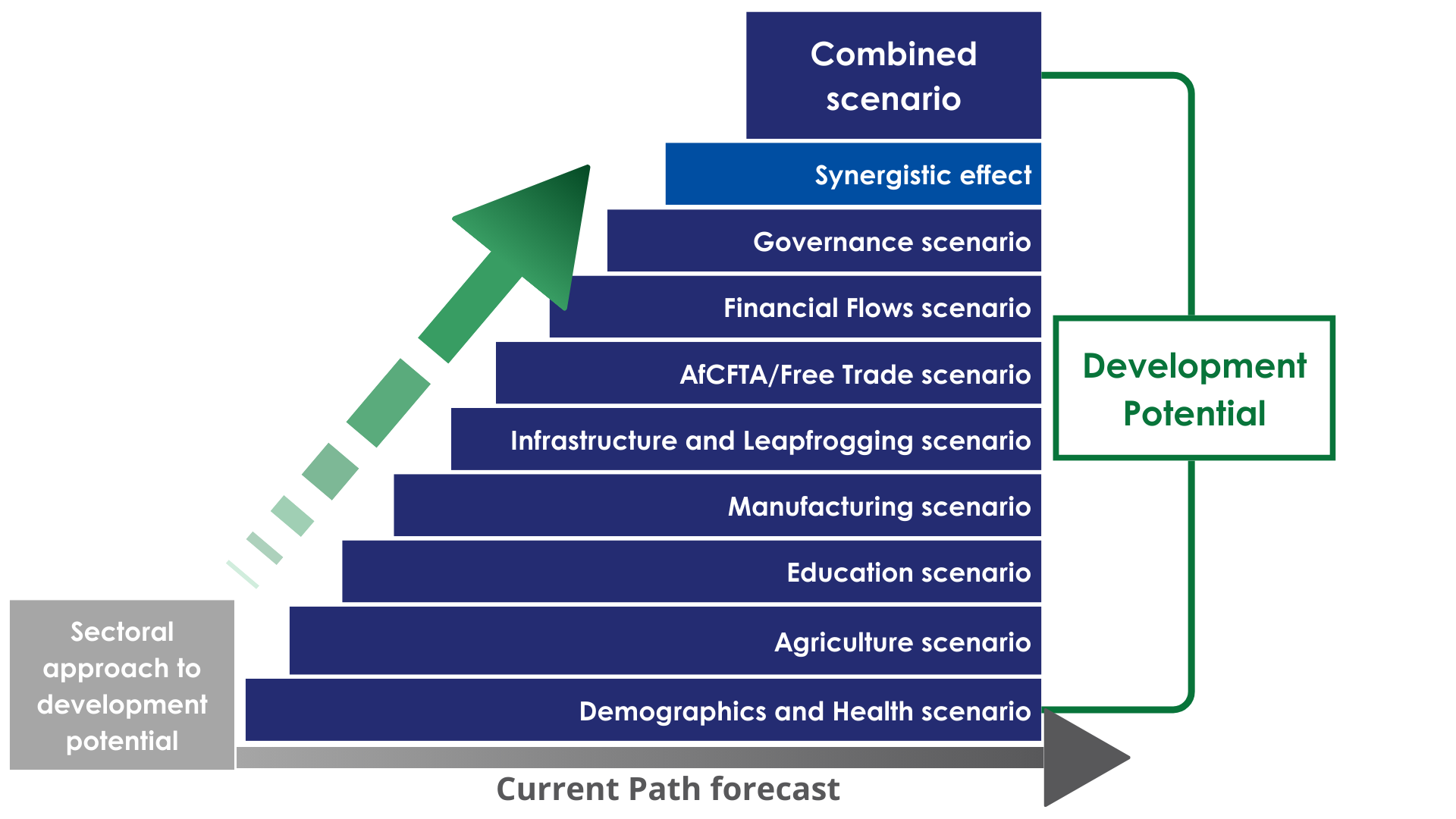
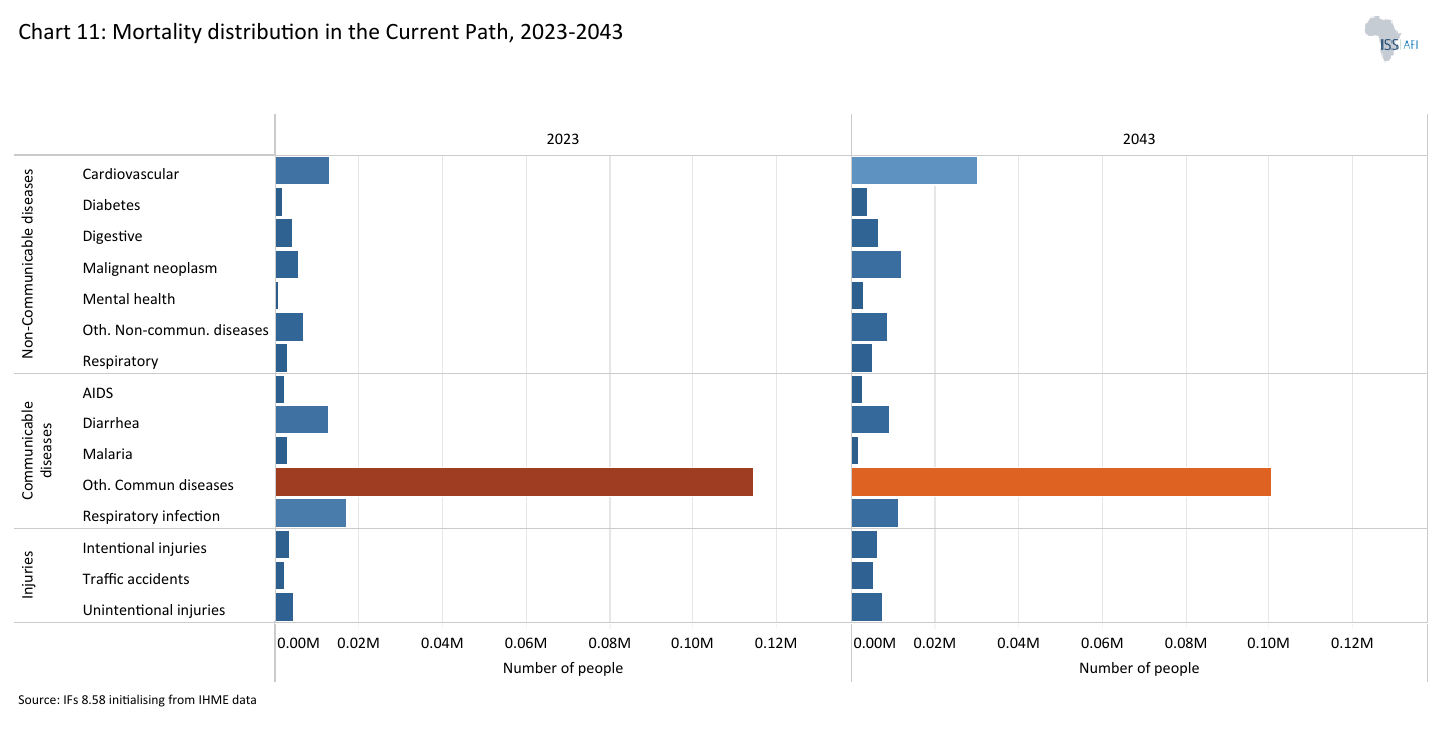
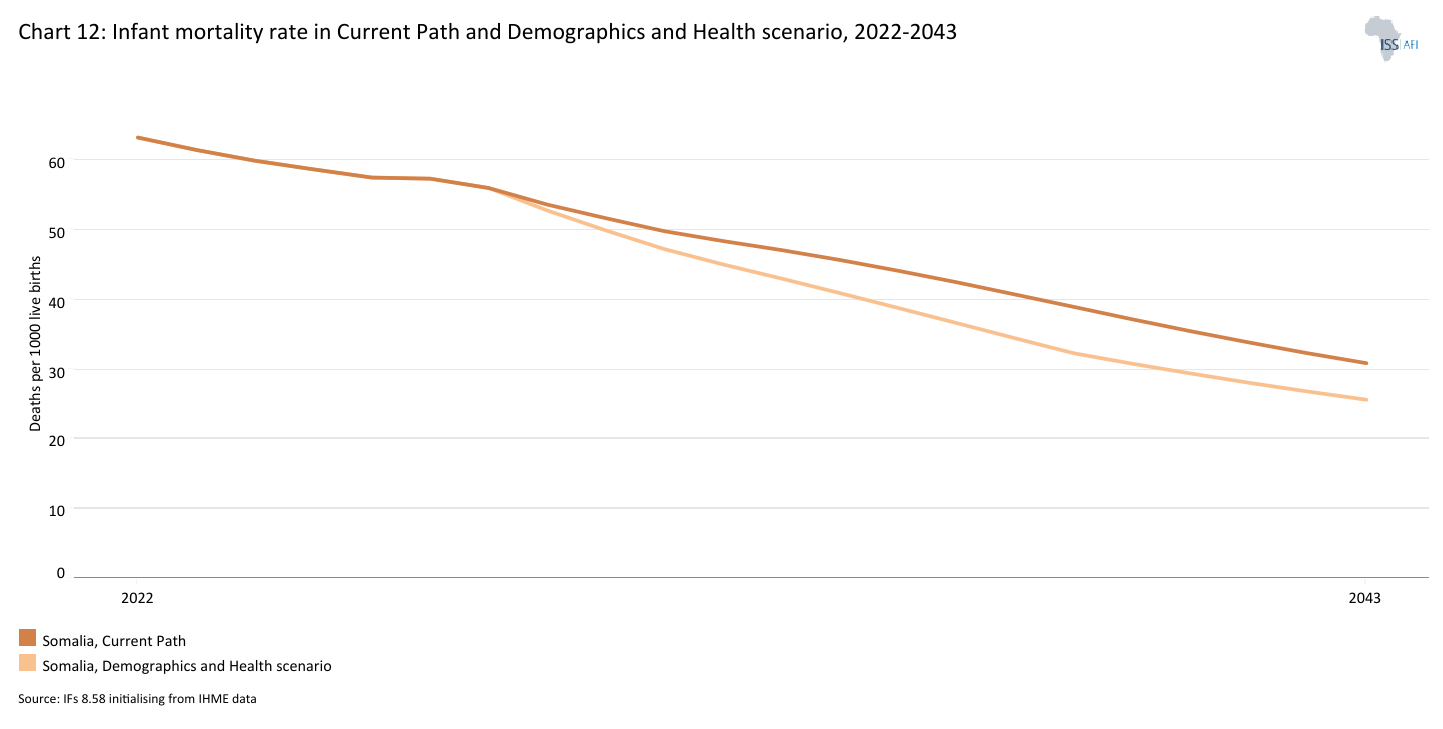
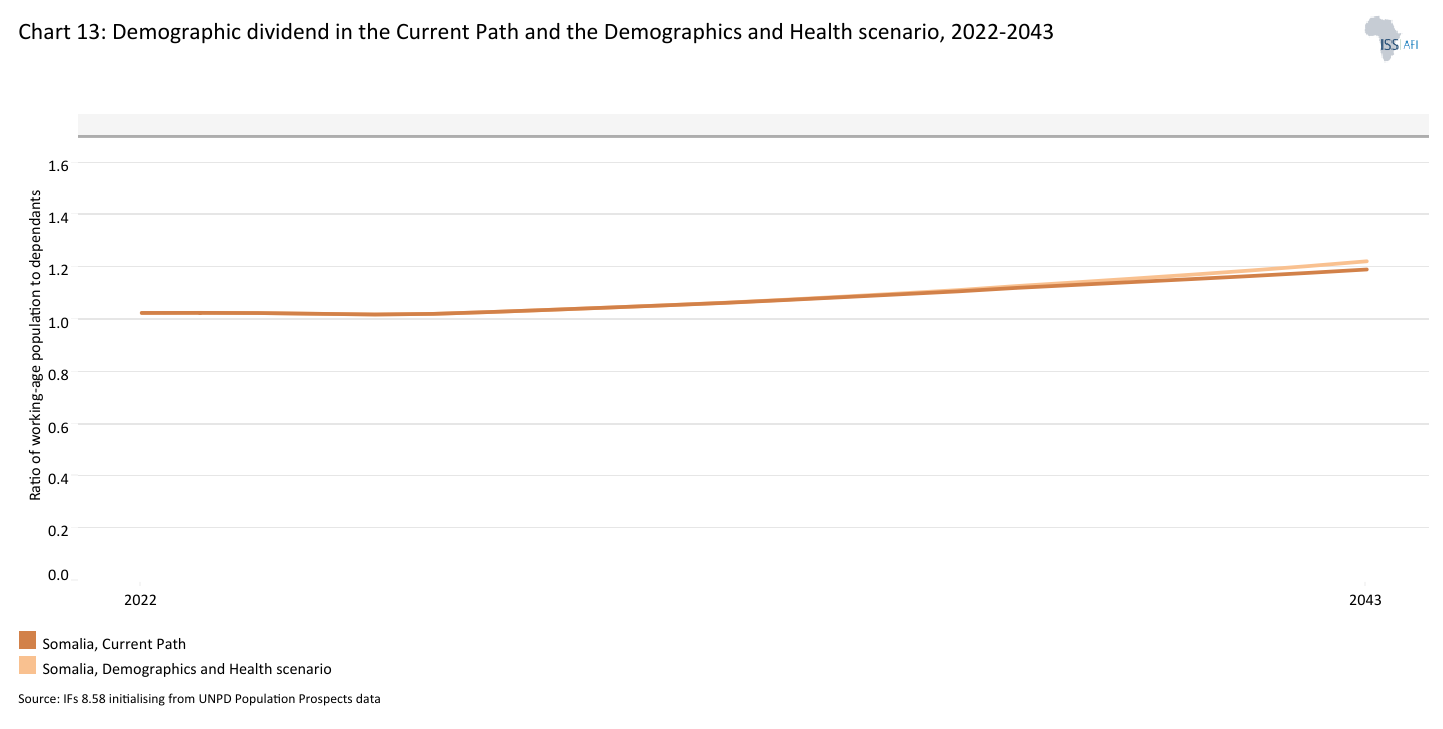
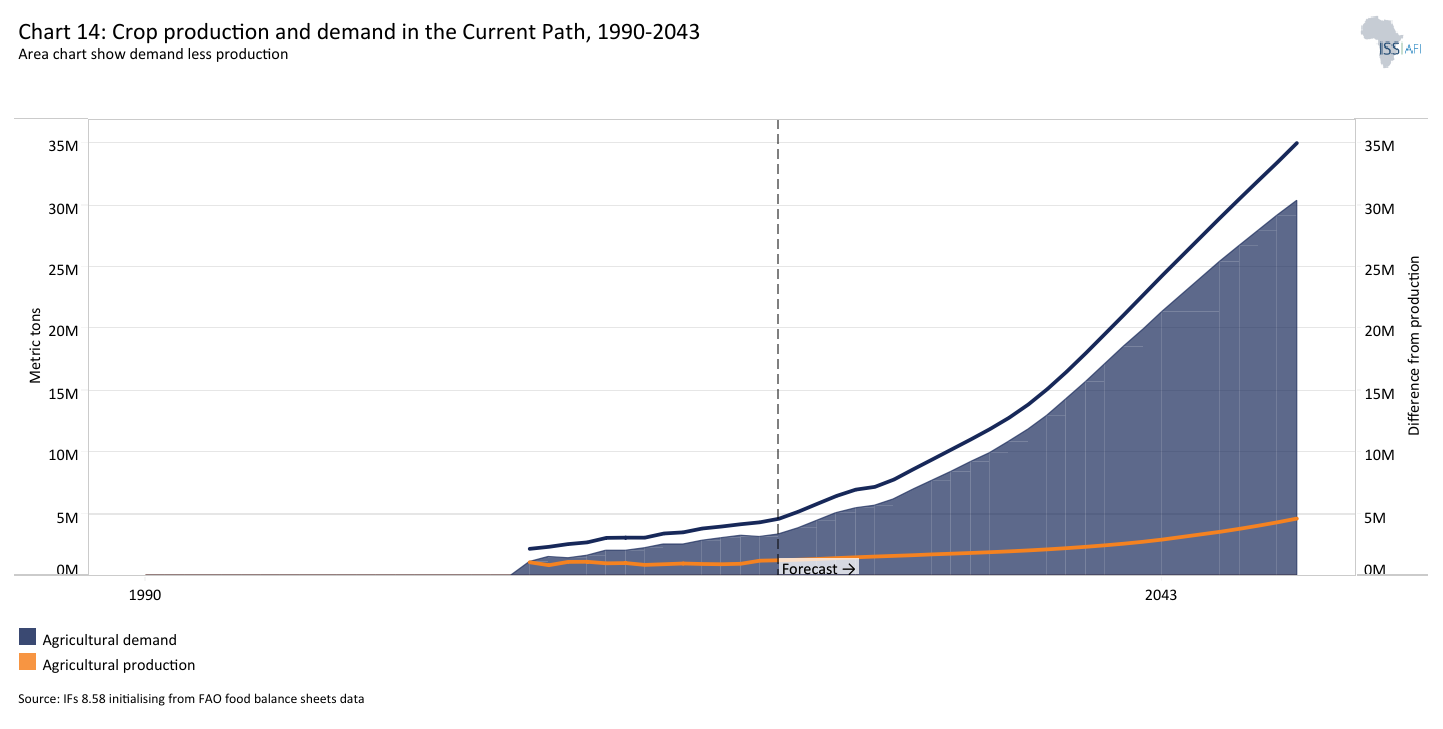
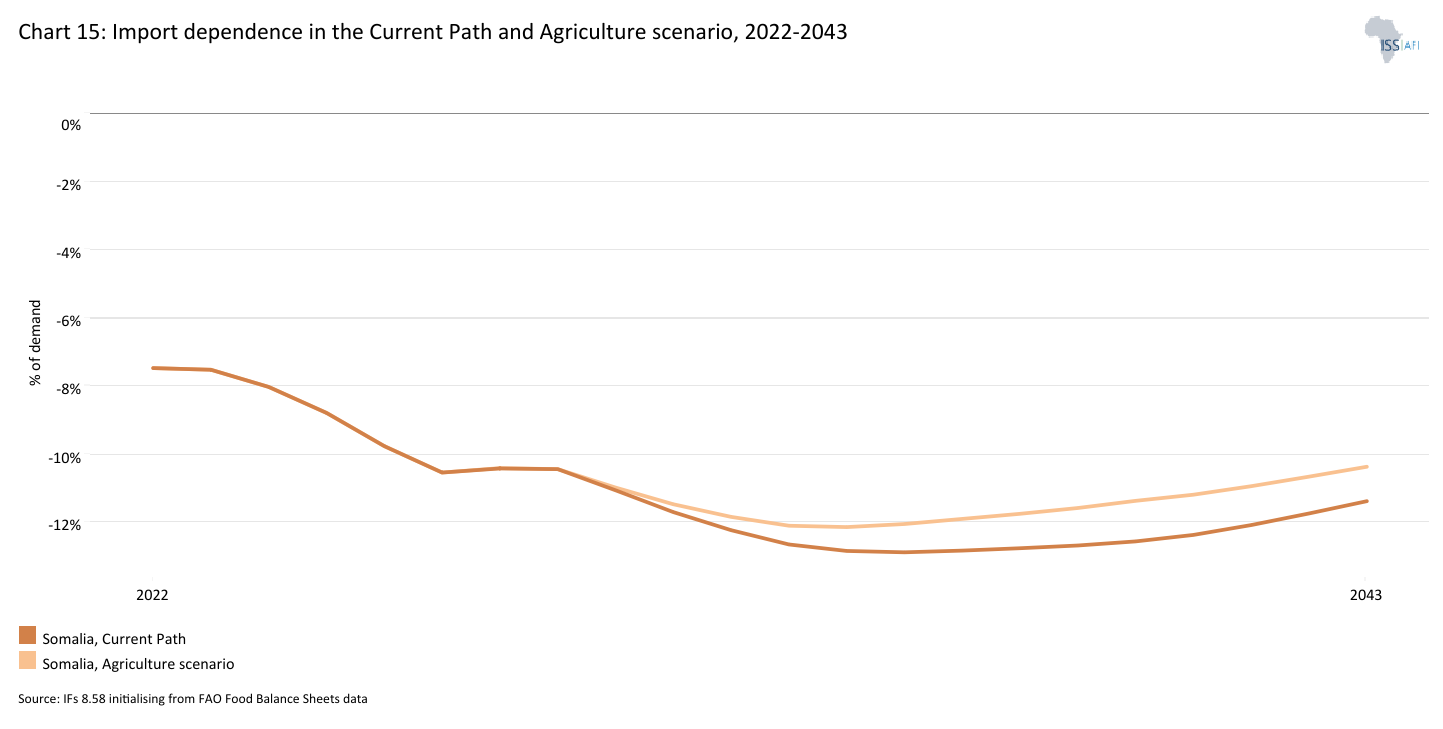
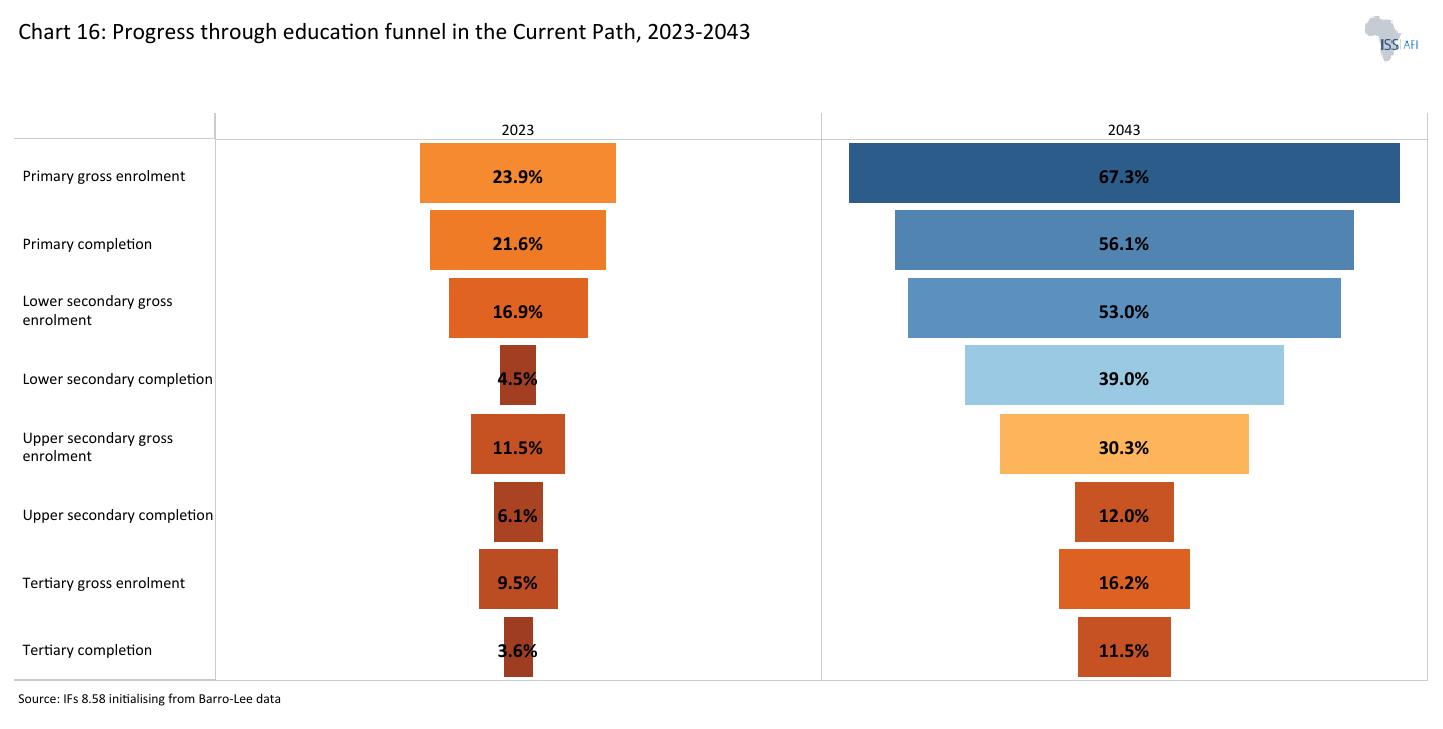
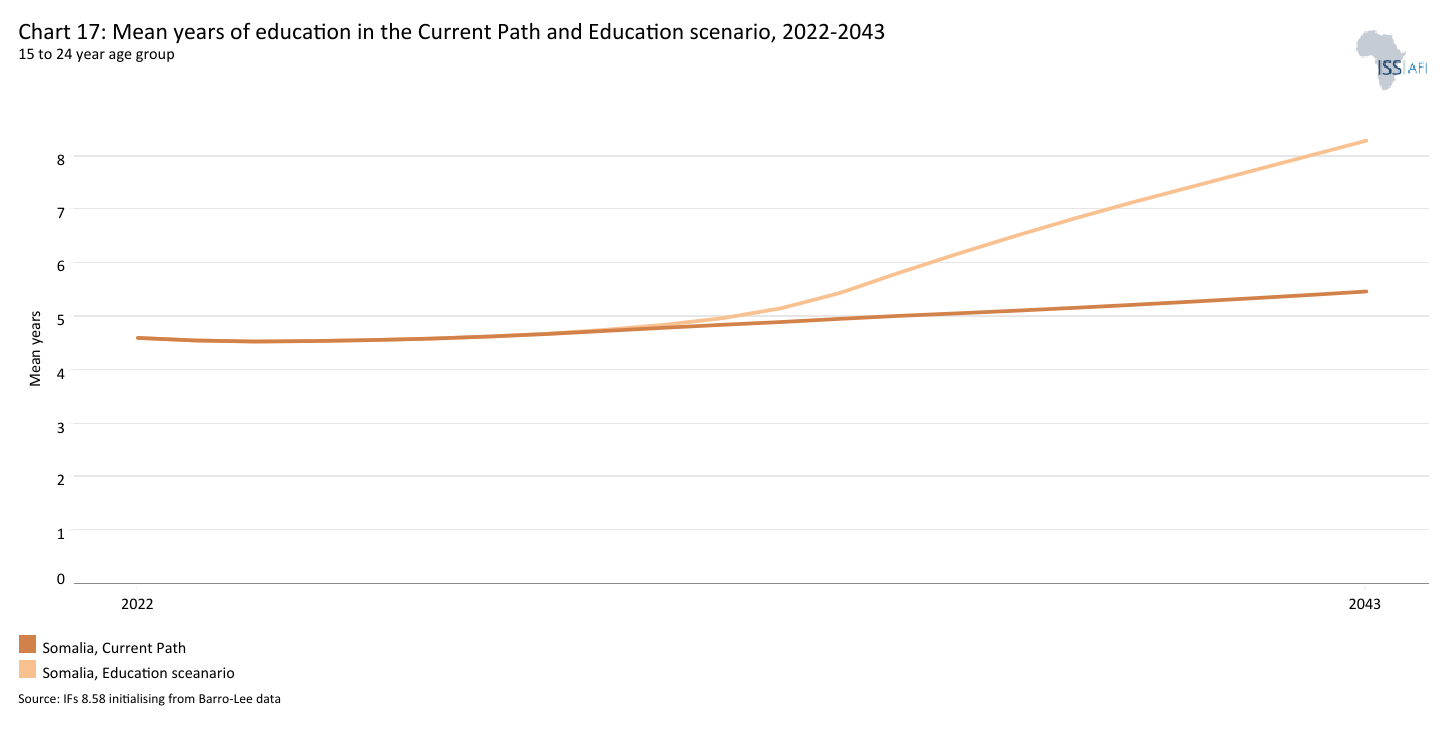
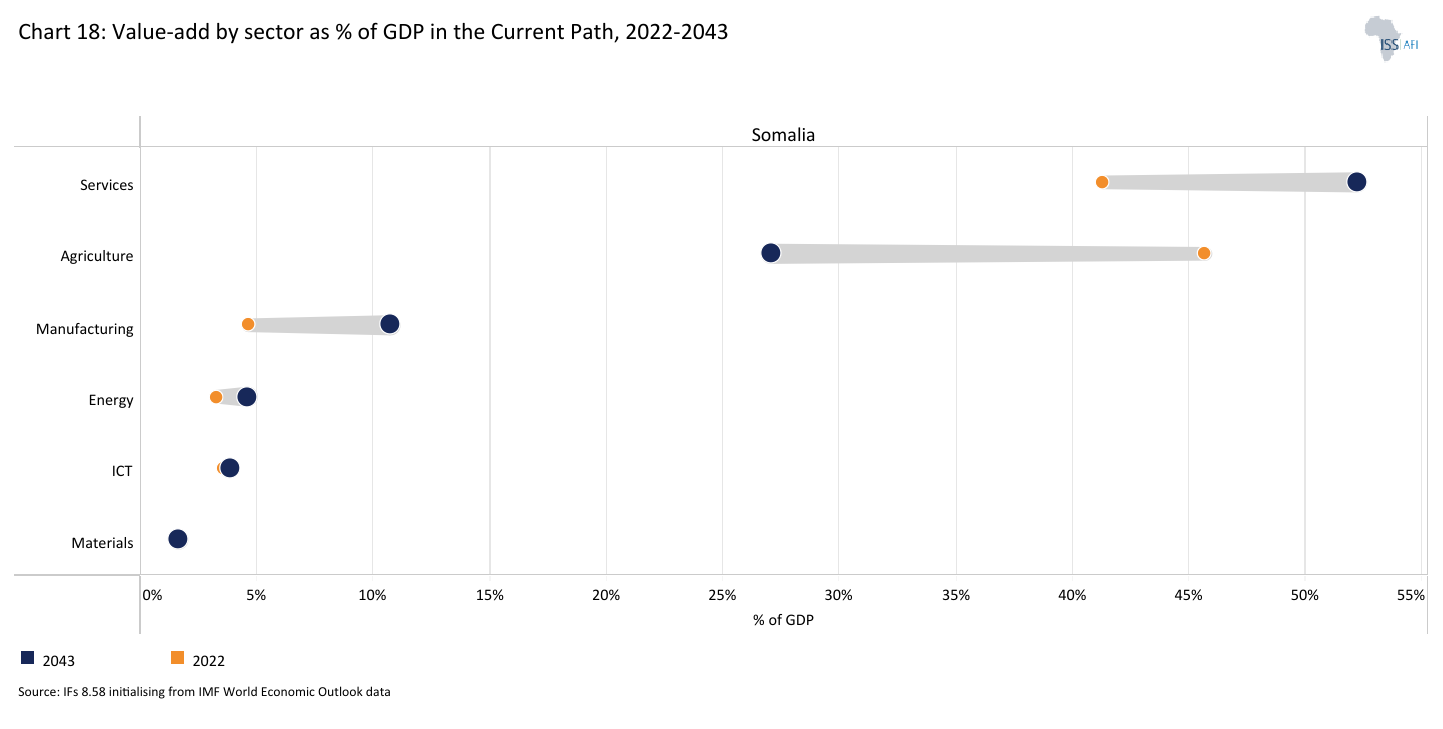
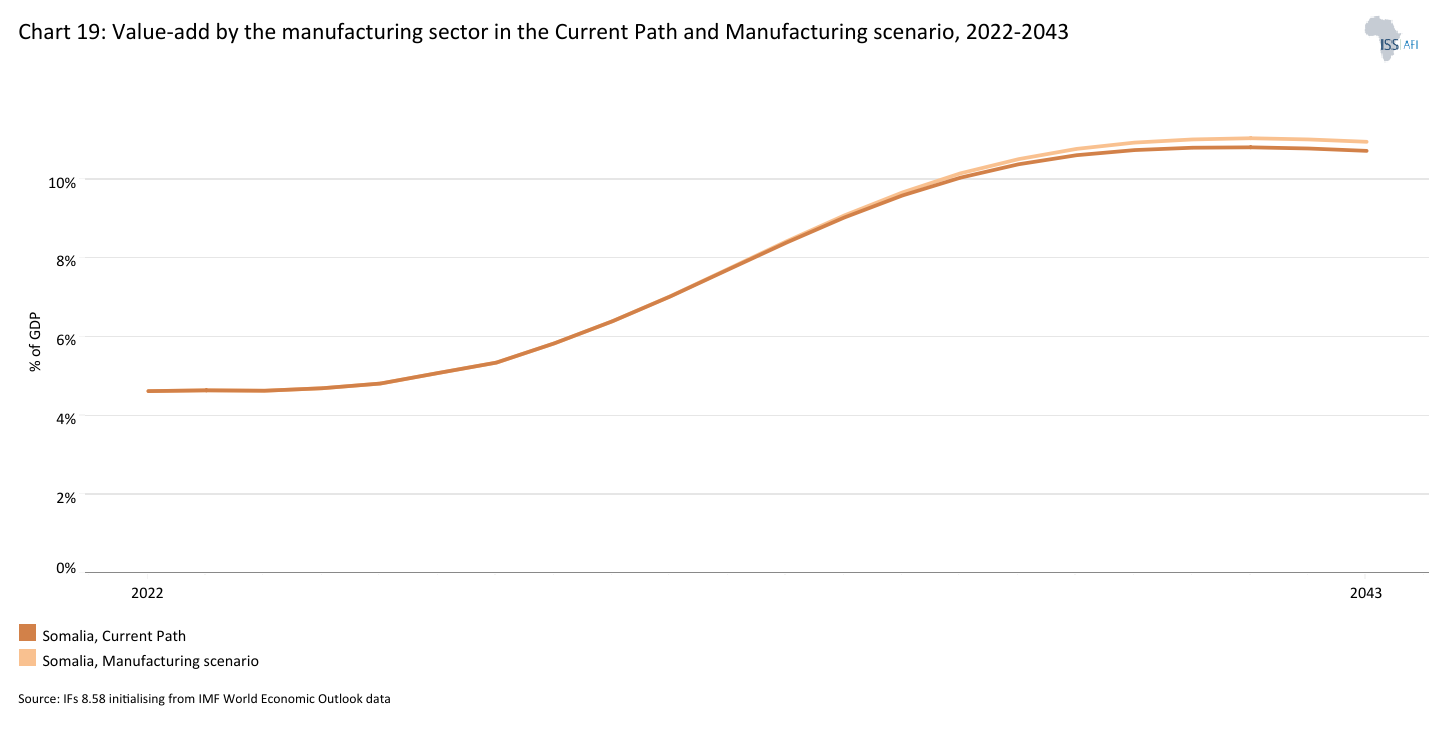
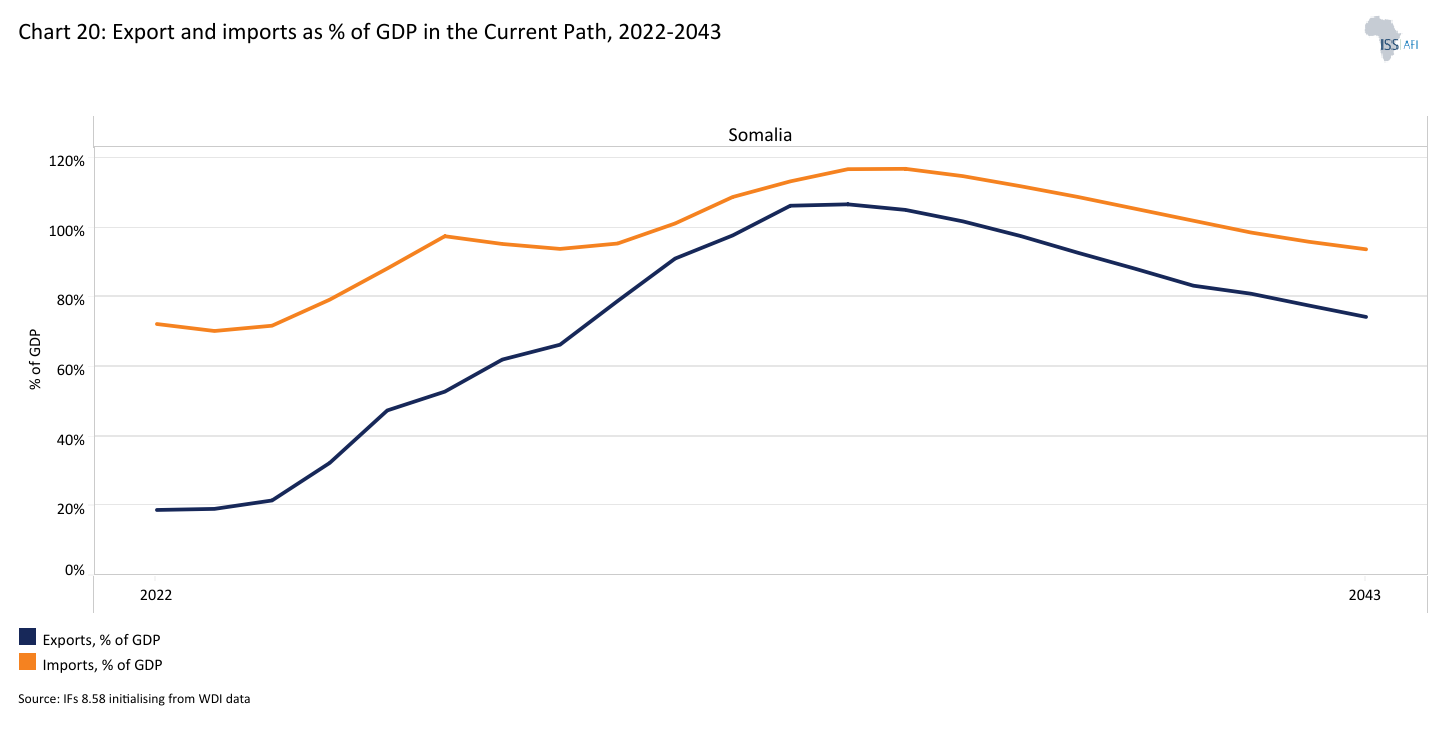
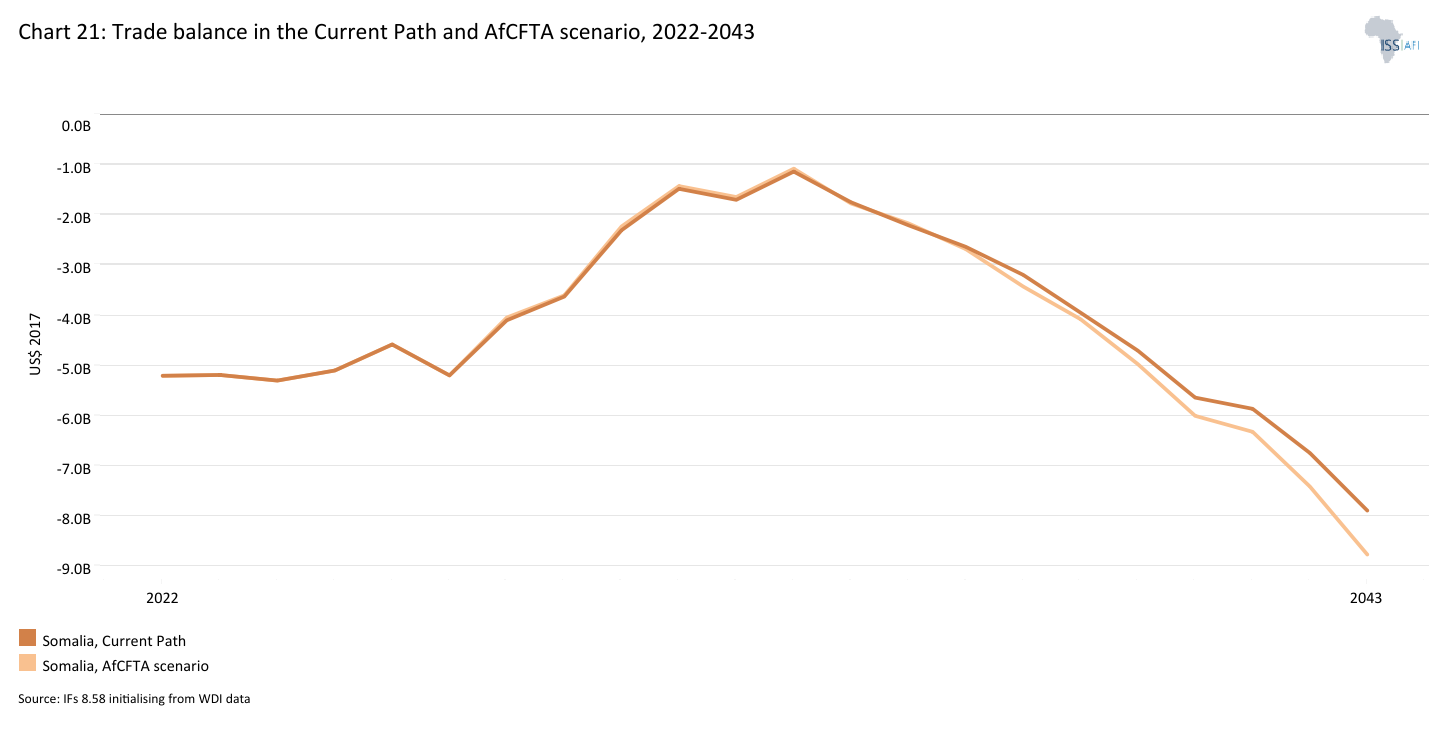
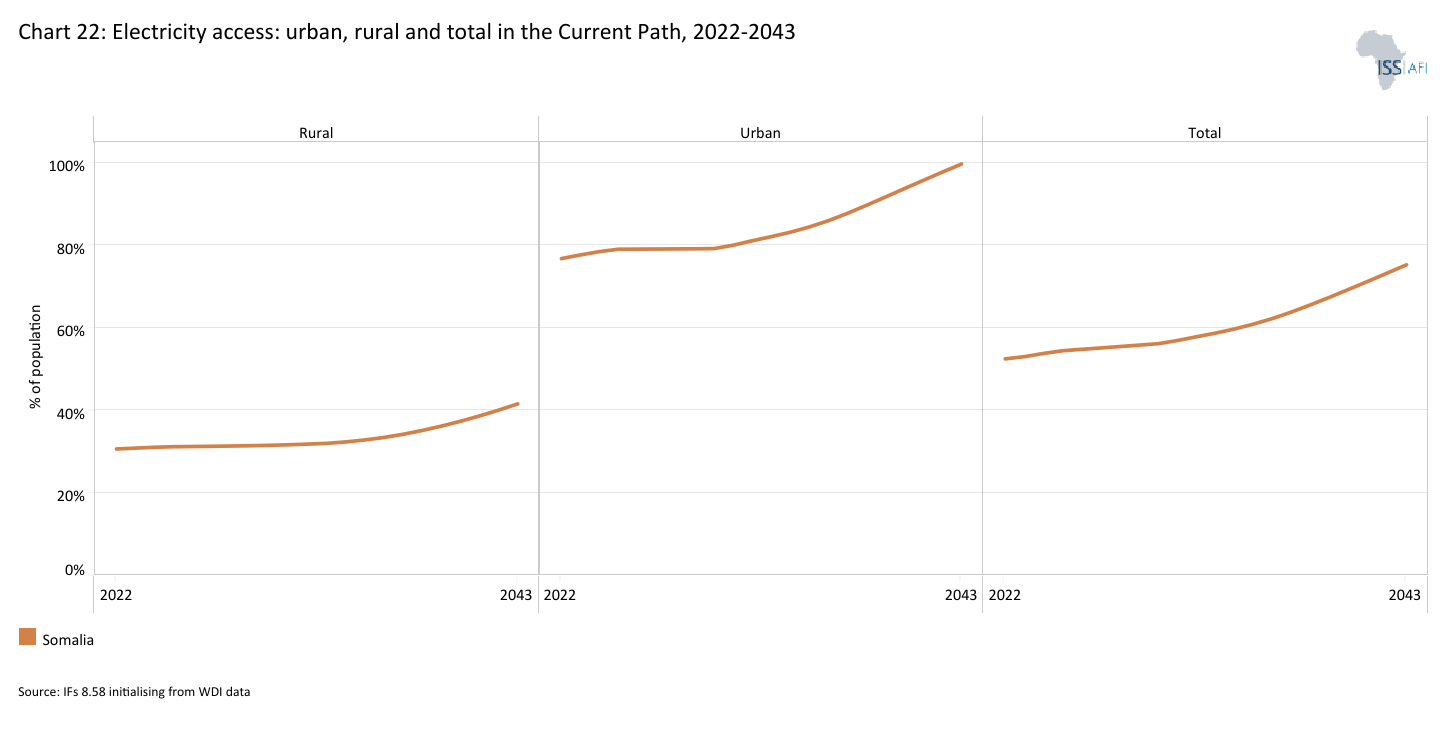
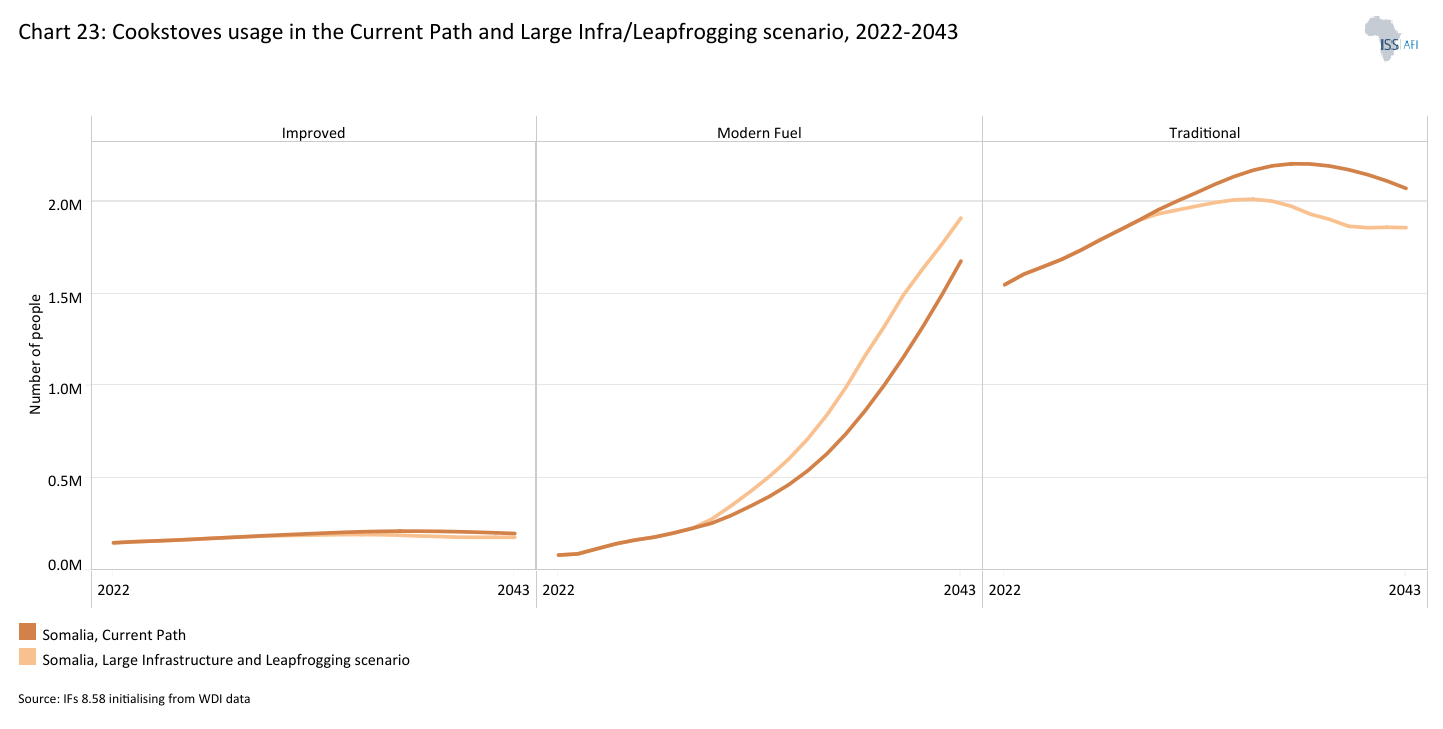
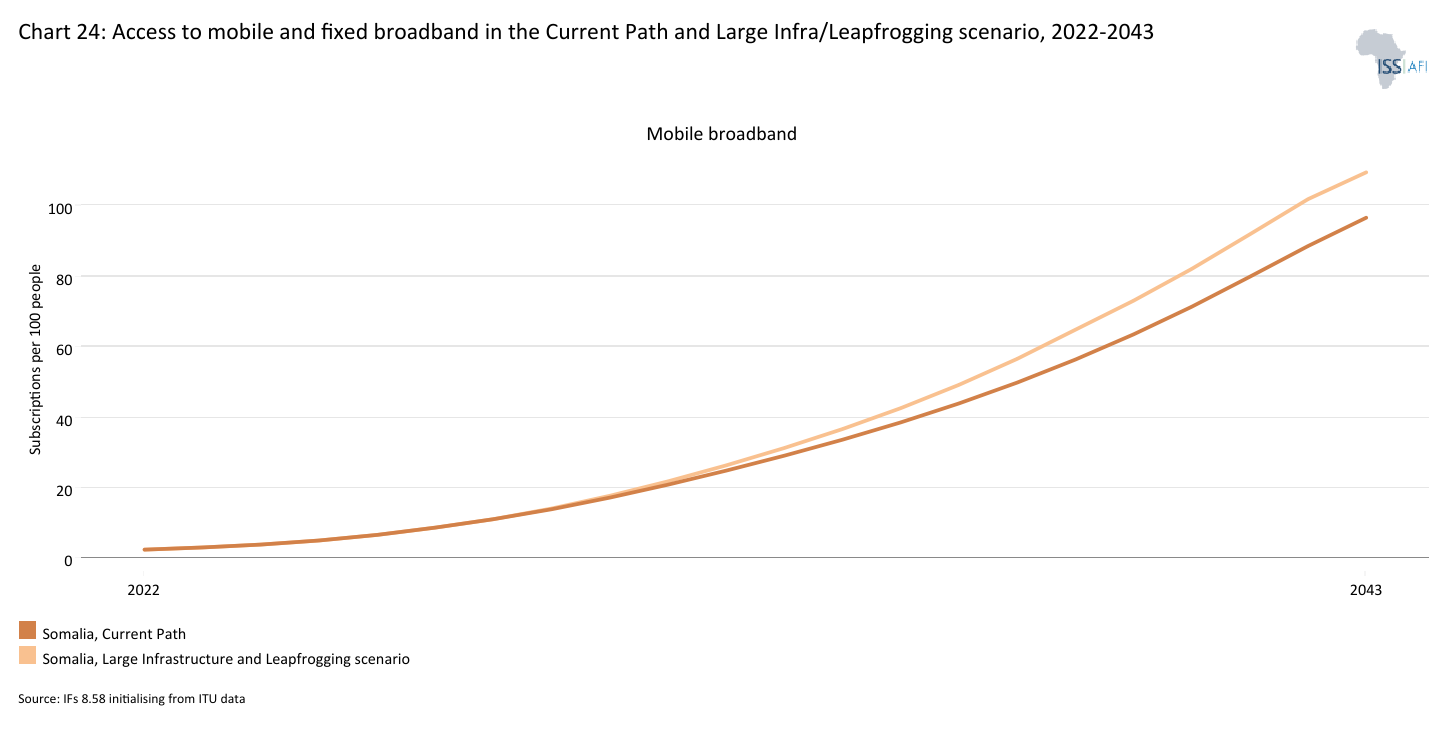
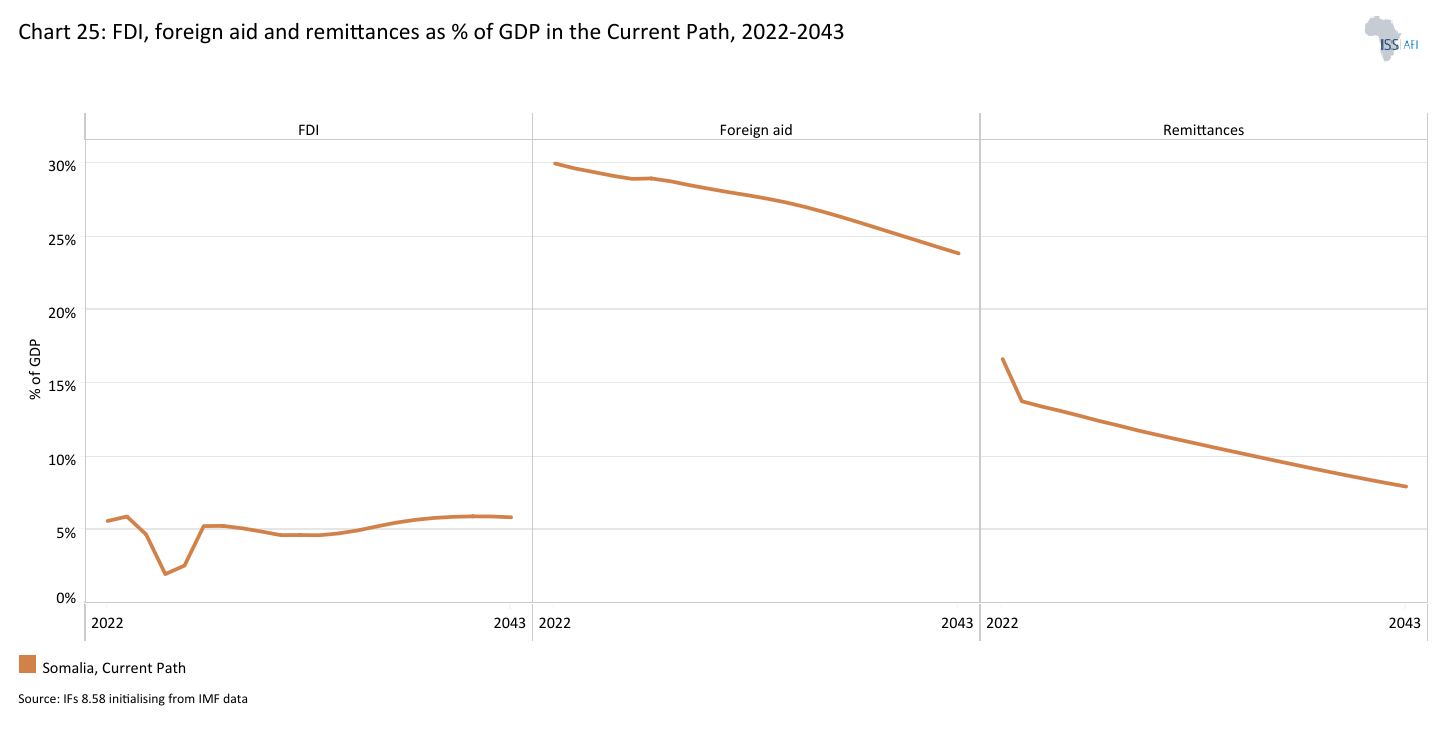
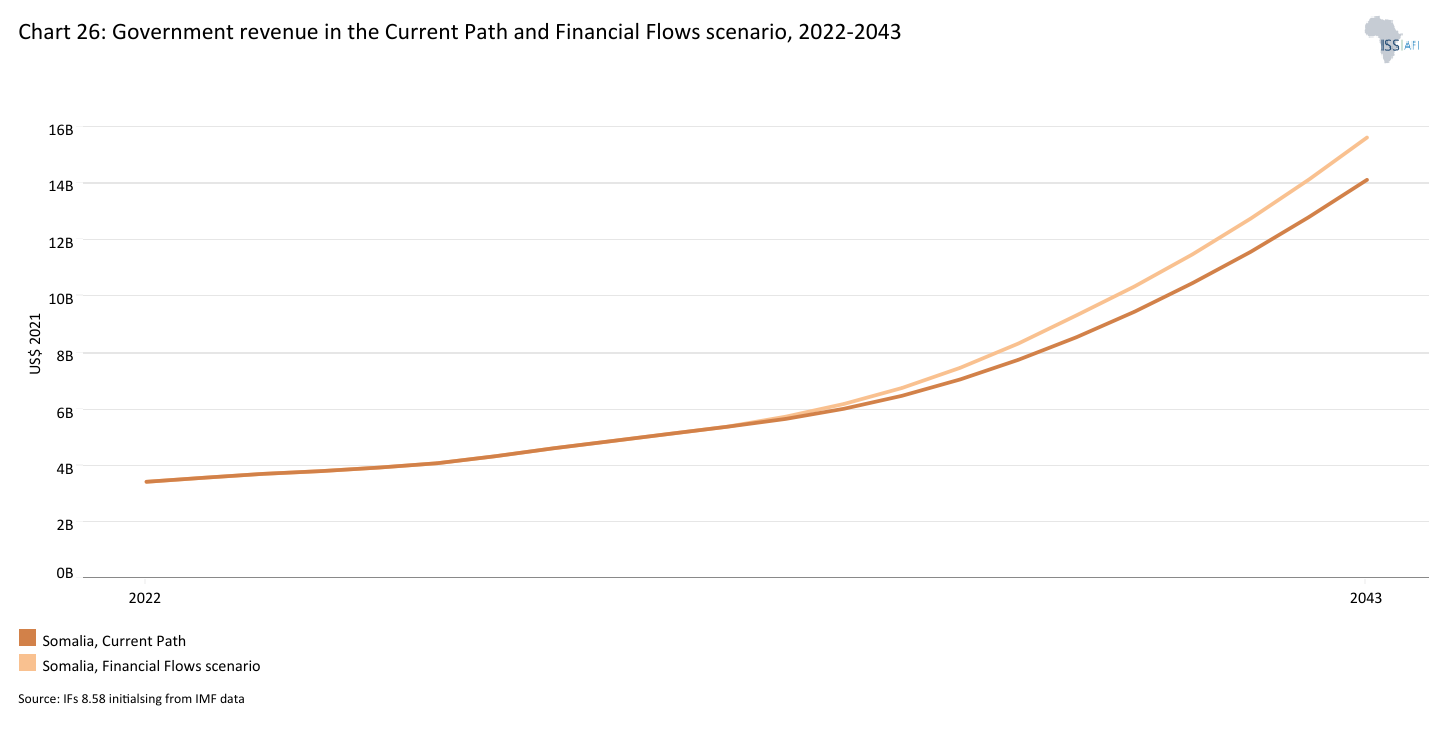
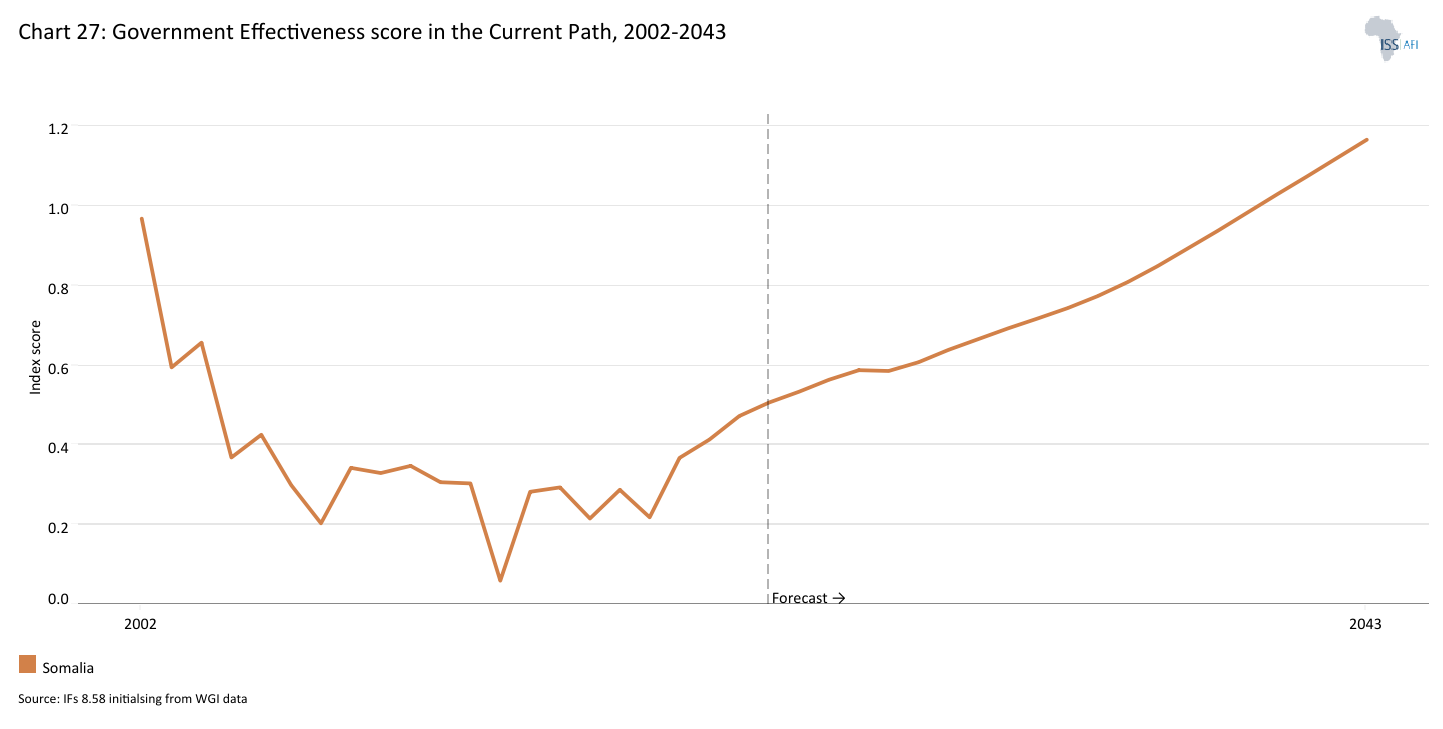
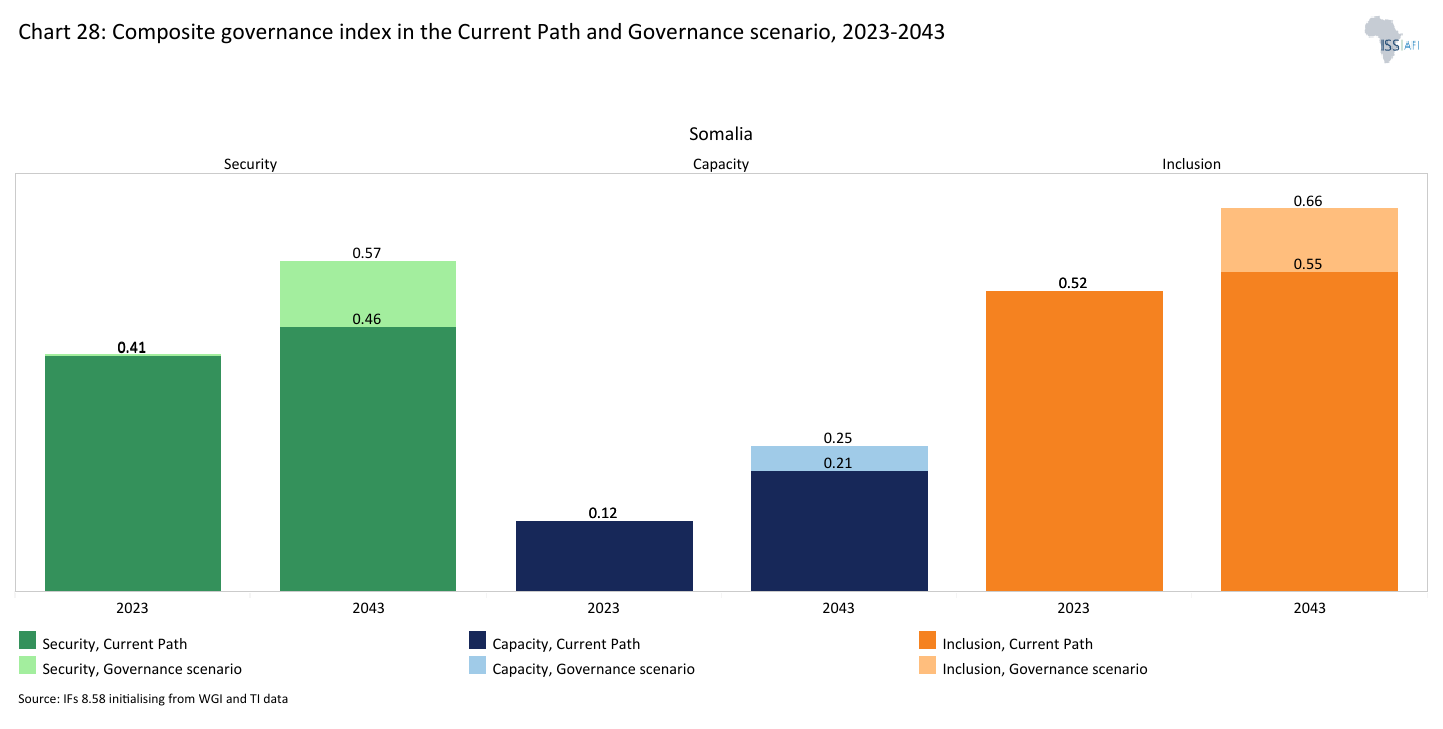
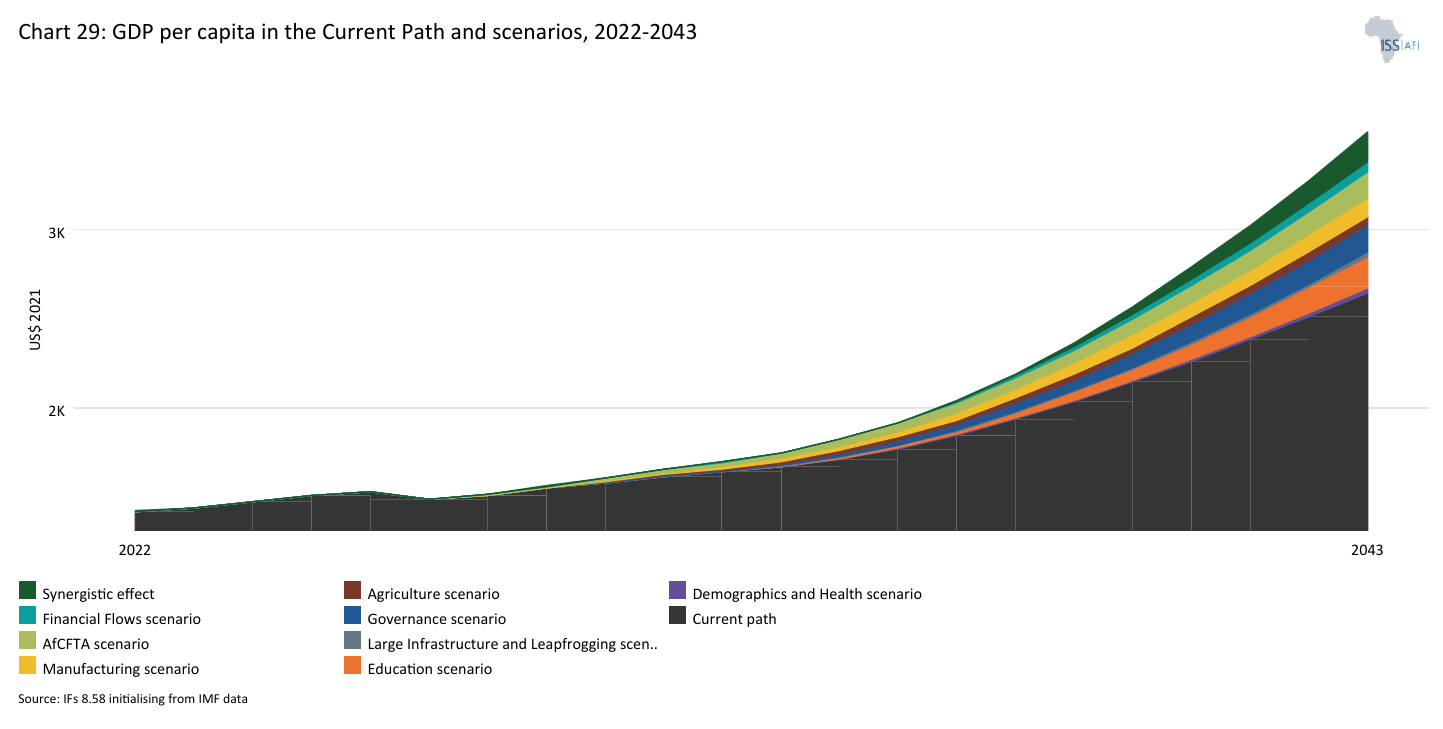
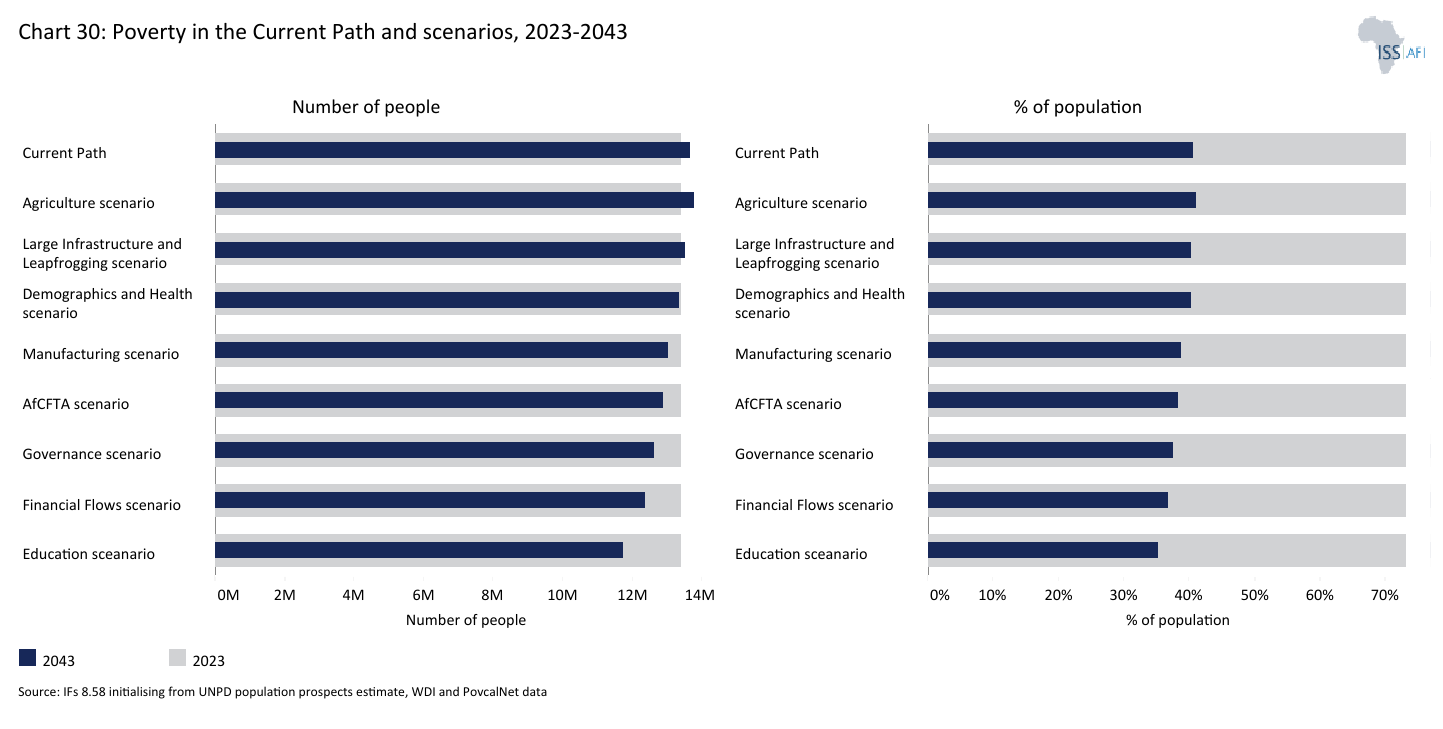
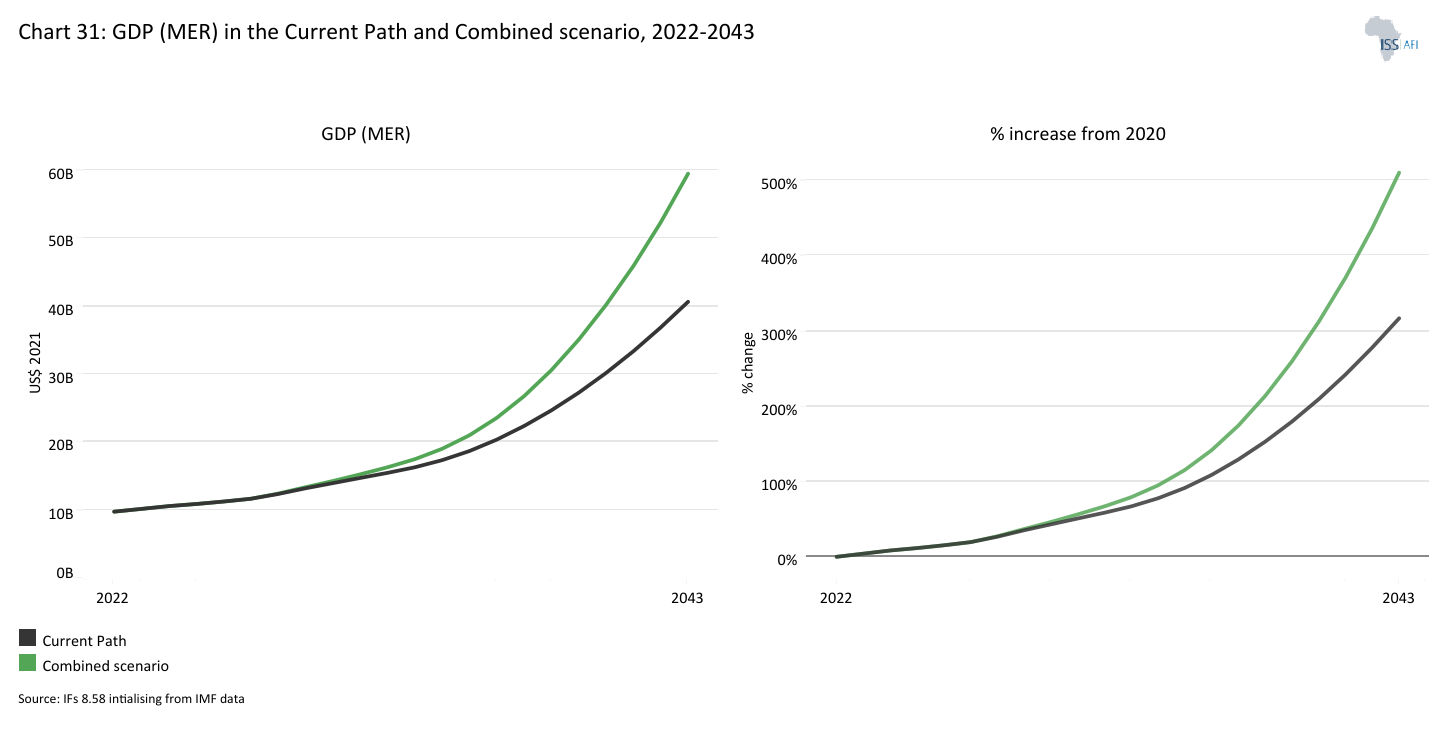
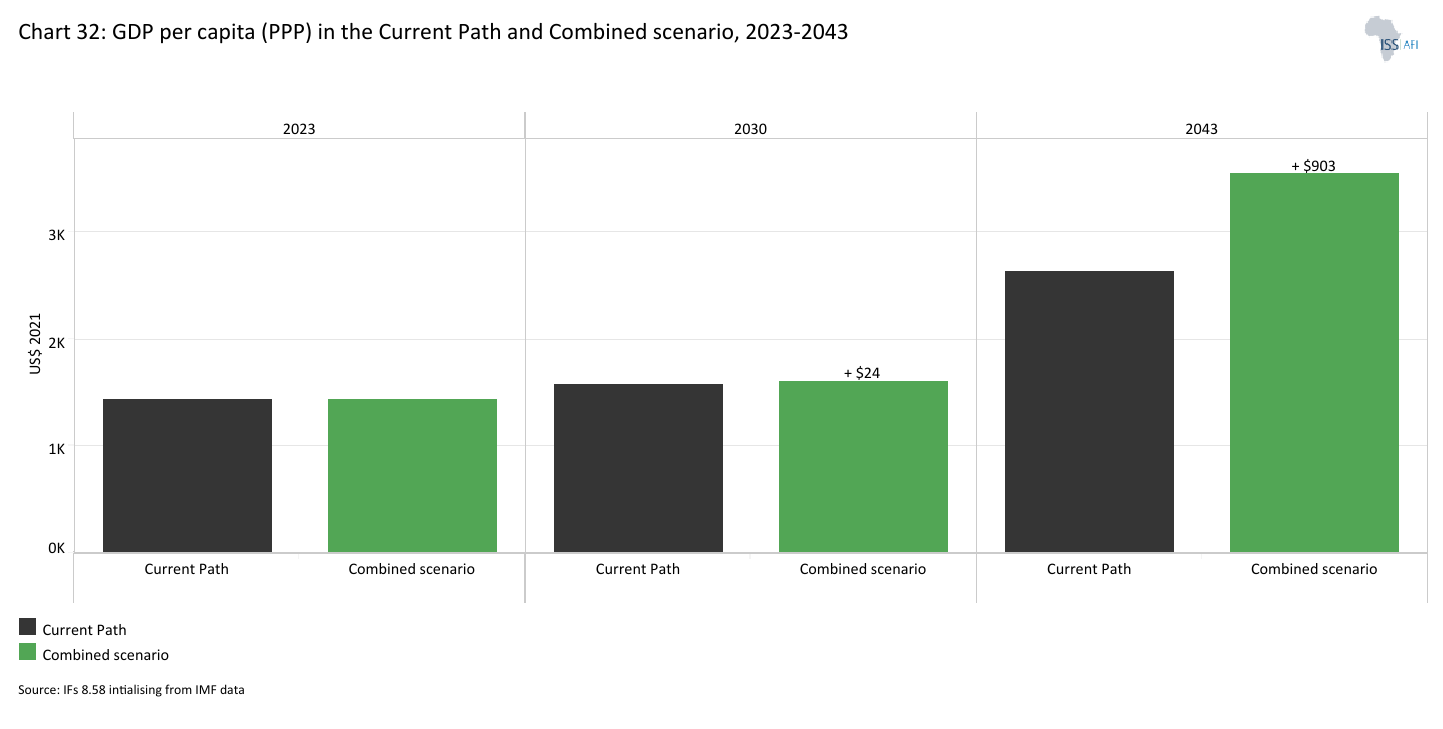
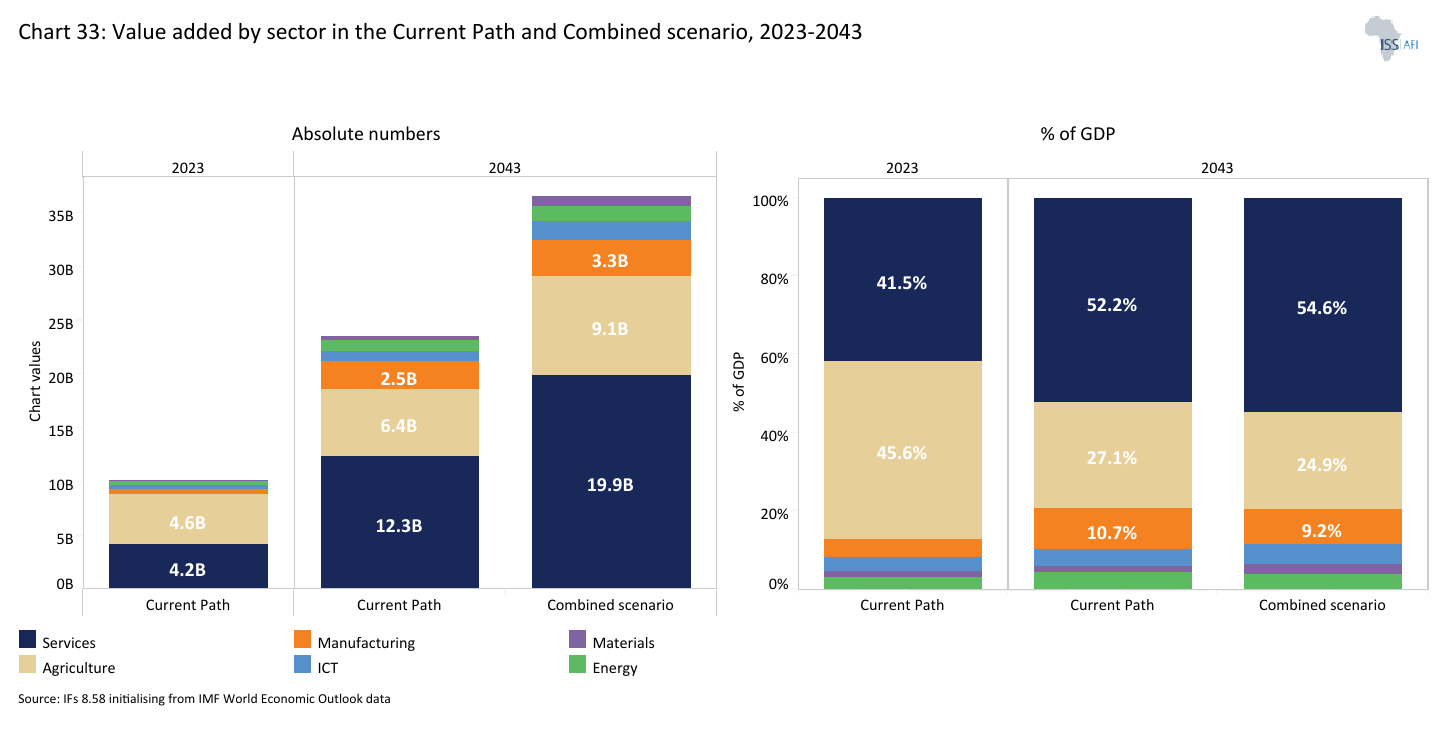
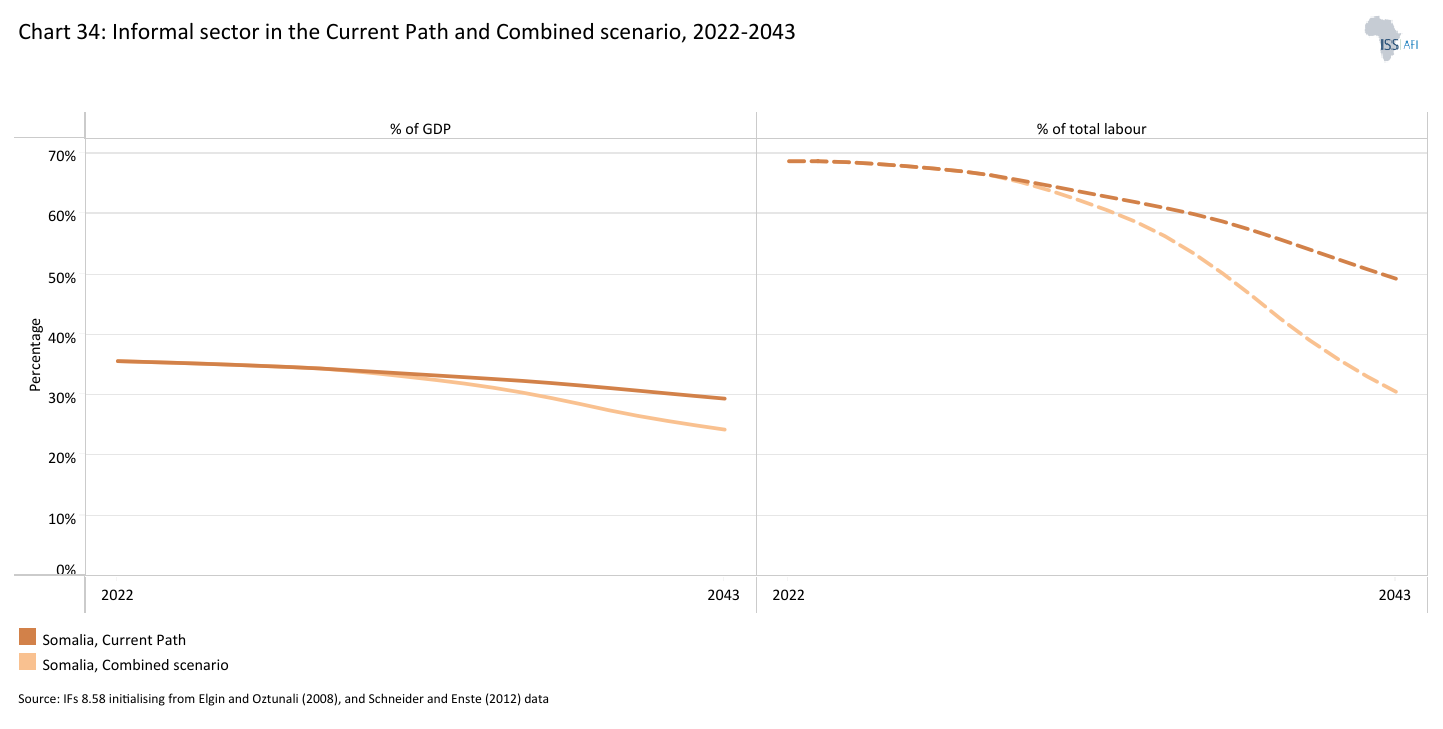
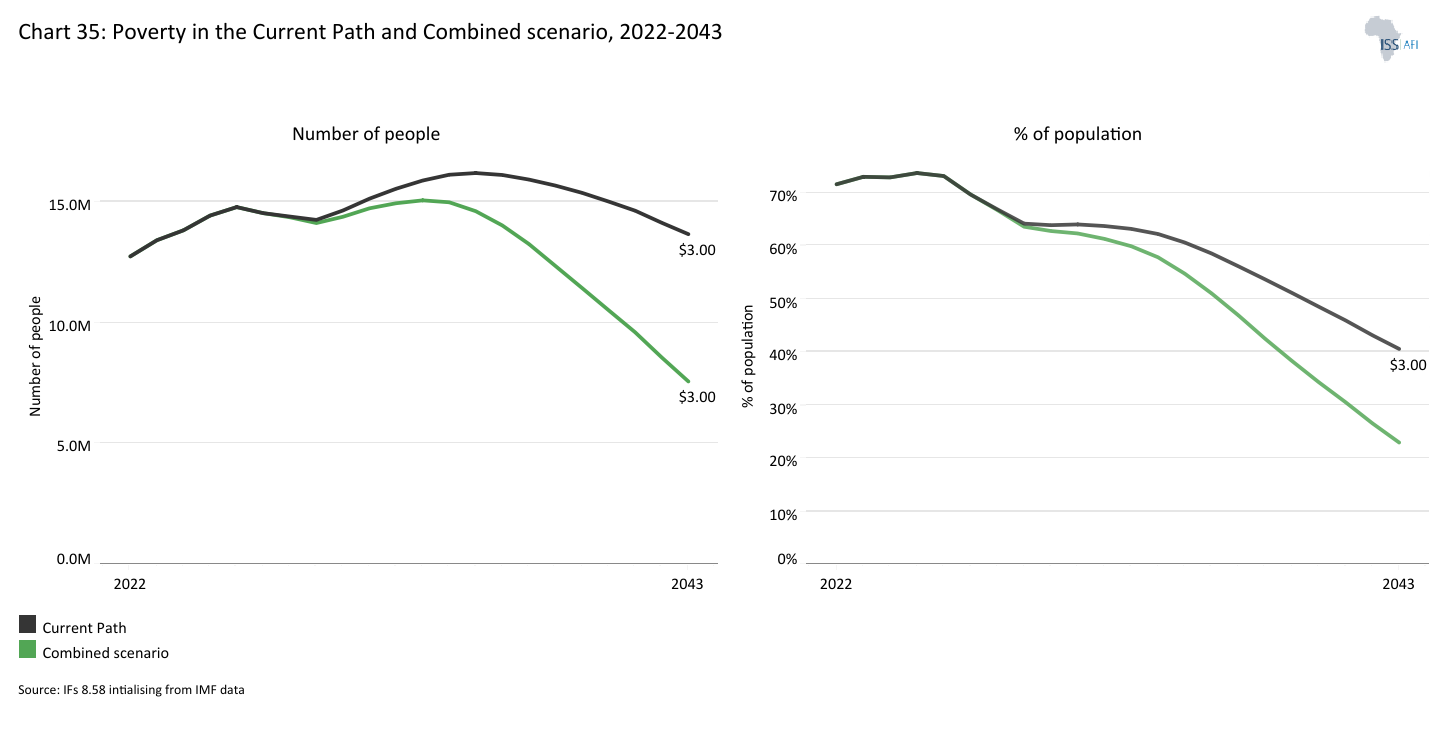
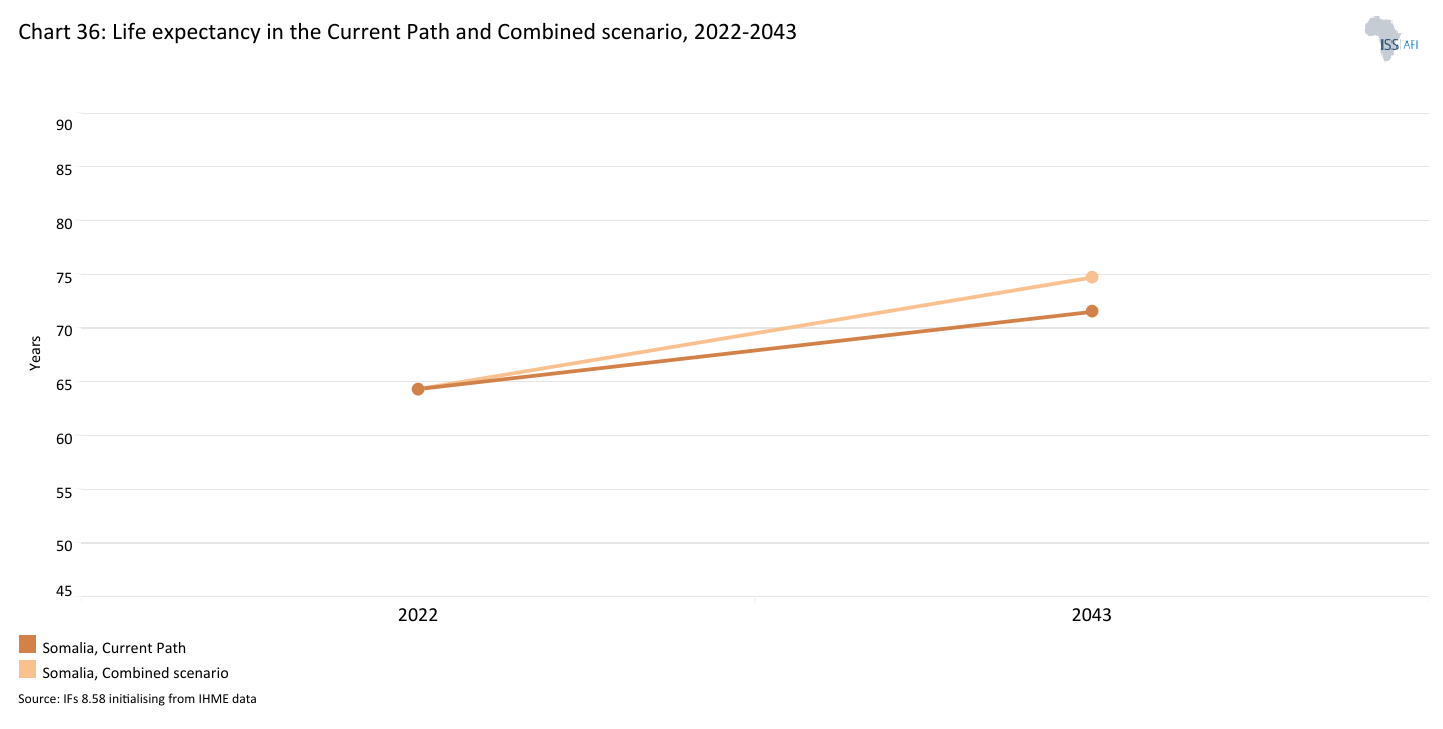
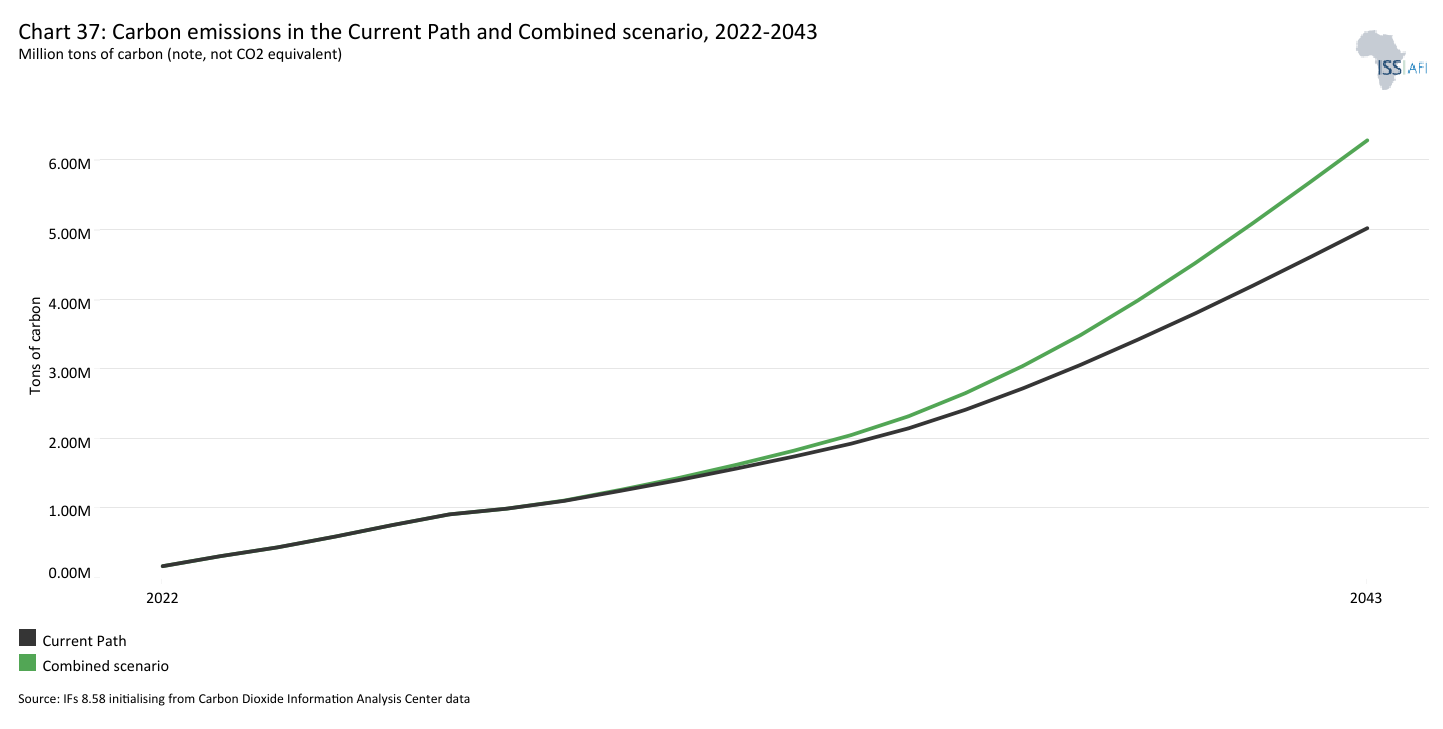
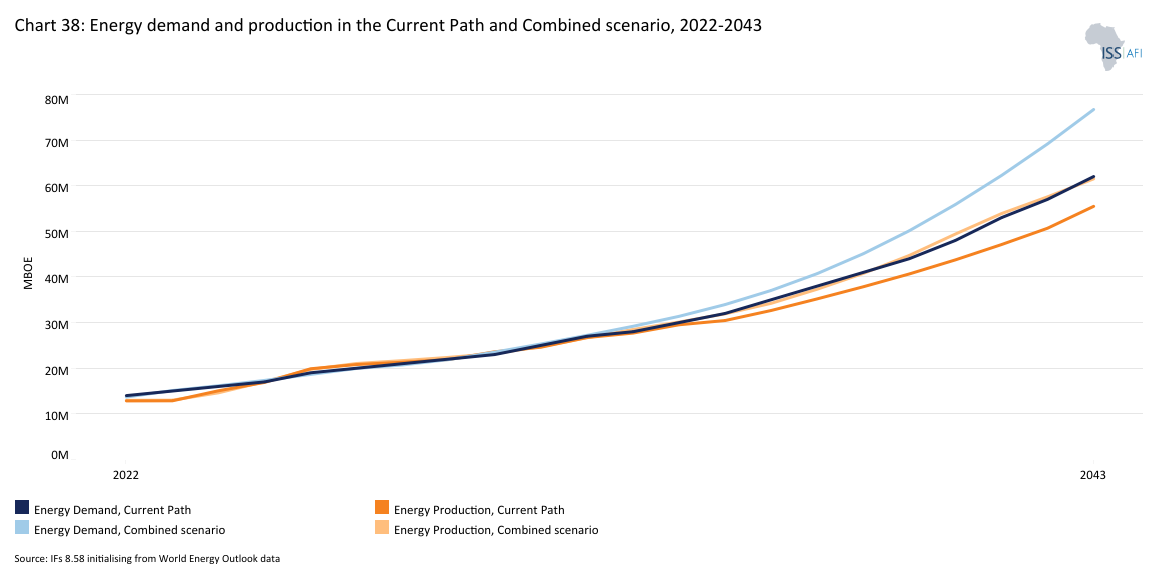

Chart 1 is a political map of Somalia.
The Federal Republic of Somalia is located in the Horn of Africa and occupies a strategic position along the Gulf of Aden and the western Indian Ocean. It shares borders with Djibouti to the northwest, Ethiopia to the west and Kenya to the southwest. With a land area of approximately 637 655 km², it is one of the larger countries in East Africa. Its coastline, stretching more than 3 000 kilometres, is the longest on mainland Africa and shapes both maritime opportunity and exposure to security risks along major shipping corridors.
Somalia gained independence in 1960 and was among the earliest post-colonial African states to hold competitive multiparty elections and experience a peaceful transfer of power. This transition was interrupted by a military coup in 1969, which centralised authority under Siad Barre. The regime’s collapse in 1991 led to the fragmentation of the central state and prolonged civil conflict. Since 2012, Somalia has operated under a Provisional Federal Constitution and an internationally recognised Federal Government. The country is structured as a federal system comprising the Federal Government of Somalia and several Federal Member States. However, the allocation of powers, fiscal arrangements and completion of the constitutional review process remain politically contested.
Territorial fragmentation is a significant issue in Somalia’s governance. The brutal civil war and the collapse of the central government led by Siad Barre resulted in the establishment of a self-declared independent breakaway state, Somaliland, in the northwest (capital: Hargeisa) in 1991. Somaliland functions autonomously but lacks international recognition. Meanwhile, Somalia, with its capital in Mogadishu, continues to exist as the internationally recognised Federal Republic to this day.
Tensions escalated in 2024 when Ethiopia signed a port access agreement with Somaliland, prompting diplomatic pushback and regional mediation, and again in December 2025 when Israel announced recognition of Somaliland, triggering condemnation from Somalia, regional states and the African Union.
Somalia’s political calendar has become more contentious. Presidential elections had originally been planned for 2026, before the current government’s mandate expired in May. But progress towards the vote had already stalled amid deep disagreements between the federal government, opposition actors, and key federal member states over the timing, format and constitutional basis of the process. In that context, parliament’s March 2026 approval of constitutional changes extended the terms of the president and lawmakers from four to five years and pushed the election timetable back by a year. The federal government has presented the move as part of a transition towards direct elections, but it has deepened disagreements with opposition actors and key federal member states over the timing, format and constitutional basis of the electoral process. Rather than resolving uncertainty, the amendments have heightened the risk of a delayed or disputed political transition, contested mandates and renewed instability. This also raised renewed concerns about the credibility of the process and the orderly transfer of authority.
Somalia’s physical geography has long influenced its economic and social organisation. Much of the country is arid or semi-arid, characterised by low and highly variable rainfall. Beyond the northern highlands and the more fertile Juba and Shabelle river corridors, extensive flat plateaus and dry savannah dominate the landscape. These environmental conditions have historically favoured mobility as a strategy for managing climatic risk. Pastoralism and agropastoralism remain central to livelihoods, while clan-based social structures continue to shape political representation, dispute resolution and access to resources.
Somalis dominate Somalia's population, organised into clans tracing descent from common male ancestors, subclans and larger families. The Sab (Rahanweyn and Digil) are southern farmers and agropastoralists. Daarood inhabit the northeast, Ogaden and the Somalia–Kenya border. Hawiye live along the middle Shabelle and in the south-central areas. Isaaq occupy central and western northern Somalia. Dir reside in the northwest with southern dispersions, while Tunni hold the Marca-to-Kismaayo coast. Bagiuni, Swahili fishing communities, live along the coastal strip and nearby islands near Kenya.
Key minorities include trade-oriented Arab communities, mainly of Yemeni origin, and Somali Bantu, concentrated along the fertile Jubba and Shabelle river valleys, where they play a central role in irrigated agriculture. Many Somali Bantus descend from populations brought to the region through the nineteenth-century slave trade and have historically faced social marginalisation within Somalia’s clan-based hierarchy. A small Italian community also remains from the colonial period.
Somali, a Cushitic Afro-Asiatic language, serves as the primary official language and is widely understood across the country despite regional dialects. Arabic is the second official language, spoken mainly in northern regions and coastal towns. English and Italian, reflecting colonial legacies, are also widely used, particularly in higher education, while Swahili is spoken in parts of southern Somalia.
Almost all Somalis follow the Shāfiʿī school within Sunni Islam. Key Muslim orders (ṭarīqa), such as the Qādirīyah, Aḥmadīyah and Ṣaliḥiyah, exert significant influence.
Classified as a low-income country, Somalia remains among the most institutionally fragile states globally. A young and rapidly expanding population places sustained strain on public services, infrastructure and employment creation. Poverty is both widespread and persistent, with one of the highest extreme poverty rates in Africa and only modest gains in per capita income from a very low starting point. Much of the economy operates informally, limiting productivity, narrowing the tax base and constraining the state’s capacity to finance essential services and long-term investment.
State capacity has improved in selected areas, particularly those monitored by the IMF and World Bank, but remains uneven. Public financial management reforms enabled Somalia to reach the completion point of the Heavily Indebted Poor Countries Initiative (HIPCI) in December 2023, securing approximately US$4.5 billion in debt relief and strengthening macroeconomic credibility. However, fiscal gains have not translated uniformly into governance effectiveness. Revenue collection remains concentrated in the capital, Mogadishu; institutional performance varies across federal member states; and service delivery in sectors such as water, electricity, health and education is uneven and heavily reliant on private providers and external partners.
Security remains the most immediate constraint on state consolidation. The federal government does not exercise full territorial control, and al-Shabaab continues to influence or administer parts of the countryside, limiting the reach of state institutions. External assistance has therefore been central to rebuilding the security sector. For example, AU and UN missions, including the African Union Mission in Somalia (AMISOM) and its successor the African Union Transition Mission in Somalia (ATMIS), have supported counter-terrorism operations and the gradual transfer of security responsibilities to Somali forces. Regional and international partners, including Ethiopia, Turkey, the EU, the UK and the United States, have also provided training, equipment and logistical support to Somali security forces. In August 2024, the AU Peace and Security Council endorsed the establishment of a new AU-led and UN-authorised mission, the African Union Support and Stabilization Mission in Somalia (AUSSOM), underscoring the continued role of international and regional assistance. Establishing a unified command structure and sustainable national security architecture remains essential for long-term stability.
Somalia is a member of the Intergovernmental Authority on Development (IGAD) and formally joined the East African Community in December 2023. It acceded to the African Continental Free Trade Area (AfCFTA) in 2023 and ratified the agreement in 2025, reinforcing its stated commitment to deeper regional and continental economic integration after decades of fragmentation.
Finally, data constraints remain significant. Decades of conflict weakened national statistical systems, resulting in modelled population estimates, limited subnational economic data and uneven administrative reporting. These limitations require cautious interpretation of trends and careful triangulation when assessing Somalia’s development trajectory.
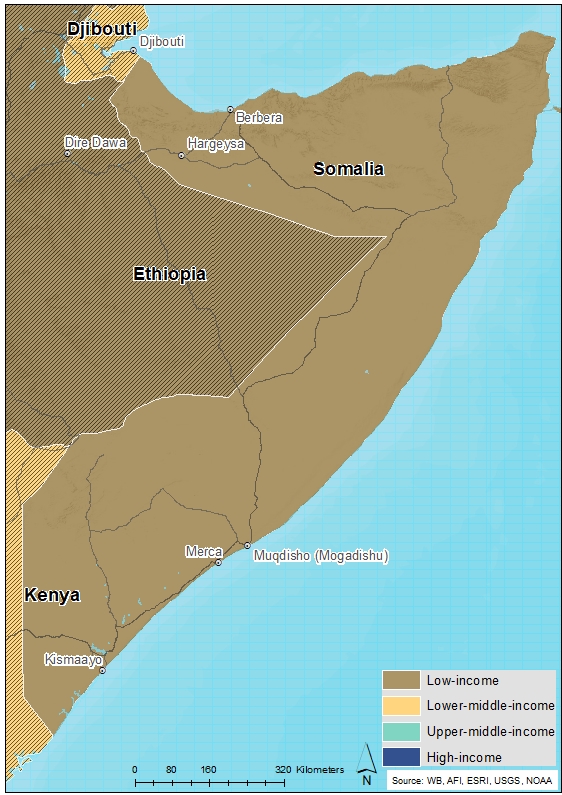
Chart 2 presents the Current Path of the population structure, from 1990 to 2043.
Somalia has not conducted a full national population census since 1975, meaning population trends over the past five decades have relied largely on estimates. The current Somali Population and Housing Census (SPHC), launched in 2023, marks a significant institutional milestone. The census project timeline outlines:
- March 2022 – December 2025: Pre-census activities
- January 2026 – October 2027: GIS development and cartographic mapping
- October – December 2028: Development of enumeration instruments and field testing
- January 2029 – December 2029: Enumeration, data processing and release of results
While the SPHC will eventually provide a national demographic baseline, existing estimates already offer valuable insight into Somalia’s population trajectory.
Despite prolonged civil conflict and state fragility, Somalia’s population has more than doubled over the past 33 years, from approximately 7.1 million in 1990 to 18.4 million in 2023. In 2024, the country ranked 24th in Africa and 68th globally in terms of population size. On the Current Path, the population will reach 33.7 million by 2043, making Somalia the 22nd most populous country on the continent.
This sustained population expansion is driven primarily by persistently high fertility, which remains among the highest globally. In the early 1990s, women had, on average, more than seven children each. The total fertility rate has declined gradually since then, but remained high at 6.1 births per woman in 2023. On the Current Path, it is expected to fall further to 4.6 births per woman by 2043. This will still exceed the replacement rate of 2.1, ensuring ongoing population growth and exerting sustained pressure on development outcomes in the coming decades.
Like many countries in sub-Saharan Africa, Somalia's population is predominantly young. In 2023, nearly three-quarters of the population was under 30, and almost half were children under 15. This means that a large portion of the population is dependent on the workforce to provide for its needs. On the Current Path, the population under 15 years will decline gradually, but will still constitute 42% of the population by 2043. The share of older persons (65 and above) has been stable at 3% over time, and is projected to remain 3% by 2043. The structure of Somalia’s population is typical of countries with high fertility rates and low life expectancy.
The dependency ratio, which compares children (under 15 years) and elderly (over 64 years) to the working-age (15-65 years) population, remains high at 97% and will continue to place sustained pressure on education systems, health services and job creation. These pressures are also unevenly distributed, with dependency ratios markedly higher in rural (131%) and nomadic (121%) areas than in urban (106%) areas. This suggests that support burdens are particularly acute outside cities, with implications for poverty, service provision and regional inequality.
Somalia’s demographic profile intersects with broader structural constraints on development. Around 75% of young people face unemployment, alongside limited educational attainment and restricted access to health services. These conditions compound the pressures created by a youthful, dependent population, constraining livelihoods, weakening economic prospects and limiting the country’s ability to translate demographic change into inclusive growth.
Chart 3 presents a population distribution map for 2023.
In 2023, Somalia had an average population density of 29 people per square kilometre, ranking 39th on the continent. Population distribution across the country is highly uneven, shaped by the interaction of climate conditions, livelihood systems, mobility patterns and fragmented governance.
Much of Somalia is arid to semi-arid, with highly variable rainfall patterns across space and time, which limits the feasibility of stable livelihoods and more permanent settlements. Higher population concentrations are found along the Juba and Shabelle river valleys, where irrigated agriculture supports more reliable livelihoods than in surrounding dryland areas. Historically, nomadic and pastoralist livelihoods have played a central role in shaping low-density settlement patterns, with seasonal mobility responding to the availability of pasture and water across extensive rangeland systems. Although the share of fully nomadic households has declined over time, mobility remains a defining feature of rural livelihoods, which still account for over 60% of the population.
Over the past decade, these traditional settlement systems have been increasingly disrupted by overlapping climate and conflict shocks. The country hosts one of the world’s largest internal displacement crises. By the end of 2024, conflict and violence had left around 3.1 million people living in internal displacement. Climate shocks have increasingly compounded and intensified displacement dynamics across the country. Since late 2021, Somalia has experienced one of the most severe droughts in decades, driven by multiple failed rainy seasons that devastated pastoral and agropastoral livelihoods. The drought triggered additional large-scale displacement, with well over a million people forced to move by early 2023, and its socioeconomic impacts have continued to reverberate beyond the peak crisis. From 2023 onwards, drought impacts have been compounded by extreme climatic volatility, including severe El Niño-related flooding, exposing millions of people to consecutive climate shocks.
Alongside climate stress, conflict and communal violence remain significant displacement triggers. In early 2023, clashes around Laascaanood led to the internal displacement of at least 150 000 people and pushed about 100 000 refugees into Ethiopia, many of whom arrived in remote and drought-affected areas. An estimated 316 000 new internal displacements linked to conflict and violence were reported in Somalia in 2024, less than half the number recorded in 2023, when fighting escalated sharply in the Sool region. This decline reflects an overall reduction in large-scale fighting and violence against civilians, despite continued military operations against Al-Shabaab and episodes of communal violence, including land-related conflicts in Gedo in July and October. By the end of 2024, an estimated 3.1 million people remained internally displaced due to conflict and violence, while disasters displaced more than 733 000.
Beyond internal displacement, Somalia remains one of the region’s major refugee-origin countries, with substantial Somali refugee populations in Kenya, Ethiopia and Yemen. Many have spent decades in exile, often in camp settings, reflecting a protracted refugee situation in which large refugee populations remain displaced for extended periods. As a result, entire generations of Somalis have grown up outside their country of origin. Host governments, including Ethiopia, have introduced measures to improve access to education, livelihoods and local integration, though constraints remain. Return movements from neighbouring countries occur periodically but remain modest relative to internal displacement. Nevertheless, returnees intersect with existing settlement pressures, particularly in urban and peri-urban areas. Population mobility in Somalia, therefore, operates across both internal and cross-border dimensions, further complicating spatial planning, service delivery and governance.
In response, the government has taken steps to strengthen institutional frameworks, including ratifying the Kampala Convention in 2019 and establishing a Durable Solutions Unit within the Ministry of Planning, Investment and Economic Development. Still, displacement pressures remain closely linked to insecurity, environmental stress and long-standing marginalisation, particularly in southern regions. In September 2024, the federal government adopted the National Solutions Pathways Action Plan for 2024–2029, outlining a framework to advance longer-term solutions for internally displaced persons and returnees. The plan focuses on expanding access to basic services, livelihood and employment opportunities, housing and tenure security, and social support systems. It builds on the earlier National Durable Solutions Strategy (2020–2024) and is aligned with broader national development priorities and the Sustainable Development Goals.
These spatial dynamics are further complicated by contested authority and state legitimacy. This includes Somaliland’s 1991 declaration of independence and its limited international recognition, as well as Puntland’s autonomous status within Somalia’s federal system, which has periodically been marked by tensions with the Federal Government over constitutional authority, governance arrangements and resource control. These issues gained renewed international salience in 2025, amid Israel’s announcement recognising Somaliland and debates at the United Nations Security Council, where concerns were raised that external engagement with Somaliland outside Somalia’s constitutional framework could undermine the country’s territorial integrity and regional stability.
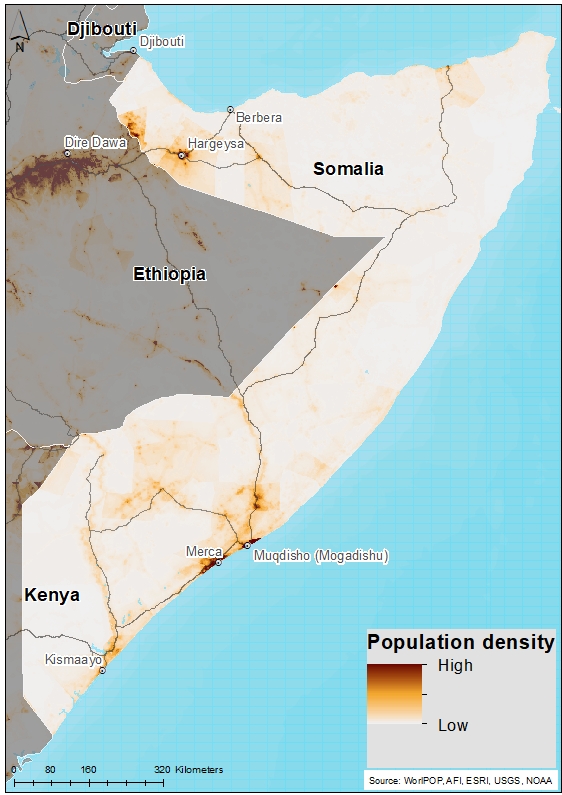
Chart 4 presents the urban and rural population in the Current Path, from 1990 to 2043.
Somalia is urbanising rapidly, and consistently faster than its low-income African peers. However, this urban expansion has been driven less by ‘classic’ structural transformation and instead by protracted conflict, climate shocks and large-scale internal displacement.
The urban population increased from 29.7% in 1990 to 48% in 2023, now ranking fifth among its low-income African peers and above the group average of 33.2%. On the Current Path, Somalia is expected to remain more urbanised than its peers, with the urban share rising to 58.4% by 2043, compared to a peer-group average of 42.8%.
Cities such as Mogadishu, Bosaso, Baidoa and Hargeisa are absorbing a disproportionate share of the displaced population. Much of this growth has taken the form of informal settlement, characterised by insecure land tenure, spatial segregation, weak service provision and high exposure to eviction. Nearly half of Somalia’s urban population lives in slum conditions, reflecting limited access to durable housing, improved sanitation and secure tenure. Municipal governance capacity remains extremely limited, shaped by fragmented authority, weak fiscal autonomy and minimal planning reach, while core urban services are predominantly delivered through private, informal or humanitarian systems.
As a result, Somali cities function as dense hubs of population and economic activity without corresponding institutional depth, inclusive labour markets or effective regulatory frameworks. Urban land has emerged as a central arena of political and economic contestation, reinforcing inequality, elite capture and social exclusion. Taken together, Somalia’s urbanisation reflects a distress-driven and structurally informal trajectory that is reshaping the country’s political economy, concentrating both opportunity and risk in cities that increasingly operate as de facto sites of governance in the absence of a consolidated social contract.
According to the World Bank, managing urbanisation is therefore central to Somalia’s development and stability, yet the country’s political and administrative realities render conventional urban policy approaches largely unworkable. While cities have benefited from committed local leadership and adaptive governance practices, these actors operate with limited tools and face persistent resistance and institutional constraints. Consequently, Somalia is not yet positioned to implement standard, state-centric urban development models. Instead, a transitional approach is required, one that works pragmatically within existing hybrid systems, avoids overburdening weak institutions and incrementally strengthens coherence, complementarity, credibility and capacity across formal and informal governance arrangements, including through regulated third-party service delivery models where appropriate.
Recent government strategies explicitly recognise the need to move beyond crisis management towards more durable and development-oriented responses to displacement and urbanisation. The National Transformation Plan (NTP 2025-2029) embeds urban-relevant priorities within its four pillars—including targeted infrastructure development, service delivery expansion, economic diversification and climate resilience—with an emphasis on strengthening institutional capacity, public sector efficiency and sustainable urban ecosystems as enablers of inclusive growth and stability in rapidly expanding cities. Complementing this, the Solutions Pathways Action Plan (2024–29) provides a practical framework for addressing displacement in urban and peri-urban areas, focusing on supporting local integration and improving access to basic services, livelihoods, and land and housing for displaced populations and host communities. The plan seeks, where feasible, to better align displacement responses with subnational planning processes and service delivery systems, recognising existing capacity constraints and institutional fragmentation. Together, these strategies point to an effort to move beyond short-term humanitarian responses towards more integrated, place-based approaches to displacement and urban governance. However, delivery continues to be shaped by weak capacity, fragmented authority and ongoing insecurity.
Chart 5 presents GDP in market exchange rates (MER) and growth rate in the Current Path, from 1990 to 2043.
Somalia’s economic trajectory reflects prolonged disruption followed by gradual but fragile recovery. GDP growth remained weak throughout the 1990s and early 2000s, shaped by state collapse, insecurity and the absence of formal economic institutions. From the late 2000s, activity began to recover as urban-based private-sector-led services expanded, including trade, telecommunications, transport and construction. Growth remained modest and uneven, concentrated in major urban centres and driven primarily by private adaptation rather than structural transformation.
Agriculture underpins the economy, contributing over 70% of GDP and employing over 80% of the labour force. Yet productivity remains low and highly exposed to climatic shocks. Recurrent drought, insecurity and climate-related disruptions constrain productivity and deter long-term investment. The economy operates within a de facto dollarised system that facilitates transactions despite weak monetary institutions but limits policy flexibility and domestic financial deepening.
Aid continues to play a central role in macroeconomics. External grants finance a substantial share of public expenditure, development projects and service delivery due to very limited domestic revenue mobilisation. While this support has helped stabilise public finances and sustain basic services, it also underscores the state’s fiscal vulnerability and dependence on external partners.
Completing the Heavily Indebted Poor Countries (HIPC) Initiative in 2023 marked an important milestone, sharply reducing external debt and restoring access to concessional finance. However, debt relief alone does not alter the underlying growth model. Somalia’s expansion remains services-led and externally supported, with limited structural transformation.
In 2023, Somalia’s GDP stood at US$8.6 billion, up from US$1.9 billion in 1990, reflecting an average growth rate of 4.9% over this period. By 2043, the economy will reach US$20.8 billion in the Current Path, implying a faster average growth rate of 7.4% between 2024 and 2043. However, Somalia’s economy remains vulnerable, externally supported and insufficiently diversified to absorb demographic pressures or deliver sustained structural transformation.
Overall, Somalia’s economy has stabilised and resumed growth, but it has not yet transitioned onto a path of diversified, productivity-driven development. The central question over the next two decades is whether macroeconomic stabilisation and incremental urban expansion can translate into structural transformation, job creation and resilience, or whether growth will remain narrow, shock-prone and externally anchored.
Chart 6 presents the size of the informal economy as per cent of GDP and per cent of total labour (non-agriculture), from 2020 to 2043. The data in our modelling are largely estimates and therefore may differ from other sources.
Somalia’s economy is predominantly informal, with a large share of the labour force concentrated in subsistence agriculture and pastoral livelihoods. This economic structure exposes households and output to significant vulnerability, given the heavy dependence of these sectors on rainfall and open grazing systems. Structural constraints are compounded by weak physical and digital infrastructure, including limited transport connectivity and communications networks, which continue to impede business activity, market integration and productivity. Persistent gender inequality further constrains economic potential, as social norms and unequal access to education and employment limit women’s participation in the labour market, reducing overall labour supply and human capital development.
Informality is not confined to low-productivity or rural activities but extends across most sectors of the economy. Very high rates of informal employment also prevail in health and social services, finance and insurance, and information and communication activities, where the vast majority of workers operate outside formal employment arrangements.
In 2023, the informal economy accounted for 36% of the country’s GDP, ranking 11th-highest on the continent. By 2043, it will decline to 29%, roughly at par with the average for low-income countries in Africa (28%). The informal economy, excluding the agriculture sector, employed 69% of total labour in 2023, with a projected decline to 49% by 2043.
While the informal economy provides an essential safety net for Somalia’s large and growing working-age population, it also constrains productivity, limits policy effectiveness and slows structural transformation. High levels of informality reduce access to better wages, social protection and redistributive mechanisms, while weakening the state’s ability to regulate and support economic activity. Although recent reforms signal progress towards formalisation, including the 2019 Company Act, the 2023 Investors and Investments Protection Law and the rollout of the Somali Business Registration System, their impact remains limited. Institutional fragility, governance weaknesses, overlapping federal and state mandates, persistent insecurity and the continued reliance on informal and clan-mediated arrangements undermine regulatory predictability and transparency. As a result, Somalia remains one of the most challenging environments for formal business activity and sustained private investment, despite incremental reform efforts.
Chart 7 presents GDP per capita in the Current Path, from 1990 to 2043, compared with the average for the Africa income group.
Somalia’s GDP per capita, measured in purchasing power parity (PPP), constant 2021 US dollars, reflects a long-term pattern of disruption and slow recovery. In 2023, Somalia’s GDP per capita stood at US$1 466, the fourth-lowest on the continent. By 2043, GDP per capita will reach US$2 644, which would improve Somalia’s relative position slightly to 46th out of 54 African countries. Even with this increase, income levels would remain well below the projected average of its low-income African peer group, estimated at US$5 117 in 2043, and the country is therefore likely to continue facing a substantial income gap relative to comparable economies over the next two decades.
This reflects underlying structural constraints that limit the pace of income growth, including high population growth, persistent informality, low productivity and the dominance of consumption-driven, services-led activity. While urbanisation, remittances and incremental macroeconomic stabilisation support continued growth, these factors alone are insufficient to trigger a decisive income take-off in the absence of industrialisation, productivity gains or large-scale employment creation.
Chart 8 presents the rate and number of extremely poor people in the Current Path from 2020 to 2043.
In 2024, the World Bank updated the poverty lines to 2021 constant dollar values as follows:
- The previous US$2.15 extreme poverty line is now set at US$3.00, also for use with low-income countries.
- US$3.65 for lower-middle-income countries, now US$4.20 in 2021 values.
- US$6.85 for upper-middle-income countries, now US$8.30 in 2021 values.
Poverty in Somalia remains widespread, persistent and structurally entrenched. Half of the population (54%) lives below the national poverty line (US$2.06 per day), and there was no progress between 2017 and 2022. This stagnation reflects weak per capita consumption growth and repeated exposure to shocks, particularly climatic shocks. While national poverty rates appear stable, this masks important underlying deterioration in rural and nomadic areas. Poverty is unevenly distributed across geography and livelihood systems, with the highest rates among nomadic households (78%) and lowest in urban areas (46%).
Using the international extreme poverty line of US$3.00 per day, Somalia had the seventh-highest poverty rate among its peer group in 2023. At this poverty threshold, around 73% of Somalians (equivalent to 13.4 million people) were living in poverty. On the Current Path, this rate will decline to 41% by 2043. However, the absolute number of people increases to 13.7 million due to population growth.
Monetary poverty only tells part of the story. In addition, the global Multidimensional Poverty Index (MPI) measures acute multidimensional poverty by measuring each person’s overlapping deprivations across 10 indicators in three equally weighted dimensions: health, education and standard of living. The MPI complements the international poverty rate by identifying who is multidimensionally poor and by showing the composition of multidimensional poverty. The headcount or incidence of multidimensional poverty is often several percentage points higher than that of monetary poverty. This implies that individuals living above the monetary poverty line may still suffer deprivations in health, education and/or standard of living.
In 2024, Somalia released its first National Multidimensional Poverty Index (MPI) using 2022 household data, establishing a baseline for assessing non-monetary deprivation. The findings reveal that multidimensional poverty is both widespread and severe. Approximately two-thirds of the population experience overlapping deprivations, and those classified as poor are, on average, deprived in more than half of the weighted indicators used to assess wellbeing. Poverty is significantly higher outside urban areas. While 62% of urban residents are multidimensionally poor, the incidence rises to 74% in rural areas and 82% among nomadic populations.
Regional disparities are equally stark. In some regions, such as Bakool and Hiraan, multidimensional poverty affects over 90% of the population, whereas in others, including Awdal and Lower Shabelle, it records substantially lower rates. The pattern of deprivation points to structural deficits in living standards and education as the main drivers of multidimensional poverty. Nationally, the most pervasive gaps concern cooking fuel availability and overcrowding, alongside serious shortfalls in education. Among nomadic communities, education is the dominant contributor, driven especially by low years of schooling and poor school attendance.
Poverty dynamics are also closely linked to fragility. Recurrent droughts and floods erode assets and destabilise pastoral and agricultural livelihoods. Conflict disrupts trade, displaces communities and weakens institutional capacity. The labour market remains dominated by informality, limiting income stability and productivity gains. Social protection systems are expanding but remain insufficiently scaled to cushion repeated shocks. As a result, many households fluctuate between vulnerability and crisis.
Somalia’s National Transformation Plan (NTP) 2025–2029 places poverty eradication at the centre of its development agenda, embedding it within a broader commitment to resilience, equity and inclusion. The Plan moves beyond narrow income-based approaches by strengthening social protection systems, expanding adaptive safety nets and improving social care services to shield vulnerable households from shocks and chronic deprivation. It recognises that breaking poverty cycles requires sustained investment in human capital, particularly through expanding access to education, skills development and nutrition support.
The NTP also treats inclusion as a structural imperative. Women’s economic empowerment, youth employment and entrepreneurship, and the institutional integration of persons with disabilities are positioned as core pillars of transformation. By aligning vocational training with labour market demand, promoting access to finance, addressing gender-based barriers and reforming legal and governance frameworks, the Plan seeks to expand productive participation across society.
Chart 9 depicts the National Transformation Plan of Somalia.
Since the mid-2010s, Somalia has progressively re-established a national development planning framework after decades of state collapse and fragmented governance. The National Development Plan 8 (2017–2019) marked the first substantive post-conflict effort to articulate national priorities and achieve the Sustainable Development Goals (SDGs).
This was followed by the National Development Plan 9 (2020–2024). It functioned not only as a development strategy but also as an interim poverty-reduction strategy and as a vehicle for macroeconomic reform. NDP 9 underpinned improvements in public financial management and supported Somalia’s progress towards debt relief under the Heavily Indebted Poor Countries Initiative. The Plan was structured around four pillars: politics, security and rule of law, inclusive economic growth and social development, reflecting an understanding that economic recovery required parallel progress in governance and stability. To strengthen oversight and accountability under the NDP 9, the Ministry of Planning, Investment and Economic Development commissioned the National Integrated Monitoring and Evaluation Framework to provide a unified approach for tracking, assessing and reporting on the implementation of NDP-9 programs, policies and projects across government.
From 2025, Somalia transitions from the NDP cycle to the National Transformation Plan (NTP) (2025–2029), signalling an ambition to move beyond stabilisation towards more transformative development outcomes. The NTP reframes national priorities around governance reform, economic transformation, human capital development and climate resilience. It places stronger emphasis on the role of state institutions, at both federal and subnational levels, in coordinating service delivery, investment and reform. The Plan reflects greater macroeconomic confidence following debt relief and improved engagement with international partners. However, its implementation remains constrained by limited administrative capacity, uneven authority across the federal system and persistent insecurity.
In parallel, the launch of Somalia’s Centennial Vision 2060 introduces a longer-term horizon. Announced following President Hassan Sheikh Mohamud’s re-election in 2022 and formally launched in 2025, the Vision outlines a 35-year strategic trajectory to 2060, the centenary of independence. The Vision aims to steer Somalia towards sustained political stability, stronger economic resilience and broader social inclusion. It is designed to anchor national priorities within a shared long-term framework, reinforce core national values, encourage locally driven solutions, and ensure that reforms and investments remain aligned with enduring national interests.
The credibility of this planning architecture depends on reliable data. Since the collapse of the central government in 1991, Somalia has operated without a coherent and functioning national statistical system. As state institutions disintegrated, so too did the infrastructure for producing and managing official data. The governing statistics law dates from 1970 and no longer reflects Somalia’s federal structure. In practice, data production became fragmented, donor-driven and often undertaken in parallel by non-state actors, with weak coordination across ministries and federal entities.
This prolonged data vacuum constrained evidence-based policymaking. Administrative systems remained underdeveloped, statistical units within ministries were weak or inconsistent and ad hoc surveys substituted for institutionalised data systems. Capacity shortages, limited financing, fragile IT infrastructure and uneven methodological standards further undermined the credibility and comparability of official statistics.
A decisive institutional shift occurred with the enactment of the 2020 Statistics Law, which established the Somalia National Bureau of Statistics as an Independent Government Body and clarified its coordination mandate across the federal system. This legal reset marked the beginning of rebuilding statistical authority as part of broader state reconstruction. The Second National Strategy for the Development of Statistics (2024–2029) consolidates this effort. It focuses on operationalising the new law through regulations and codes of practice, modernising administrative data systems to reduce over-reliance on costly surveys, institutionalising data quality standards and investing in ICT and geospatial infrastructure. It also recognises the political realities of a federal system and seeks to strengthen coordination, harmonisation and trust across institutions. The significance of these reforms extends beyond technical data improvements. Credible statistics are essential for development planning, fiscal management, service delivery and accountability. Without reliable data, national plans cannot be monitored, performance cannot be measured and public trust cannot be built.
The eight sectoral scenarios as well as their relationship to the Current Path and the Combined scenario are explained in the Technical page. Chart 10 summarises the approach.
Chart 11 presents the mortality distribution in the Current Path for 2023 and 2043.
The Demographics and Health scenario envisions ambitious improvements in child and maternal mortality rates, enhanced access to modern contraception, and decreased mortality from communicable diseases (e.g., AIDS, diarrhoea, malaria, respiratory infections) and non-communicable diseases (e.g., diabetes), alongside advancements in safe water access and sanitation. This scenario assumes a swift demographic transition, supported by increased investments in health and water, sanitation, and hygiene (WaSH) infrastructure.
Visit the themes on Demographics and Health/WaSH for more details on the scenario structure and interventions.
Somalia’s health outcomes remain among the weakest globally, with high maternal and child mortality and widespread malnutrition. Access to basic care is limited for large segments of the population, and health service provision is overwhelmingly dependent on external assistance, with donor financing accounting for around 95% of total health expenditure. This heavy reliance on external funding leaves the system highly exposed to external shocks and geopolitical factors, and recent reductions in international support have placed growing pressure on the continuity and quality of essential health and nutrition services. A 2025 survey by the Somali NGO Consortium highlights the scale of disruption caused by the suspension of US aid to Somalia. More than 60% of NGOs operating in the country reported receiving stop-work orders. The suspension has led to widespread interruptions across critical sectors, including health, nutrition, WASH, food security, education and protection, alongside staff layoffs and unpaid leave.
Additionally, the health workforce is critically overstretched, with a severe shortage of trained professionals and pronounced urban–rural imbalances driven by insecurity, internal migration and outward emigration. Health facilities are unevenly distributed and often poorly equipped, with many facilities non-operational or failing to meet basic infection prevention standards. These weaknesses are compounded by persistent shortages of medicines and supplies, alongside procurement and transport challenges that are further exacerbated by insecurity.
Within this context, the mortality profile in 2023 was dominated by communicable diseases, reflecting the high prevalence of preventable and treatable conditions in a setting characterised by weak health system capacity and limited access to safely managed water and sanitation. Conflict, displacement and overcrowded living conditions further amplify transmission risks and disrupt access to preventive and curative care. Routine immunisation coverage in Somalia was low for many years, remaining below 50% for extended periods. More recent estimates, however, indicate significant progress, with around 70% of children fully vaccinated by 2024.
Looking ahead, communicable diseases are projected to remain the leading cause of mortality through to 2043, even as deaths from non-communicable diseases (NCDs) increase markedly. In 2023, the leading causes of death were “other communicable diseases” including respiratory infections, cardiovascular diseases, diarrhoeal diseases and cancers. By 2043, other communicable diseases will remain the leading cause, while cardiovascular diseases and cancers rise to second and third place, respectively, overtaking respiratory infections and diarrhoeal diseases, which fall to fourth and fifth.
These shifts reflect an intensifying dual burden of disease, in which persistent infectious mortality coexists with a growing challenge of chronic conditions, placing increasing strain on an already fragile health system. Managing this transition will require sustained efforts to reduce preventable infectious disease deaths while simultaneously strengthening the system’s capacity to detect and treat NCDs.
In the near term, reducing infectious disease mortality remains critical. Priority interventions include expanding access to basic and preventive services, strengthening routine immunisation and maternal and child health programs, improving infection prevention and control standards in health facilities, and reinforcing community-based health delivery in displacement-affected and hard-to-reach areas. Sustained investment in WaSH services, nutrition support and early disease detection will also be key to reducing preventable deaths in a context of recurrent shocks and population displacement. Without progress on these fronts, gains in health outcomes are likely to remain fragile.
At the same time, the rising burden of NCDs will require targeted health system strengthening. Priorities include improving access to early diagnosis and basic screening, progressively integrating NCD prevention and treatment into primary health care, and strengthening disease surveillance and health information systems to support planning and resource allocation. Complementary public health efforts, including addressing malnutrition, reducing tobacco use and promoting physical activity, will also be important in moderating the long-term growth of NCDs.
Chart 12 presents the infant mortality rate in the Current Path and in the Demographics and Health scenario, from 2020 to 2043.
The infant mortality rate is the probability of a child born in a specific year dying before reaching the age of one. It measures the child-born survival rate and reflects the social, economic and environmental conditions in which children live, including their health care. It is measured as the number of infant deaths per 1 000 live births and is an important marker of a country's overall health system quality.
Somalia continues to face extremely high levels of maternal and newborn mortality. UNICEF 2019 estimates indicate that around four in every 100 children die within the first month of life, and nearly eight in 100 do not survive to their first birthday. Approximately one in 20 women of reproductive age dies each year from complications related to pregnancy or childbirth.
Limited access to, and utilisation of, maternal and newborn health services contribute significantly to these outcomes. The 2020 Somalia Demographic and Health Survey shows that only about one-third of births take place with the assistance of skilled health personnel, and a similar share of women receive antenatal care from a trained provider during their most recent pregnancy. Postnatal care coverage is particularly weak, with nearly nine in ten mothers not receiving a check-up within the first two days after childbirth. Service availability is also uneven: a 2016 national assessment found that Basic Emergency Obstetric and Neonatal Care services were available in fewer than half of urban health facilities and only one-fifth of rural facilities. Essential Newborn Care was offered in less than a third of urban facilities and just over one in ten rural facilities.
In 2023, Somalia’s infant mortality rate stood at 62 deaths per 1 000 live births, more than double the Sustainable Development Goal target of fewer than 25 deaths per 1 000 live births by 2030. On the Current Path, the rate is projected to decline to 31 deaths per 1 000 live births in 2043, indicating substantial improvement but still falling short of the global benchmark. Under the Demographics and Health scenario, however, infant mortality could fall further to 26 deaths per 1 000 live births, bringing the country close to achieving the SDG target.
Chart 13 presents the demographic dividend in the Current Path and in the Demographics and Health scenario, from 2020 to 2043.
The demographic dividend, which refers to economic growth resulting from changes in a country's population structure, is influenced by factors such as declining fertility rates and improvements in health and education. With fewer dependants (children under 15 and adults over 65) to support, families and governments can allocate more resources to savings, education, infrastructure and economic development, driving accelerated growth.
The demographic dividend is attained when the ratio of working-age persons (15–64 years of age) to dependants is at least 1.7:1. However, attaining the demographic dividend does not automatically translate into economic growth. Realising the potential demographic dividend depends on simultaneous policy-driven improvements in employment, governance and basic service provision.
In Somalia’s case, persistently high fertility and rapid population growth mean that this transition will unfold slowly under the Current Path. In 2023, the ratio of working-age individuals to dependants stood at approximately 1.03, indicating that for every 1 dependent person (children under 15 or elderly over 65), there were approximately 1.02 people of working age (15–64). This implies that the economic burden of supporting non-workers was relatively low, which is a key requirement for economic acceleration. Although fertility is projected to decline over time, the reduction will be slow. As a result, the dependency burden will ease only marginally, with the demographic dividend ratio rising to 1.19 working-age persons per dependant by 2043 under the Current Path, and slightly higher to 1.22 under the Demographics and Health scenario.
Even under the Demographics and Health scenario, which reduces infant mortality, expands access to family planning and strengthens overall health outcomes, improvements in the age structure remain incremental. Demographic shifts operate over decades, and the large youth cohorts already born will continue to move through the dependency cycle before substantially altering the overall ratio.
Somalia is projected to reach a ratio of 1.7 working-age persons per dependant only towards the end of the 2060s, more than a decade later than the projected average of 2052 for low-income Africa. This delayed window has significant implications. For the next several decades, demographic momentum will continue to exert pressure on public services, education systems and labour markets, even as gradual gains in human capital materialise.
The policy implication is clear. Somalia cannot rely solely on demographic change to unlock growth and must balance immediate priorities with sustained long-term investments. Accelerating fertility decline through expanded access to family planning and greater investment in girls’ education is essential to reducing dependency pressures. At the same time, the country must manage immediate strains on employment, service delivery and human capital while advancing longer-term structural transformation, including stronger institutions, economic diversification and broader inclusion.
Chart 14 presents crop production and demand in the Current Path from 1990 to 2043.
The Agriculture scenario envisions an agricultural revolution that ensures food security through ambitious yet feasible increases in yields per hectare, driven by improved management, seed, fertiliser technology and expanded irrigation. Efforts to reduce food loss and waste are emphasised, with increased calorie consumption as an indicator of self-sufficiency and prioritising it over food exports. Additionally, enhanced forest protection demonstrates a commitment to sustainable land-use practices.
Visit the theme on Agriculture for our conceptualisation and details on the scenario structure and interventions.
A thriving agriculture sector is crucial to long-term peace and development in Somalia. Crop and livestock production together account for more than 70% of GDP and employ more than 80% of the labour force. Within this, livestock is the dominant subsector, contributing roughly 45% of GDP and underpinning around 80% of foreign currency earnings. An estimated 70% of Somalis depend directly or indirectly on livestock-related activities along the value chain, whether through herding, trading, processing or transport.
Despite its potential, the crop sector underperforms relative to its pre-conflict levels and its current potential. The country has an estimated 8.9 million hectares of arable land, significant groundwater reserves and three major river systems, the Shabelle, Jubba and Dawa, which together stretch roughly 2 500 kilometres. Agro-pastoral systems dominate much of rural life, particularly in the fertile river valleys of the south. Agricultural production is concentrated in southern Somalia, where soils are relatively fertile and river-based irrigation is available.
Maize is one of the country’s most important staple crops. It is primarily cultivated in Lower Shabelle and serves as a key source of household nutrition and livestock feed. However, domestic maize production remains far below national requirements. Yields are relatively low due to limited irrigation infrastructure, erratic rainfall, poor access to improved seeds and fertilisers, and high post-harvest losses. Annual output is estimated at 75 000 to 80 000 metric tons, while demand exceeds 1.2 million tons.
Fodder production remains underdeveloped but a vital part of Somalia’s livestock economy, which is the country’s largest contributor to GDP. However, a feed deficit of around 34%, driven by recurring droughts, overgrazing and rangeland degradation, continues to constrain productivity and raise livestock mortality during dry periods. Expanding the cultivation of drought-tolerant fodder crops, particularly in irrigated areas of Lower Juba and Lower Shebelle, offers significant scope to strengthen resilience and improve output.
Environmental degradation represents a significant constraint on Somalia’s development trajectory. The causes of degradation are estimated at 38% of the land area affected by biological decline, and a further 34% by water-driven soil erosion, meaning that more than 70% of already degraded land is under significant ecological stress. Only about 14% of the overall land remains unaffected by degradation. These patterns reflect the country’s heavy reliance on natural resources and its growing vulnerability to degradation driven by overgrazing, deforestation and unsustainable land use. Somalia has taken constructive steps in response, including its commitment under SDG 15 to achieve land degradation neutrality, alongside reforestation and soil conservation initiatives. Stronger land-use planning, improved environmental data systems, consistent monitoring and better coordination across sectors and levels of government are essential. Without strengthened land governance and sustained resource management, ecological decline will continue to erode food security, slow poverty reduction, and heighten risks to long-term stability.
Climate change is compounding Somalia’s structural vulnerabilities and intensifying pressure on its food systems. Longer and more frequent dry spells are reducing water availability, degrading rangelands and causing repeated livestock and crop losses. Between 2021 and 2023, the country experienced its worst drought in nearly four decades, following successive failed rainy seasons. The shock affected more than half the population, depleted key water sources, destroyed pasture, caused large-scale livestock losses and triggered widespread displacement. Recent initiatives, such as the Ugbaad climate-resilient agriculture program, signal a shift towards more adaptive water management, drought-resistant inputs and ecosystem restoration. While these interventions are important, their impact will depend on scale, coordination and sustained implementation.
These climate shocks interact with conflict, economic fragility and environmental degradation to disrupt production and weaken resilience. As a result, food insecurity remains chronic. In 2023, around 1.9 million people in Somalia were facing severe levels of food insecurity, classified as crisis or worse under the Integrated Food Security Phase (IPC) classification, the highest number recorded since the Global Report on Food Crises began in 2016. Acute malnutrition also remained alarmingly high, with an estimated 1.8 million children under five affected.
Against this backdrop, crop demand will rise steeply under the Current Path from 4.63 million metric tons in 2023 to 24.35 million metric tons by 2043, mainly due to rapid population growth. Production will increase, but at a far slower rate, from 1.26 to 2.94 million metric tons in the same period. Accordingly, the crop production deficit will widen from roughly 3.37 million metric tons to 21.41 million metric tons. This trajectory depicts severe food insecurity and tends to have negative implications for macroeconomic stability.
Chart 15 presents the import dependence in the Current Path and the Agriculture scenario, from 2020 to 2043.
The widening crop production deficit shown in Chart 14 translates directly into persistent reliance on imported food, as depicted in Chart 15. Under the Current Path, import dependence will remain high, with the agricultural trade deficit increasing from almost 8% of demand in 2023 to 11.4% by 2043. The Agriculture scenario will modestly improve the outlook, with higher domestic crop production slightly reducing import dependence. By 2043, the agriculture trade deficit will decline to around 10.4% of demand.
In Somalia’s context, this dependence has macroeconomic consequences. Food imports must be financed in foreign currency, placing pressure on limited reserves and exposing the economy to global price volatility and supply disruptions. In a system already vulnerable to climate shocks and political fragility, high import dependence amplifies inflationary risk and household food insecurity.
Livestock exports partially offset this exposure by generating foreign exchange. Somalia has one of the largest livestock populations in Africa with substantial herds of goats, sheep, camels and cattle, reflecting the country’s long-standing pastoral traditions. Sheep and goats account for the bulk of livestock exports, mostly to Gulf and Middle Eastern markets. In addition to live animal trade, products such as hides, skins and dairy contribute to domestic and regional value chains, further reinforcing the sector’s economic importance. However, the sector is itself climate-sensitive and vulnerable to trade restrictions. It cannot fully compensate for structural food deficits.
Beyond land-based systems, Somalia’s blue economy represents a significant but underutilised additional avenue for strengthening external balances. The country has the longest coastline in mainland Africa and substantial marine resources, yet the fisheries sector contributes only around 2% of GDP despite recent nominal growth. Artisanal fishers produce approximately 6 000 tonnes annually, while illegal, unreported and unregulated foreign vessels are estimated to capture around 13 000 tonnes per year, more than double the artisanal catch. Total national marine potential is estimated at roughly 200 000 tonnes, indicating substantial untapped capacity. At the same time, governance reforms have strengthened oversight of the sector, including improvements in licensing systems and enforcement against illegal fishing. Further building the blue economy will require investment in coastal infrastructure, cold chains, enforcement capacity, value addition and stronger integration into maritime trade networks.
Given continued demographic growth and persistent climate vulnerability, Somalia’s structural exposure is unlikely to diminish in the near term. Without sustained productivity gains that unlock underutilised agricultural potential and diversification beyond rain-fed systems into irrigation, livestock value addition and fisheries development, the country will remain dependent on food imports over the next two decades.
Chart 16 depicts the progress through the educational system in the Current Path, for 2023 and 2043.
The Education scenario represents reasonable but ambitious improvements in intake, transition, and graduation rates from primary to tertiary levels as well as better-quality education at the primary and secondary levels. It also models substantive progress towards gender parity at all levels, additional vocational training at the secondary school level, and increases in the share of science and engineering graduates.
Visit the theme on Education for our conceptualisation and details on the scenario structure and interventions.
Since the establishment of the Federal Government of Somalia in 2012, rebuilding the education system has been a central pillar of state reconstruction. The Ministry of Education, Culture and Higher Education (MoECHE) has progressively reasserted national oversight, positioning education as essential to economic recovery, social cohesion and long-term stability.
Institutionally, notable progress has been made. One of the most significant milestones was the passage of the Education Act in April 2021, following a four-year consultation process. The Act now serves as the primary legal framework regulating and guiding the operation of a unified national education system. In 2021, Somalia adopted a 4+4+4 education structure, replacing earlier parallel systems such as the 6+3+3 model. The reform standardises general education into four years of lower-primary, four years of upper-primary, and four years of secondary schooling, aligning the system nationally and supporting curriculum harmonisation. Oversight bodies for higher education and technical and vocational education and training (TVET), including the National Commission for Higher Education, have also been established.
However, institutional reform has not translated into broad-based access. In 2020, more than 85% of school-age children were out of school, placing Somalia among the countries with the highest exclusion rates globally. Poverty remains the strongest predictor of exclusion, with children from the poorest households far less likely to attend school than those from wealthier families. Rural and nomadic communities face structural barriers, while internally displaced children, children with disabilities and girls remain disproportionately marginalised.
Gender inequality is particularly pronounced at the adolescent level. Child marriage remains widespread, with roughly 40-45% of girls marrying before the age of 18. Poverty often drives the practice, as low-income households treat early marriage as a coping strategy. Pregnancy, domestic responsibilities and marital obligations significantly reduce school participation. Among girls aged 15–17, only 16% of those who are married are enrolled in school, compared to 40% of those who have never married. Weak legal enforcement, limited awareness of the harms of early marriage and inadequate gender-responsive school infrastructure further entrench exclusion. Restricted educational access then reinforces limited economic opportunities for women, sustaining a cycle in which early marriage remains a rationalised alternative.
Quality deficits further weaken the system. A large proportion of teachers lack formal qualifications, and shortages of trained personnel, learning materials and effective supervision undermine classroom outcomes.
Early childhood education is minimal and largely provided privately, with limited regulatory oversight and weak data coverage. This early childhood landscape is dominated by Traditional Qur’anic schools (TQS) and Integrated Qur’anic schools (IQS), which operate under different models. TQS offer low-cost Islamic instruction to pre-primary-aged children, particularly in rural areas. They fall under the Ministry of Religious Affairs, with limited oversight from the Ministry of Education, Culture, Higher Education and Research (MOECHE). These schools are not part of the formal education system and do not provide structured early childhood education.
In contrast, IQS follow a broader curriculum and extend into the primary cycle. Typically managed by associations, they offer a three-year pre-primary program starting at age five. Learners who complete IQS can transition to lower-primary education. While the curriculum remains strongly oriented towards religious instruction, it also prepares children for formal schooling. Governance of the subsector is fragmented. Weak coordination between the Ministry of Justice and the Ministry of Religious Affairs, which oversee Qur’anic schools, and the Ministry of Education, which is responsible for early childhood education, constrains effective management and oversight.
The TVET subsector remains underdeveloped and highly informal. Although the number of centres has expanded, provision is geographically uneven, public-sector capacity is limited and enrolment levels remain modest relative to population needs. Instructor shortages and inconsistent data reporting constrain effective planning, and gender parity varies significantly across states.
Governance and financing constraints continue to limit progress. Lines of responsibility between federal and state institutions are not always clear, coordination mechanisms remain weak and administrative capacity is uneven. Despite decentralisation ambitions, the federal government still executes the majority of public education spending, reflecting concerns about subnational readiness. This raises legitimate questions about the depth and functionality of decentralisation in practice. Implementation of the Education Sector Strategic Plan (2022–2026) has also been slowed by delayed planning cycles, funding shortfalls, donor–government misalignment and fragmented partner coordination. Heavy reliance on external financing underscores the sector’s structural vulnerability.
Data systems are improving but remain fragile. The Education Management Information System (EMIS) has expanded coverage, yet weak school-level reporting, limited technical capacity and insufficient quality assurance reduce the reliability of sector data and constrain evidence-based policymaking.
Recent initiatives signal renewed political commitment. The 2023 National Education Conference created space for broader stakeholder engagement, and the recruitment of 3 000 new teachers marked a concrete step toward strengthening system capacity. Yet the scale of exclusion, persistent governance weaknesses and financing constraints mean that reform remains fragile.
Somalia has rebuilt key elements of its educational institutional architecture. The deeper challenge now lies in translating policy frameworks into equitable access, improved quality and sustainable delivery at scale. Until that gap is closed, education will remain both one of Somalia’s greatest vulnerabilities and one of its most strategic opportunities. Performance projections reinforce this concern.
SDG 4.1 commits states to ensuring that all girls and boys complete free, equitable and quality primary and secondary education. In the Current Path, primary completion in Somalia will rise from 21.6% in 2023 to 56.1% in 2043. This is a significant improvement, signalling system consolidation and improved retention. However, even by 2043, nearly half of primary-age children would still not complete primary school. This falls well short of universal completion and indicates persistent structural exclusion. At the secondary level, the gap is more pronounced. Lower-secondary completion will increase to 39.0% in the Current Path, while upper-secondary completion will reach only 12.0%. Although lower-secondary enrolment expands substantially, attrition between enrolment and completion remains high, particularly at the upper-secondary level.
SDG 4.3 calls for equal access to affordable and high-quality technical, vocational and tertiary education. Tertiary education in Somalia will expand, but from a very low base. In the Current Path, gross enrolment will rise from 9.5% to 16.2%, and completion will reach 11.5% by 2043. The constraint lies earlier in the pipeline. With upper-secondary completion projected at just 12.0%, the number of students eligible to enter tertiary education will remain structurally capped.
Somalia appears to be on a path of gradual system consolidation rather than universal provision. Achieving the SDG targets would require accelerated gains in completion rates, targeted equity interventions and sustained investment in system quality. Otherwise, demographic growth will continue to outpace institutional capacity.
Chart 17 presents the mean years of education in the Current Path and in the Education scenario, from 2020 to 2043, for the 15 to 24-year age group.
The average years of education in the adult population aged 15 to 24 is a good first indicator of how the stock of knowledge in society is changing. In 2023, Somalia ranked 52nd out of 54 African countries. This low starting point reflects the legacy of conflict, prolonged state collapse and heavy reliance on fragmented, largely private provision.
As shown in Chart 16, progression through the education funnel will remain constrained at each stage, particularly at the lower- and upper-secondary level. These bottlenecks are reflected in the mean years indicator. On the Current Path, mean years of schooling for young people will rise modestly, from 4.6 years in 2023 to 5.5 years by 2043.
Under the Education scenario, mean years of education will increase much more rapidly, reaching 8.3 years by 2043. This improvement from the Current Path reflects stronger progression and retention across the pipeline. Improvements in primary intake and survival feed into higher-secondary transition and graduation rates, while improvements in quality, expanded vocational pathways and stronger tertiary enrolment deepen the overall years of schooling accumulated by each cohort.
This acceleration reflects system-wide reforms across the education pipeline. The Education scenario strengthens the system at every level to better align education with development needs. At the primary level, reforms improve intake, retention and learning quality. At the secondary level, higher transition and graduation rates reduce dropout and expand participation, alongside a larger vocational track to diversify pathways and better match labour market demand. At the tertiary level, enrolment and completion increase, together with a greater share of science and engineering graduates to strengthen the advanced skills supply. Gender parity embedded across all levels further amplifies these gains. In a context where early marriage and poverty constrain girls’ progression, sustained improvements in female educational attainment can alter labour market participation and intergenerational opportunity structures.
Education reform alone will not guarantee economic transformation. The returns to expanded and improved schooling will depend on labour-market absorption, private-sector growth and political stability. However, without sustained improvements in both attainment and quality, Somalia risks stabilising at low average levels of schooling that constrain long-term growth, productivity and state-building prospects.
Chart 18 presents the value-added by sector as share of GDP in the Current Path, for 2023 and 2043.
Drawing on the 2024 Somalia Economic Update and the Somalia Economic Outlook (2nd Edition), Somalia remains in the early phases of economic transformation. Progress in shifting labour and capital from low-productivity, subsistence and informal activities into higher-productivity sectors has been slow and uneven. A large proportion of the population continues to depend directly or indirectly on agriculture, livestock, petty trade and informal services, underscoring the narrow productive base and limited sectoral diversification. Structural transformation is further constrained by low female labour force participation, with participation rates significantly lower for women than men.
Agriculture continues to play a central role in employment and exports, particularly through livestock. Recent sectoral performance has been mixed. Livestock production and exports have shown relative resilience, while several staple crops have struggled to recover fully from the 2020–2023 drought, widely regarded as the most severe in four decades. The drought significantly reduced pasture, water availability and crop yields, and caused major livestock losses. Although pastoral systems can adjust through mobility, both crop and livestock production remain highly exposed to climatic shocks, animal disease and external market disruptions. The country’s long coastline offers considerable fisheries potential, yet much of this capacity remains underutilised due to weak regulation, limited cold-chain infrastructure and illegal fishing.
Despite the importance of agriculture, domestic value addition is minimal. Most livestock and agricultural products are exported in unprocessed form, reflecting weak agro-processing capacity. The modest industrial base that existed before state collapse has largely eroded, and manufacturing contributes only a very small share to overall output. Small-scale food processing, grain milling, textiles and leather production exist but operate at limited scale, outdated technology and weak infrastructure support. Construction has expanded in major cities, driven partly by diaspora investment and urban growth, yet this has not translated into broader industrial development. Persistent infrastructure deficits compound these limitations. Inadequate electricity supply, weak transport networks, limited port capacity and underdeveloped logistics systems increase production costs and restrict market access. Energy shortages in particular limit industrial expansion and agro-processing. Although policy frameworks for industrial development have been revived in recent years, implementation capacity remains uneven.
At the same time, services and trade have become increasingly prominent in the economic landscape. Telecommunications, financial services and money transfer operations have expanded despite continued institutional fragility. Remittances and diaspora investment play an outsized role in sustaining consumption and financing business activity, including a substantial share of start-up capital for small and medium enterprises. Expansion in formal services and urban construction has been particularly visible in major centres including Mogadishu, Garowe, Baidoa and Kismayo. Building activity has increased, supported by diaspora capital, and improved, though still uneven, local security conditions. Trade and transport systems also remain a critical backbone of domestic distribution and cross-border exchange. However, much of this activity remains informal and lightly regulated. Operating outside the formal tax base, it constrains productivity growth, weakens revenue mobilisation and limits deeper state–private sector linkages.
These structural features are reflected in Somalia’s macroeconomic performance. Economic growth has been modest in recent years, and rapid population growth has limited per capita income gains. Household consumption accounts for the largest share of output and is heavily supported by remittances, aid and imports, signalling that domestic production remains too weak to drive sustained income expansion. The economy, therefore, combines private-sector adaptability with continued dependence on climate-sensitive sectors and on external financing.
Overall, Somalia’s growth pattern combines private sector adaptability with structural fragility. Continued dependence on livestock and primary commodity exports, high informality, weak industrial capacity and reliance on remittances and aid limit the pace of productivity transformation. Sustained progress will depend on diversifying export value chains, strengthening energy and transport systems, expanding manufacturing and agro-processing, raising labour force participation, and deepening institutional and fiscal capacity.
On the Current Path, Somalia’s economic structure will shift gradually between 2023 and 2043. Agriculture’s share of GDP will decline markedly from 46% to 27%. Over the same period, the services sector will expand to the dominant contributor to economic activity, from 42% to 52%. Manufacturing will also grow, albeit from a low base, increasing its share from 5% to 11%. The energy sector will expand modestly from 3% to 5%, while ICT will remain relatively stable at around 4% of GDP. The materials sector will show little change over the forecast horizon, maintaining a steady share of roughly 2%.
Chart 19 presents the contribution of the manufacturing sector to GDP in the Current Path and in the Manufacturing scenario, from 2020 to 2043. The data are in US$ and as a % of GDP.
In the Manufacturing scenario, reasonable but ambitious growth in manufacturing is envisaged through increased investment in the sector, research and development (R&D) and improved government regulation of businesses. This aims to enhance total labour.
Visit the theme on Manufacturing for our conceptualisation and details on the scenario structure and interventions.
By 2043, manufacturing value added will increase from approximately US$2.5 billion under the Current Path to US$2.7 billion under the Manufacturing scenario, an improvement of around US$200 million. While this reflects measurable industrial deepening in absolute terms, manufacturing’s share of GDP will remain at 11% in 2043. The limited impact highlights persistent structural constraints in Somalia. Industrial expansion remains closely tied to improvements in energy reliability, transport infrastructure, access to finance, skills development and institutional coherence. Without broader system-wide reforms in these enabling conditions, manufacturing growth does not generate strong backward and forward linkages or significant spillovers into higher-productivity employment.
Even under positive reforms, Somalia’s projected transition is constrained by structural factors that limit industrial take-off. The dominance of services signals progress, but also highlights the need for deliberate strategies to strengthen manufacturing capacity if the country aims for productivity gains and employment-intensive growth. Even with coordinated reforms across sectors, manufacturing will expand only modestly and remain a relatively small share of GDP, while services will account for more than half of total output by 2043. While services can drive growth, especially in ICT, trade and finance, they do not automatically replicate the broad-based productivity gains associated with manufacturing-led development. For employment, this pattern has mixed implications. A growing services sector can generate jobs, but many service activities in low-income contexts remain informal and low-productivity. Without a stronger manufacturing base, the economy may struggle to absorb a rapidly growing labour force into higher-productivity employment.
Chart 20 depicts exports and imports as a percentage of GDP, from 2000 to 2043, in the Current Path.
The AfCFTA scenario represents the impact of fully implementing the African Continental Free Trade Agreement by 2034. The scenario increases exports across manufacturing, agriculture, services, ICT, materials and energy. It also includes improved multifactor productivity growth from trade and reduced tariffs for all sectors.
Visit the theme on AfCFTA for our conceptualisation and details on the scenario structure and interventions.
Somalia’s strategic location along major maritime routes linking the Middle East, Asia and East Africa provides a natural advantage for trade. Historically, this position has supported strong commercial ties with Gulf economies across the Red Sea corridor. However, geographic advantage has not yet translated into broad-based export diversification or industrial development. The economy therefore remains structurally reliant on imports to meet domestic demand, increasing exposure to global supply disruptions, currency fluctuations and commodity price cycles.
Ongoing geopolitical tensions, elevated global interest rates and shifting trade policies continue to place pressure on developing and emerging market economies. For Somalia, whose economy is externally exposed, these global dynamics amplify existing structural vulnerabilities and reinforce the importance of resilient trade partnerships and diversified export markets.
Against this backdrop, Somalia has sought to deepen regional and continental economic integration. The country joined the East African Community (EAC) in 2023 and ratified the AfCFTA in 2025, initiating the alignment of trade policies and institutions with the continental framework. Somalia has begun implementing a range of reforms designed to lower trade barriers and strengthen trade-related infrastructure. Key measures include the creation of the National Trade Facilitation Committee and the National Monitoring Committee on Non-Tariff Barriers, alongside the rollout of the SOMCAS electronic customs platform. Preparations for accession to the World Trade Organization, together with bilateral initiatives such as the Somalia–Kenya memorandum of understanding to strengthen cross-border investment in East Africa, further reflect growing regional trade cooperation.
In 2023, total exports of goods and services reached approximately US$2 billion. Live animals accounted for roughly 62% of exports, followed by seafood, precious metals, natural resins and limited agricultural products such as sesame. Despite modest diversification over time, the export base remains narrow and dominated by low-value primary commodities that are highly sensitive to climatic shocks, price volatility and external market restrictions.
Somalia’s export destinations are highly concentrated. The United Arab Emirates, Oman and Saudi Arabia together account for more than 80% of total exports, reinforcing Somalia’s heavy reliance on Gulf markets. While these relationships reflect long-standing commercial and cultural ties, such concentration leaves the economy vulnerable to regulatory changes, market restrictions and economic fluctuations in a small number of partner countries.
Somalia is highly import-dependent. Total imports reached approximately US$7.4 billion in 2023 and are concentrated in food, fuel, manufactured goods and capital equipment, reflecting limited domestic production capacity and the underdevelopment of local manufacturing and agro-processing industries. Top import destinations include China, India, Turkey, Brazil and Kenya.
Chart 21 presents the trade balance in the Current Path and in the AfCFTA scenario, from 2020 to 2043, as a percentage of GDP.
In 2023, Somalia had a trade deficit of 51.1% of GDP. This will decline to a deficit of 19.4% of GDP by 2043 on the Current Path. Under the AfCFTA scenario, the trade deficit will be slightly above the Current Path at 20% of GDP in 2043.
The limited impact of the AfCFTA scenario reflects Somalia’s current trade structure. The country’s export markets are heavily concentrated in the Gulf states, accounting for 80% of total exports. As a result, reductions in intra-African trade barriers do not immediately translate into large increases in Somalia’s exports to African markets.
Structural constraints further limit the short-term gains from continental trade integration. As previously mentioned, Somalia’s manufacturing sector remains small and underdeveloped, constraining the country’s ability to expand exports of higher-value manufactured goods. Instead, exports are dominated by low-value primary commodities, particularly live animals, limiting opportunities for value addition and diversification. At the same time, Somalia remains highly dependent on imports, particularly food, fuel and manufactured goods, reinforcing persistent trade imbalances.
The AfCFTA agreement could offer important long-term benefits. By reducing tariff and non-tariff barriers across the continent, the agreement provides a framework for expanding market access, attracting investment and supporting the gradual development of new export sectors. Deeper integration into African markets could help Somalia diversify its trade partnerships beyond the Gulf, reduce vulnerability to external market shocks and encourage the development of domestic manufacturing and agro-processing industries over time. Realising these gains, however, will depend on complementary domestic reforms aimed at strengthening productive capacity, improving trade facilitation and supporting export diversification.
Chart 22 presents the Current Path of access to electricity for urban, rural and the total population from 2000 to 2043.
The Large Infrastructure and Leapfrogging scenario involves ambitious investments in road and renewable energy infrastructure, improved electricity access and accelerated broadband connectivity. It emphasises adopting modern technologies to enhance government efficiency. It incorporates significant investments in major infrastructure projects, such as rail, ports, and airports (other infrastructure), while highlighting the positive impacts of renewables and ICT.
Visit the themes on Large Infrastructure and Leapfrogging for our conceptualisation and details on the scenario structure and interventions.
Somalia’s infrastructure sector reflects decades of state collapse, conflict and underinvestment. Damage and neglect have left the country with severely limited transport, energy and public service systems. Despite recent institutional rebuilding, infrastructure gaps continue to constrain economic diversification, trade competitiveness and social development. Closing these deficits will demand sustained, large-scale capital investment.
In 2025, Somalia ranked 26th on the Africa Infrastructure Development Index (AIDI) produced by the African Development Bank. The index comprises transport, electricity, ICT and water supply and sanitation (WSS) components. Somalia placed last in the electricity composite index, 50th in transport and 43rd for ICT. Its best ranking was for WSS at 26th out of 54 African countries.
However, fiscal constraints restrict the government’s ability to finance such projects. Public expenditure remains overwhelmingly recurrent. Recurrent spending accounted for approximately 98% of total expenditure in 2023, with similarly high shares recorded in preceding years. This imbalance reflects weak domestic revenue mobilisation relative to overall expenditure needs, leaving minimal fiscal space for capital investment. As a result, major infrastructure development depends largely on external grants, concessional loans and development partner support, alongside growing private sector participation in select sectors such as ports, telecommunications and urban electricity provision.
Somalia’s road network extends over 21 000 kilometres, but only a small proportion, around 14%, is paved and many sections are in poor condition. Limited maintenance, climate shocks and insecurity have further weakened connectivity, particularly in rural areas. Only around one-third of Somalia’s rural population is estimated to have access to an all-season road, reflecting severe connectivity gaps outside major urban corridors. Poor road quality raises transport costs, reduces access to markets and services, and fragments domestic economic integration. With support from development partners, through initiatives such as the Road Infrastructure Programme and the Horn of Africa Infrastructure Integration Project, strategic road corridors are being rehabilitated to improve transport connectivity and strengthen regional trade links.
Ports in Mogadishu, Bossaso and Kismayo remain central to trade flows, given the country’s strong dependence on imports and livestock exports. In addition, smaller ports such as Hobyo and Garacad have attracted increasing interest for expansion and commercial development. These facilities are strategically significant given Somalia’s long coastline and the country’s heavy reliance on maritime trade. Investments in port management and facilities have aimed to enhance efficiency and revenue generation.
Somalia’s main airports include Aden Adde International Airport in Mogadishu, as well as Hargeisa, Bosasso, Garowe and Kismayo. Mogadishu functions as the primary international gateway, while regional airports support domestic and cross-border connectivity within the Horn of Africa. In January 2023, Somalia regained full control of its airspace after more than three decades of external administration, marking a significant step in restoring aviation sovereignty and strengthening regulatory oversight through the Somali Civil Aviation Authority in coordination with ICAO. International connectivity has expanded in recent years. Diaspora travel, business activity, humanitarian operations and religious travel have driven passenger growth. Despite this progress, infrastructure gaps persist, including the need for upgrades to terminals, runways and cargo handling facilities. The sector presents opportunities for public-private investment, particularly in airport modernisation and air cargo development.
Energy infrastructure remains one of the most binding constraints on development. Expanding access to reliable, affordable electricity is widely recognised as essential for industrial growth, agro-processing, and improved service delivery. Somalia’s electricity supply is largely provided by private operators relying on diesel-powered mini-grids, resulting in some of the highest electricity tariffs in Africa and limited, uneven access outside urban centres. The absence of a national grid and the dependence on imported fuels increase vulnerability to global price fluctuations, while investment in renewable energy, particularly solar, is gradually expanding but remains fragmented and undercapitalised.
In 2023, just over half of the population (53%) had access to electricity, with stark disparities between urban and rural areas. While approximately 78% of the urban population had access to electricity, only 31% of rural residents were connected. These gaps are projected to persist. On the Current Path, overall electricity access will reach 75% by 2043, with universal coverage in urban areas, while rural access will rise only modestly to around 42%.
To guide long-term development, the Federal Government adopted the Somali National Infrastructure Strategy (2019-2063), which sets out priorities across transport, energy, water, ICT and social infrastructure. The strategy aligns infrastructure development with broader economic transformation goals and the SDGs.
Overall, Somalia’s infrastructure landscape is characterised by incremental recovery rather than rapid transformation. Strategic projects in roads, ports and energy are underway, and policy frameworks have strengthened. However, persistent deficits in connectivity, power supply, water access and public investment capacity continue to limit productivity growth and structural transformation. Sustained improvements will depend on strengthened institutions, expanded domestic revenue mobilisation, improved project execution capacity and continued support from regional and international partners.
Chart 23 presents the number of people using cookstoves in the Current Path versus the Large Infrastructure and Leapfrogging scenario, from 2020 to 2043.
Somalia has one of the lowest levels of access to clean cooking globally. Although urban households are gradually shifting to modern fuels such as LPG, most people still rely on charcoal and firewood. This dependence carries high costs. Household air pollution remains a serious health risk, especially for women and young children. At the same time, demand for biomass fuels accelerates deforestation and land degradation in a country already highly vulnerable to climate shocks.
Improved cookstoves have expanded across Africa over the past two decades, but not fast enough to keep pace with population growth. They are often promoted as a bridge to cleaner fuels such as LPG or bioLPG. In practice, results have been mixed. Health and emissions gains are frequently undermined by stove stacking and inconsistent use. In remote rural areas, where modern fuels are not realistically accessible and sustainable biomass is available, improved cookstoves can still offer incremental benefits. Local production can support small enterprises and reduce exposure to volatile import prices. Even so, they do not represent a structural shift in the cooking energy system. Uptake is typically based on one-off purchases rather than reliable energy service models, limiting scale and long-term impact.
Under the Current Path, households using traditional cookstoves will increase from 1.6 million in 2023 to 2.1 million by 2043. In the Large Infrastructure and Leapfrogging scenario, the number of households using traditional cookstoves will be about 200 000 lower than the Current Path forecast for 2043, indicating a modest acceleration in the shift away from biomass. This shift is reflected in modern fuel uptake. By 2043, 1.7 million people will use modern fuels under the Current Path, compared to 1.9 million in the Large Infrastructure and Leapfrogging scenario. The gains are tangible but limited.
Clean cooking should therefore be treated as a central development and public health priority. Affordability constraints, weak fuel supply chains and limited perceived advantages over traditional practices drive low adoption. Awareness campaigns alone will not be sufficient. Targeted subsidies, financing mechanisms and stronger distribution systems are essential to reduce upfront costs and ensure a reliable supply. Policy measures could include LPG affordability support, decentralised solar and biogas where viable, strengthened distribution networks, incentives for local manufacturing, and the integration of clean cooking targets into broader rural development and energy strategies. Urban trends show that progress is possible when affordability and supply reliability align, but nationwide transformation will require sustained coordination among government, private-sector actors and development partners.
Chart 24 presents the percentage of the population and number of people with access to mobile and fixed broadband in the Current Path and in the Large Infrastructure and Leapfrogging scenario, from 2020 to 2043. The user can toggle between mobile and fixed broadband.
Digital technologies are widely recognised as critical tools for responding to Somalia’s structural development pressures, including protracted conflict, climate shocks, food insecurity and displacement. Despite underdeveloped formal sectors and institutions, Somalia has developed one of the most dynamic mobile money ecosystems globally. Mobile money services are used by more than 70% of adults and have largely replaced cash for everyday transactions. Roughly 155 million mobile money transactions are processed each month, valued at approximately US$2.7 billion. These platforms facilitate domestic payments and remittances, support informal commerce and expand access to financial services in areas where traditional banking infrastructure is limited.
Digital inclusion is therefore embedded within national policy priorities. The foundation was laid through the National Communications Law (2017) and the National ICT Policy and Strategy (2019–2024). Following stakeholder validation in late 2023, the ICT Digital Inclusion Policy builds on this, establishing a targeted framework and a five-year implementation roadmap focused on digital exclusion of marginalised groups.
Somalia’s digital ecosystem is more dynamic than often assumed. Since 2014, fibre deployment and international submarine cable connectivity have strengthened core infrastructure. In 2024, leading operators began rolling out commercial 5G services in major urban centres, building on earlier 4G expansion.
Network performance in urban areas has improved steadily, with download speeds in some cases comparable to regional averages. However, these gains are unevenly distributed. Outside major cities, infrastructure deficits remain significant. Network reliability varies, electricity supply is inconsistent, and service costs remain high relative to household incomes. Digital exclusion is concentrated among rural communities, internally displaced populations, women, youth, older persons, people with disabilities and those with limited formal education. Beyond connectivity, limited digital literacy and a shortage of locally relevant content restrict meaningful participation in the digital economy.
The telecommunications sector is largely private-sector driven and operates under a technology-neutral licensing regime. Competition has lowered headline prices and expanded services, but market incentives alone have not delivered connectivity to underserved and commercially unattractive areas. While Somalia benefits from international submarine cable connections, it lacks a strong national fibre backbone, relying heavily on microwave networks that limit resilience and performance.
Affordability comparisons within the East African Community and Djibouti show that, although service prices may appear relatively low in absolute terms, they are costly relative to national income levels. On the regulatory front, Somalia performs relatively well, particularly in formal mandates and competitive frameworks, placing it broadly in line with regional reform trends.
The 2025 entry of Starlink adds a new layer of complexity. Satellite connectivity has the potential to improve access in hard-to-reach locations, yet high equipment and subscription costs place it beyond the reach of most households. In urban markets, where terrestrial services are already available, the competitive advantage is limited. Moreover, public debate surrounding the licensing process underscores the importance of transparency and regulatory accountability in managing new market entrants. The broader question is whether emerging technologies will complement existing networks to close rural gaps or primarily serve higher-income users in already connected areas.
Taken together, Somalia’s digital landscape in 2026 reflects both progress and persistent structural constraints. Urban connectivity has improved and competition is active, yet affordability pressures, rural infrastructure deficits and skills gaps continue to limit inclusive participation. The central policy question is no longer whether digital transformation is advancing, but whether technological upgrades, new entrants and regulatory reforms can be aligned to reduce, rather than entrench, existing inequalities.
On the Current Path, Somalia’s mobile broadband subscriptions per 100 people will increase from 3 to 97 between 2023 and 2043. The Large Infrastructure and Leapfrogging scenario will accelerate adoption and increase mobile broadband subscriptions to 110 per 100 people by 2043.
In terms of fixed broadband, Somalia ranked 17th out of 22 low-income African countries in 2023, with 1.1 subscriptions per 100 people. The Current Path forecast indicates steady growth, reaching 19.7 subscriptions per 100 people by 2043, overtaking the group average of 15.8. A modest additional increase is observed in the Large Infrastructure and Leapfrogging scenario, which will reach 21.4 subscriptions per 100 people by 2043.
Chart 25 presents the trends in FDI, aid and remittances in the Current Path and in the Financial Flows scenario as a percentage of GDP, from 1990 to 2043.
The Financial Flows scenario represents a reasonable but ambitious increase in inward flows of worker remittances, aid to poor countries and the stock of foreign direct investment (FDI) and additional portfolio investment inflows. We reduce outward financial flows to emulate a reduction in illicit financial outflows.
Visit the theme on Financial Flows for our conceptualisation and details on the scenario structure and interventions.
Foreign aid has shaped Somalia’s development trajectory since the mid-twentieth century. Rather than tapering off, reliance on aid intensified across subsequent decades. Aid flows increased from the 1970s through to the end of the 1980s, and very large volumes of official assistance followed after 1991, amounting to billions of dollars over the years that followed. The composition of that support also changed in ways that matter for long-term outcomes. After the collapse of the central government in 1991, assistance became overwhelmingly crisis-oriented, with humanitarian allocations frequently matching or exceeding development funding.
Despite the scale and longevity of aid, development outcomes remain weak. Efforts to improve aid coordination in the post-civil war era have aimed to align assistance with global principles and frameworks, such as country ownership and accountability. For example, the Somali Compact signalled an attempt to consolidate external support around a shared state building and peacebuilding framework. Successive national development plans shift focus toward development priorities and domestic planning and architecture. However, the aid ecosystem remains fragmented and politicised, with institutional instability, weak accountability and federal–state tensions continuing to undermine coherence and trust.
The wider context keeps pushing aid back towards emergency response. Recurrent drought, insecurity and weak resilience have entrenched humanitarian need and driven large-scale displacement, placing intense strain on infrastructure and services, particularly in Mogadishu. These pressures also constrain domestic revenue mobilisation, reinforcing dependence on external resources. This dependence carries its own risk: donor concentration and sudden policy shifts can destabilise the system. The suspension of USAID assistance in January 2025 had a significant impact, linked to immediate job losses and interruptions to health and education services, alongside setbacks for private sector development. In Somalia, funding reductions created pipeline breaks that sharply curtailed emergency food assistance by more than 80%. With an estimated 4.4 million people facing high levels of food insecurity, coverage fell from 2.2 million recipients before the US cuts to 1.1 million by April 2025, and dropped further to around 350 000 as supply interruptions linked to financing gaps took hold. As other donors also reduce commitments, the resulting financing gap threatens recovery gains.
Somalia’s investment environment shows gradual improvement, reflected in rising foreign direct investment (FDI) and a growing set of institutional and legal reforms aimed at attracting investors. FDI inflows have increased steadily from US$11.84 million in 1990 to US$626.2 million in 2023. Investment originates largely from Turkey, the United Arab Emirates, Kenya and Ethiopia, and is concentrated in telecommunications, agro-processing, construction and port development. Infrastructure constraints remain a major drag on competitiveness. Weak road networks, unstable electricity supply and ageing port infrastructure raise operating costs and restrict growth. The World Bank notes that weak economic integration and low-complexity investment continue to limit productivity gains in Somalia’s private sector. The country remains only loosely connected to global value chains, with limited foreign value added in exports and weak upstream and downstream linkages, a pattern reinforced by the economy’s geographic and economic fragmentation. Although FDI appears sizeable relative to GDP and stocks have risen in recent years, per capita levels remain low and efficiency-seeking investment is minimal. Instead, inflows are largely driven by diaspora and transnational Somali conglomerates, and are often channelled into lower-productivity activities, in some cases contributing to market distortions.
Policy measures have been introduced to strengthen investor confidence and improve the investment climate. Somalia established the Somalia Investment Promotion Office (SOMINVEST) under the Ministry of Planning to promote and facilitate investment. The Investment and Investors Protection Law, enacted in 2023, provides guarantees that include full foreign ownership, the right to repatriate capital and protections for investor rights. In addition, the government is developing Special Economic Zones and offering tax incentives to encourage investment in priority sectors such as agriculture, energy and fisheries, with the stated aim of supporting diversification and long-term growth. Related reforms include the PPP Law and the roll-out of digital systems for customs and tax administration. Business registration processes have also improved, contributing to greater transparency and efficiency, but contract enforcement, tax compliance and cross-border trade remain challenges.
Despite the reform momentum, the operating environment remains highly uncertain, inter-regional tensions continue and insecurity persists in ways that discourage long-term commitments. Incomplete federal arrangements add an additional layer of unpredictability for investors assessing regulatory consistency across territories. These challenges sit alongside broader macro-institutional fragility, including a heavy reliance on external assistance and a narrow domestic tax base, which limits the state’s ability to finance infrastructure and deliver predictable public services at scale. Additionally, Somalia was ranked second-worst in Transparency International’s 2024 Corruption Perceptions Index, and firms routinely report informal payments, unclear tax rules and bureaucratic obstacles that delay market entry and complicate expansion. These issues weaken predictability, increase transaction costs and reduce the effectiveness of recent reforms intended to improve the investment climate.
Domestic investment is showing early signs of increased momentum, linked to renewed entrepreneurship, especially among the Somali diaspora. Local capital is reported to be moving into real estate, telecommunications and small-scale manufacturing. The private sector is the main driver of the economy, contributing around 75% of GDP and 87% of wage employment. Somalia also has a large base of micro, small and medium-sized enterprises (MSMEs), estimated at more than 174 000.
Somalia’s financial sector remains underdeveloped. The country has a growing network of licensed banks and money-transfer firms, and mobile money has become the default transaction channel for many people who are excluded from conventional banking. However, finance is still a binding constraint and formal financial inclusion remains low. Only around 15% of the population holds a bank account, and fewer than 5% use formal credit. Microfinance providers and mobile money operators help to narrow the gap. Still, progress is slowed by fragmented regulation, elevated credit risk and collateral requirements that most households and small businesses cannot meet.
Remittances from the Somali diaspora are another critical lifeline. With Somalis making up one of the world’s largest populations living abroad (by share) as of 2021, remittance inflows have become a routine survival strategy for an estimated 40-60% of households. However, the outlook for both aid and remittances is uncertain. As Somalia moves into a post-context of the Heavily Indebted Poor Countries Initiative (HIPC), external financing is expected to shift towards concessional borrowing, with tighter links to fiscal performance and debt sustainability. That could become restrictive if domestic revenue mobilisation does not improve substantially. Remittances may also shrink over the near to medium term as older diaspora cohorts retire and as younger generations, who may feel less connected to extended family networks, become less likely to send money back to relatives. However, the outlook for both aid and remittances is uncertain.
Chart 26 presents government revenue in the Current Path and in the Financial Flows scenario, from 2020 to 2043. The data is in US$ 2017 and % of GDP.
Wagner's law, or the law of increasing state activity, states that public expenditure increases as national income rises. In the Financial Flows scenario, it is reasonable to expect government revenues to increase as a percentage of GDP relative to the Current Path.
Government revenue in Somalia remains limited but has improved gradually in recent years, supported by reforms aimed at strengthening fiscal management and broadening the tax base. Domestic revenue is still driven primarily by export revenue and taxes. The roll-out of digital systems for customs and tax administration, alongside related reforms such as the PPP Law and improvements in business registration processes, has enhanced transparency and administrative efficiency. These measures have contributed to modest gains in revenue mobilisation and expanded fiscal space.
However, structural weaknesses continue to constrain revenue performance. The tax base remains narrow, income and corporate taxation are limited, and compliance challenges persist. Contract enforcement, tax compliance and cross-border trade procedures remain problematic, undermining predictability for businesses and reducing the effectiveness of reforms. At the same time, the broader operating environment remains uncertain. Inter-regional tensions, insecurity and incomplete federal arrangements create regulatory inconsistencies across territories, discouraging long-term investment and complicating enforcement.
These governance constraints are compounded by macro-institutional fragility. Somalia continues to rely heavily on external assistance, and its limited domestic revenue base restricts the state’s ability to finance infrastructure and deliver consistent public services.
On the Current Path, government revenue is projected to increase from US$3.6 billion in 2023 to US$14.1 billion by 2043. Under the Financial Flows scenario, revenues will rise further to US$15.6 billion over the same period.
As a share of the economy, government revenue stood at 35.2% of GDP in 2023 and is projected to decline slightly to 34.8% by 2043 on the Current Path. Under the Financial Flows scenario, improved financial inflows and strengthened fiscal capacity would raise government revenue to 37.3% of GDP by 2043.
Chart 27 presents the Current Path of government effectiveness comparing the country to the average for the African income group, from 2002 to 2043.
Somalia’s governance trajectory has been shaped by rupture and negotiated reassembly. After independence in 1960, the country briefly sustained competitive electoral politics. The 1969 military coup under Siad Barre centralised authority and progressively personalised rule. When the regime collapsed in 1991, the central state apparatus disintegrated, leaving a fragmented political landscape in which authority persisted through clan structures, customary law and armed actors rather than formal institutions.
From 2000 onwards, national reconstruction relied on explicit clan-mediated power sharing. The 4.5 formula structured parliamentary representation among major clans and minority groups and enabled executive formation through negotiated inclusion. Under this formula, each of the four main clans receives an equal number of seats. In contrast, minority groups collectively receive half the number of representatives allocated to any one of the major clans. The 2012 Provisional Constitution then re-established a federal framework, but the settlement remains incomplete and politically contested. In practice, clan identity continues to shape representation and senior appointments despite limited formal recognition in the constitutional text.
Territorial fragmentation remains a defining fault line in Somalia’s governance trajectory. Somaliland declared independence in 1991 following the collapse of the Siad Barre regime and has since operated as a de facto separate political entity with its own institutions, elections and security structures. Despite this sustained internal consolidation, it has not secured broad international recognition, and the Federal Government of Somalia continues to assert sovereignty over the territory. Tensions escalated in 2024 when Ethiopia signed a memorandum of understanding with Somaliland on potential port access, a move widely interpreted as opening the door to recognition. Somalia strongly rejected the agreement as a violation of its territorial integrity and intensified diplomatic efforts to rally regional and international support. Somalia also concluded a defence and cooperation framework with Türkiye, which subsequently mediated between Somalia and Ethiopia. This engagement culminated in the Ankara Declaration, reflecting an attempt to defuse escalating tensions. The episode underscored how Somalia’s unresolved territorial question is embedded in wider Red Sea and Horn of Africa geopolitical competition.
The dispute intensified further in December 2025, when Israel announced recognition of Somaliland, triggering condemnation by Somalia and strong pushback from regional actors. States that have historically opposed Somaliland’s secession, including Djibouti, Egypt, Sudan, South Sudan, Türkiye and Saudi Arabia, reiterated their support for Somalia’s territorial integrity. Other governments adopted a more cautious posture, refraining from immediate public alignment while monitoring the evolving diplomatic landscape. For the African Union, unilateral assertions of sovereignty are inherently problematic. The Peace and Security Council firmly rejected the move, stating that no external actor has the right to alter the territorial integrity of a member state. Yet this forceful stance effectively stalled the debate without advancing a negotiated solution. Somaliland’s bid for recognition reflects deeper tensions in African post-colonial statehood. It brings unresolved questions about sovereignty, legitimacy and borders into focus, with significant legal, political and geopolitical consequences for the region.
Against this backdrop of fragmented authority and negotiated state-building, it is important to assess not only political arrangements but also the state’s implementation and delivery, as measured by the government effectiveness index. In the modelling, the index captures perceptions of the quality of public services, the quality of the civil service and the degree of its independence from political pressures, the quality of policy formulation and implementation and the credibility of the government's commitment to such policies.
In 2023, Somalia scored 0.5 out of 5 on the World Bank Governement Effectiveness index, reflecting institutional fragility and weak service delivery. The model projects a gradual improvement to 1.2 by 2043, on the Current Path. While this represents measurable progress, it remains low by regional and global standards. By 2043, the projected average for sub-Saharan Africa will be around 2.2, while low-income African countries will average closer to 1.9.
Chart 28 presents the security, capacity and inclusion index for the Current Path versus the Governance scenario, in 2023 and 2043.
This scenario assumes better governance: stability, capacity and inclusion. It measures a state’s progress by averaging these three indices. To this end, it includes an index (0 to 1) for each dimension, with higher scores indicating better outcomes.
Visit the theme on Governance for a full conceptualisation and details on the scenario structure and interventions.
In 2023, Somalia recorded a score of 0.35 on the IFs governance index, which measures performance across security, state capacity and inclusion. On the Current Path, the score is projected to increase modestly to 0.41 by 2043. Under the Governance scenario, institutional reforms and improvements in state effectiveness will raise the score further to 0.49 by 2043.
Persistent security challenges continue to constrain development progress. Somalia’s federal government does not exercise full territorial control, and al-Shabaab continues to influence or administer parts of the countryside, limiting state authority and undermining rule-of-law institutions. External security assistance has therefore been central to state reconstruction. The African Union Transition Mission in Somalia (ATMIS), deployed in April 2022, was mandated to strengthen Somali security forces and support a gradual transfer of responsibility from international troops to national institutions. In practice, the transition has proved complex. Shortfalls in force integration, logistics and command capacity, combined with political sensitivities surrounding troop drawdowns, have slowed progress. The launch of the African Union Support and Stabilization Mission in Somalia (AUSSOM) in January 2025, under the oversight of the AU Peace and Security Council, reflects a shared recognition among Somali authorities and external partners that the security handover remains unfinished. Building a unified, professional and nationally accountable security architecture remains central to durable stability.
Political instability, centred on disputes over the 2026 electoral process, federal–regional tensions and constitutional disagreements, is distracting attention and resources from counter-terrorism operations. The federal government’s push to reform the electoral system, contested by powerful federal member states such as Puntland and Jubaland, has heightened the risk of legitimacy crises and public unrest, further undermining unified security efforts.
The security crisis is closely intertwined with climatic and humanitarian pressures. Recurrent drought, layered onto conflict and displacement, has contributed to one of the world’s most acute food insecurity crises, leaving millions at risk of severe hunger and acute malnutrition. These overlapping shocks not only deepen immediate vulnerability but also weaken livelihoods, strain social cohesion and undermine the economic foundations needed for recovery.
The escalation of conflict in the Middle East adds a further layer of risk to Somalia’s fragile security environment. Rising tensions across the Red Sea and Gulf of Aden are increasing geopolitical competition along one of the world’s most strategic maritime corridors. Somalia’s long coastline and limited maritime enforcement capacity make it particularly exposed to illicit trafficking, arms flows and external proxy activity linked to these wider conflicts. At the same time, intensifying crises in the Middle East risk diverting international political attention, security assistance and humanitarian funding away from the Horn of Africa. For Somalia, where the transition from international peacekeeping to nationally led security arrangements remains incomplete, such shifts could slow stabilisation efforts and prolong reliance on external security support.
Taken together, Somalia faces a dangerous convergence of insurgent resurgence, political fragmentation and humanitarian distress. Without stronger political consensus, improved coordination among security actors and sustained investment in civilian protection and resilience, the risk of further instability and prolonged conflict remains high.
In 2023, Somalia scored 0.41 out of 1 on the security index in our modelling, well below both its regional and income-group peers. East Africa and low-income Africa scored 0.67 and 0.63, respectively. Under the Current Path, Somalia’s score will improve only marginally to 0.46 by 2043. By contrast, integrated reforms under the Governance scenario would raise the score to 0.57 by 2043.
State capacity has improved in targeted areas, but remains uneven and geographically constrained. The most tangible gains have been in public financial management. Reforms to revenue administration, budgeting and debt oversight enabled Somalia to reach the Heavily Indebted Poor Countries (HIPC) Initiative completion point in December 2023, unlocking approximately US$4.5 billion in debt relief. This milestone strengthened macroeconomic credibility and expanded fiscal space.
However, stronger fiscal management does not automatically translate into effective governance. Federal revenue collection remains concentrated in Mogadishu, and administrative reach across much of the country is limited by insecurity and fragmented authority. Institutional performance also varies significantly across federal member states. Puntland, which has consistently supported a federal rather than secessionist model, exercises relatively stronger territorial control, collects customs revenues and has managed more regular leadership transitions than most southern states. This uneven subnational capacity underscores that Somalia’s governance challenge is not a total breakdown, but uneven progress within a federal system that remains politically fragile.
Service delivery, including water, electricity, health care and education, remains uneven and heavily reliant on private provision and external donor support. Without deeper institutional consolidation and agreement on resource sharing between the federal government and federal member states, increased fiscal space may not generate broad-based improvements in legitimacy or public services. Persistent corruption, reflected in Somalia’s position as the second-worst-performing country in Transparency International’s 2024 Corruption Perceptions Index, further undermines public trust and distorts resource allocation.
Somalia records its lowest performance on the capacity component of the composite governance index in our modelling. With a score of 0.12 in 2023, rising only to 0.21 under the Current Path by 2043, this reflects the fragility of the country’s core state institutions. After decades of state collapse, many foundational systems are still being rebuilt. Institutions formally exist, but their operational depth remains limited, and many core functions continue to depend heavily on external funding and technical assistance. Fiscal constraints, together with unresolved divisions of authority between the federal government and federal member states, further complicate coordination and slow policy implementation. Even under the Governance scenario, the projected increase to 0.25 by 2043 points to gradual strengthening rather than transformation. In practice, Somalia’s central governance challenge lies not only in designing reforms, but in building institutions capable of implementing them consistently and at scale.
Political inclusion in Somalia continues to be mediated largely through negotiated collective identities rather than exercised primarily through individual citizenship in practice. The 4.5 power-sharing formula privileges major clan groupings, while minority communities continue to experience structural marginalisation and unequal access to political representation and protection.
Electoral governance remains contested amid federal–member state tensions and ongoing debates over electoral reform. Although federal member state constitutions assign responsibility for state and local elections to subnational authorities, practice has varied, with the federal government playing a more direct role in some contexts. In 2023, the National Consultative Council, without Puntland’s participation, agreed to align federal and member-state election timelines and established a national electoral commission, transferring election management authority to Mogadishu. Supporters argue this promotes coherence, while critics view it as centralisation that risks undermining federal autonomy. The approach to the 2026 electoral cycle has intensified these tensions, with resistance from some federal member states, delays and constitutional contestation affecting perceptions of electoral credibility and inclusiveness.
Civic space remains constrained by insecurity and political contestation. Somalia is rated “Not Free” in Freedom House’s Freedom in the World 2025 assessment, reflecting weak protections for political rights and civil liberties. Journalists and civil society actors face periodic intimidation, and minority groups encounter barriers to justice, particularly where formal legal institutions are weak. Gender inclusion also remains uneven. Although quota commitments have improved women’s parliamentary representation relative to earlier periods, participation remains below agreed targets. High rates of early and child marriage further constrain girls’ educational attainment and long-term civic and economic participation.
Somalia’s inclusion score is projected to increase modestly from 0.52 in 2023 to 0.55 by 2043 on the Current Path. The relatively higher inclusion score reflects Somalia’s negotiated and competitive political order. However, inclusion in formal representation does not necessarily translate into equal access, institutional depth or effective service delivery. The positive interventions in the Governance scenario will improve inclusivity to 0.66 in 2043.
Chart 29 presents GDP per capita in purchasing power parity (PPP) in the Current Path and each of the eight sectoral scenarios. The data is from 2020 with a forecast to 2043.
GDP per capita will increase across all sectoral scenarios relative to the Current Path. However, the Education, Governance and AfCFTA scenarios have the most significant positive impact.
The Education scenario will increase GDP per capita by US$182, making it the single-largest contributor among the individual sectoral interventions. The scenario targets the entire education pipeline, including improvements in primary intake and survival rates, learning outcomes, secondary school transition and graduation rates, and tertiary enrolment and completion. It also expands participation in vocational and STEM-related programs, while promoting gender parity across education levels. These interventions strengthen human capital formation by increasing both the quantity and quality of education.
The strong impact of the Education scenario partly reflects a broader catch-up dynamic often observed in countries starting from low levels of human capital. With low enrolment, completion and learning outcomes across the education system, even moderate improvements can yield substantial gains in human capital. Expanding access to foundational education is particularly important. Improvements in literacy, numeracy and basic skills increase the productive capacity of the labour force, even when individuals do not progress to higher levels of education. These gains materialise even in a context where informality remains high, as basic education continues to improve productivity in these sectors. Strengthening foundational education, therefore, plays a central role in supporting inclusive growth, economic participation and long-term development.
The Governance scenario will add US$153 to GDP per capita. Weak governance continues to constrain Somalia’s economic performance. Institutional fragility, insecurity and regulatory uncertainty deter investment, raise the cost of doing business and reduce the efficiency of public spending. Strengthening institutions eases these constraints. Greater policy predictability and lower corruption improve investor confidence, enhance resource allocation and ensure that both public and private capital are used more productively. In a fragile context such as Somalia’s, improved governance can unlock growth that has long been suppressed by instability and uncertainty.
The AfCFTA scenario will increase GDP per capita by US$142. This aligns with wider evidence that deeper regional integration presents a significant opportunity for Somalia to expand market access, stimulate trade and strengthen economic resilience. For a small and import-dependent economy, improved access to regional markets can meaningfully raise returns to production and investment.
So far, the analysis has examined sectoral scenarios individually. In reality, however, these sectors are deeply interconnected. When reforms are implemented simultaneously, their effects reinforce one another. In the modelling, this interaction generates an additional synergistic gain of US$170 in GDP per capita by 2043, beyond the improvements produced by individual sectoral interventions.
Under this Combined scenario (further discussed in Chart 32), GDP per capita will reach US$3 547 by 2043, compared with US$2 654 on the Current Path, representing a total improvement of US$903. This highlights that while individual reforms generate measurable gains, the largest improvements in living standards arise when reforms are implemented together across multiple sectors.
Chart 30 presents poverty in the Current Path and for each scenario, from 2020 to 2043. The user can select the number of extremely poor people or the percentage of the population.
Poverty reduction remains one of Somalia’s most pressing development challenges. Under the Current Path, extreme poverty will affect 40.5% of the population by 2043, equivalent to 13.7 million people.
The Education scenario will deliver the largest poverty reduction. By 2043, the poverty rate will fall to 35.1% of the population, corresponding to 11.7 million people. This represents 2 million fewer people living in extreme poverty compared with the Current Path.
The Financial Flows scenario has the second-largest effect, resulting in 1.3 million fewer people living in extreme poverty compared with the Current Path. The poverty rate will decline to 36.7% of the population, equivalent to 12.4 million people, by 2043. Somalia is heavily dependent on aid and remittances. These flows support household consumption, finance basic services, finance income-generating projects and help stabilise the economy. When financial inflows increase, become more predictable or are used more productively, the effects are felt quickly. Remittances directly raise household incomes and reduce poverty. Aid can expand fiscal space for social spending, projects and infrastructure. Because external finance already plays a systemic role in Somalia, changes in financial flows have a larger impact than in many other low-income countries.
The third-highest impact results from the Governance scenario. By 2043, the poverty rate will decline to 37.5% of the population, equivalent to a total of 12.6 million people, or about 1.1 million fewer people living in extreme poverty compared with the Current Path. This outcome highlights how institutional quality remains central to both growth and inclusion. Improvements in governance act as a system-wide enabler by strengthening state capacity, improving the delivery of basic services and social programs, and creating a more stable environment for livelihoods and income generation.
Chart 31 presents GDP in the Current Path and in the Combined scenario from 2020 to 2043. The data is in US$ 2017 and at market exchange rates (MER).
The Combined scenario combines all eight sectoral scenarios: Governance, Demographics and Health, Education, Large Infrastructure and Leapfrogging, Agriculture, Manufacturing, AfCFTA and Financial Flows.
Somalia’s GDP (MER) will increase from US$10.2 billion in 2023 to US$40.6 billion by 2043 under the Current Path. This growth reflects an average annual GDP growth rate of approximately 7.4% from 2024 onwards. In comparison, under the Combined scenario, which assumes the successful implementation of coordinated interventions across all key development areas, Somalia’s economic trajectory improves significantly. The average annual growth rate will reach 9.3%, outpacing the Current Path. By 2043, GDP (MER) will reach US$59.5 billion, which is US$18.9 billion higher than in the Current Path.
Chart 32 presents GDP per capita in purchasing power parity (PPP) in the Current Path and the Combined scenario. The data is from 2023 with a forecast to 2043.
In the Current Path, Somalia’s GDP per capita (PPP) will increase from approximately US$1 440 in 2023 to US$2 644 by 2043. While this indicates steady improvement, it points to gradual advancement rather than a fundamental shift in the country’s economic structure.
Under the Combined scenario, outcomes are more substantive. GDP per capita (PPP) will rise to US$3 547 by 2043. This reflects cumulative gains in productivity, institutional effectiveness, human capital development and deeper regional and global integration. Importantly, the difference is not only quantitative but structural. Higher per capita income under the Combined scenario suggests a more diversified and resilient economy, stronger employment generation, faster poverty reduction and more inclusive growth dynamics.
Chart 33 presents the value-add by sector in the Current Path and in the Combined scenario, for 2023 and 2043. The data is in US$ 2017 and as a percentage of GDP.
Our modelling provides forecasts in six economic sectors namely agriculture, energy, materials (including mining), manufactures, services and ICTech.
In 2023, Somalia’s economy was heavily concentrated in agriculture and services. Agriculture accounted for 45.6% of GDP, equivalent to US$4.6 billion, while the services sector contributed 41.5%, or US$4.2 billion. Manufacturing accounted for a much smaller share of the economy at 4.6% of GDP (US$0.5 billion). ICT, energy and materials each contributed less than 4% of total output.
Under the Current Path, Somalia’s economic structure will gradually shift over the next two decades. By 2043, the services sector will become increasingly dominant, accounting for 52.2% of GDP, reflecting continued expansion in trade, transport, telecommunications and other service activities. At the same time, agriculture’s share will decline to 27.1% of GDP, although the sector will still grow in absolute terms. Manufacturing will increase to 10.7% of GDP, indicating some progress toward diversification, while ICT will grow modestly to 3.8% of GDP. Energy and materials will also expand gradually but remain relatively small contributors to overall output. This depicts limited structural transformation. The agriculture and service sectors remain dominant contributors to GDP. However, all sectors will increase in absolute terms, depicting spillover effects of manufacturing to other sectors.
In comparison, under the Combined scenario, coordinated improvements across sectors will result in the following structural changes. Services will strengthen further, reaching 54.6% of GDP (US$19.9 billion), which will be about US$7.6 billion higher than the Current Path. Agriculture’s share will fall to 24.9%, but its value added will rise to US$9.1 billion, roughly US$2.7 billion higher than the Current Path. Manufacturing will grow in absolute terms to US$3.3 billion (about US$0.8 billion above the Current Path). Still, its share will be lower at 9.2% of GDP compared with 10.7% in the Current Path, reflecting faster expansion in other parts of the economy. ICT will increase to 5.0% of GDP (US$1.8 billion), about US$0.9 billion higher than the Current Path. Energy will rise to US$1.4 billion (around US$0.3 billion higher), while materials will recover to US$0.53 billion and 2.5% of GDP, a notable improvement from the Current Path outcome.
The projected shift toward a more service-oriented economy has important implications for the depth of structural transformation. While growth in services, particularly in trade, transport and telecommunications, will drive overall expansion, it does not necessarily translate into broad-based productivity gains or sufficiently high-quality employment. Much of Somalia’s service sector is likely to remain informal and low-productivity, limiting its capacity to absorb a rapidly growing labour force. Although manufacturing expands in absolute terms under both scenarios, its relatively modest share of GDP suggests that its role in driving productivity and job creation will remain constrained. As a result, the economy risks maintaining a dual structure, with a small, more dynamic segment alongside a large informal base, unless further progress is made in strengthening higher-productivity sectors.
Chart 34 presents the size of the informal sector in the Current Path and in the Combined scenario, from 2020 to 2043.
Somalia’s informal sector plays a dual role in the economy. It provides essential income opportunities in a context of limited formal job creation, but high levels of informality also signal weak structural transformation. Informal firms tend to operate at low productivity, remain small-scale and have limited access to finance, technology and formal markets. As a result, they contribute less to productivity growth and generate limited tax revenue, constraining the state’s ability to invest in public goods.
In 2023, the informal sector accounted for approximately 35.5% of GDP, slightly above the low-income African average of 32.8%. On the Current Path, this share will decline to 29.4% by 2043, reflecting gradual formalisation as the economy expands. Under the Combined scenario, it will fall further to 24.3%, below the projected peer-group average of 28.9%.
Under the Combined scenario, informal employment will fall from 68.7% of the labour force in 2023 to 30.5% by 2043, compared to 49.3% on the Current Path.
The overall decline in informality under the Combined scenario reflects the compounded impact of cross-sector reforms. Productivity gains in manufacturing and agro-processing, better governance and regulatory efficiency, stronger regional integration through AfCFTA, and sustained investment in education and skills development all work together to expand formal employment and enterprise capacity. These dynamics reinforce each other: improved governance and access to finance lower the costs of doing business, while education and digital connectivity enhance employability and innovation. The result is a gradual but sustained shift from survivalist informal activity toward more productive, formalised participation in Somalia’s growing economy.
Chart 35 presents poverty in the Current Path and the Combined scenario, for 2023 and 2043.
In the Combined scenario, Somalia will achieve a far greater reduction in poverty than on the Current Path. Using the international extreme poverty and low-income country line of US$3.00 per day (2021 PPP), the poverty rate will decline from 73% in 2023 to 23% by 2043. This represents an 18 percentage-point improvement compared to the 2043 Current Path projection of 41%.
Although the poverty rate will decline gradually on the Current Path, the absolute number of people living in poverty will increase slightly due to rapid population growth, rising from 13.4 million in 2023 to 13.7 million in 2043. In other words, income gains are not sufficient to offset demographic expansion.
The Combined scenario will reverse this pattern. By 2043, the number of people living in poverty will fall to 7.6 million, which will be 6.1 million fewer people in poverty compared to the Current Path projection. This highlights the scale of impact that coordinated structural reforms could have on living standards.
Chart 36 compares life expectancy in the Current Path with the Combined scenario from 2020 to 2043.
In 2023, the life expectancy at birth for the average Somali was 65 years, with women having higher life expectancy than men, at 67 years and 63 years, respectively. On the Current Path, average life expectancy in Somalia will increase to 72 years in 2043, with female life expectancy rising to 74 years, compared to 69 years for men.
Under the Combined scenario, life expectancy in Somalia will increase by approximately three years, rising from 72 years in 2023 to 75 years by 2043. The gender gap in longevity will persist, with women projected to live to 77 years on average, compared to 72 years for men in 2043.
These improvements are the result of coordinated reforms across health, education, infrastructure and governance, which reinforce one another rather than operating in isolation.
In the health sector, expanded access to quality primary care, stronger disease prevention and surveillance systems, and improved availability of essential medicines will reduce avoidable mortality and morbidity. A healthier population is more productive, more economically active and less vulnerable to shocks. Investments in education, particularly girls’ education and public health awareness, will further strengthen these outcomes by improving health literacy, supporting preventive behaviours and generating long-term gains in maternal and child health.
Improvements in basic infrastructure, including access to clean water, sanitation, nutrition and reliable electricity, will reduce exposure to communicable diseases and improve overall living conditions, especially in underserved rural areas. These interventions address the underlying determinants of poor health rather than focusing solely on symptoms.
Governance reforms will enhance the efficiency, transparency and accountability of public spending, ensuring that resources are allocated more effectively and reach intended beneficiaries. At the same time, poverty-reduction and social-protection measures will reduce financial barriers to care, allowing vulnerable households to access essential services without falling deeper into poverty.
Chart 37 compares carbon emissions in the Current Path with the Combined scenario from 2020 to 2043. Note that the data is in million tons of carbon, not CO2 equivalent.
Somalia is among the lowest emitters of fossil-fuel carbon globally, and ranked 10th on the continent for lowest emissions in 2023. As the population and economy expand, carbon emissions will increase from 0.31 million tons of carbon in 2023 to 5 million tons of carbon by 2043 under the Current Path.
In comparison, under the Combined scenario, carbon emissions will rise more rapidly than on the Current Path, reaching 6.3 million tons in 2043. This reflects the acceleration of economic growth, industrial activity and energy demand driven by cross-sector improvements. As incomes increase, infrastructure expands and productive sectors grow, overall energy consumption will rise, leading to higher emissions.
Somalia is strengthening institutional, technical and community capacity to address climate change through coordinated national action. Government institutions, including the Ministry of Environment and Climate Change and regional authorities, are delivering targeted training and awareness programs to civil servants, civil society organisations and women’s groups to improve the implementation of adaptation, mitigation and technology transfer initiatives.
Climate action is anchored in Somalia’s Centennial Vision 2060, which sets out a long-term ambition to build a peaceful, prosperous and climate-resilient state. This vision is operationalised through the NTP (2025–2029), which integrates climate mitigation, adaptation and resilience into broader economic reform and state-building priorities.
At the policy level, Somalia has aligned its disaster risk reduction and climate frameworks with international commitments. The Somali Disaster Management Agency’s (SODMA) Strategic Plan 2024–2029 aligns with the Sendai Framework for Disaster Risk Reduction 2015–2030. This UN-endorsed global framework guides countries in reducing disaster losses through improved risk governance, preparedness, investment in resilience and stronger recovery systems. The plan emphasises preparedness, coordination and strengthened disaster risk management systems. Somalia has also advanced its commitments under the UN Framework Convention on Climate Change, including nationally determined contributions and adaptation planning processes.
Climate governance is grounded in constitutional provisions that guarantee the right to a healthy environment and require sustainable management of natural resources. Building on this foundation, Somalia adopted a National Climate Change Policy in 2023, prioritising adaptation and resilience given its high vulnerability. The National Adaptation Plan (2026-2030) sets out practical adaptation priorities, supported by sectoral policies and strategies.
Operationally, national efforts combine immediate response measures, such as early warning systems and emergency assistance, with longer-term resilience strategies. These include improved water management, drought-resistant crops, rangeland restoration, reforestation and livelihood diversification. Together, these efforts aim to reduce vulnerability, strengthen resilience and align climate action with long-term sustainable development.
Chart 38 compares energy demand and production in the Current Path with the Combined scenario from 2020 to 2043.
Production is done in nine types, namely oil, gas, coal, hydro, nuclear, solar, wind, geothermal and other renewables. The data is converted into million barrels of oil equivalent (BBOE) to allow for comparisons. Note that energy production could be for domestic use or for export.
Energy demand is projected to grow faster than domestic production over the forecast period, widening the supply gap. In 2023, energy demand and production stood at approximately 13 million barrels of oil equivalent (MBOE) and 15 MBOE, respectively. On the Current Path, demand will rise to 62 MBOE by 2043, while production increases more slowly to 55 MBOE.
Under the Combined scenario, demand will grow more rapidly to 77 MBOE, reflecting stronger economic growth, rising incomes and faster structural transformation that increase energy consumption across households, industry and services. Although production will be higher under the Combined scenario, reaching 61 MBOE, it will still fall short of demand, further widening the supply gap.
Chart 39 summarises the policy recommendations for Somalia.
Somalia’s development trajectory continues to reflect the long-term consequences of decades of conflict, even as gradual progress in rebuilding state institutions and governance capacity becomes increasingly visible. State formation remains uneven and fragile, and the legacies of conflict continue to shape the country’s economic and social foundations.
Within this context, Somalia’s development prospects are shaped by a set of reinforcing structural hurdles. Insecurity and limited state capacity constrain service delivery and investment. Low human capital and rapid population growth limit per capita income growth. Climate shocks disrupt agricultural production and sustain reliance on food imports. Persistent trade deficits, concentrated among a small number of Gulf partners, expose the economy to external vulnerabilities. At the same time, an underdeveloped manufacturing sector hinders productivity growth.
The report’s central finding is that piecemeal reform will not be sufficient. The largest development gains emerge from coordinated action across sectors. This is evident in the Combined scenario, where integrated improvements across key development areas would raise GDP (MER) by US$18.9 billion, increase GDP per capita by US$903, and extend life expectancy by three years. By 2043, the scenario will also result in 6.1 million fewer Somalis living in extreme poverty compared to the Current Path.
The scenario comparison section highlights that improvements in education and governance are among the most powerful levers for development in Somalia, generating the largest gains in GDP per capita while also accelerating poverty reduction.
Within governance, however, the analysis points to a critical constraint: state capacity. Somalia records its lowest performance on the capacity component of the composite governance index in our modelling, reflecting the continued fragility of core public institutions. While they increasingly exist in formal terms, their operational depth remains limited and many core functions still depend heavily on external financing and technical support. The central challenge, therefore, is not policy ambition but implementation capacity. Strengthening core public institutions, improving public financial management, and enhancing coordination between the federal government and federal member states will be essential to translate policy commitments into tangible development outcomes.
The strong impact of education reflects a broader catch-up dynamic typical of countries starting from low levels of human capital. With low enrolment, completion rates and learning outcomes across the education system, even moderate improvements can yield substantial gains in productivity, living standards and poverty reduction. These findings also align with the priorities embedded in Sustainable Development Goal 4. The SDG framework places strong emphasis on foundational learning, including early childhood development, universal completion of quality primary education and the achievement of basic literacy and numeracy. Strengthening these foundational stages is essential for improving progression through the education system and building the human capital required for long-term development.
Somalia’s projected economic transition is characterised by continued expansion in the services sector, while higher-productivity sectors remain underdeveloped. A large share of economic activity remains informal and concentrated in low-productivity agriculture and low-productivity services, limiting the pace of structural transformation. Although services can support growth, sustained development typically requires the expansion of the manufacturing and agro-processing sectors, which deepen value chains and create wider economic linkages.
Somalia’s agricultural economy must become both more climate-resilient and more productive. Agriculture and livestock remain central to livelihoods, but their continued exposure to drought, environmental degradation and climate variability undermines stability and growth. At the same time, Somalia must address critical gaps in productive capacity, including the underuse of irrigable land, limited value addition in agro-processing and the underdevelopment of the blue economy. Expanding these areas will help the country retain more value domestically, diversify exports and support employment creation.
Closing critical infrastructure gaps will be necessary to support structural transformation. Low electricity access, high power costs, limited digital infrastructure, weak transport connectivity and underdeveloped logistics systems continue to constrain firm growth and value-added production. Expanding renewable energy, improving transport links between agricultural zones and ports, and strengthening logistics and trade infrastructure can lower transaction costs and support domestic value chains. Given Somalia’s limited fiscal space, infrastructure expansion will require carefully structured public–private partnerships and targeted external financing focused on high-impact projects.
Somalia’s trade structure remains strongly concentrated, with exports dominated by live animal trade to a small number of Gulf markets. This concentration exposes the economy to external shocks and limits opportunities for broader value addition. Expanding trade with regional and continental markets, therefore, offers an important opportunity to diversify exports and strengthen economic resilience. Deeper integration through the African Continental Free Trade Area presents an opportunity to expand Somalia’s regional trade links, but realising these gains will require improvements in competitiveness, customs efficiency, trade logistics and regulatory alignment. Somalia’s long coastline and growing port infrastructure offer a potential advantage for strengthening trade links with neighbouring countries and wider African markets. At the same time, reducing reliance on live animal exports will require developing new export sectors, including agro-processing, fisheries, value-added livestock products and selected service industries. Achieving this transition will depend on sustained investment in infrastructure, skills and institutional capacity.
Strengthening domestic revenue mobilisation and gradually reducing reliance on external assistance will be critical for Somalia’s long-term fiscal sustainability. The country’s narrow tax base, widespread informality and heavy dependence on donor financing limit the state’s ability to finance development and deliver services reliably. Expanding domestic revenues through stronger administration, improved compliance and the gradual formalisation of economic activity will therefore be essential. At the same time, a more predictable regulatory environment, stronger financial governance and lower investment risk can help attract greater private capital, including diaspora investment and foreign direct investment into productive sectors. Over time, shifting from aid-financed consumption toward investment-driven growth supported by stronger domestic revenues will be key to building fiscal resilience and strengthening state capacity.
Somalia needs a proactive and inclusive approach to urban governance to manage rapid displacement-driven urbanisation. Climate shocks and conflict have pushed large numbers of people into towns and cities, where many settle in informal areas characterised by insecure tenure, weak infrastructure and limited access to services. Without deliberate policy responses, this pattern of urban growth risks deepening vulnerability and entrenching urban poverty. The challenge is compounded by Somalia’s limited administrative capacity, which constrains the adoption of conventional state-led urban planning models. As the World Bank notes, the country is not yet positioned to implement urban development strategies that rely on strong, coherent state institutions. Urban policy must therefore adopt a pragmatic approach that works within Somalia’s existing hybrid governance arrangements, while gradually strengthening public institutions and administrative capacity. Within this context, sustainable long-term solutions for internally displaced persons and returnees should prioritise livelihoods, housing security and access to services, rather than prolonged camp-based assistance. If managed effectively, urbanisation could become a driver of economic diversification and more efficient service delivery. If neglected, however, it is likely to reinforce inequality, instability and fiscal pressures.
Rapid population growth continues to shape Somalia’s development prospects. High fertility rates and early marriage place sustained pressure on schools, health systems and labour markets, slowing improvements in per capita income. Expanding access to family planning, delaying early marriage and strengthening girls’ education will therefore be essential for moderating dependency ratios and improving long-term human capital outcomes. Strengthening the health system will be equally important as the population grows. Expanding community-based health services, particularly in displacement-affected and underserved areas, can improve access for vulnerable populations. At the same time, investments in water, sanitation and hygiene remain critical for reducing preventable disease, while early screening and integrated primary care will become increasingly important as the burden of non-communicable diseases rises.
Ultimately, Somalia’s future will depend on whether it can turn incremental gains into a coherent development pathway that aligns institutional capacity, economic transformation and human capital, and translates these into a coordinated reform agenda.
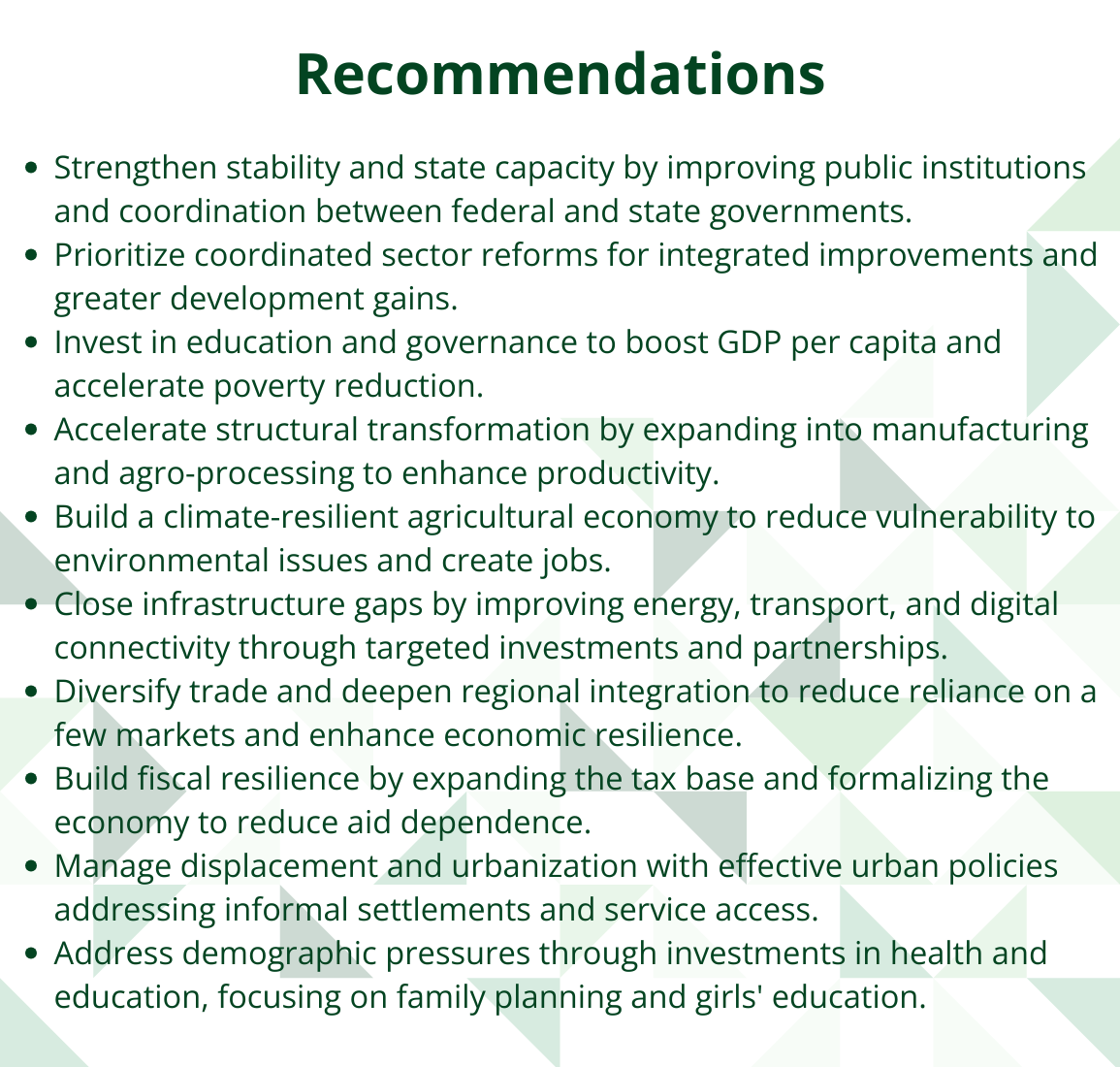
Page information
Contact at AFI team is Michelle van Rooyen
This entry was last updated on 15 June 2026 using IFs v8.58.
Donors and sponsors


Reuse our work
- All visualizations, data, and text produced by African Futures are completely open access under the Creative Commons BY license. You have the permission to use, distribute, and reproduce these in any medium, provided the source and authors are credited.
- The data produced by third parties and made available by African Futures is subject to the license terms from the original third-party authors. We will always indicate the original source of the data in our documentation, so you should always check the license of any such third-party data before use and redistribution.
- All of our charts can be embedded in any site.
Cite this research
Michelle van Rooyen (2026) Somalia Development Futures. Published online at futures.issafrica.org. Retrieved from https://futures.issafrica.org/geographic/countries/somalia/ [Online Resource] Updated 15 June 2026.