Why AI rivalry may actually make the world safer

Preventing an AI crisis requires US-China cooperation and effective governance of companies such as OpenAI.
The African Futures and Innovation (AFI) programme is again updating its forecasts of alternative global futures and their implications for Africa. AFI's four illustrative scenarios, Sustainable World, Divided World, World@War and Growth World, have become a widely used reference point for thinking about different global trajectories and how they could shape the continent’s future.
One recurring criticism of futures work is that it tends to underestimate the pace of global change, particularly advances in generative artificial intelligence (AI). Revisiting AFI's scenarios suggests that this criticism also applies to the programme’s work, particularly given the rapid pace of AI advancement.
In 2010, DeepMind was founded with the ambition to develop artificial general intelligence, systems capable of learning and reasoning across a wide range of tasks, rather than a specialised domain. At that point, AI could only reliably recognise a cat's picture under controlled conditions. Fast forward to April 2026, when Ukrainian officials announced that Russian soldiers had surrendered during an assault conducted entirely by unmanned ground robots and aerial drones, without Ukrainian infantry participating, reflecting the progress made with AI since 2010.
Fully autonomous battlefield systems that independently decide whom to kill are likely still a few years away, but are already being deployed in an environment where targets are clearly military, though still with human oversight. Ask ChatGPT, and it currently responds that, beyond 2035, fully autonomous battlefield systems capable of complex, adaptive operations over long periods may become common, given current rates of advances in AI, robotics, sensing and communications.
AFI’s global futures scenarios extend to 2050. By then, AI is likely to have advanced far beyond the capabilities of autonomous battlefield systems.
For some aspects of AI, recursive self-improvement appears increasingly plausible and, according to a recent forecast, could be realised in 2027, given current rates of acceleration. Recursive self-improvement is the process by which an AI system improves its own capabilities and then uses those improved capabilities to make itself even better, creating a feedback loop of accelerating improvement. The authors, a host of AI experts, describe the scenario as their ‘best guess’ of what AI in 2027 might look like. Even if their estimates are off by a year or three, the findings are alarming.
By 2027, they argue, AI could be well beyond the stage where it outperforms humans across most cognitive tasks and is capable of independently making scientific and engineering discoveries, although not in all domains. Recursive self-improvement could not only result in an ‘intelligence explosion’ but also means that AI development likely becomes highly nonlinear. Free of human control, these systems may develop and use coding languages that will become alien and incomprehensible to people, as human ability to understand what is being done trails behind.
By 2027, AI could be well beyond outperforming humans across most cognitive tasks and be capable of independently making scientific and engineering discoveries
One of AFI’s four future scenarios, the worst-case World@War scenario, tells a story of successive conflicts originating in the Middle East or elsewhere, but does not adequately account for AI systems outside human control. Military expenditure and inequality increase, and Africa’s GDP per capita and poverty reduction trends are flat or negative. For Africa, whose long-term development prospects largely depend on the stability of the international system, the trajectory of AI competition therefore matters far beyond the AI battlefield.
The World@War scenario is one in which war(s) are eventually waged by AI and in cyberspace, rather than on the physical battlefield, with unpredictable outcomes.
It has interesting effects: it facilitates China's more rapid regional and eventual global dominance as the country with the greatest material power potential well before 2050. Instead of China’s economy being 22% larger than the US economy in 2050 at market exchange rates, as in the business-as-usual forecast, it would be 60% larger in the World@War scenario. China is already around 28% larger in purchasing power terms.
The extent to which China’s growth translates into regional and later global dominance depends on various factors. The West could continue to dominate, but only if its system of alliances and partnerships survives the assault from the Trump administration, which, in this scenario, does not occur, implying a Sinocentric world order.
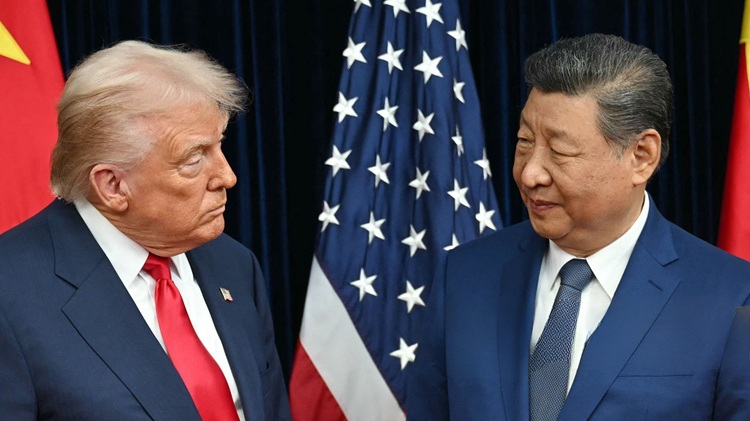
In this context, the realisation that the US and China are currently approaching AI parity is a positive development, given the need for the two superpowers to buy into any associated global governance arrangement. The US currently retains a narrow lead over China in frontier generative AI, particularly in the most advanced closed models, chips, cloud infrastructure and private investment. China, however, has largely caught up in model performance, leads in publication volume and patents, and is increasingly competitive in open-weight and lower-cost models. The time gap between the US and China in AI is estimated at 7 months (equivalent to a 2.7% difference in model performance), essentially reflecting parity.
Parity is likely a prerequisite for progress in AI governance when one considers the history of a previous global threat, nuclear weapons, which were used only when a single country possessed them. Once the former USSR achieved parity with the US, the threat of mutually assured destruction prevented its further use, even during the Cuban Missile Crisis. Shaken by the extent of the nuclear threat to humanity, and at the height of the threat of mutual assured destruction, the two global protagonists eventually negotiated and established a system of nonproliferation (supported by treaties such as the Nonproliferation Treaty) and oversight (particularly through the International Atomic Energy Agency) that has stood the test of time, although current prospects are perhaps less promising.
Parity is likely a prerequisite for progress in AI governance when one considers the history of a previous global threat, nuclear weapons
According to some, the potential destructive effects of AI are similar to those of nuclear weapons, and the pathways to control proliferation are the same, starting with the involvement of the AI superpowers, the US and China. Already, at the time of the release of Claude Mythos, Anthropic expressed concern that ‘AI models have reached a level of coding capability where they can surpass all but the most skilled humans at finding and exploiting software vulnerabilities.’ The challenge is that effective governance may only follow a major AI crisis, at which point the genie may be out of the bottle, as open-source generative AI will shortly be able to self-improve and self-generate, with no way to switch it off.
This leads to a second key consideration: the need to end open AI systems, such as those pursued by the company OpenAI. Nominally, open AI models (which can be downloaded and modified) promote transparency, innovation and wider access to the technology. Yet as frontier capabilities advance, these benefits increasingly need to be weighed against the security risks posed by unrestricted access to highly capable systems. Open systems allow anyone to own, modify and further develop their own system.
Just think of the effect if tomorrow's Al Qaeda develops its own upgraded version of the Mythos or Claude Code models. Proprietary systems, on the other hand, mean that someone has a kill switch, normally the developer or owner, who therefore has global control over their deployment.
While proprietary control also raises important governance concerns, it creates a focal point for accountability and intervention—something that unrestricted open-weight frontier models inherently lack.
Mythos could apparently undermine the entire internet and bring the global economy to a standstill. Such were the concerns that the US government temporarily blocked its export, but then relented, fearing it would cede its remaining narrow technological lead to China. So-called open-weight AI models are particularly problematic because the trained parameters (the “weights”) are publicly released, allowing users to download and run the software themselves.
The third and perhaps most difficult element is strengthening accountability of private companies such as OpenAI, given their ownership structures, extraordinary concentration of technological power, financial muscle and, in this case, the absence of standard corporate good governance mechanisms. More fundamentally, OpenAI exemplifies a broader governance question: whether decisions about developing and deploying technologies with potentially global consequences can be left in private hands.
A broader governance question is whether decisions about developing and deploying technologies with potentially global consequences can be left in private hands
Irrespective of the future scenario that unfolds, there can be no more urgent challenge than making humanity safe for AI. The patchwork of frameworks from the United Nations, the Group of 7 (G7), the Organisation for Economic Co-operation and Development (OECD), the Council of Europe and the European Union will struggle to establish a mandatory global regulatory regime without the US and China on board. Without their full commitment and energetic pursuit of AI regulation and control worldwide, increasingly capable AI systems like Anthropic’s Claude Code could threaten the global economy and the international environment on which Africa’s long-term development depends.
Image: BrianPenny/Pixabay
Republication of our Africa Tomorrow articles only with permission. Contact us for any enquiries.