Toward a “mini-polar” future: where do Africa and Europe stand?

Listen to this article
In 2050, the world will be warmer, older, more African, less European–and yet not fully multipolar.

The world order is undergoing a fundamental transformation. In 2022, former German Chancellor Olaf Scholz asserted that the world following Russia’s invasion of Ukraine faced a ‘Zeitenwende: an epochal tectonic shift.’ Chinese President Xi Jinping often extols geopolitical ‘changes unseen in a century.’ And in a recent speech, Director General of the African Union Commission, Fathallah Sijilmassi, declared, ‘We have come to hold the pen. And to build the new world order, and to contribute to building the new world order, while the plans are still on the table.’
These statements raise as many questions as they answer. What direction is the world order turning? How is it changing? What exactly is being built? Which implications does this dynamic have for Europe, Africa and their relations? To look clearly ahead, we must first look at the past.
The past
Rewind to 1975. The world order—defined by Cold War competition between the United States (US) and the Soviet Union—was bipolar, but unevenly so: the US held a clear edge over the Soviet Union in terms of its economic, military, demographic and technological foundations for national power, a shorthand term describing the capacity a country has to influence the actions of others as well as resist others’ influence. The American economy was nearly double the size of the Soviet economy. Soviet figures are difficult to verify, but one estimate for 1975 would convert to roughly US$250 billion in 2023. Again, the US spent more than double on the military without placing great strain on its economy. While the Soviet population was larger than the US population, it was also older and had a lower life expectancy.
Geopolitically aligned with the US, the combined power of Western Europe—that is, the total sum of its countries’ economic, military and other capabilities—ranked third in the global hierarchy behind the US and the Soviet Union. It possessed strong colonial-era ties that shaped Africa’s economic life, for example, with nearly two-thirds of the continent’s imports coming from Europe. In terms of demographics, Europe comprised roughly one-sixth of the world’s population, while Africa comprised roughly one-tenth. The median age in Europe was just over 30 years old; in Africa, it was roughly 16.
Despite its prowess today, China meanwhile was still focused primarily on maintaining internal order amid the tail end of its Cultural Revolution, with a large share of its meagre (by comparison) roughly US$20 billion defence budget being allocated to internal security. Likewise, China had barely begun to expand its influence abroad, with the exception of the Tazara railway line in Tanzania, which connects the country to Zambia as part of a broader strategy of political solidarity and development cooperation with Africa.
By 2000, that order had inverted. The Soviet collapse had left the US as the sole superpower in a context where, as announced by President George H.W. Bush on 11 September 1990, a “new world order” could emerge. Eleven years to the day afterwards, that suddenly seemed naïve, but at the turn of the millennium, the world remained unipolar, with an unrivalled American economy and military.
Below that top tier of the international order, however, China had quietly closed the gap with Germany, France, Britain and Japan. Russia, meanwhile, had ceased to be a top influencer in any single African country, and Britain's global footprint contracted sharply.
The fleeting American moment passed. By 2025, China’s economic, military and technological rise had become impossible to ignore, even while its population peaked. The US still clearly possessed more national power than any other country in the world, including by spending roughly triple on its military relative to the Chinese, but its lead over China had shrunk substantially and was smaller than the gap between the US and the Soviet Union amid the Cold War. India’s rise was also undeniable, owing in large part to a massive demographic tailwind where the dependency ratio of elderly and youth to working-age individuals continued to decline (while rising in much of the West), with its national power approaching parity with top European powers.
Africa’s diversification of its economic, political and security ties meant that the colonial powers of Europe were steadily displaced by China, which, by 2025, was a source of more than one-fifth of Africa’s goods imports, as well as by a fast-growing Middle Eastern diplomatic presence, particularly in East Africa. Some consider this to be a world on the brink of multipolarity, though its bipolar traits are strong enough to foster rhetoric about a potential “New Cold War.”
The future
Where the world may be headed in the coming decades is unknowable in specific, micro-level detail. Yet at the macro level, a few things are relatively certain: in 2050, the world will be warmer, older, more African, and less European.
A quarter century from now, long-term projections of fertility, mortality and migration suggest that roughly one in fourteen people on the planet will be European, with the median age in the late 40s. Roughly one in four people will be African, with the median age in the mid-20s. Still, given present-day advantages and extraordinary human capital, we can expect Europe to account for one-sixth of global economic activity by 2050, the US for roughly one-fifth and still-rising (if slowly) China for around one-quarter. Despite lacking comprehensive national power, as individual African consumers gain purchasing power, the continent is likely to become a market characterised by increasing competition and rapid growth. Dynamic projections of aid, trade and arms patterns, as well as of diplomatic engagement, suggest China will gain influence in Nigeria and Ethiopia while the EU and the US hold their ground in Egypt and South Africa, for example.
Militarily, on a global scale, the US military is expected to further dominate, with a budget exceeding US$1.1 trillion in today’s dollars. China is forecast to spend roughly US$800 billion on its military, Western Europe around US$500 billion, and Russia about as much as it did in 2025, around US$150 billion.
Collectively, these and other data points paint a picture of a “mini-polar” world: a world order which is largely a bipolar competition between the US and China, though with one bloc (the EU) and one country (India) likely possessing enough power to shape geopolitics within their immediate geographic regions and, more broadly, on issues such as digital sovereignty where they invest considerable resources. Beyond that, the distribution of power will be more diffuse. Small powers are unlikely to consolidate into large poles or spheres of influence, but could make it more difficult for others’ plans, especially given massive increases in military spending. (For example, Nigeria’s military expenditures are forecast to more than triple in real terms over the next 25 years.) No new actor is likely to replace the leading powers, but neither can they be ignored.
The present
Of course, none of what may come is fixed. Present policies may make alternative futures more likely—such as a more closed US or Europe in terms of migration or trade, accelerating their respective declines in national power and thus accelerating the rise of China and the Global South, yet also rising powers in Africa, particularly Nigeria.
Whether mini-poles—the EU and India—can amount to that status is also a question of governance. In India’s case, domestic governance remains a concern as the world’s largest democracy struggles to achieve unity. In the EU’s case, collective governance that drives coherent and consistent foreign policy is necessary to ensure it can leverage the full weight of its member states’ collective national power. Think of a team of horses pulling in the same direction versus pulling in different directions. The former can achieve extraordinary things. The latter can tear whatever it is pulling apart.
By 2050, Africa’s favourable demographics alone will likely not be enough to achieve even the status of mini-pole for any of its individual countries or a collective African Union. The continent’s militaries and technologies today are too far behind, and its economy is much too small. Yet the continent’s leaders can leverage their countries’ increased power to strike more favourable partnerships with Europe, leaning on one another to facilitate Africa’s rise while arresting Europe’s decline. They can also look to India—a potential kingmaker in a close bipolar competition between the US and China, and a country which fully appreciates the scars of colonialism. The African Union faces a similar challenge as the EU to act collectively and coherently, though it has much farther to go than its continental counterpart to the north.
Africa is unlikely to achieve mini-pole status, yet the continent’s leaders can leverage their countries’ increased power to strike more favourable partnerships with Europe
An alternative future, which continues recent policies of economic confrontation and actual war, which advances nationalist rhetoric, and which treats migration almost solely as a threat rather than as a potential opportunity if managed correctly, is likely to be one of disarray. It is a bleak picture.
The emerging world order is unlikely to resemble either the Cold War or the brief era of American unipolarity. It will instead be defined by two global poles, a handful of mini-poles, and a growing number of states—including many in Africa—with greater room to shape outcomes than at any point in recent history. Whether that produces greater cooperation or greater rivalry depends less on structural trends than on the political choices governments make today.
The forecasts were done using version 8.72 of the International Futures forecasting platform.
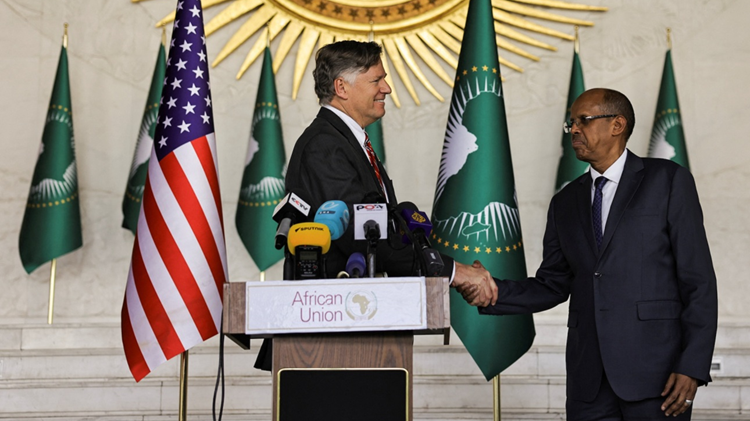
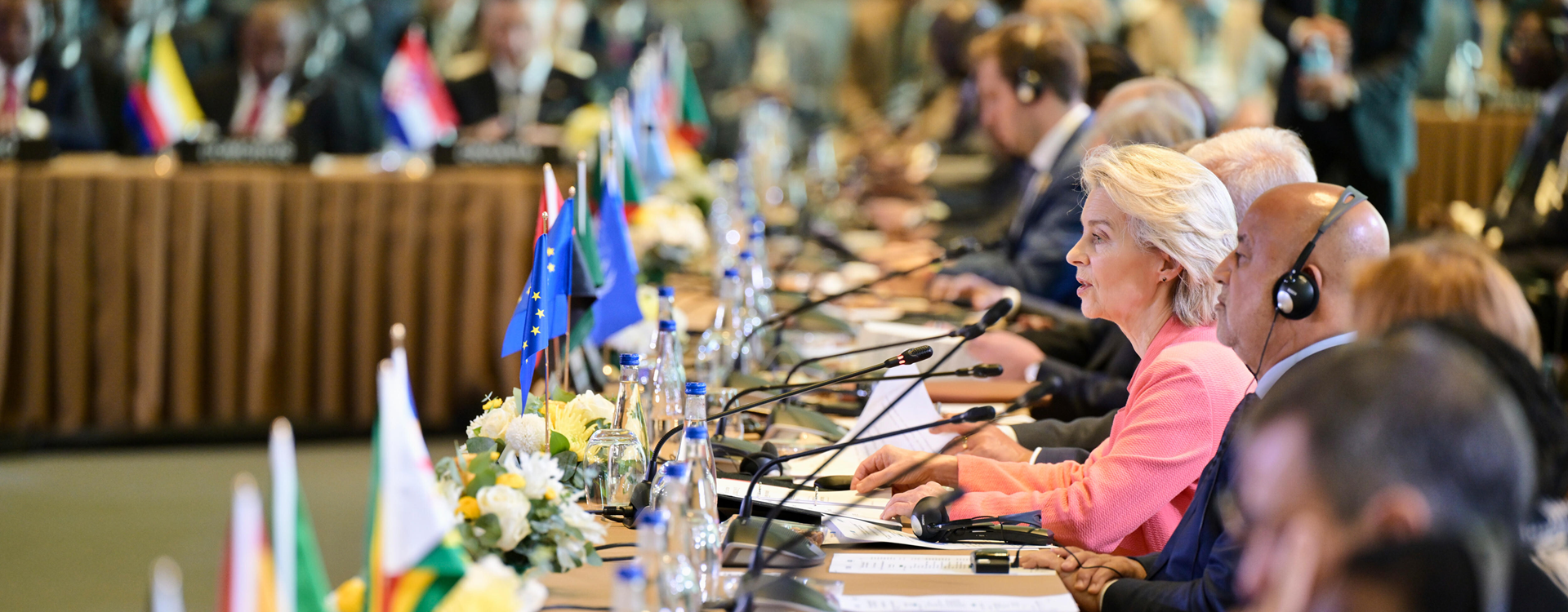
Image: picture alliance / Hans Lucas | POOL UNION EUROPEENNE / AGENCE HANS LUCAS
Picture description: Over the last 25 years, the leaders of the European Union and the African Union have built a partnership and discussed cooperation to jointly face future challenges, as they did at the seventh EU-AU Summit in Luanda, Angola on 24 November 2025.
Republication only with permission. Contact us for any enquiries.
This article is part of the Spotlight series in the project, The Future of African-European Relations.
The Future of African-European Relations project examines how the two regions can build stronger partnerships in an era of geopolitical fragmentation, economic competition and changing global power dynamics. It is a collaboration between the African Futures & Innovation Programme at the Institute for Security Studies (ISS), the Federation of German Industries (BDI), the Hanns Seidel Foundation and the Megatrends Afrika consortium, comprising the German Institute for International and Security Affairs (SWP), the German Institute of Development and Sustainability (IDOS) and the Kiel Institute for the World Economy. Drawing on the expertise, research and analytical frameworks of the participating institutions, the project explores how different global futures could shape trade, investment, development cooperation and shared prosperity between Africa and Europe - and it aims to develop policy recommendations for different stakeholders.
Disclaimer: Opinions expressed reflect the views of authors, not necessarily those of the organisations partnering in the project, The Future of African-European Relations.