Africa cannot afford a security-first world
As conflict and military spending rise, Africa will bear the costs of global insecurity while much-needed development and reforms are pushed aside.
Much of today’s foreign policy debate is centred on the fate of the rules-based international order. Should it be defended, reformed, replaced or reimagined for a more multipolar world? These are necessary debates. Yet the cost of failure is less often confronted.
Much of today’s foreign policy debate is centred on the fate of the rules-based international order, yet the cost of failure is less often confronted
That cost is already visible. The World Bank warns that the Middle East conflict is expected to slow global growth to the lowest rate since COVID-19, driven by higher energy prices, steeper inflation and increased borrowing costs. UNDP estimates that military escalation in the region could push more than 30 million people into poverty across 162 countries. At the same time, OECD preliminary data show that official development assistance fell by 23.1% in 2025, the largest annual contraction on record.
These pressures are not confined to battlefields. They move through resource prices, fertiliser markets, food systems, debt, aid budgets, climate adaptation and political attention. Development becomes easier to defer precisely when it is most needed.
As marginal players globally, African countries inevitably have little effect on the course of events that lead to international tensions and war. Most have less fiscal room than other countries. The result is not only greater exposure to insecurity, but a narrowing of development space: poverty reduction, climate adaptation, energy access and institutional reform become easier to postpone in the name of crisis management.
To illustrate the risk, AFI draws on forecasts from one of four global scenarios, modelled under the Africa in the World theme: World@War, Growth World, Divided World and Sustainable World.
World@War is the worst-case scenario for everyone, as overall gains are lowest. Rather than a single war, this is a story of successive conflicts likely originating in the Middle East, followed by successive regional conflicts elsewhere, such as in Europe, Asia, Africa and South America. Military expenditures and inequality increase. World@War shows what the African continent stands to lose when hard security crowds out development, climate resilience and institutional reform.
In the World@War scenario, global military expenditure will rise from US$2.3 trillion in 2025 to US$9.0 trillion by 2050, more than double the US$4.4 trillion projected under the Sustainable World.
The issue is not only the size of that expenditure, but more importantly, the international environment that accompanies a security-first approach. Africa’s development prospects depend on geopolitical stability, affordable finance, functioning trade systems, investment and the policy space to pursue long-term transformation. When hard security dominates, these conditions weaken. Fiscal pressure deepens, concessional finance becomes harder to sustain, climate adaptation is delayed and institutional reform is treated as secondary to crisis management.
The development consequences are starkly visible when considering that the World@War scenario will result in a world economy that is US$77 trillion smaller in 2050 than in a best-case Sustainable World, with Africa growing particularly slowly despite its much larger population.
In the World@War scenario, Africa’s GDP per capita will be US$8 000 by 2050, meaning average output per person is almost 40% lower. A lower GDP per capita trajectory points to weaker domestic demand, a smaller taxable base, lower savings and investment potential, and slower progress towards the structural transformation needed to reduce poverty at scale. In development terms, World@War does not simply leave Africa poorer on average. It weakens the economic conditions that enable poverty reduction, resilience and long-term transformation.
As can be expected, the extreme poverty rate in Africa will also be the highest in the World@War scenario at 16%, equivalent to 267 million more Africans living in extreme poverty by 2050 than in the best-case Sustainable World.
This risk was also tested at a recent Futures Dialogue on multilateralism amid fragility and power shifts, convened by the Institute for Security Studies, the South African Institute of International Affairs and the Netherlands Ministry of Foreign Affairs. Using the African Futures framing of the four global scenarios, participants explored how international cooperation might evolve over the next two decades through the relationships among security, prosperity and values.
The Futures Dialogue recognised that under conditions of uncertainty and fragmentation, security becomes the non-negotiable concern, while prosperity and values become conditional, selective or deferred. That matters for Africa because insecurity is rarely produced solely by military threats. It is often intensified by exclusion, inequality, weak legitimacy, climate vulnerability and unresolved historical grievances. These are precisely the issues that will intensify with the World@War scenario.
The discussion reinforced a central point: security, prosperity and values cannot be treated as separate agendas. Across the scenarios, the question is not simply how the balance between them shifts, but what is lost when one priority crowds out the others.
Security, prosperity and values cannot be treated as separate agendas
This does not mean African countries can afford to underplay global insecurity. Rising conflict, geopolitical rivalry and shocks to trade, food, energy and finance will place real pressure on African states. Governments will need stronger defence, intelligence, border management, cyber capability and regional security cooperation. However, these investments will fail if they are treated as substitutes for development and resilience.
The lessons from the World@War scenario and the Futures Dialogue point to three priorities. First, African countries need to build resilience before external shocks become recurring domestic crises. That means making development central to security strategy, not treating it as a separate agenda to be postponed when risks rise. In practice, this requires protecting the public institutions, fiscal buffers and social systems that allow states to absorb pressure, while reducing the vulnerabilities that make global disruption so damaging, including high import dependence, weak domestic production capacity and limited room to respond when prices rise or supply chains break. That will be politically difficult in a more insecure world, but it is non-negotiable. Without these foundations, more security spending will not produce greater stability.
Second, African countries cannot build resilience one border at a time. Conflict spillovers, illicit economies, displacement and shocks to trade and infrastructure all cross borders. Regional bodies and member states need to build the systems of cooperation before those shocks hit, from cross-border early warning and conflict prevention to coordinated border management and contingency planning for critical corridors.
Third, the domestic warning is that conflict and instability are not only signs of weak coercive capacity. They also show where development has failed to provide human security in everyday life, where services are unreliable, institutions lack credibility, opportunities are limited and trust in the state is weak. Military capability may contain violence for a time, but it cannot create the conditions for lasting stability.
For Africa, the danger is clear. A more conflict-driven global order will not only raise defence pressures but also divert political attention and resources from the development and reform that make societies more stable. Security without development is crisis management with a longer timeline. The task now is to ensure that, even as threats multiply, Africa’s development space does not become another casualty of global insecurity.
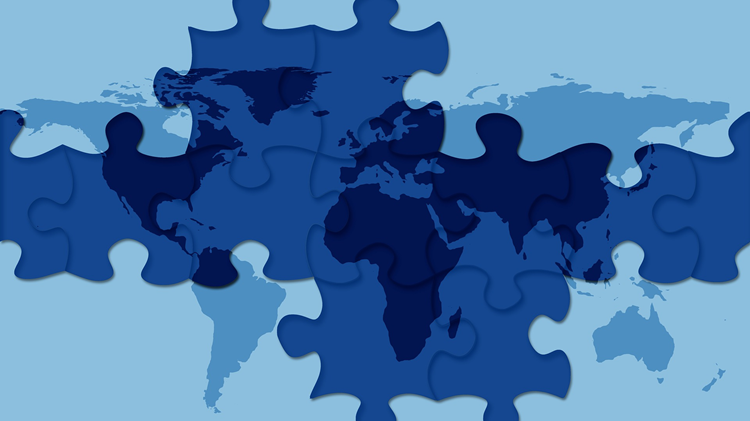
Image: geralt/Pixabay
Republication of our Africa Tomorrow articles is only with permission. Contact us for any enquiries.