 22 Africa’s Migration Futures
Feedback welcome
Our aim is to use the best data to inform our analysis. See our Technical page for information on the IFs forecasting platform. We appreciate your help and references for improvements via our feedback form.
This theme on migration in Africa examines movement within African countries, between African countries and between Africa and the rest of the world. It explores migration as both an outcome and a driver of development, shaped by demographic change, economic opportunity, conflict, climate pressures and migration policy. Drawing on historical and current evidence, it uses the International Futures (IFs) model to explore how African international migration could evolve under four global scenarios to 2050: Growth World, Sustainable World, Divided World and World at War. The analysis examines differences in the scale and geography of migration, including how regional migration systems shape outcomes across the continent.
For more information about the International Futures (IFs) modelling platform used for scenario development, please see the Technical page.
Summary
This theme report examines migration within African countries, international migration between African countries and international migration between Africa and the rest of the world. It combines historical and current migration evidence with scenario analysis using the International Futures (IFs) model to explore how African international migration could evolve under four global scenarios to 2050.
Migration is both an outcome and a driver of development. Internal migration within countries is a major part of Africa’s wider mobility landscape, including movement from rural areas to towns and cities as economies, livelihoods and labour markets change. International migration between African countries is also important, particularly through established labour, trade, family and circular migration systems. Forced displacement adds another major dimension: most people displaced by conflict, violence or disasters remain within their own countries. Refugees who cross an international border often move to neighbouring states. At the same time, some people facing strong pressures to move are unable to do so because they lack the resources, networks or opportunities required.
International migration represents only one part of this wider mobility landscape. In this report, international migration refers to movement across a national border. It is divided into intra-African international migration (between African countries) and off-continent international migration (from African countries to destinations outside Africa). In 2025, 52.5 million international migrants were African-born: close to 27 million lived elsewhere in Africa, and 25.6 million lived off the continent. African international migration is therefore relatively evenly divided between intra-African and off-continent destinations, although a modest majority of African international migrants remain within Africa.
Migration patterns are shaped by the interaction of demographic change, labour markets, economic opportunity, governance, conflict, climate pressures, regional integration and migration policy. Migration pressure does not necessarily translate into actual migration. People require resources, information, networks, legal pathways and functioning transport systems to move. Conflict, poverty and environmental stress can therefore increase the need to migrate while simultaneously reducing people’s ability to do so, producing internal displacement, short-distance movement and involuntary immobility rather than long-distance international migration.
Using the four global scenarios developed in the theme on Global Power Shifts, the Growth World produces the largest international migrant stock as greater household resources and international labour demand increase people’s ability to move. The Sustainable World produces the strongest shift towards intra-African migration as regional integration, freer movement and stronger African labour markets expand opportunities on the continent. The Divided World constrains movement through harder borders and weaker cooperation. At the same time, the World at War generates the greatest pressure to move but the smallest international migrant stock because conflict, falling incomes and disrupted routes severely constrain migration capability.
The scenarios, therefore, differ not only in the scale of international migration but also in its geography and the conditions under which movement occurs. Regional migration systems remain important: established corridors, geographic proximity, regional integration arrangements, labour markets and migrant networks shape how the same global scenario plays out differently across Northern, Eastern, Western, Central and Southern Africa.
Irrespective of the scenario that may unfold, policy priorities should include reducing forced displacement and involuntary immobility; expanding safe, regular and productive migration pathways; strengthening intra-African mobility and regional labour markets; protecting migrant workers; improving documentation and migration data; lowering remittance costs; and ensuring that migration governance supports, rather than undermines, Africa’s broader development and integration objectives.
All charts for Africa’s Migration Futures
- Chart 1: Migration outcomes shaped by aspirations and the capability to migrate
- Chart 2: A conceptual framework for the ‘Drivers of Migration’.
- Chart 3: Migration-Development transition model
- Chart 4: African-origin international migrant stock by destination region, 1990–2025
- Chart 5: Asylum-seekers, internally displaced people and refugees in Africa, 2000-2025
- Chart 6: Dimensions of the four global scenarios
-
Chart 7: Migration logic for the four global scenarios
Chart 7: Migration logic for the four global scenarios

- Chart 8: Global international migrant stock by scenario, 2025-2050
- Chart 9: African-origin international migrant stock by scenario, 2025–2050
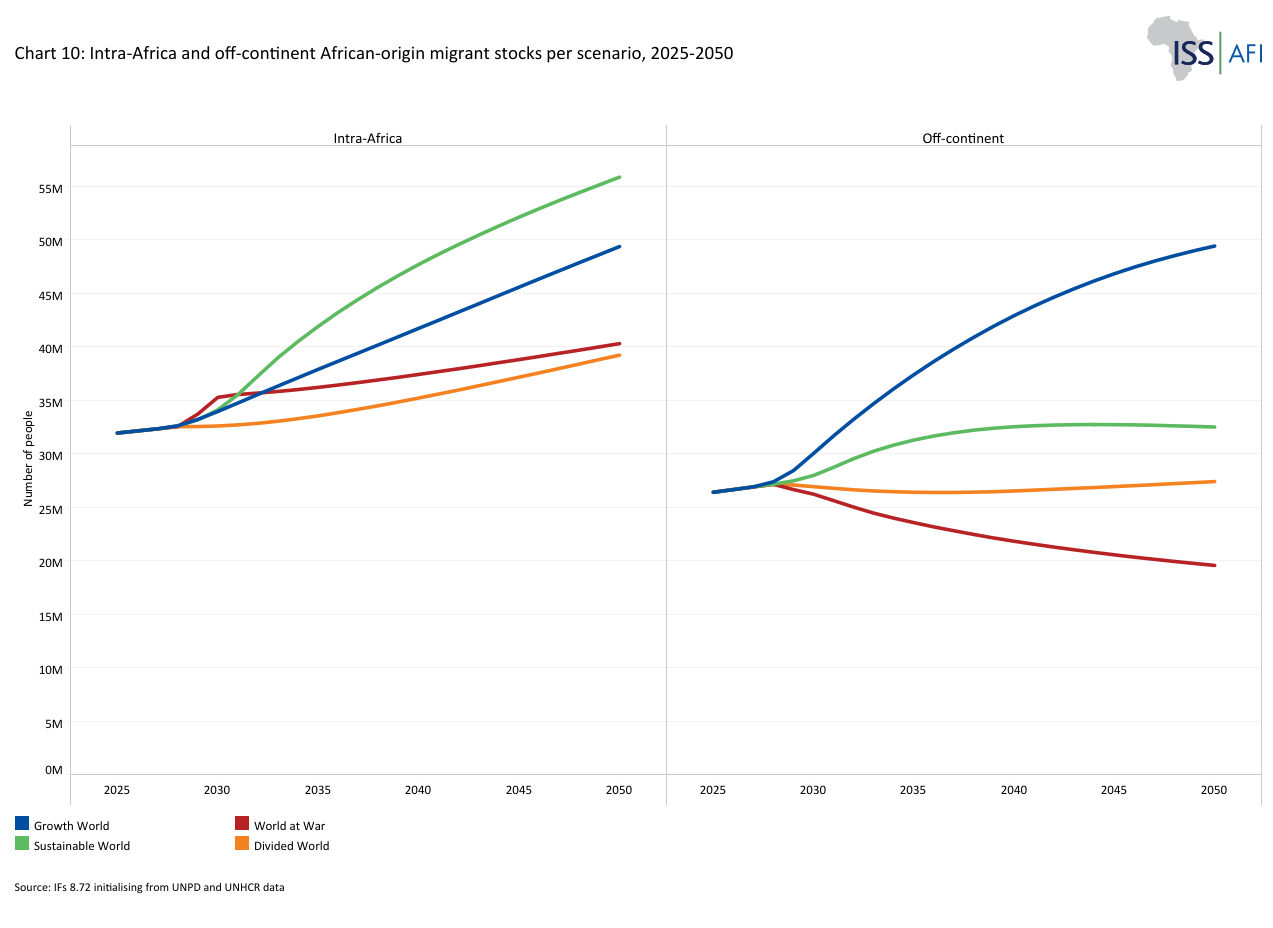
- Chart 10: Intra-Africa and off-continent African-origin migrant stocks per scenario, 2025-2050
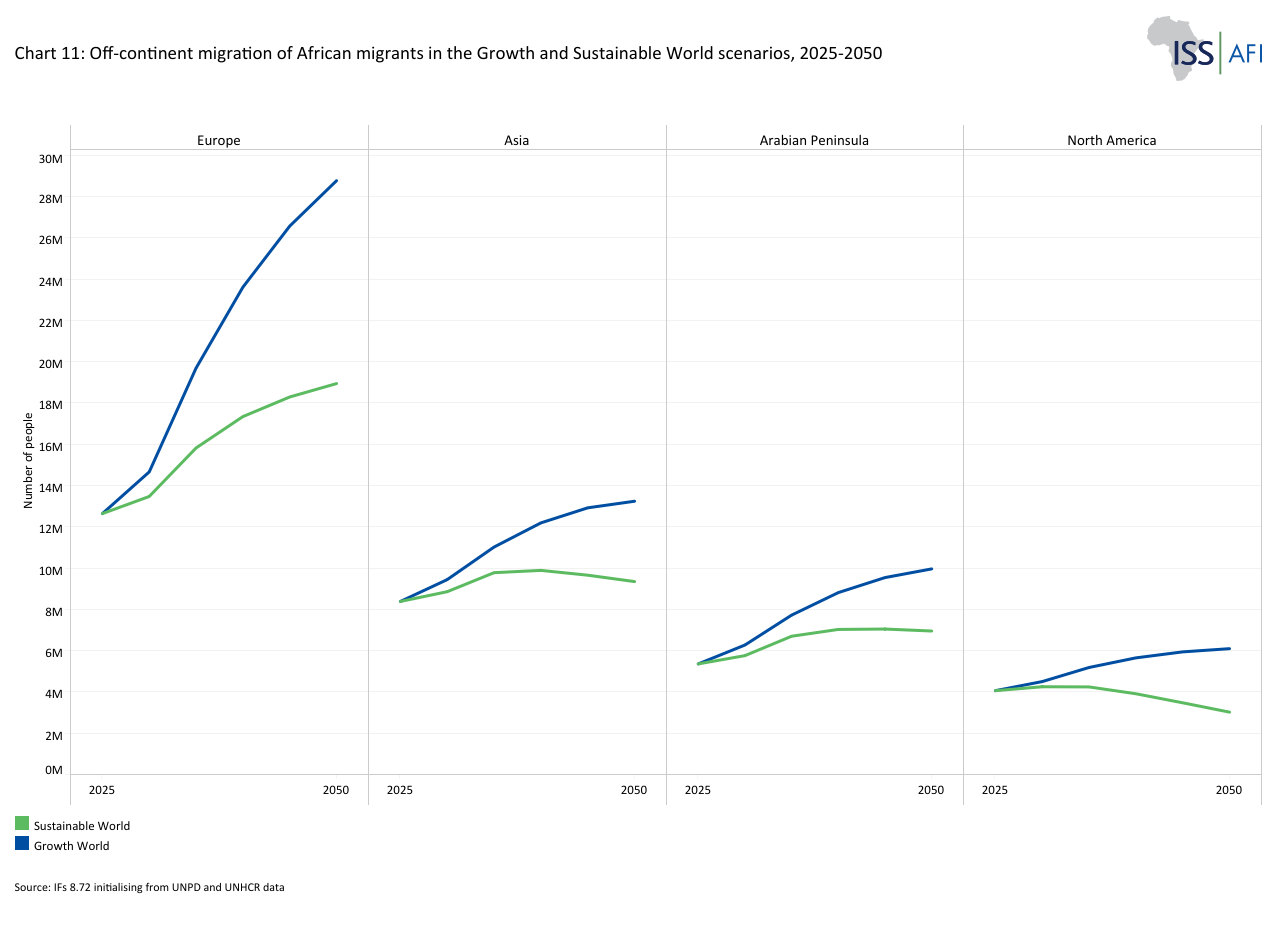
- Chart 11: Off-continent migration of African migrants in the Growth and Sustainable World scenarios, 2025-2050
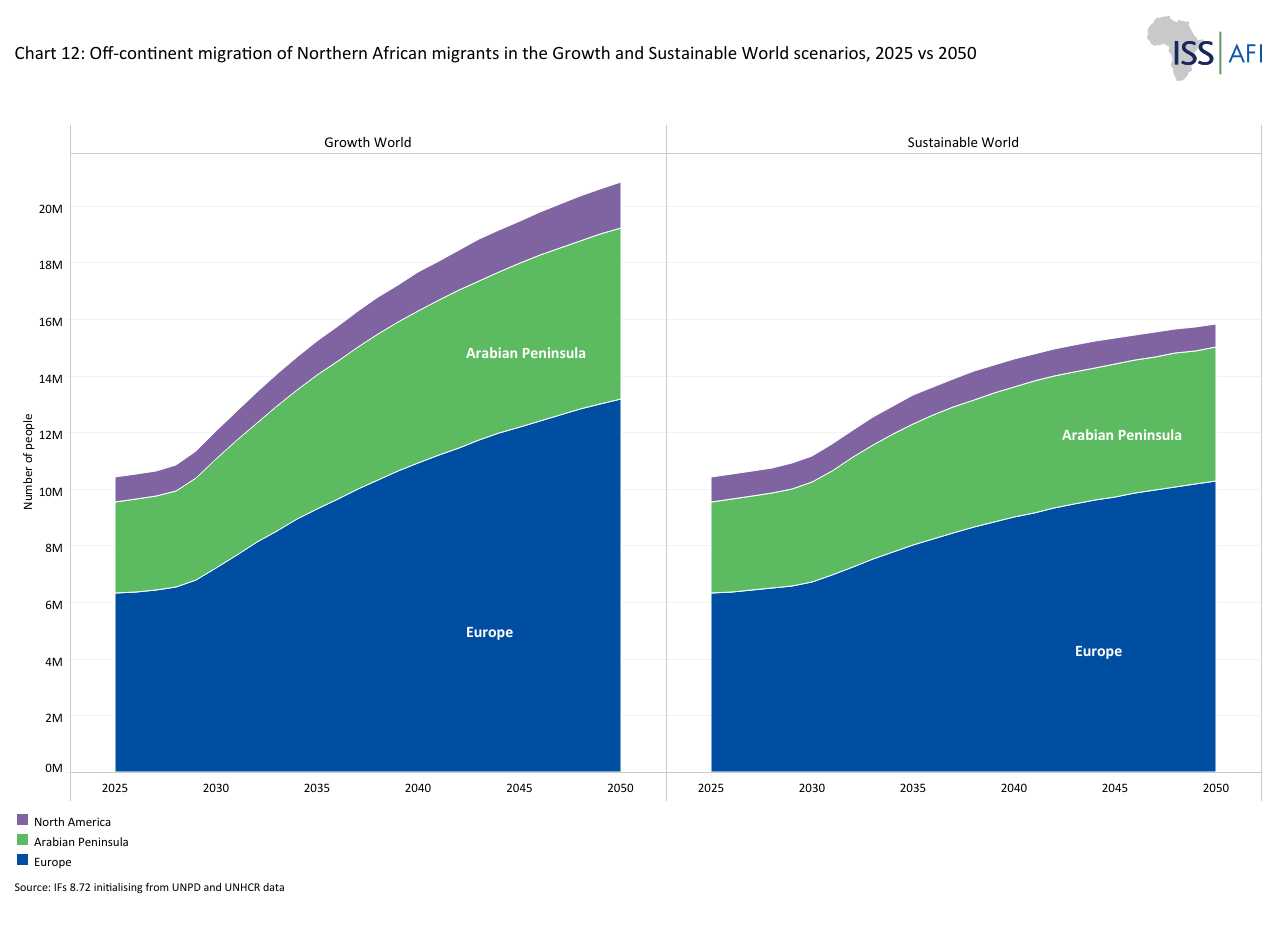
- Chart 12: Off-continent migration of Northern African migrants in the Growth and Sustainable World scenarios, 2025 vs 2050
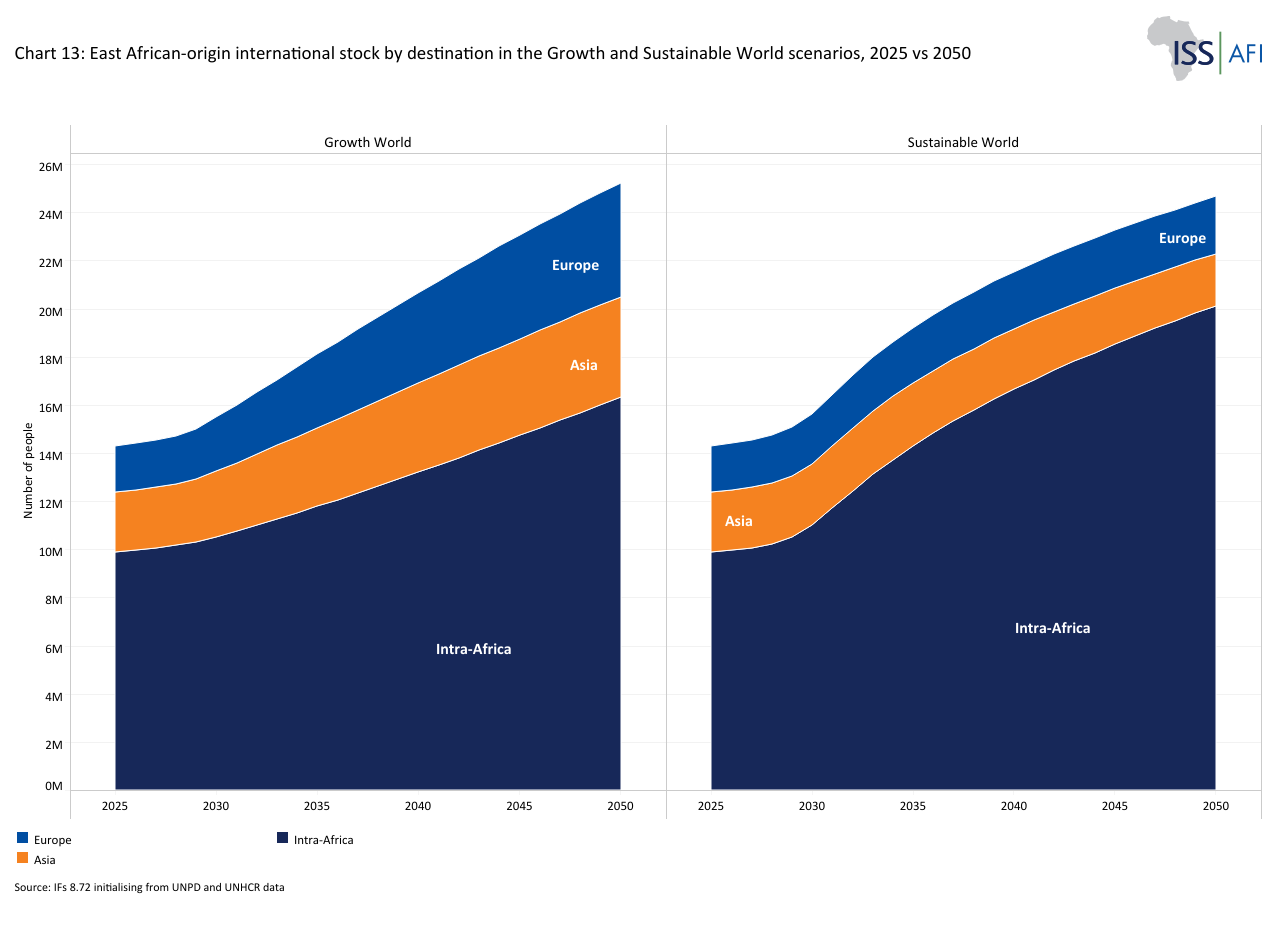
- Chart 13: East African-origin international stock by destination in the Growth and Sustainable World scenarios, 2025 vs 2050
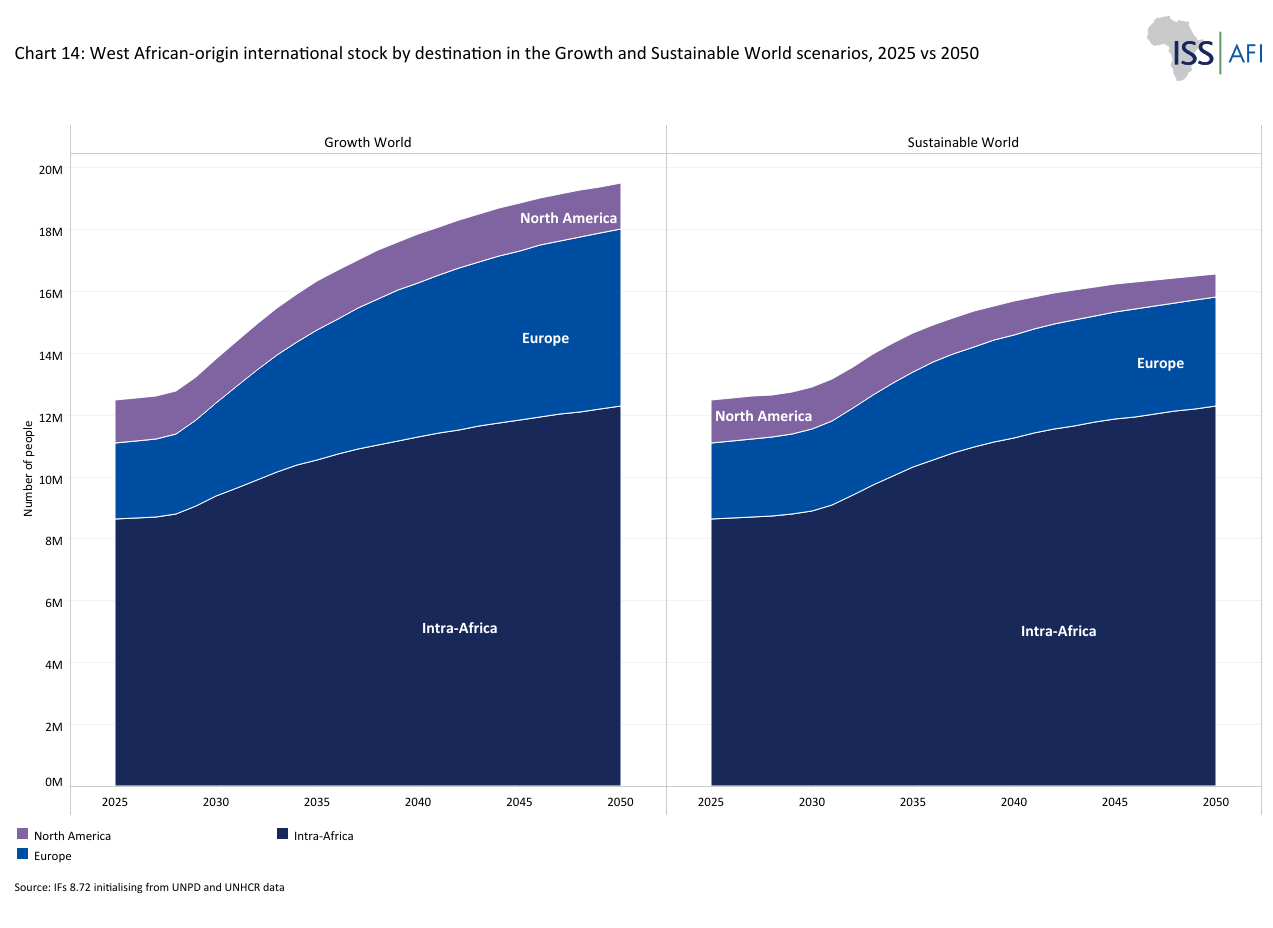
- Chart 14: West African-origin international stock by destination in the Growth and Sustainable World scenarios, 2025 vs 2050
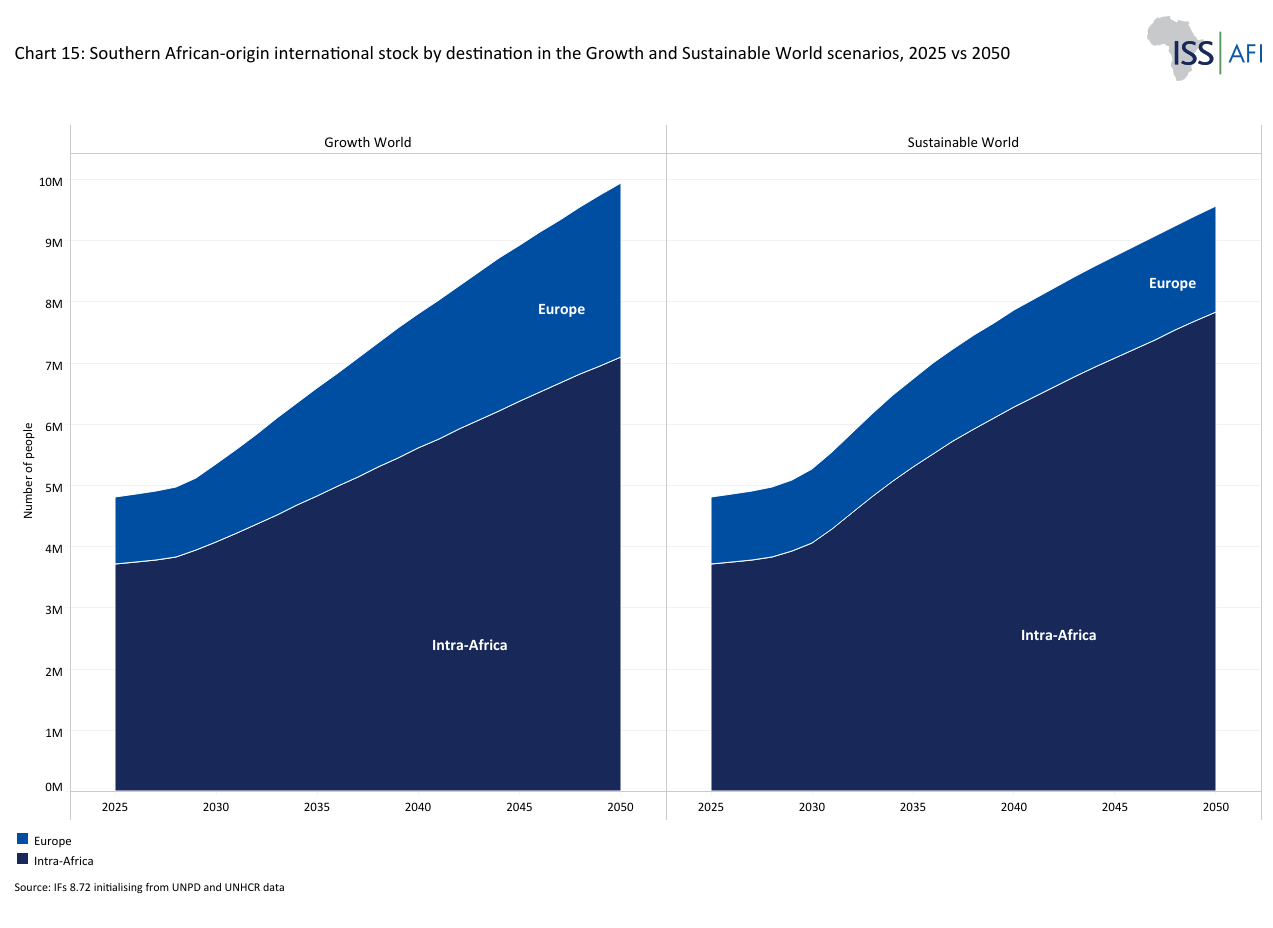
- Chart 15: Southern African-origin international stock by destination in the Growth and Sustainable World scenarios, 2025 vs 2050
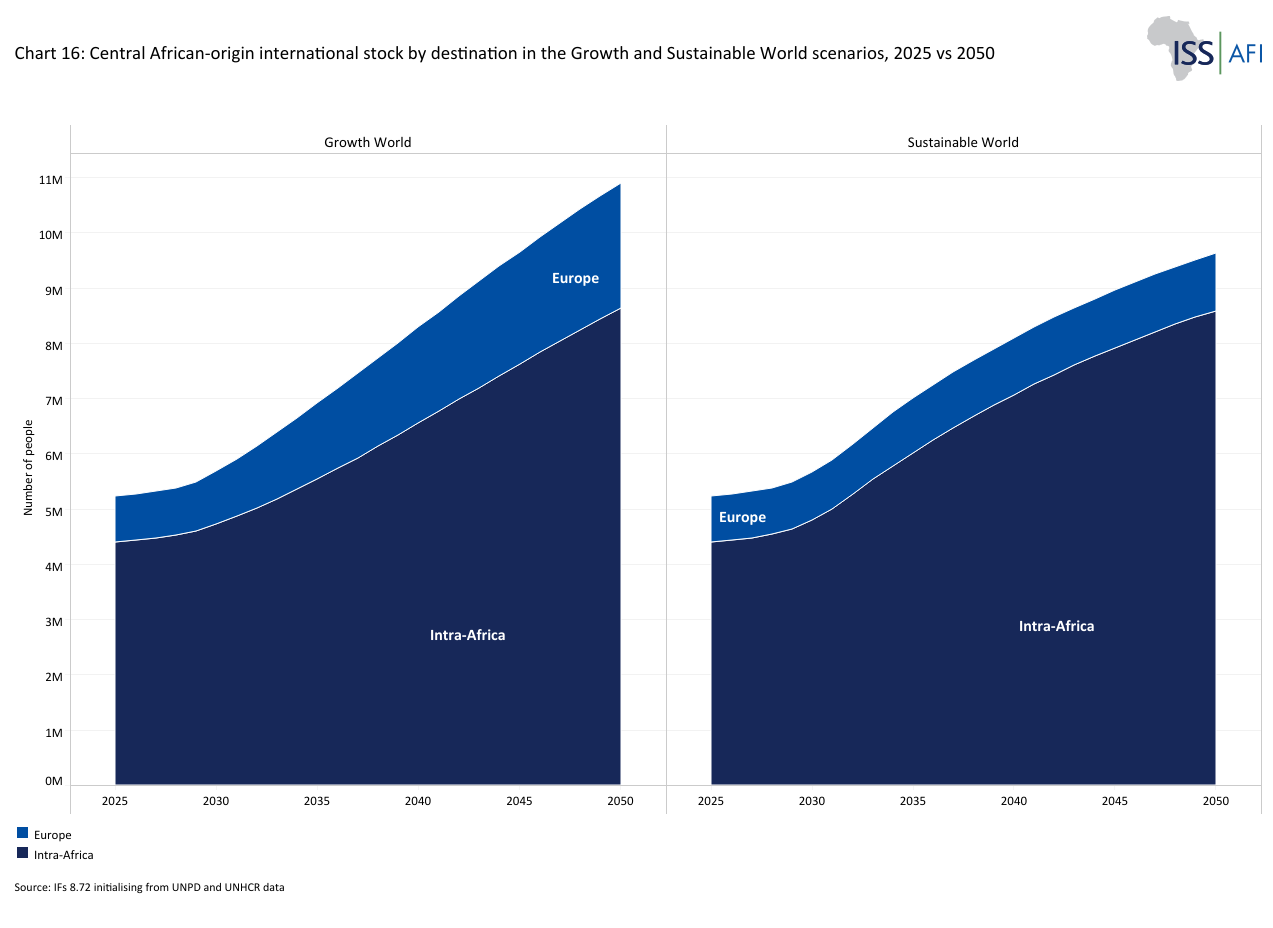
- Chart 16: Central African-origin international stock by destination in the Growth and Sustainable World scenarios, 2025 vs 2050
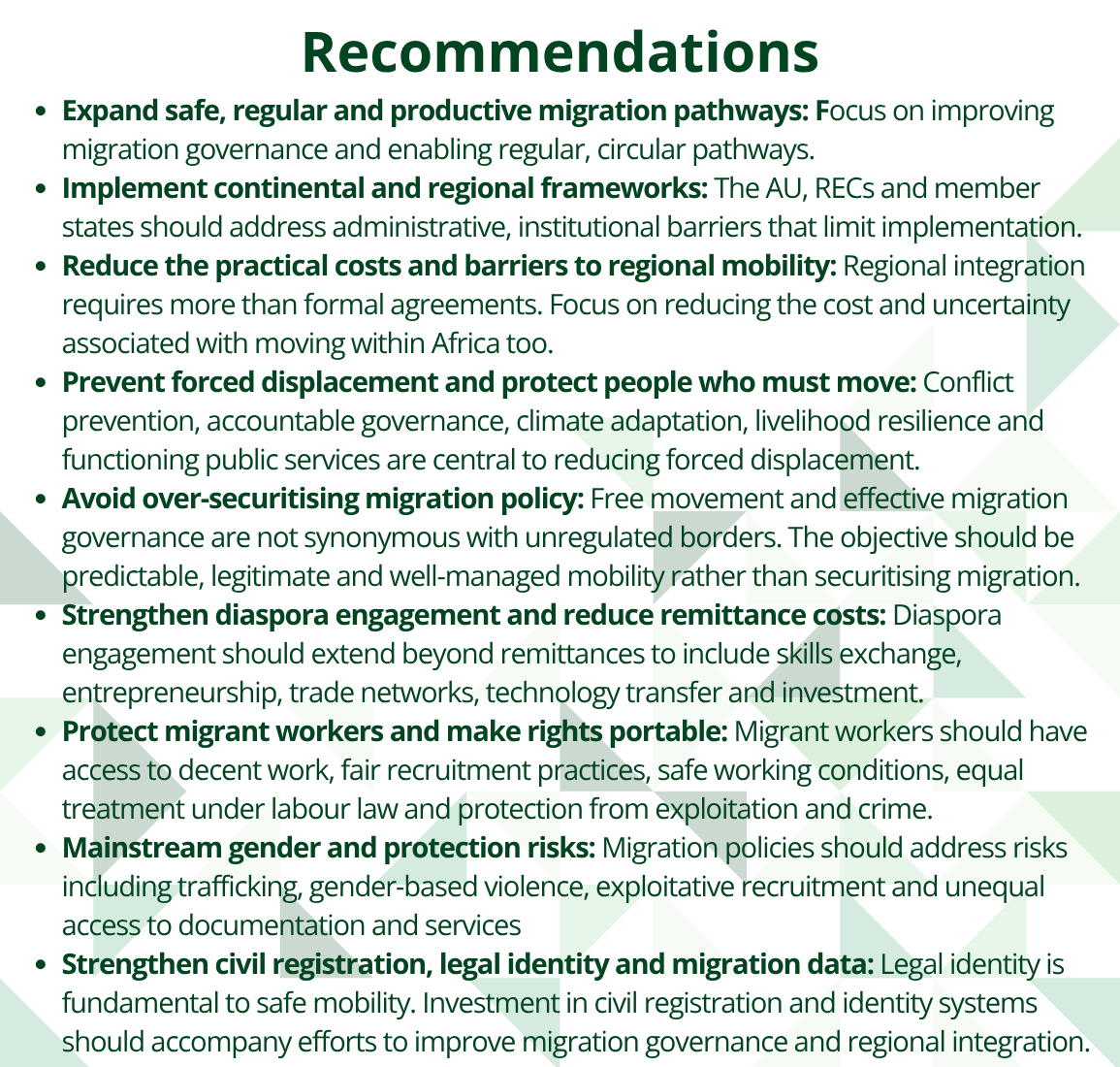
- Chart 17: Policy recommendations
Introduction: Migration and Africa’s Development Pathway
Download to pdfMigration is both an outcome and a driver of development. Across Africa, decisions to move, remain or return emerge from the interaction of demographic change, labour markets, governance, conflict, climate pressures and regional integration. Migration in turn influences labour allocation, remittances, urbanisation, productivity, inequality, human capital and economic integration.
Migration requires resources, networks and opportunities, meaning that those facing the greatest pressures, such as poverty and climate change, may often be unable to move. Africa’s wider mobility landscape, therefore, includes voluntary mobility, forced mobility and immobility, with people and households sometimes shifting from one category to another over time.
Although migration has become increasingly politicised, off-continent migration receives disproportionate attention. The broader African mobility landscape is shaped by substantial internal movement within countries, while intra-African migration between countries also plays an important role in established labour and livelihood systems. African international migration itself is relatively evenly divided between intra-African and off-continent destinations.
This theme examines migration as part of Africa’s broader development pathway. Internal migration refers to movement within a country’s borders, including rural-to-urban migration and movement between provinces or regions. International migration refers to movement across an international border. It consists of intra-African migration (movement between African countries) and off-continent migration (movement from African countries to destinations outside Africa). The International Futures (IFs) model quantifies international migrant flows and stocks.
Distinctions between types of migration are analytically important because they have different development, legal and political implications. Firstly, voluntary migration refers to movement primarily driven by the motivation to improve living conditions and expand opportunities, including employment, education, family reunification, social mobility and environmental pressures. Much African migration is voluntary and economically motivated, and a substantial share of documented international movement occurs through regular channels. The true scale of irregular (sometimes referred to as undocumented or illegal) migration is difficult to measure because administrative data capture it only partially. Migrants may also move between regular and irregular status during different stages of their journeys. Circular migration refers to repeated voluntary movements between origin and destination countries and can generate remittances, skills transfers and investment, while simultaneously helping destination countries address labour shortages. Internal migration, within the borders of a country, is the most prevalent form of mobility in Africa and is closely linked to structural transformation, urbanisation and changing labour markets.
Secondly, forced migration occurs when individuals are compelled to move due to conflict, violence, persecution, disasters or severe governance failures. It includes refugees, asylum seekers and internally displaced persons (IDPs), each recognised under specific international legal frameworks. Africa hosts some of the world’s largest displacement crises, many of which become protracted (5+ years) because return, local integration or resettlement opportunities remain limited.
Displaced populations often lose homes, livelihoods, documentation and access to education or healthcare, while large-scale displacement can place pressure on host communities, infrastructure and public services. They may nevertheless contribute economically when they are allowed to work, move freely and access markets. In practice, the distinction between voluntary and forced international migration is often blurred, as violence and insecurity frequently overlap with economic strain, food insecurity, climate stress and unsustainable livelihoods.
Thirdly, immobility refers to situations in which people remain in place despite deteriorating economic, political or environmental conditions, often because of limited resources, insufficient social networks, restrictive border systems or physical insecurity. Those with the greatest need to move are often the least able to do so safely and may become trapped in highly vulnerable conditions. Understanding immobility is important because development outcomes are also shaped by those who are unable to move, and migration policies that restrict movement can exacerbate forced immobility.
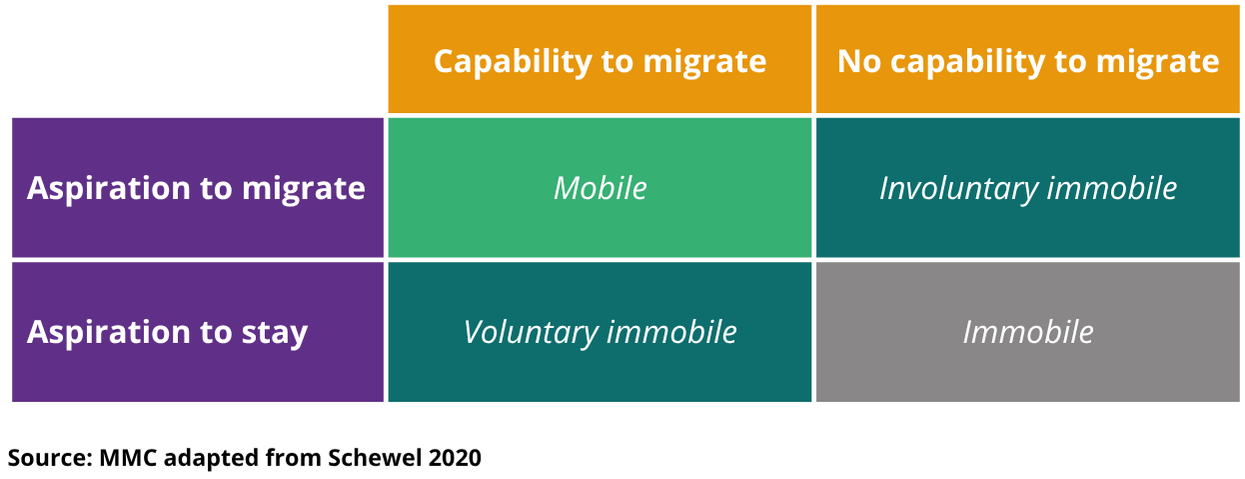
Migration aspiration refers to the desire or motivation to move, while migration capability refers to the practical resources, finances, networks and freedom required to actually migrate. Actual migration occurs only when a person has both the aspiration and capability. Chart 1 depicts how aspirations and the capability to migrate shape migration outcomes.
African migration patterns vary significantly across countries and subregions depending on historical systems, economic geography, governance quality, labour demand, transport infrastructure and conflict dynamics. Mobility reflects both efforts to improve livelihoods and responses to risk, shaped by access to resources, information, social networks and legal pathways. Migration systems in Africa are highly path-dependent: existing migrant communities, established trade corridors, linguistic ties, colonial relationships and family networks influence where people move. These network effects reduce the financial and social costs of migration, cumulatively reinforcing established corridors even when the original drivers weaken.
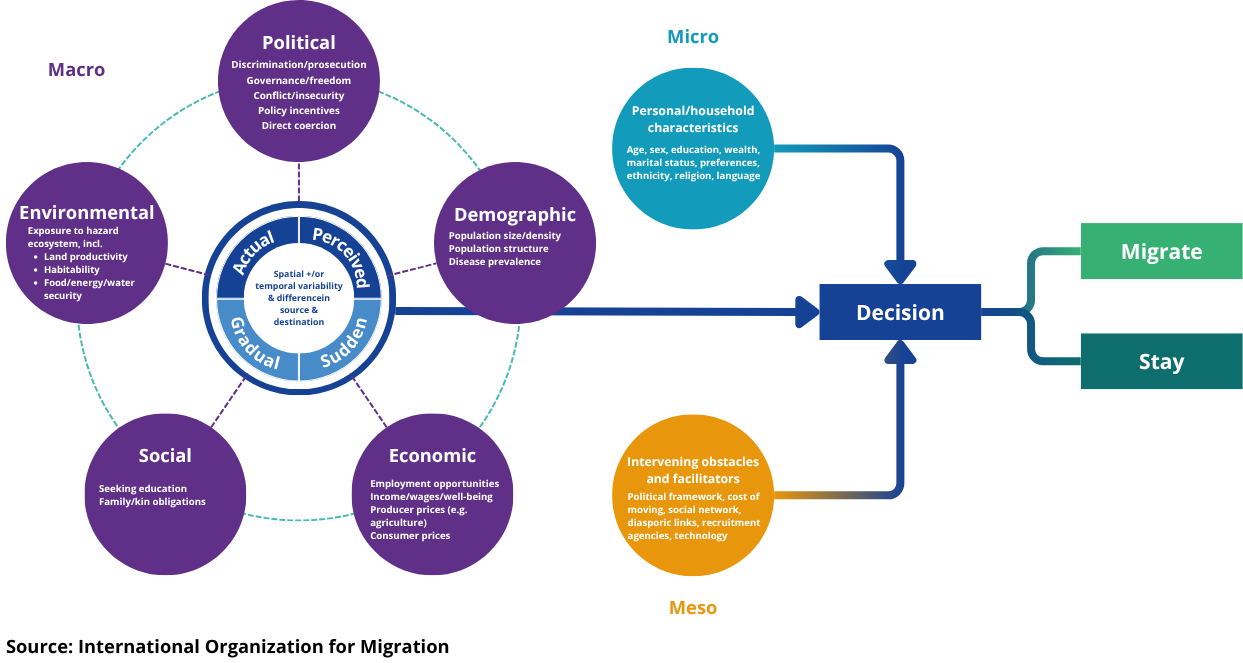
Migration frameworks often distinguish between “push” and “pull” factors. Push factors are conditions in the source country that encourage people to leave their places of origin, such as poverty, unemployment, insecurity or environmental stress. Pull factors are destination-country conditions that attract migrants, including wages, employment opportunities, security, education and social services. This push/pull framing can be applied at the macro- and micro-levels, reflected in Chart 2.
At the macro level, structural conditions such as economic growth, demographic change, governance quality, conflict and environmental pressures are among the biggest push factors. Economic stagnation, high unemployment and limited livelihood opportunities, particularly among youth, are among the most important drivers of migration across Africa. At the same time, differences in wages, labour demand and perceived economic opportunity are the strongest pull factors.
Governance and political conditions are strong push factors. Weak institutions, corruption, political exclusion, insecurity and conflict contribute to internal displacement and cross-border migration. In fragile and conflict-affected states, displacement often becomes protracted, with negative consequences for productivity, social cohesion and development.
Environmental pressures increasingly interact with these dynamics. Climate change affects migration indirectly through its impacts on agriculture, food security, water availability, livelihoods and conflict. Droughts, floods and environmental degradation can undermine household resilience and increase mobility pressures, particularly in rural and fragile regions. Environmental stress rarely acts as an isolated driver of migration; instead, it compounds existing fragilities and increases exposure to economic, political and social risks. Migration can also function as an adaptation strategy, enabling households to diversify livelihoods, spread risk and access alternative sources of income.
At the micro level, whether these wider pressures ultimately translate into migration depends on the circumstances and choices of individuals and households. Age, gender, education, skills, income, aspirations, family responsibilities and access to information all affect both the desire and the capacity to move. Migration, therefore, differs significantly between groups. Young adults, particularly those with some education and resources, are generally more likely to migrate than the poorest or oldest segments of society. Gender shapes aspirations and the capacity to move, as well as the routes, employment opportunities and risks available to migrants.
Between the macro and micro levels sits a range of meso-level conditions that can make migration more or less possible. These include migration policies and institutions, visa regimes, border controls, labour agreements, regional free-movement arrangements, asylum systems, recruitment channels, transport links, the costs of moving, access to finance and technology, and social and diaspora networks. These factors can facilitate movement, redirect it towards particular destinations or channels, or prevent it altogether. Digital communication platforms, mobile financial systems and social media also increasingly shape access to information and migrant networks.
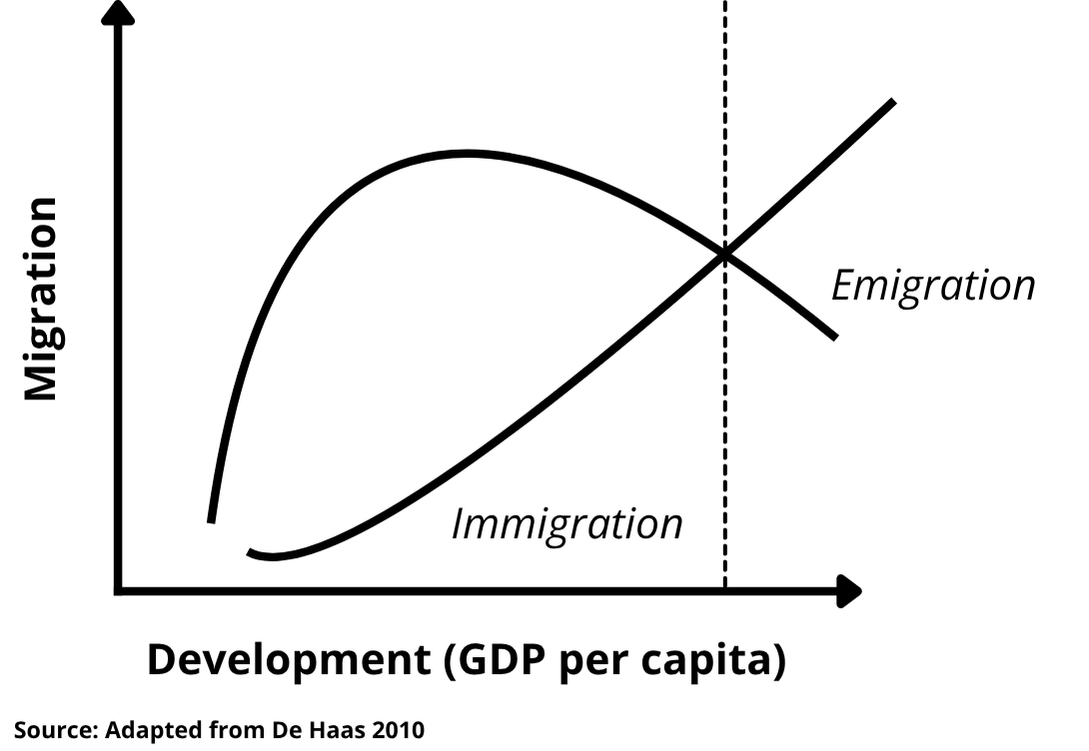
Migration and development are deeply interconnected. Although migration is often framed as a consequence of poverty or conflict, development does not necessarily reduce migration. Improvements in income, education, infrastructure and connectivity can reduce some of the pressures that compel people to move while simultaneously increasing their capacity and aspirations to do so. Migration may therefore initially increase as countries develop, before stabilising or declining as domestic opportunities expand further. This broad relationship is often described as the migration or mobility transition. It should not, however, be understood as an automatic or linear process: historical evidence from Africa shows that migration patterns have risen, fallen and changed direction as economic, demographic and political conditions have evolved. Chart 3 illustrates the migration-development transition model.
Africa is likely to remain within this transition for some time. Improvements in development and governance may reduce some distress-related pressures. Still, they are occurring alongside rapid population growth, a large young population, a vast expansion of the working-age population and the lowest existing mobility in the world. Many African economies are not yet creating sufficient productive employment to absorb this growing labour supply.
Migration remains an important mechanism through which workers and households respond to these differences in opportunity: within countries, between African countries and, for those with the resources and opportunities to do so, off-continent.
Internal migration is equally important to this development transition. As economies urbanise and diversify, workers move from rural areas and agriculture towards towns and cities and into manufacturing, services and informal urban employment. Africa’s urban population is projected to reach around 1.4 billion by 2050. This movement can support structural transformation by bringing labour closer to more productive activities and larger markets. Still, rapid urbanisation can also outpace job creation, housing, infrastructure and public-service provision, contributing to informal and precarious urban livelihoods. Migration is therefore not separate from Africa’s development transition; it is one of the mechanisms through which that transition occurs.
Migration can influence structural transformation by changing the distribution of labour, skills, capital and knowledge within and between economies. Migrants can fill labour and skills gaps, contribute to production and tax revenues, establish businesses and support productivity in destination countries. Globally, migrants are estimated to contribute around 10% of GDP, while research on African migration suggests that migrants spend approximately 85% of their incomes in destination countries.
For countries of origin, one of the most visible economic effects is through remittances. Africa received approximately US$95 billion in remittances in 2025, making these flows a stable source of external finance for the continent. While most originate outside Africa, intra-African transfers are increasingly important: around US$20 billion in 2023, or roughly one-fifth of Africa’s total remittance inflows, originated from within the continent. Remittances primarily support household consumption, food security, education, healthcare and housing, while also providing foreign exchange and helping some countries finance current-account deficits. Their contribution to longer-term structural transformation, however, depends partly on whether they can also be channelled into savings, investment and productive activity.
Migration can also facilitate the transfer of skills, knowledge and technology, while diaspora networks can strengthen trade and investment links between origin and destination countries. These effects are particularly relevant within Africa, where regional migration connects labour markets and supports cross-border commerce. Around 86% of employment on the continent is estimated to be informal, and informal cross-border trade is an important source of livelihoods, particularly for women and small-scale traders. UNECA estimates that informal cross-border trade accounts for 7–16% of all intra-African trade.
The effects are not uniformly positive. Emigration can reduce pressure in labour markets and allow workers to access opportunities unavailable at home. Still, sustained losses of scarce skills can weaken domestic capacity in sectors such as health, engineering and education. An estimated 70 000 skilled professionals leave Africa annually, although the scale and consequences of these losses differ substantially between countries and sectors. The movement of highly skilled workers can therefore generate both brain drain and opportunities for “brain circulation” through return migration, diaspora engagement and knowledge exchange.
The development impact of migration consequently depends not simply on how many people move, but on who moves, where they move, the conditions under which movement occurs and how migration is governed. Safe and regular mobility, recognition of qualifications, portable social protection, lower remittance costs and better links between migration and labour-market planning can increase its development benefits, while poorly governed or forced movement can expose migrants and communities to high social and economic costs.
These dynamics are central to Africa’s broader regional integration agenda. The AU’s Agenda 2063 envisages an integrated continent in which people, goods, services and capital can move more freely. The African Continental Free Trade Area (AfCFTA) advances this objective through greater economic and trade integration. The Protocol to the Treaty Establishing the African Economic Community Relating to Free Movement of Persons, Right of Residence and Right of Establishment (Free Movement Protocol) seeks to facilitate the movement, residence and establishment of African citizens. The two frameworks are legally distinct but complementary: deeper trade integration is likely to be more effective when traders, entrepreneurs, workers and service providers can also move more easily across borders.
Unlike the AfCFTA Agreement, which entered into force in 2019 and under which trading began in 2021, the Free Movement Protocol was adopted by the AU in 2018 but has not secured sufficient ratifications to enter into force.
Both political concerns and practical implementation challenges have constrained progress. Some governments remain concerned about sovereignty, border control, security and the possibility of large or poorly regulated migration flows. Others face practical constraints related to population registration and identity documentation, border management systems, recognition of qualifications, social security portability and the alignment of national migration and labour market regulations. The result is an important gap in Africa’s integration project: continental trade integration has advanced considerably further than continental free movement of people.
Africa’s Migration Profile
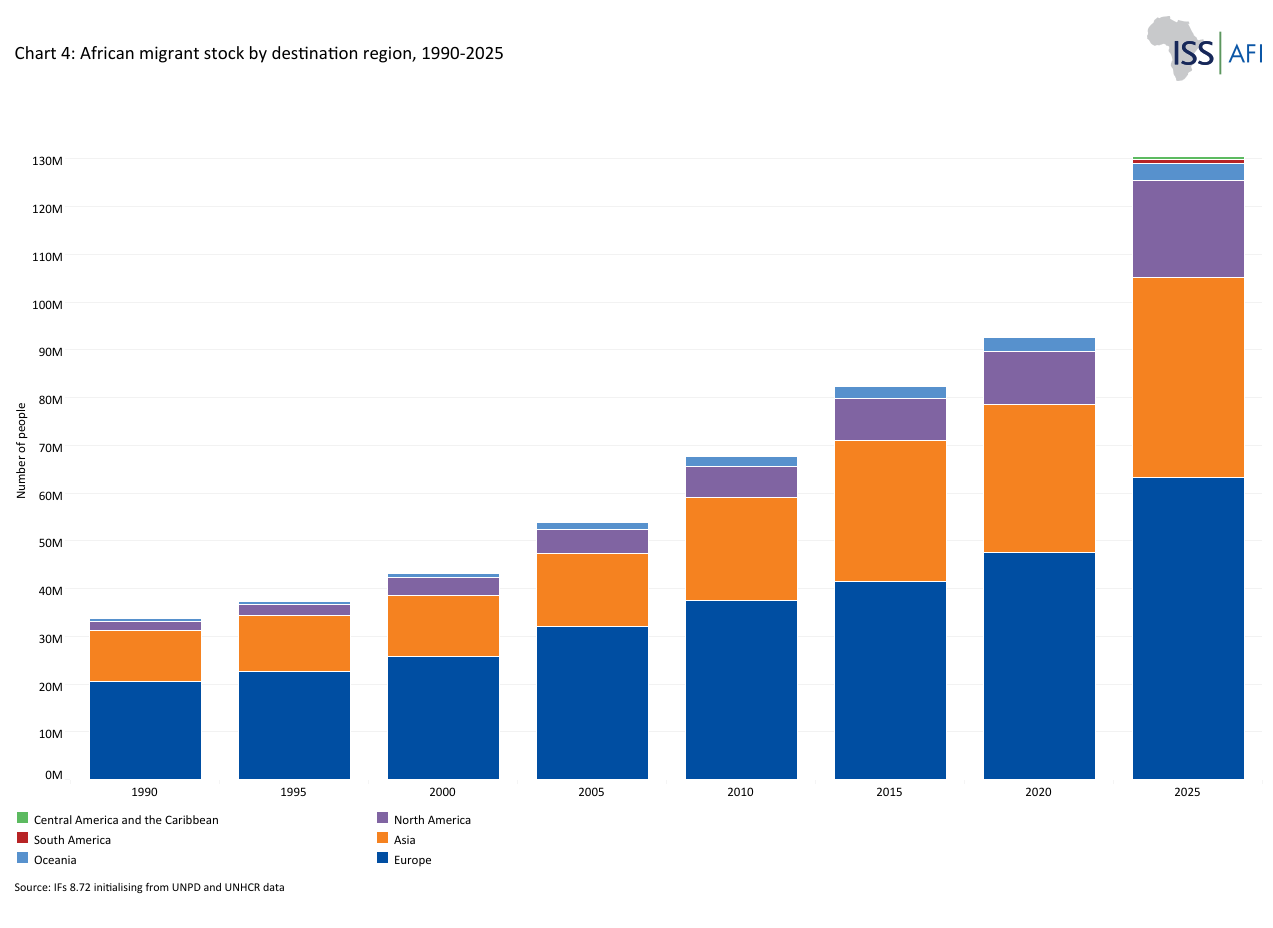
Download to pdfOf the approximately 313 million international migrants globally in 2025, around 52.5 million were born in an African country. Of these, 26.9 million lived in another African country, representing intra-African international migration, while 25.6 million lived outside the continent, representing off-continental international migration. African-born migrants living off-continent represent a relatively small share of Africa’s total population (roughly 1.65%). Chart 4 presents the African-origin international migrant stock by destination region from 1990 to 2025.
Among African migrants living off-continent, Europe is the largest destination, hosting approximately 48% (12.2 million), followed by Asia with 32% (8.1 million, of which the Arabian Peninsula accounts for nearly 5.4 million), North America with just under 4 million, and Oceania with about 0.7 million. The remainder live in other destinations, including South and Central America and the Caribbean.
Africa is also a migration destination. In addition to the 26.9 million African-born migrants, approximately 5.2 million migrants living in Africa originated outside the continent. The continent therefore hosted roughly 32.1 million international migrants in total in 2025. Africa consequently functions simultaneously as a region of origin, destination and transit.
Relative to its large population, however, international migration remains comparatively limited in much of Africa. The UN estimates that international migrants accounted for 3.7% of the total global population in 2024, compared with 12.6% in Europe and 15.9% in North America; in sub-Saharan Africa, the share was about 2%. This should not be interpreted as meaning that Africans are generally immobile, since these figures exclude internal migration and displacement. Rather, international mobility remains constrained for many Africans by migration costs, restrictive migration regimes, infrastructure and connectivity gaps, and limited access to regular migration pathways. Reducing unnecessary barriers to safe and regular mobility could therefore support greater regional integration, labour-market matching and development.
Africa’s migration systems vary considerably across regions. Eastern Africa has particularly large migrant and displaced populations, reflecting the interaction of cross-border labour mobility, regional integration and protracted conflict. Countries with relatively large international migrant populations in relation to their size include Gabon, Equatorial Guinea and Djibouti.
A substantial share of intra-regional migration occurs through established labour and livelihood systems and, in some Regional Economic Communities (RECs), through formal provisions facilitating cross-border movement. The East African Community Common Market Protocol, for example, provides for free movement of persons and workers, as well as rights of establishment and residence, although implementation remains uneven. The scale of irregular migration is more difficult to establish because administrative systems generally capture only part of this movement.
Much intra-African international migration is labour-oriented, with migrants moving towards regional economic hubs such as Abidjan, Johannesburg, Lagos and Nairobi. Estimates put the number of international migrant workers in Africa at approximately 14.5 million in 2019. Many migrants maintain strong economic and social networks with their countries of origin through remittances, family networks and repeated or circular movement.
Climate change, mobility and adaptation
Climate change is intensifying mobility pressures by affecting livelihoods, food and water security and exposure to disasters. Scenario modelling by the Africa Climate Mobility Initiative suggests that, under high-impact conditions, up to 5% of Africa’s population could be moving in response to climate impacts by 2050, with most movement expected to remain within countries. The World Bank estimates that climate change could drive up to 86 million internal migrants in sub-Saharan Africa and approximately 19 million in Northern Africa by 2050.
Africa remains highly dependent on climate-sensitive livelihoods, including agriculture. As climate change increasingly affects crop quality and yields, vulnerable communities often face severe impacts while possessing limited adaptation options.
Most climate-related migration remains internal or regional rather than long-distance international movement, with people facing declining agricultural productivity, environmental degradation or diminishing returns from fishing and livestock production often moving first towards nearby towns and cities.
Forced displacement and protracted crises
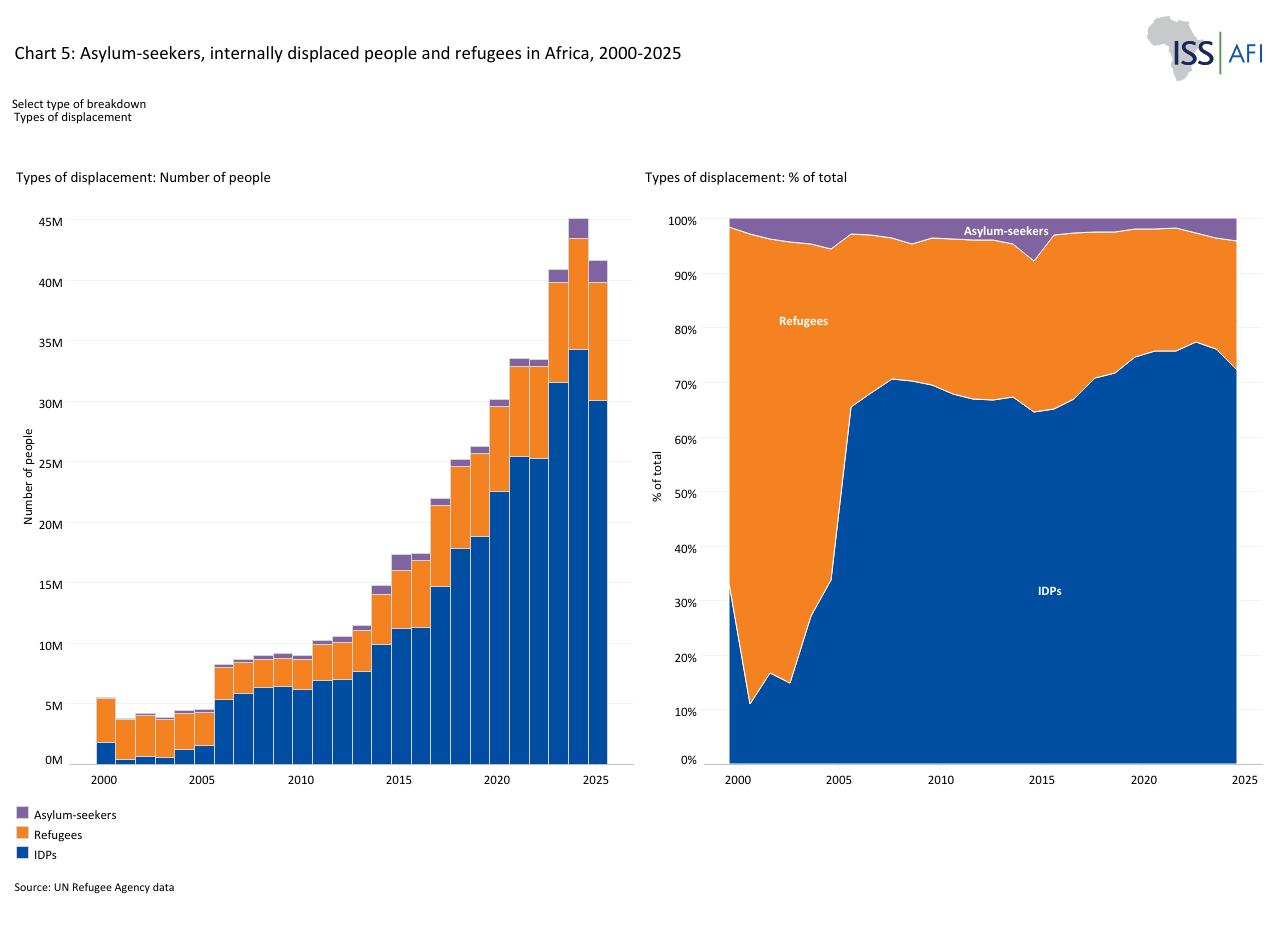
Forced displacement has become one of the defining features of African mobility. According to the Internal Displacement Monitoring Centre, 38.8 million people were internally displaced in sub-Saharan Africa at the end of 2024, accounting for about 47% of the global total. Of these, 33.1 million were displaced by conflict and violence and 5.7 million by disasters. Most people forced from their homes remain within their own countries, while refugees who cross an international border often remain in neighbouring states.
Refugee and asylum-seeker populations are concentrated particularly in Eastern Africa and the Horn of Africa, driven by protracted crises in Sudan, South Sudan, Somalia and Ethiopia. Central Africa and parts of Western Africa also host large displaced populations linked to conflicts in the Sahel, DR Congo and surrounding areas.
Durable solutions remain limited, leaving many people in prolonged displacement or dependent on return, local integration or resettlement opportunities. Displacement in Africa is also increasingly urbanised, with growing numbers of displaced people settling in towns and cities rather than camps. Chart 5 shows asylum-seekers, internally displaced people and refugees in Africa from 2000 to 2025.
Irregular migration and changing routes
Irregular migration is difficult to measure consistently because available data generally capture only detected crossings, making continent-wide trend analysis uncertain. Nevertheless, the three major irregular migration corridors are:
- the Southern Corridor towards South Africa;
- the Eastern Corridor towards the Arabian Peninsula; and
- Mediterranean and Atlantic routes linking Northern, Eastern and Western Africa with Europe.
Detected movements along these routes fluctuate considerably in response to conflict, border enforcement and changes in route accessibility. Detected irregular crossings into Europe peaked in 2015 and rose again, to a lesser extent, in 2023 before declining along several routes. Movement along the Eastern Corridor towards Yemen and the Arabian Peninsula has similarly varied in response to conflict, changing border controls and dangerous conditions along the route.
These changes do not necessarily indicate equivalent changes in the underlying pressure or intention to migrate. Migration routes are adaptive: restrictions or increased enforcement along one route can redirect movement towards alternative pathways rather than preventing it altogether. In some cases, these alternative routes are longer, more expensive and more dangerous.
Migrants travelling irregularly may rely on smugglers or other intermediaries to cross borders or navigate restricted routes. This can expose them to exploitation, abuse, trafficking and death. Smuggling arrangements vary considerably, from small and relatively informal networks to more organised criminal operations. Restrictive migration environments can therefore instead reshape the geography and risks of irregular movement, even where the underlying drivers of migration persist.
Gender and migration
Women increasingly migrate independently for work, education and economic opportunity. As of 2019, women accounted for 39% of migrant workers in Africa, with the number of female labour migrants increasing by 60% between 2010 and 2019. As of 2020, approximately 47% of international migrants in Africa were female.
Women migrants are disproportionately concentrated in informal sectors, including domestic work, care work and informal trade, where legal protections are often limited and workers frequently remain undercounted in official statistics.
These continental patterns vary substantially across regions, reflecting differences in geography, economic structures, conflict, governance and regional integration.
Africa’s Migration Future to 2050
Download to pdf- Briefly
- Modelling migration
- Applying four global scenarios to migration
- International migration to 2050
- The scale of future African international migration
- Intra-African and off-continental international migration
- Off-continental migration destinations
- Regional migration systems to 2050
The migration forecasts presented below do not distinguish legal status, motivation for movement or whether movement is forced or voluntary, regular or irregular. The International Futures (IFs) migration model forecasts international migrant flows and stocks. It does not forecast internal migration or displacement within African countries, or explicitly account for circular migration or involuntary immobility.
IFs models international migration through two connected components. A country-level, or monadic, model estimates total outward migration from each country, while a bilateral, or dyadic, gravity model distributes migrants among potential destination countries.
At the country level, migration responds to changes in population, economic growth, income, poverty and insecurity. At the bilateral level, destination patterns are influenced by geographic distance and existing migrant stocks. Established migrant communities reduce the costs and risks of moving, reinforcing migration corridors over time. Migration flows subsequently alter bilateral migrant stocks, which in turn influence future flows.
The results refer to annual international migration flows and accumulated international migrant stocks. A detailed explanation of the migration module, its underlying data, parameters and limitations is available under the scenario section of the Technical page.
The migration scenarios presented here use four global scenarios set out in the Global Power Shifts and Africa in the World themes as an underlying framework: a Sustainable World, a Growth World, a Divided World and a World at War. These four scenarios are structured around two broad uncertainties: the extent of global integration or fragmentation and the degree to which sustainability, equity and long-term resilience are prioritised. They are not predictions, but alternative futures used to explore how different global pathways could shape Africa’s development. Chart 6 depicts the dimensions of the four global scenarios.
The four global scenarios create very different environments for migration. The Sustainable World combines stronger international cooperation, African regional integration, improved governance and lower conflict. The Growth World produces rapid economic growth and high trade and capital mobility, but also greater inequality and weaker environmental protection. The Divided World is characterised by global fragmentation, nationalism, weaker multilateral cooperation and stronger anti-migrant sentiment. At the same time, the World at War combines geopolitical conflict, economic disruption, greater authoritarianism and weaker international integration.
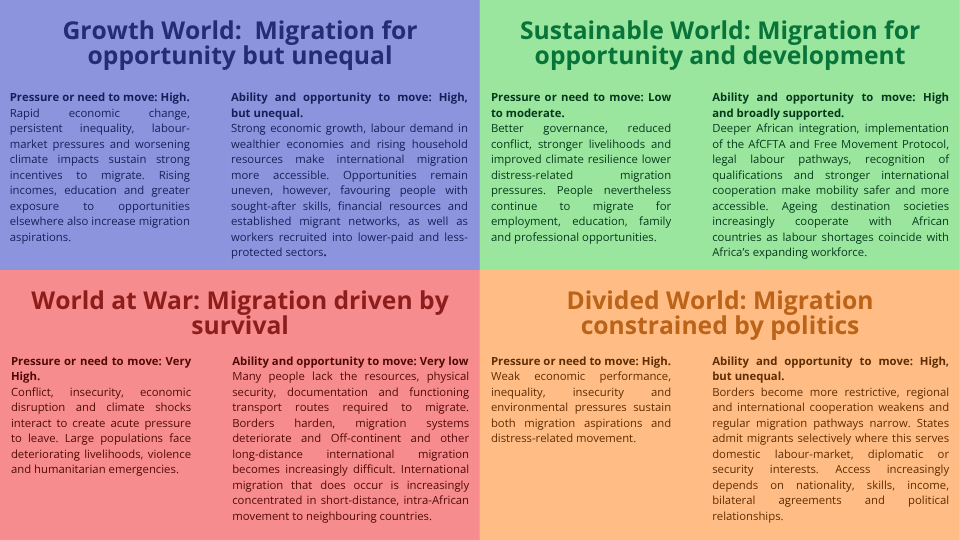
To translate these broader global scenarios into migration outcomes, this theme considers two related questions: how strong are the pressures or incentives for people to move, and how able are they to act on those pressures or incentives?
- Pressure or need to move captures the forces that encourage or compel migration, including conflict, insecurity, livelihood deterioration, inequality and environmental stress, as well as aspirations for employment, education and improved living standards.
- Ability and opportunity to move captures whether people can translate those pressures or aspirations into actual migration. Household resources, legal pathways, labour demand, regional integration, migrant networks, transport systems and destination-country policies shape it.
The scenarios explore how different combinations of migration pressure and the ability to move shape migration outcomes, as summarised in Chart 7.
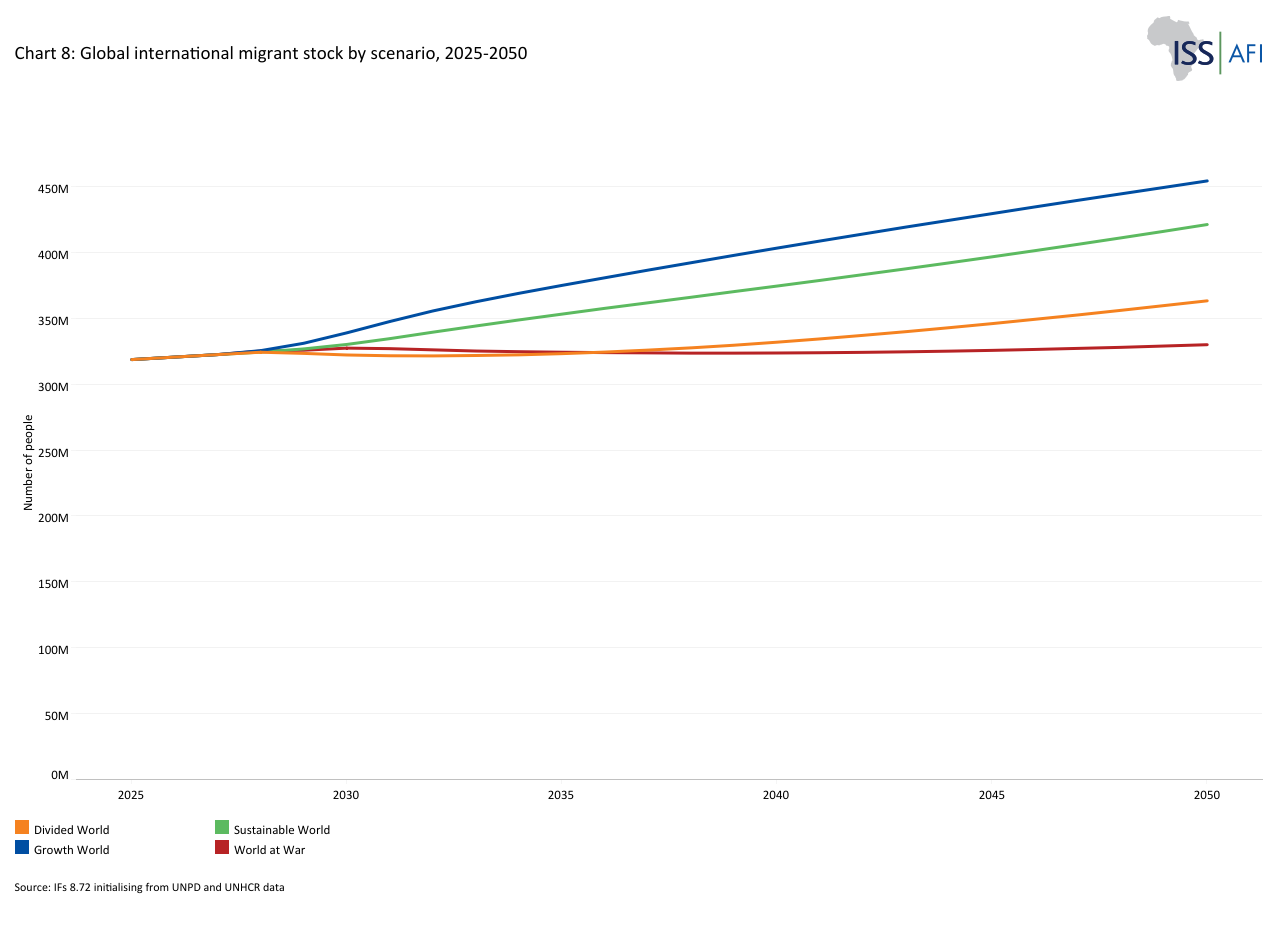
There were approximately 313 million international migrants globally in 2025. By 2050, the global international migrant stock increases under all four scenarios, but at very different rates: to approximately 454 million in the Growth World, 421 million in the Sustainable World, 363 million in the Divided World and 330 million in the World at War. Chart 8 presents the global international migrant stock by scenario from 2025 to 2050.
The divergence reflects the interaction between pressure to move and the ability and opportunity to do so. The Growth World produces the largest increase, around 45% above the 2025 level, as strong economic growth, rising household resources, high connectivity and international labour demand expand people’s capacity to migrate. The Sustainable World also produces substantial growth, to around 35% above 2025, supported by stronger development outcomes, international cooperation and more accessible, regular migration pathways.
The increase in international migrant numbers is much slower in the Divided World and very limited in the World at War. Political fragmentation, harder borders and weaker economic performance constrain international mobility in the Divided World. In the World at War, conflict and insecurity generate acute pressure to move but simultaneously erode household resources, disrupt transport systems and close migration pathways.
These global patterns provide the context for Africa’s migration trajectory. The following sections examine how the same interaction between migration pressure and mobility capability shapes African-origin migration, including its division into intra-African international migration and off-continent international migration.
The African-origin international migrant stock comprises African-born people living outside their country of birth, whether in another African country or off-continent. It therefore comprises both intra-African international migration and off-continent international migration.
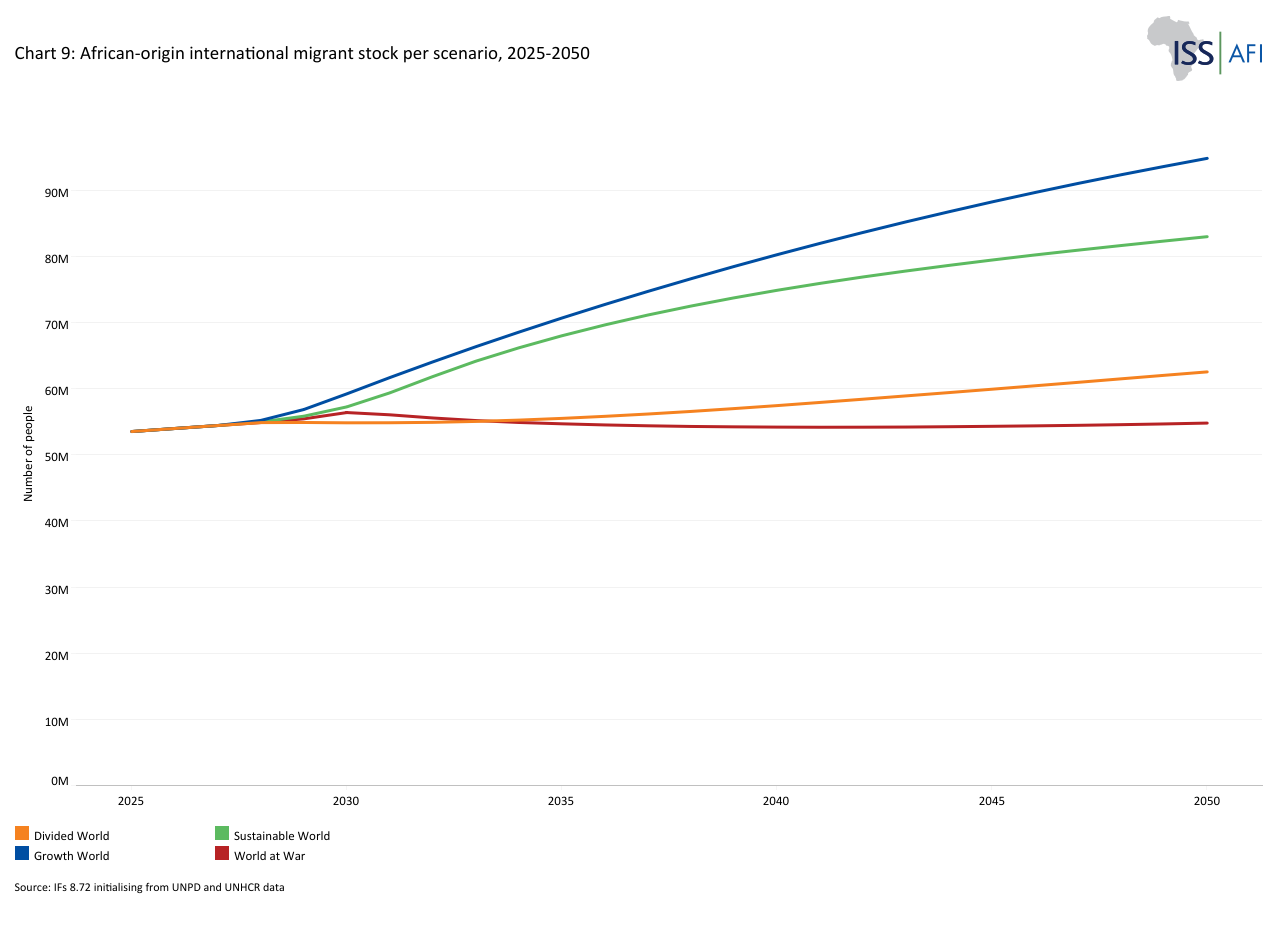
In 2025, there were just less than 52.5 million African-origin international migrants, almost evenly divided between intra-African and off-continent destinations. By 2050, the stock is forecasted to increase to approximately 95 million in the Growth World, 83 million in the Sustainable World, 63 million in the Divided World and 55 million in the World at War. Chart 9 shows the African-origin international migrant stock by scenario from 2025 to 2050.
The scenarios diverge most clearly after 2030. The Growth World produces the largest African-origin international migrant stock, while the World at War produces the smallest. This does not mean that migration pressures are lowest in the World at War. Rather, conflict and economic disruption increase the need to move while simultaneously reducing household resources, disrupting migration routes and hardening borders.
The World at War should therefore not be interpreted as a low-mobility future. Its conditions are more consistent with high levels of internal displacement, short-distance cross-border movement and involuntary immobility, while long-distance international migration becomes more difficult.
The Growth World combines strong migration capability with persistent migration pressure. Rapid economic growth increases household resources and connectivity, while labour shortages in wealthier ageing economies strengthen demand for African workers. Inequality and environmental pressures nevertheless remain comparatively high, producing both opportunity-led migration and more unequal forms of labour mobility.
The Sustainable World produces the second-largest African-origin international migrant stock. Rising incomes, education, infrastructure and connectivity increase people’s capacity to move, even as improved governance, lower conflict and stronger climate adaptation reduce distress-related pressures. Stronger African integration also shifts a larger share of international migration towards destinations within the continent.
In 2025, approximately 27 million African-born international migrants lived in another African country, while around 26 million lived outside the continent. African international migration was therefore almost evenly divided between intra-African and off-continent destinations. By 2050, however, the balance differs significantly across the four scenarios. Chart 10 depicts intra-African and off-continent African-origin migrant stocks by scenario from 2025 to 2050.
The Sustainable World produces the strongest shift towards intra-African international migration. By 2050, approximately 50.7 million African-origin migrants will live in another African country, compared with 32.3 million outside the continent, up from roughly half in 2025.
This reflects a more integrated African economy in which the AfCFTA is more fully implemented, the Free Movement Protocol is operational, cross-border infrastructure improves and regional labour markets deepen. Better recognition of qualifications and more regular labour pathways make it easier for Africans to move towards opportunities elsewhere on the continent. Migration becomes more closely embedded in Africa’s own structural transformation.
The Growth World also produces substantial intra-African migration, which reaches approximately 45.6 million by 2050. Off-continent migration, however, increases even faster to around 49.3 million. It is the only scenario in which African migrants living outside the continent outnumber those living elsewhere in Africa, accounting for about 52% of the total. Strong international labour demand, rising household resources and established migration corridors reinforce movement towards higher-income destinations.
The Divided World remains predominantly intra-African, with approximately 35.4 million African-origin migrants living elsewhere in Africa and 27.1 million living outside the continent by 2050. Around 57% of the international migrant stock is therefore intra-African. This should not be interpreted as stronger African integration. Rather, longer-distance movement is more constrained by harder borders, weaker cooperation and increasingly selective migration pathways. Established African corridors persist due to proximity, historical ties and migrant networks. These conditions are also more conducive to irregular and higher-cost movement, although the model does not quantify migrants by legal status.
The World at War produces the highest intra-African share, at around 65%. By 2050, approximately 35.5 million African-origin migrants will live in another African country, compared with only 19.4 million outside the continent. Again, this does not indicate stronger regional integration or more effective migration governance. It reflects the greater difficulty of long-distance migration as household resources decline, routes are disrupted and borders become more restrictive. Internal displacement and involuntary immobility are also likely to be substantially higher than the international migrant stock alone suggests.
The historical analysis shows that African migration outside the continent is concentrated principally in Europe and the Arabian Peninsula. Looking to mid-century, the Growth and Sustainable Worlds produce the largest off-continent migrant stocks but differ substantially in the scale and distribution of that movement. Chart 11 shows the off-continent migration of African migrants in the Growth and Sustainable World scenarios from 2025 to 2050.
Europe remains the largest off-continent destination in both scenarios. The stock of African-born migrants living in Europe rises from around 12 million in 2025 to 29 million in the Growth World by 2050, compared with 19 million in the Sustainable World. Relative to Europe’s total population, however, these stocks remain modest. African-born migrants account for approximately 1.6% of Europe’s population in 2025 and would represent around 3.9% in the Growth World and 2.6% in the Sustainable World by 2050. Europe’s total population remains broadly stable in the Growth World, at around 747 million, and declines to approximately 719 million in the Sustainable World, compared with about 744 million in 2025. Established diaspora networks, historical and linguistic ties, family connections and long-standing migration corridors continue to support movement to Europe. The stronger increase in the Growth World reflects rising household resources and mobility capability in Africa alongside greater labour demand in ageing European economies.
Asia remains the second-largest destination region. African-origin migrant stocks in Asia rise from around 8 million in 2025 to 13.2 million in the Growth World and 9.3 million in the Sustainable World by 2050. Much of this movement is concentrated in the Arabian Peninsula. In the Growth World, the African-born migrant stock in the Arabian Peninsula reaches approximately 10.6 million by 2050, compared with around 7.6 million in the Sustainable World.
North America also attracts a larger share of African off-continent migration in the Growth World. By 2050, the African-born migrant stock in North America will reach approximately 6 million in the Growth World, compared with around 3 million in the Sustainable World. This further illustrates the stronger outward orientation of the Growth World, where higher household resources and strong labour demand in wealthier economies expand opportunities for long-distance migration.
Europe and the Arabian Peninsula represent different migration systems. African migration to Europe occurs through a wide range of pathways, including employment, education and family reunification, with greater opportunities for longer-term residence and settlement. However, access and rights vary considerably between countries and migration categories. Migration to the Arabian Peninsula is more strongly linked to labour demand. It is generally more temporary, with recruitment and employer-linked sponsorship systems shaping entry, employment and length of stay.
In the Growth World, rising household resources and external labour demand expand established migration corridors to Europe, Asia and North America. In the Sustainable World, migration outside Africa grows more slowly as stronger African integration and expanding opportunities direct a larger share towards destinations within the continent.
Africa does not have a single migration system. Geographic proximity, regional labour markets, economic integration, conflict and established migrant networks have created distinct migration systems across the continent. The scenarios explore how different development pathways change the scale and geographical orientation of these established systems.
The following sections focus primarily on the Growth and Sustainable Worlds, which produce the largest African-origin international migrant stocks and provide the clearest contrast between stronger off-continent migration and deeper intra-African integration.
Northern Africa – a transit and externally orientated migration system
More than any other African region, Northern Africa functions simultaneously as a destination, transit zone and staging area for off-continent migration, reflecting its position at the intersection of Africa, Europe and the Middle East. The region has relatively low migrant density, limited intra-regional migration and strong connections with external destination systems, making it particularly sensitive to changes in migration policy, border enforcement, labour demand and geopolitics.
Unlike other African regions, fewer than half of Northern Africa’s approximately 2.7 million migrants in 2024 were African-born, while only around 11% originated within the subregion. At the same time, the stock of African-born migrants in Northern Africa increased from approximately 419 000 in 1990 to more than 1.3 million in 2024, illustrating the region’s continuing role as both destination and transit space.
Egypt and Libya exemplify these dynamics. Egypt increasingly hosts people displaced by conflict in neighbouring countries, particularly Sudan. At the same time, Libya has shifted from being primarily a labour destination before 2011 to a major transit hub linking African migration systems with Mediterranean routes to Europe. Northern Africa, therefore, forms part of a wider transcontinental migration system in which movements within Africa, migration towards Europe and labour migration towards the Middle East intersect.
Northern Africa remains strongly oriented towards off-continent destinations under both the Growth and Sustainable Worlds. The North African-origin migrant stock in Europe rises from around 6.3 million in 2025 to 13.2 million in the Growth World and 10.3 million in the Sustainable World by 2050. Migration to Asia increases from around 5.1 million to 8 million in the Growth World and to 6.6 million in the Sustainable World, with the Chart 12 presents the off-continent migration of Northern African migrants in the Growth and Sustainable World scenarios in 2025 vs 2050.
The results show that even under stronger African integration, Northern Africa remains structurally tied to Europe and the Middle East. Its migration future is therefore shaped not only by developments within Africa but also by external labour demand, migration policy, border management and geopolitical relationships. These established corridors expand more strongly in the Growth World than in the Sustainable World.
Eastern Africa - A multi-nodal migration system with regional integration prospects
Eastern Africa has one of Africa’s largest and most complex migration systems, combining intra-African labour mobility, large-scale forced displacement and established migration corridors beyond the continent. Unlike regions dominated by a single destination hub, Eastern Africa is multi-nodal: several countries simultaneously function as countries of origin, destination and transit.
In 2024, Eastern Africa hosted approximately 8.8 million international migrants, around 95% of whom were African-born and approximately 74% of whom originated within the subregion. Major destination countries included Sudan, Uganda, Ethiopia, Kenya and South Sudan, although each also participates in wider outward and transit migration systems. Kenya functions as an important economic, educational and transport hub, while Uganda and Ethiopia host large displaced populations alongside substantial labour and livelihood mobility.
Forced displacement is a defining feature of the regional migration system. Protracted conflicts in Sudan, South Sudan, Somalia and neighbouring countries have generated repeated internal displacement and cross-border refugee movements, usually towards nearby African countries. Uganda, Kenya and Ethiopia remain important refugee-hosting countries. These movements should, however, be distinguished from the international migrant stocks modelled in IFs, which do not identify whether migration is forced or voluntary.
Eastern Africa is also connected to destinations beyond Africa through several established migration systems. The most prominent is the Eastern Corridor, which links the Horn of Africa with Yemen and the Arabian Peninsula. Migrants from Ethiopia, Somalia, Djibouti and neighbouring countries use these routes for employment and other livelihood opportunities, while Sudan connects Eastern Africa with Northern Africa and onward routes towards Europe. A further southward system links parts of Eastern Africa with Southern Africa, particularly South Africa.
The Growth and Sustainable Worlds produce markedly different migration geographies for Eastern Africa. In both scenarios, international migration continues to increase, but the relative importance of African and off-continent destinations changes substantially. Chart 13 illustrates the East African-origin international stock by destination in the Growth and Sustainable World scenarios in 2025 vs 2050.
The stock of East African-origin migrants living elsewhere in Africa rises from approximately 9.9 million in 2025 to around 16.3 million in the Growth World and 20 million in the Sustainable World by 2050. The Sustainable World therefore produces the stronger shift towards intra-African international migration, consistent with deeper regional integration, freer movement, stronger African labour markets and improved connectivity.
The difference is equally visible in established off-continent migration systems. In 2025, approximately 1.9 million East African-origin migrants lived in Europe, and around 2.5 million in Asia, with the Arabian Peninsula hosting roughly 2 million.
In the Growth World, these established long-distance corridors expand substantially. By 2050, the East African-origin migrant stock in Europe reaches approximately 4.7 million, while the stock in Asia rises to 4.18 million (the Arabian Peninsula rises to around 3.6 million). Rising household resources, stronger connectivity and labour demand outside Africa therefore increase East Africans’ ability and opportunity to migrate over longer distances.
The Sustainable World produces a different pattern. The East African-origin migrant stock in Europe increases more moderately, reaching approximately 2.4 million by 2050, while migration to the Arabian Peninsula remains broadly at its 2025 level at approximately 2 million. These results do not imply lower overall mobility in the Sustainable World. Rather, a larger share of East African international migration is redirected towards opportunities within Africa.
Eastern Africa consequently illustrates particularly clearly how development pathways can change not only the scale of international migration but also its geography. The Growth World connects the region more strongly to both African and global labour markets. At the same time, the Sustainable World strengthens an already substantial regional migration system and shifts a greater share of movement towards destinations within Africa.
Western Africa - an established regional system that will remain resilient
Western Africa has one of the world’s strongest intra-regional migration systems, combining labour mobility, displacement and return migration. In 2024, the region hosted approximately eight million international migrants, around 89% of whom originated within the subregion. The intra-regional migrant stock increased from approximately 3.8 million in 1990 to 7.1 million in 2024.
The 1979 ECOWAS Protocol on Free Movement formalised longstanding mobility patterns through a phased framework providing for visa-free entry, followed by rights of residence and establishment. While entry provisions for ECOWAS citizens have been widely implemented, residence and establishment rights remain constrained by administrative barriers, documentation requirements and uneven border enforcement. International migration within Western Africa, therefore, continues through a combination of formal regional arrangements and historically embedded labour, trade and family networks.
More recently, conflict, insecurity and political instability in the Central Sahel, particularly Burkina Faso, Mali and Niger, and the Lake Chad Basin have intensified forced displacement. Forced displacement in Western Africa more than doubled over the past decade to approximately 7–7.5 million people by 2025, with Nigeria and Burkina Faso accounting for some of the largest displaced populations.
Western Africa is also connected to Northern Africa and off-continent destinations through established Mediterranean and Atlantic migration routes. Although these movements remain considerably smaller than intra-African international migration, the stock of West African-origin migrants living outside Africa has grown substantially since 1990.
In both the Growth and Sustainable Worlds, Western Africa retains a strongly African-oriented international migration system. The stock of West African-origin migrants living elsewhere in Africa increases from approximately 8.5 million in 2025 to around 12.3 million by 2050 in both the Growth and Sustainable Worlds. Despite very different global development pathways, the two scenarios therefore produce remarkably similar aggregate stocks of West African migrants elsewhere on the continent, reflecting the resilience of long-established regional labour, trade and migration networks supported by geographic proximity and ECOWAS free movement. Chart 14 shows the West African-origin international stock by destination in the Growth and Sustainable World scenarios in 2025 vs 2050.
The main divergence occurs in off-continent international migration. Europe remains the most important destination outside Africa. The West African-origin migrant stock in Europe increases from approximately 2.4 million in 2025 to around 5.7 million in the Growth World, compared with approximately 3.6 million in the Sustainable World by 2050. The difference becomes particularly pronounced after 2030, as rising household resources, greater connectivity and external labour demand expand opportunities for longer-distance migration in the Growth World.
North America remains a much smaller destination. From approximately 1.3 million West African-origin migrants in 2025, the stock increases slightly to around 1.4 million in the Growth World by 2050.
These results underline the resilience of Western Africa’s established intra-African migration system. The scenarios have a much stronger effect on the scale of long-distance off-continent migration than on the region’s underlying African migration system.
Southern Africa - A regional labour migration system centred on South Africa
Southern Africa’s migration system is primarily intra-regional and concentrated around South Africa as its dominant economic hub. In 2024, the region hosted approximately 4.8 million migrants, of whom 61% originated within the subregion, and 77% were African-born. Longstanding regional labour corridors are complemented by smaller flows from other African regions and outside the continent.
Its largest corridor, from Zimbabwe, comprised approximately 1.1 million migrants in 2024, up from around 116 000 in 2000 as Zimbabwe experienced a prolonged economic and political crisis. Many Zimbabwean migrants work in informal trade, domestic work and agriculture and support households through remittances. Other major corridors into South Africa originate in Mozambique (approximately 400 000), and Lesotho and Malawi (around 200 000 each). Together, migrants from the other nine Southern African countries accounted for approximately two-thirds of the subregion’s intra-regional migrant stock in 2024.
Although South Africa is the primary hub, migration patterns form a dense web of cross-border movements shaped by geographic proximity, historical labour migration, conflict legacies and regional labour-market opportunities. Around 16% of migrants living in Southern Africa originated elsewhere on the continent, with most residing in South Africa.
Southern Africa also hosts the continent’s largest stock of non-African migrants: approximately 1.1 million in 2024, concentrated mainly in Angola and South Africa. Angola’s oil and construction sectors have attracted workers from Portugal, Brazil and China, while South Africa draws migrants through its comparatively diversified economy and infrastructure.
Southern Africa’s migration system was profoundly shaped by colonial land dispossession and labour recruitment for South Africa’s mines and farms. These systems drew workers from neighbouring countries through regulated contracts that generally required them to return home upon completion of their employment. At its peak in the late 1980s, mining employed almost 500 000 foreign workers. This had fallen to 35 000 by 2023 as the mining industry weakened, became more mechanised and immigration restrictions increased. Since 1994, migration to South Africa has also become more diverse, encompassing low- and high-skilled workers, refugees and asylum seekers, while declining formal recruitment has contributed to more mixed and irregular movement. Migrants often face insecure work and limited protections, alongside recurrent xenophobic violence targeting foreign nationals and migrant-owned businesses.
Southern Africa retains a strong regional migration system under both scenarios. The stock of Southern African-origin migrants living elsewhere in Africa increases from approximately 3.6 million in 2025 to around 7.0 million in the Growth World and 7.8 million in the Sustainable World by 2050. The persistence of strong intra-African international migration reflects the region’s long-established labour corridors, particularly those linking neighbouring countries with South Africa. Chart 15 depicts the Southern African-origin international stock by destination in the Growth and Sustainable World scenarios in 2025 vs 2050.
The stronger divergence occurs in off-continent international migration. The Southern African-origin migrant stock in Europe increases from approximately 1.1 million in 2025 to around 2.8 million in the Growth World, compared with about 1.7 million in the Sustainable World by 2050.
North America remains a much smaller destination. The Southern African-origin migrant stock there increases from approximately 0.3 million in 2025 to around 0.6 million in the Growth World, while remaining close to 0.3 million in the Sustainable World by 2050.
The Sustainable World produces a more regionally concentrated migration pattern, as regional integration and freer movement make African labour markets more accessible.
Central Africa - proximity shapes migration flows and stocks
Central Africa’s migration system is characterised mainly by bilateral cross-border corridors linking adjacent countries. A limited number of origin countries—particularly DR Congo and the Central African Republic—generate large-scale movements into neighbouring states.
DR Congo lies at the centre of this system, functioning as both a major destination and the region’s largest country of origin. In 2024, DR Congo hosted more than 1 million African migrants, including 442 585 from Central Africa and substantial flows from Rwanda, South Sudan, Angola and Sudan. The global stock of Congolese migrants reached approximately 2.1 million in 2024, of whom around 1.8 million lived outside Central Africa. Most were concentrated in neighbouring countries, particularly Uganda, Rwanda, Burundi and the Republic of the Congo, demonstrating the proximity-driven nature of movement.
Most countries in Central Africa play dual roles as migrant-sending and migrant-receiving countries, with much movement occurring between neighbouring states and often shaped by local crises. Equatorial Guinea presents a distinct profile, attracting a relatively large non-African workforce associated with its oil, gas and construction sectors.
In 2025, DR Congo faced Africa’s largest internal displacement crisis. The country recorded a record high of 9.7 million internal displacement movements driven by conflict and violence, almost double the number recorded in 2024. By comparison, approximately 1.25 million Congolese refugees and asylum seekers were living in other countries. More than three decades of conflict have escalated through fighting involving the Congolese armed forces, M23 and numerous other armed groups, despite the country’s extensive mineral wealth. Repeated displacement has left many families without secure access to food, water, healthcare or education and has exposed children to recruitment and forced labour.
Central African international migration remains strongly oriented towards destinations elsewhere in Africa under both scenarios. The stock of Central African-origin migrants living elsewhere on the continent increases from approximately 4.4 million in 2025 to around 8.6 million by 2050 in both the Growth and Sustainable Worlds. Despite the very different development pathways, the aggregate African destination stock is therefore almost identical by mid-century, reflecting the persistence of Central Africa’s proximity-based migration system. Chart 16 presents the Central African-origin international stock by destination in the Growth and Sustainable World scenarios in 2025 vs 2050.
Migration to Europe remains much smaller but shows a substantially greater difference between the two scenarios. The Central African-origin migrant stock in Europe increases from approximately 0.8 million in 2025 to around 2.2 million in the Growth World, compared with approximately 1 million in the Sustainable World by 2050. The Growth World, therefore, produces much stronger expansion of the region’s principal off-continent migration corridor, while the Sustainable World remains more strongly concentrated within Africa.
DR Congo particularly clearly illustrates the persistence of this proximity-based system. Across nine neighbouring destinations included in IFs, the Congolese migrant stock increases from around 1.7 million in 2025 to almost 4 million by 2050 in both scenarios. Uganda remains the largest individual destination, while Rwanda, Burundi, the Republic of the Congo, Angola, Tanzania, South Sudan and Zambia continue to form important corridors.
Different development pathways, therefore, alter individual routes and the scale of off-continent migration without fundamentally changing the combined importance of neighbouring African destinations. In Central Africa, migration governance will remain closely linked to cross-border cooperation between adjacent states, particularly where conflict and displacement overlap with established regional mobility systems.
The four scenarios show why lower international migrant numbers should not be taken as evidence of reduced displacement or vulnerability. The World at War generates the greatest pressure to move but the smallest international migrant stock. Conversely, better development does not necessarily mean less migration. The Sustainable World produces substantial mobility, but stronger regional integration redirects a much larger share of it towards opportunities within Africa.
The regional analysis reinforces a second finding: the same development pathway can produce different migration outcomes depending on the migration system already in place. In Western and Eastern Africa, where cross-border mobility is supported by established regional agreements, labour and trade networks and longstanding migration corridors, stronger African integration can have a particularly strong effect on where people move. In Central Africa, proximity to neighbouring countries remains the dominant organising feature of migration, while in Southern Africa, longstanding labour corridors centred on South Africa remain persistent. Northern Africa differs again: its geography and strong connections with Europe and the Middle East mean that its migration system remains more strongly influenced by off-continent labour demand, migration policy and border management.
Good migration governance, now and in the future, depends heavily on Regional Economic Communities, cooperation between neighbouring states and the labour markets and migration corridors already in place.
Against this background, ten policy priorities emerge for African governments, Regional Economic Communities, the African Union and their partners.
Expand safe, regular and productive migration pathways
African migration policies should be aligned with broader development, labour and education strategies. Regular labour, education, family and circular migration pathways can help match Africa's expanding workforce with developmental opportunities within the continent and abroad while reducing the risks and costs associated with irregular movement.
The scenarios show that improved development conditions can increase people’s capacity to migrate even as distress-related pressures decline. The Sustainable World illustrates this clearly: improved development conditions do not eliminate migration but create greater scope for mobility to occur through safer, more regular and development-supportive channels. Policies should therefore focus on improving migration governance and enabling regular and circular pathways rather than solely on restricting migration.
Implement continental and regional frameworks
Africa already has ambitious migration and integration frameworks, including Agenda 2063, the African Continental Free Trade Area, the AU Free Movement Protocol, the Migration Policy Framework for Africa and REC-level mobility arrangements. The principal challenge is implementation.
The AU, RECs and member states should improve policy coherence, clarify responsibilities and address administrative and institutional barriers that limit implementation. National migration policies should be more closely aligned with regional and continental commitments, while cooperation between RECs will be increasingly important where migration corridors cross regional boundaries.
Reduce the practical costs and barriers to regional mobility
Regional integration requires more than formal agreements. Better transport links, more efficient and interoperable border systems, recognition of qualifications, portable social protection, streamlined and efficient migration administration and accessible identity documentation can reduce the cost and uncertainty associated with moving within Africa.
These investments are particularly important in the Sustainable World, where the largest share of African migrants move within the continent due to improving integration and expanding opportunities. By 2050, around 61% of African-origin international migrants live elsewhere in Africa in the Sustainable World, compared with 48% in the Growth World. Interventions should focus on facilitating legitimate mobility, strengthening effective border governance and improving state capacity to govern migration.
Prevent forced displacement and protect people who must move
Conflict, insecurity, livelihood collapse and climate shocks, especially in the World at War scenario, can create intense pressure to leave while simultaneously destroying the resources, infrastructure and routes that enable migration.
Conflict prevention, accountable governance, climate adaptation, livelihood resilience and functioning public services are therefore central to reducing forced displacement. Where displacement occurs, rights-based protection, access to work and services, documentation and durable solutions should be prioritised.
Policies must also account for involuntary immobility. Some of the people facing the greatest risks may have the fewest resources or capabilities to move. Migration governance must include measures that enable people to move in ways that enable development and reduce vulnerabilities, such as planned relocation or urbanisation.
Avoid over-securitising migration policy
Restrictive enforcement can change irregular routes without removing the pressures that drive them. Where regular pathways narrow, migration may become more expensive, irregular and dangerous, increasing reliance on smugglers and exposure to exploitation and abuse.
The Divided World demonstrates how migration can persist even when political fragmentation and harder borders constrain formal mobility. African governments and external partners should therefore assess migration-control measures against their effects on rights, regional integration, development and institutional accountability, rather than primarily against interception or arrival numbers.
Free movement and effective migration governance are not synonymous with unregulated borders. The objective should be predictable, legitimate and well-managed mobility rather than securitising migration.
Strengthen diaspora engagement and reduce remittance costs
African diasporas are important sources of finance, skills, knowledge, trade links and investment. Remittances exceed US$100 billion in some recent Africa-wide estimates and provide an important source of household income and foreign exchange.
Governments can increase the development returns of migration by lowering transfer costs, expanding formal and digital remittance channels, improving financial inclusion and creating credible opportunities for diaspora saving and investment. Diaspora engagement should extend beyond remittances to include skills exchange, entrepreneurship, trade networks, technology transfer and investment.
Protect migrant workers and make rights portable
The development benefits of labour migration depend significantly on the conditions under which migrants work. Migrant workers should have access to decent work, fair recruitment practices, safe working conditions, equal treatment under labour law and protection from exploitation and crime.
Social security and benefit systems should be made portable across borders. Bilateral and regional labour agreements should incorporate enforceable rights and protections rather than focusing only on recruitment volumes.
This will become increasingly important if ageing economies outside Africa seek greater access to the continent's expanding workforce. The difference between mutually beneficial labour mobility and extractive migration will depend substantially on the rights, bargaining power and protections available to migrant workers.
Mainstream gender and protection risks
Migration opportunities, employment sectors, routes and risks differ substantially by gender. Women are increasingly migrating independently for work, education and economic opportunity, but remain concentrated in some sectors where labour protections are weak and exposure to exploitation is high.
Migration and displacement policies should therefore use gender-responsive analysis and address risks including trafficking, gender-based violence, exploitative recruitment and unequal access to documentation and services. Gender should be considered not only as a protection issue but also in understanding how migration affects labour markets, households, remittances and development outcomes.
Strengthen civil registration, legal identity and migration data
Legal identity is fundamental to safe mobility, access to services and the protection of rights. UNECA has estimated that around 542 million Africans lack foundational identification, while UNICEF estimates that 49% of children under five in sub-Saharan Africa are unregistered and 61% lack a birth certificate.
Investment in civil registration and identity systems should therefore accompany efforts to improve migration governance and regional integration. Better documentation can expand access to regular pathways, labour markets, financial services and social protection while strengthening states' ability to manage migration.
At the same time, major gaps remain in data on irregular migration, circular mobility, displacement and migrant characteristics. Better migration, displacement and labour-market data are essential if policy is to be based on the scale and characteristics of actual movement rather than assumptions or perceptions.
Build more accurate public narratives about migration
Migration debates are increasingly shaped by claims that migrants are primarily security, economic or social threats. Yet the evidence presented in this study shows a more complex reality. Most African mobility takes place within the continent, much of it within countries, while African international migration is almost evenly divided between intra-African and off-continent destinations. Migration is closely intertwined with labour markets, structural transformation, regional integration and household livelihoods, and its effects vary depending on who moves, where they move and the conditions under which movement occurs.
Governments, researchers, civil society and the media should communicate more clearly where migrants move, why they move and how migration affects countries of both origin and destination. Better public narratives should not dismiss legitimate concerns about employment, public services, infrastructure or social cohesion, but should distinguish these from unsupported or politicised claims. Policy should be based on the actual scale, composition and consequences of migration rather than perceptions that overstate particular forms of movement.
Chart 17 summarises the policy recommendations. The scenarios differ not only in the scale and geography of migration, but also in the conditions under which movement occurs. Migration can contribute to development when people can move safely, exercise meaningful choice, access rights and employment, and maintain productive links with countries of origin. By contrast, conflict, forced displacement, exploitation, restricted pathways and involuntary immobility can increase vulnerability and undermine development outcomes. Migration policy should therefore focus not only on the volume of movement but also on improving the conditions under which mobility takes place and reducing forced and unsafe forms of movement.
Africa's migration future will not be determined by migration policy alone. It will be shaped by the continent's wider development trajectory: whether economies create opportunities, institutions become more effective, regional integration deepens, conflict declines and African countries can engage with global labour markets on more favourable terms. Migration governance can influence who can move, where they move and under what conditions, but these outcomes remain closely connected to the broader choices shaping Africa's future.
Page information
Contact at AFI team is Alize le Roux
This entry was last updated on 26 October 2026 using IFs v8.72.
Donors and sponsors
Reuse our work
- All visualizations, data, and text produced by African Futures are completely open access under the Creative Commons BY license. You have the permission to use, distribute, and reproduce these in any medium, provided the source and authors are credited.
- The data produced by third parties and made available by African Futures is subject to the license terms from the original third-party authors. We will always indicate the original source of the data in our documentation, so you should always check the license of any such third-party data before use and redistribution.
- All of our charts can be embedded in any site.
Cite this research
Alize le Roux (2026) State Futures in the Global South. Published online at futures.issafrica.org. Retrieved from https://futures.issafrica.org/thematic/22-migration/ [Online Resource] Updated 26 October 2026.