 Djibouti
Feedback welcome
Our aim is to use the best data to inform our analysis. See our Technical page for information on the IFs forecasting platform. We appreciate your help and references for improvements via our feedback form.
This report analyses Djibouti’s current development path and prospects, examining how various sectoral interventions could shape the country’s economic and social landscape through to 2043, the end of the third ten-year implementation plan of the African Union's Agenda 2063. The analysis is grounded in scenario modelling and explores eight key sectors. In addition to evaluating the effects of each sectoral scenario individually, the report assesses the combined impact of these interventions on Djibouti’s long-term growth and development trajectory. The report concludes by summarising the key findings and offering policy insights to support Djibouti in pursuing a more inclusive, resilient and sustainable future. It underscores the importance of coordinated, multi-sectoral reforms to unlock the country’s long-term economic and social potential.
Visit the Technical section for additional information on the International Futures (IFs) modelling platform, which serves as the analytical foundation for this report's scenario simulations.
Executive Summary
This page begins with an introductory assessment of the country’s context, examining current population distribution, social structure, climate and topography.
- Djibouti is a small, lower-middle-income country located at a strategic maritime chokepoint in the Horn of Africa, with development anchored in its role as a regional logistics and trade hub. The country is highly urbanised, with over 60% of the population concentrated in Djibouti City, and faces severe climate and water constraints.
The introduction is followed by an analysis of the Current Path for Djibouti, which informs the country’s likely baseline trajectory to 2043. It is based on prevailing macroeconomic factors and assumes that no major shocks will occur in a ‘business-as-usual’ future.
- Djibouti’s population is transitioning toward a working-age-dominant structure, creating potential for a demographic dividend, contingent on job creation and skills development. The total population will grow from approximately 1.17 million people in 2024 to almost 1.5 million people by 2043.
- Urbanisation is nearing saturation, rising modestly from 79% in 2024 to 80.5% by 2043, with future pressure driven by absolute urban population growth rather than shifts in rural-urban migration.
- Gross domestic product (GDP) at market exchange rates (MER) will grow from US$4.25 billion in 2024 to US$13.13 billion by 2043 (6.1% annually), below the 8–10% target set in Vision 2035.
- GDP per capita in purchasing power parity (PPP) will nearly double to US$12 220 by 2043, but will remain insufficient to meet the Vision 2035 target of tripling income per capita by 2035.
- Djibouti’s Current Path suggests a gradual but meaningful reduction in informality over the 2024-2043 period, with the informal share of GDP falling from 22.4% to 18% and informal employment from 36.6% to 28.2%. Reducing informality is not only a labour issue, but central to fiscal sustainability and productivity growth.
- Poverty declines significantly, reaching 3.1% at the US$3.00 line and about 8.5% at the US$4.20 line by 2043, though risks will remain from debt, climate stress and corridor dependence.
- Djibouti’s development strategy is anchored in Vision 2035, which is built around governance, economic diversification, private-sector investment, human capital and regional integration.
The next section compares progress on the Current Path with eight sectoral scenarios . These are Demographics and Health; Agriculture; Education; Manufacturing; the African Continental Free Trade Area (AfCFTA); Large Infrastructure and Leapfrogging; Financial Flows; and Governance. Each scenario is benchmarked to present an ambitious but reasonable aspiration in that sector, comparing Djibouti with other countries at similar levels of development and characteristics.
- The Demographics and Health scenario will accelerate progress toward SDG 3.2 targets, reducing infant mortality to 6.8 per 1 000 by 2043, which represents about 2.8 fewer infant deaths per 1 000 live births than the Current Path forecast.
- Improvements in agriculture under the Agriculture scenario will reduce the trade deficit from 11.8% of GDP in 2024 to 7.1% by 2043. However, structural dependence on imports due to climate, land and water constraints remains. This deficit will be 0.1 percentage points lower than the Current Path forecast.
- The Education scenario suggests that by 2043, the average years of schooling for individuals aged 15 to 24 will increase to about 11 years, 2.2 years higher than in the Current Path. This improvement indicates that more young adults are nearing completion of upper-secondary education and pursuing tertiary education, which will boost future workforce productivity.
- In the Manufacturing scenario, the sector’s growth will modestly shift the economic structure toward industry, though services will remain dominant. By 2043, only the manufacturing and materials sectors will have higher GDP shares than in the Current Path. However, in absolute terms, every sector will be larger under the Manufacturing scenario relative to the Current Path, but manufacturing will grow the most.
- AfCFTA implementation will boost export growth, narrowing the 2043 trade deficit forecast from 5.9% of GDP under the Current Path to around 2.2%. Structural constraints will limit full gains.
- The Large Infrastructure and Leapfrogging scenario will accelerate fixed broadband and energy access, with near-universal clean cooking achieved by 2043.
- The Financial Flows scenario will significantly increase fiscal space and investment, with government revenue rising to over 22% of GDP by 2043, which is about 0.3 percentage points above the Current Path forecast. Notably, the rise in revenue as a share of GDP suggests modest but meaningful improvements in tax effort and efficiency, rather than growth alone.
- Djibouti’s overall governance index will improve from 0.50 in 2024 to 0.73 by 2043 under the Governance scenario, compared to 0.61 under the Current Path. This accelerated progress would bring Djibouti closer to the governance levels of Africa’s stronger performers, such as Botswana, which will reach 0.77 by 2043 (from 0.71 in 2024).
The fourth section compares the impact of each of these eight sectoral scenarios with one another and subsequently with a Combined scenario (the integrated effect of all eight scenarios). The forecasts measure progress on various dimensions such as economic size (in market exchange rates), gross domestic product (GDP) per capita (in purchasing power parity), extreme poverty, carbon emissions, the changes in the structure of the economy and selected sectoral dimensions such as progress with mean years of education, life expectancy, the Gini coefficient or reductions in mortality rates.
- Good governance will have the most significant overall impact, greatly enhancing growth, per capita income, poverty reduction, and institutional effectiveness.
- In the Combined scenario, GDP (MER) will expand to US$21.46 billion by 2043 (approximately US$8.33 billion above the Current Path forecast), with average growth rising to 8.9%, meeting Vision 2035 targets.
- GDP per capita (PPP) will triple to approximately US$20 090 by 2043 under the Combined scenario (about US$7 870 higher than the Current Path forecast), achieving the Vision 2035 income per capita target, albeit with delay.
- In the Combined scenario, structural transformation will begin, with gains (relative to the Current Path by 2043) in manufacturing and ICT, reducing reliance on a predominantly services-led model.
- By 2043, the informal sector’s contribution to GDP will decline to 11.1% under the Combined scenario, about 6.9 percentage points lower than the Current Path forecast. Informal employment in the non-agricultural labor force will also fall to 14.4%, roughly 13.8 percentage points below the Current Path, reflecting a significant shift in the labour market structure from one in three workers being informal to one in seven.
- Poverty (at the US$4.20 poverty line for LIMCs) will drop to 2.6% by 2043 under the Combined scenario, with nearly 88 000 additional people lifted out of poverty relative to the Current Path.
- Life expectancy will rise to 80.2 years by 2043 under the Combined scenario (about 4.3 years above the Current Path forecast), reflecting major improvements in health and well-being.
- Fossil-fuel carbon (CO2) emissions will increase with growth and demand but remain low in global comparison. At the same time, renewable energy will expand to almost 76% of production by 2043 (about 5 percentage points above the Current Path forecast), driven mainly by solar.
The report concludes with policy recommendations. Djibouti’s development trajectory to 2043 reflects steady growth under the Current Path, but one that will fall short of the ambitions of Vision 2035, particularly in terms of inclusiveness, job creation and income growth. The analysis shows that the country’s main constraint is not infrastructure, but the efficiency and inclusiveness of its existing growth model. Governance, financial flows and regional integration emerge as the highest-impact drivers of change, while sectors such as agriculture and infrastructure will play more enabling roles. Under a Combined scenario, growth will accelerate significantly, poverty will decline to very low levels, and informality will fall sharply, supported by stronger institutions, human capital and private-sector development. The findings underscore that Djibouti’s long-term success depends on shifting from a capital-intensive, corridor-based model toward a more diversified, productivity-driven and inclusive economy.
All charts for Djibouti
- Chart 1: Political map of Djibouti
- Chart 2: Population structure in the Current Path, 1990–2043
- Chart 3: Population distribution map, 2024
- Chart 4: Urban and rural population in the Current Path, 1990-2043
- Chart 5: GDP (MER) and growth rate in the Current Path, 1990–2043
- Chart 6: Size of the informal economy in the Current Path, 2022-2043
- Chart 7: GDP per capita in Current Path, 1990–2043
- Chart 8: Extreme poverty in the Current Path, 2022–2043
- Chart 9: National Development Plan of Djibouti
- Chart 10: Relationship between Current Path and Scenarios
- Chart 11: Mortality distribution in the Current Path, 2024 and 2043
- Chart 12: Infant mortality rate in Current Path and Demographics and Health scenario, 2022–2043
- Chart 13: Demographic dividend in the Current Path and the Demographics and Health scenario, 2022–2043
- Chart 14: Crop production and demand in the Current Path, 1990-2043
- Chart 15: Import dependence in the Current Path and Agriculture scenario, 2022–2043
- Chart 16: Progress through the education funnel in the Current Path, 2024 and 2043
- Chart 17: Mean years of education in the Current Path and Education scenario, 2022–2043
- Chart 18: Value-added by sector as % of GDP in the Current Path, 2024 and 2043
- Chart 19: Value-add by the manufacturing sector in the Current Path and Manufacturing scenario, 2020–2043
- Chart 20: Exports and imports as % of GDP in the Current Path, 2000-2043
- Chart 21: Trade balance in the Current Path and AfCFTA scenario, 2022–2043
- Chart 22: Electricity access: urban, rural and total in the Current Path, 2000-2043
- Chart 23: Cookstove usage in the Current Path and Large Infra/Leapfrogging scenario, 2022–2043
- Chart 24: Access to mobile and fixed broadband in the Current Path and the Large Infra/Leapfrogging scenario, 2022–2043
- Chart 25: FDI, foreign aid and remittances as % of GDP in the Current Path and in the Financial Flows scenario, 1990-2043
- Chart 26: Government revenue in the Current Path and Financial Flows scenario, 2020–2043
- Chart 27: Government effectiveness score in the Current Path, 2002-2043
- Chart 28: Composite governance index in the Current Path and Governance scenario, 2024 and 2043
- Chart 29: GDP per capita in the Current Path and scenarios, 2022–2043
- Chart 30: Poverty in the Current Path and Scenarios, 2022–2043
- Chart 31: GDP (MER) in the Current Path and Combined scenario, 2022–2043
- Chart 32: GDP per capita in the Current Path and the Combined scenario, 2022-2043
- Chart 33: Value added by sector in the Current Path and Combined scenario, 2024 and 2043
- Chart 34: Informal sector in the Current Path and Combined scenario, 2022–2043
- Chart 35: Poverty in the Current Path and Combined scenario, 2024 and 2043
- Chart 36: Life expectancy in the Current Path and Combined scenario, 2022–2043
- Chart 37: Carbon emissions in the Current Path and Combined scenario, 2022–2043
- Chart 38: Energy demand and production by type in the Current Path and Combined scenario, 2022-2043
- Chart 39: Policy recommendations
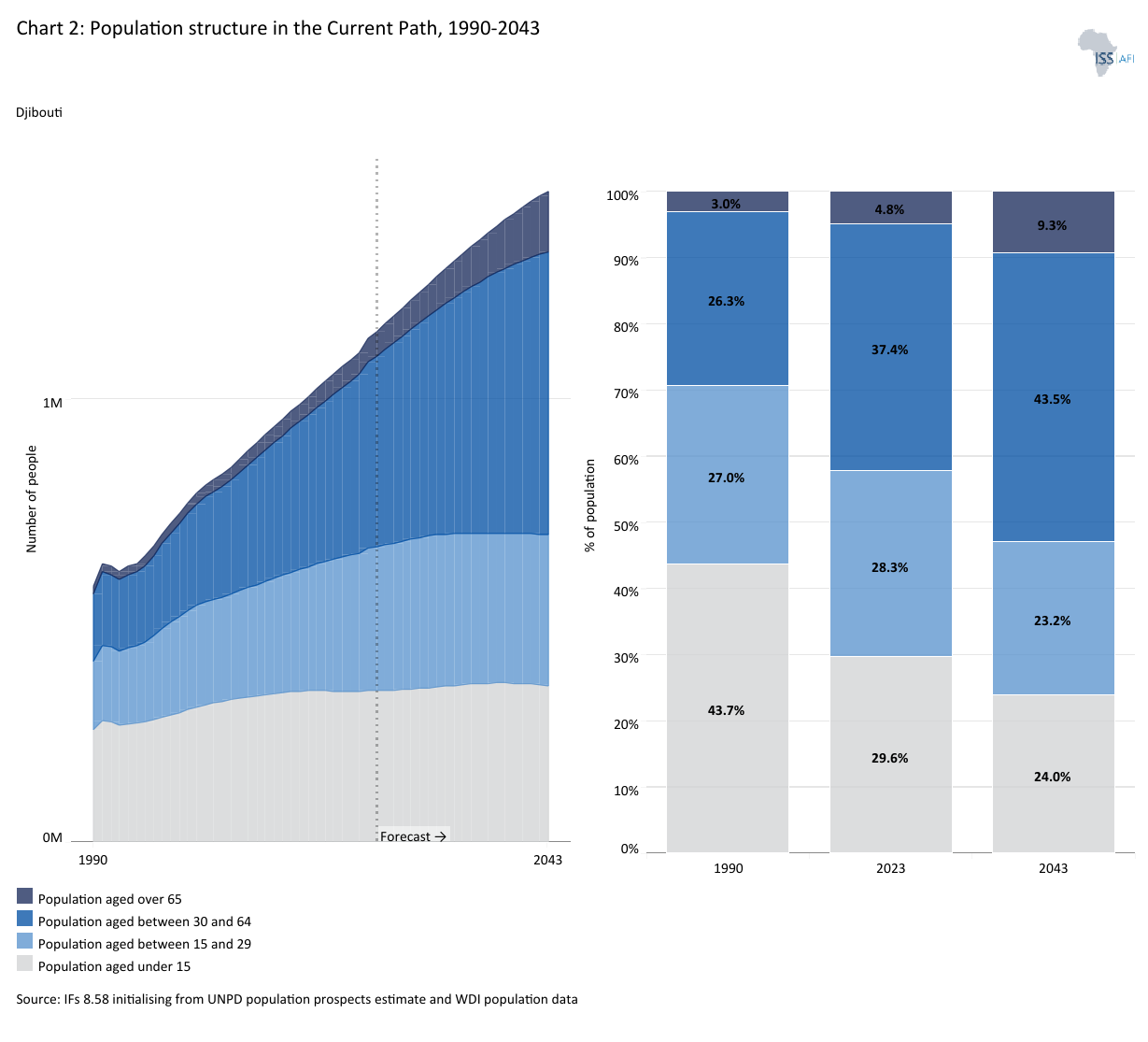
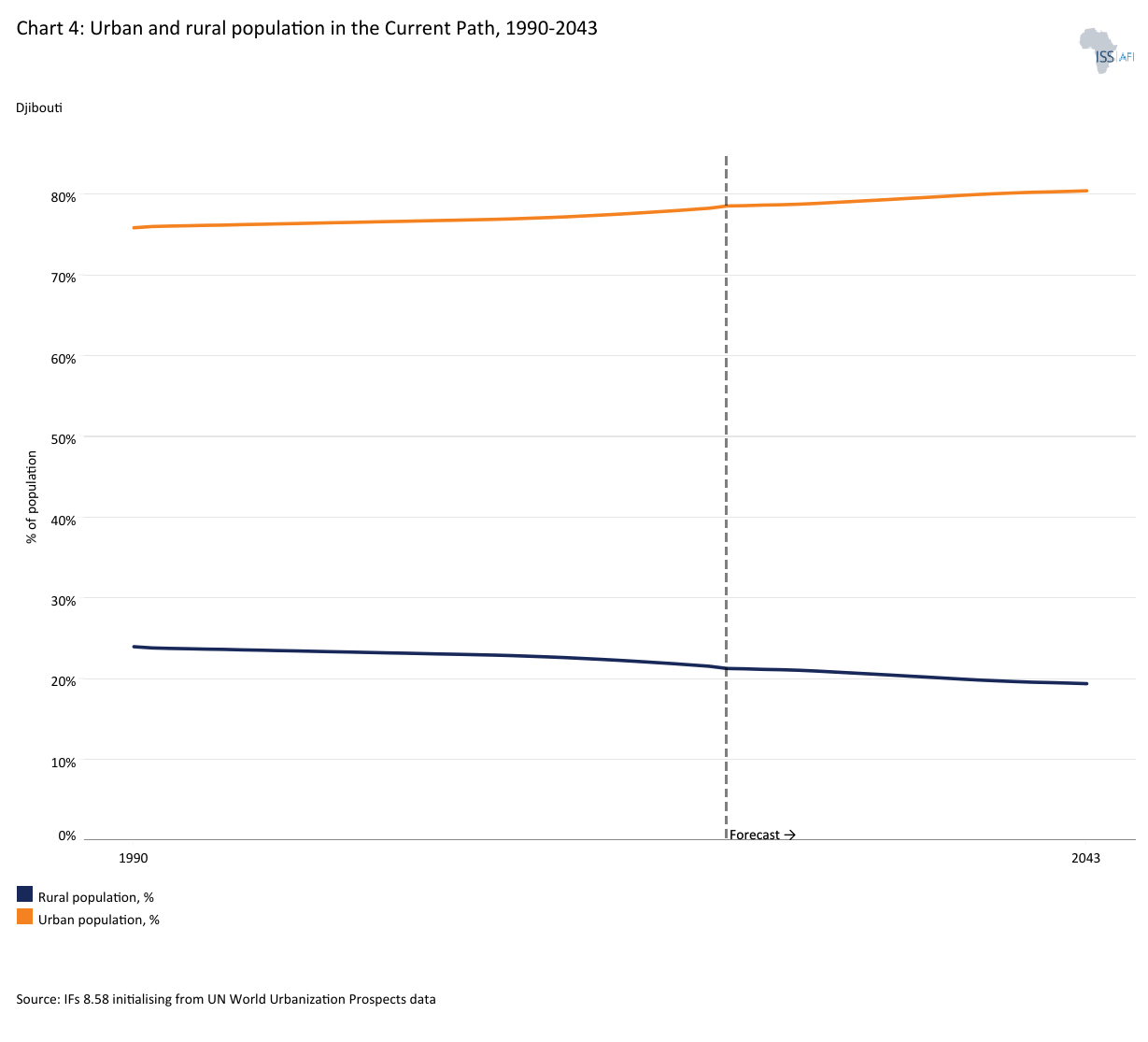
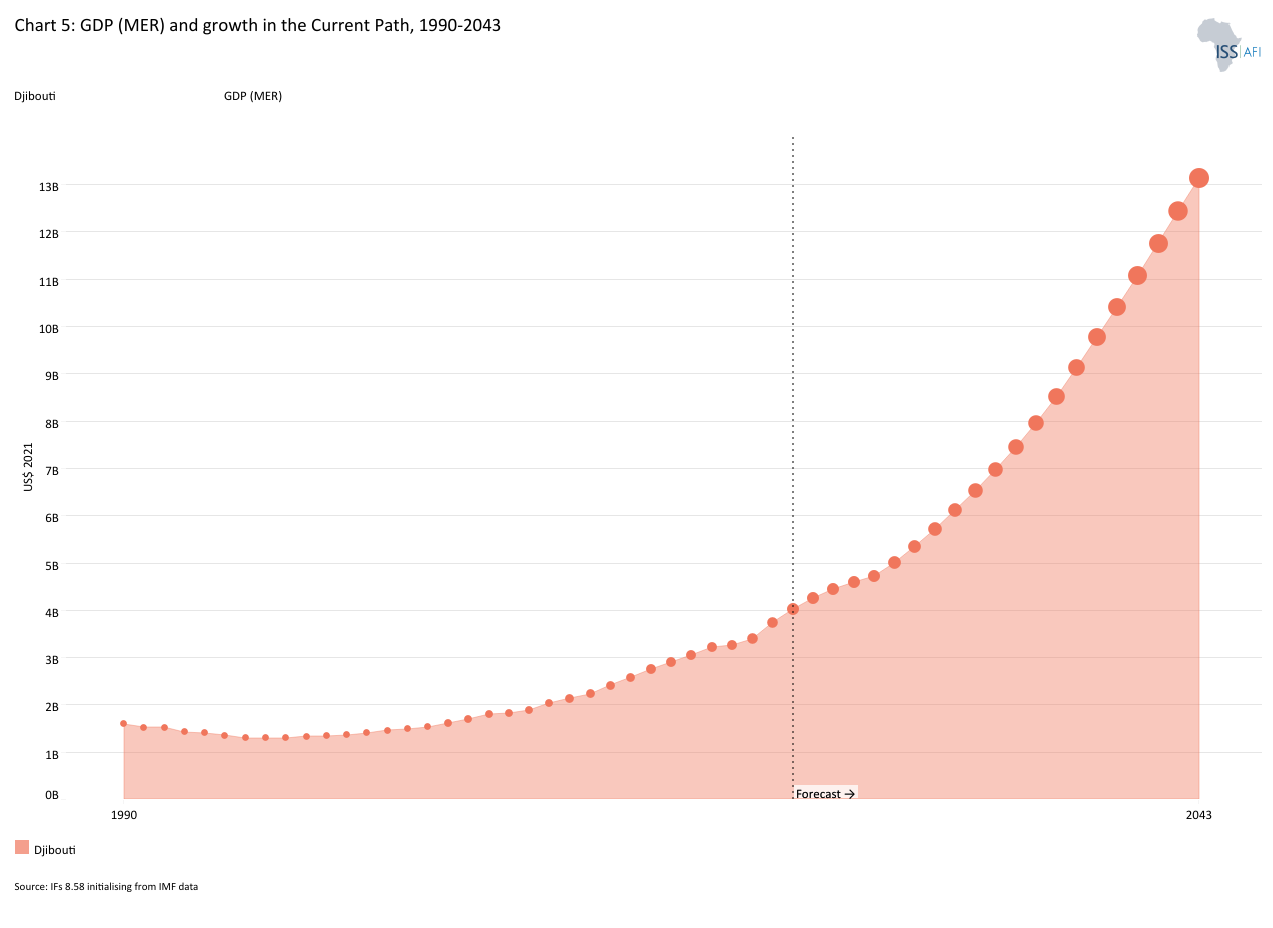
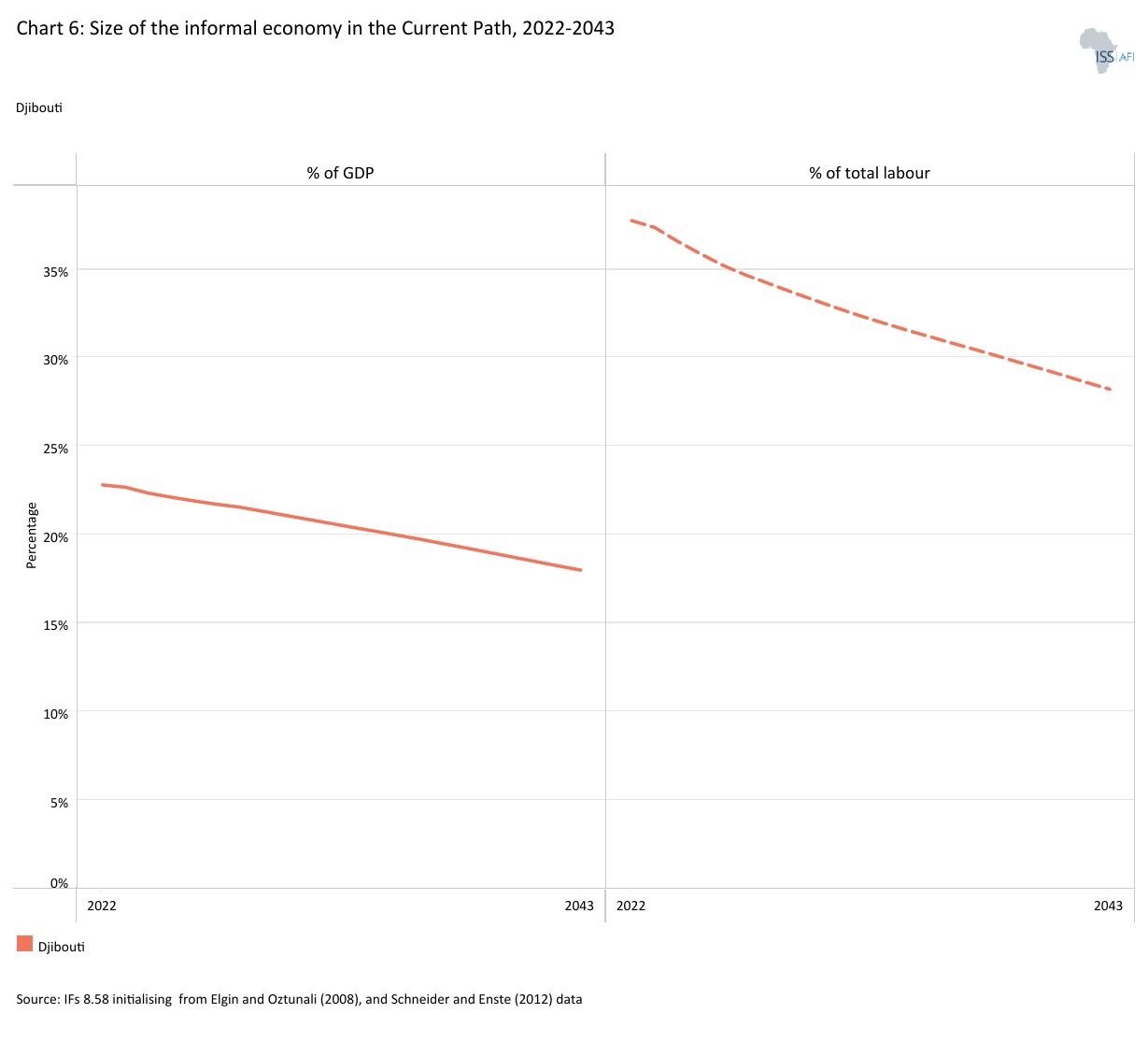
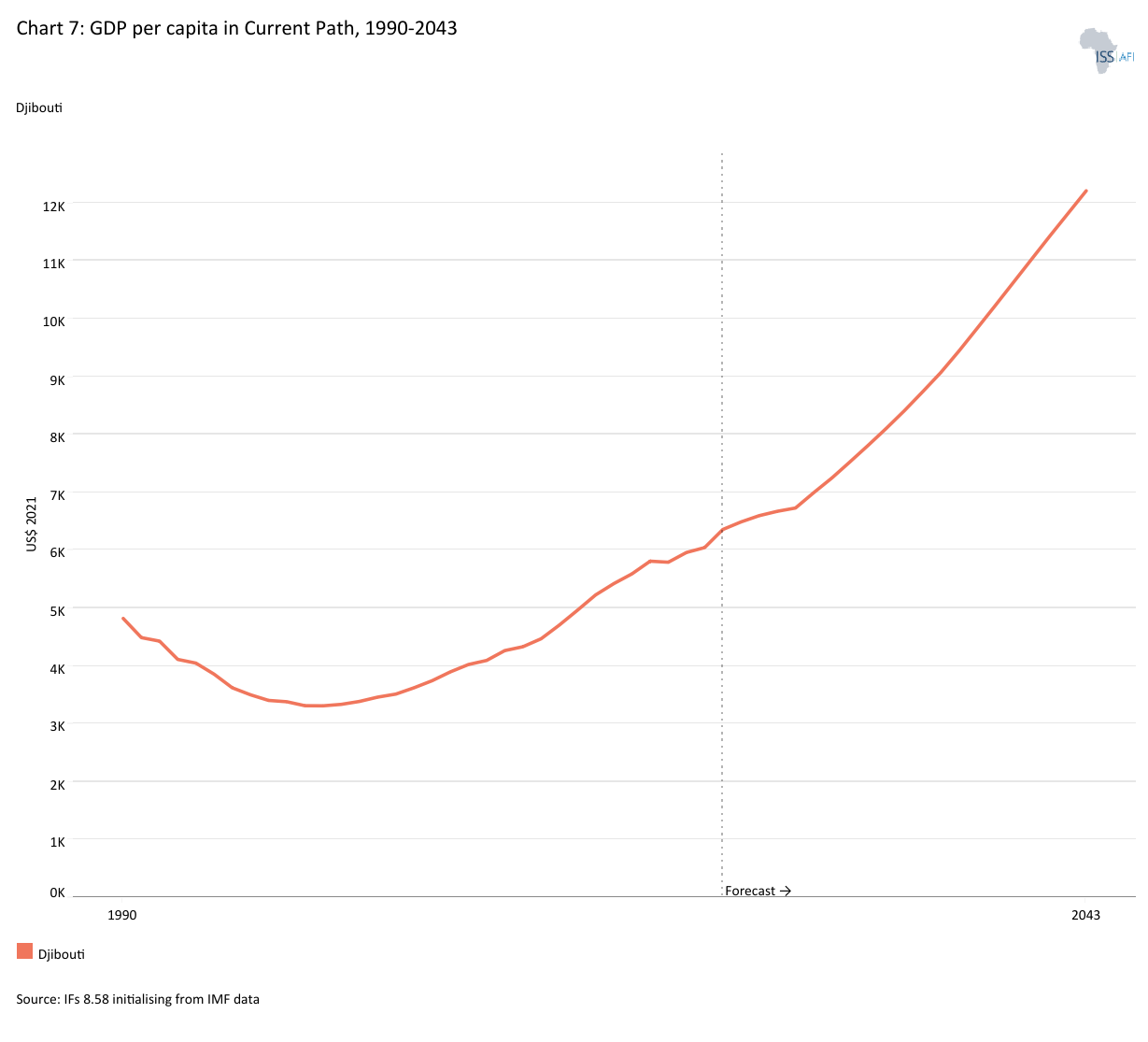
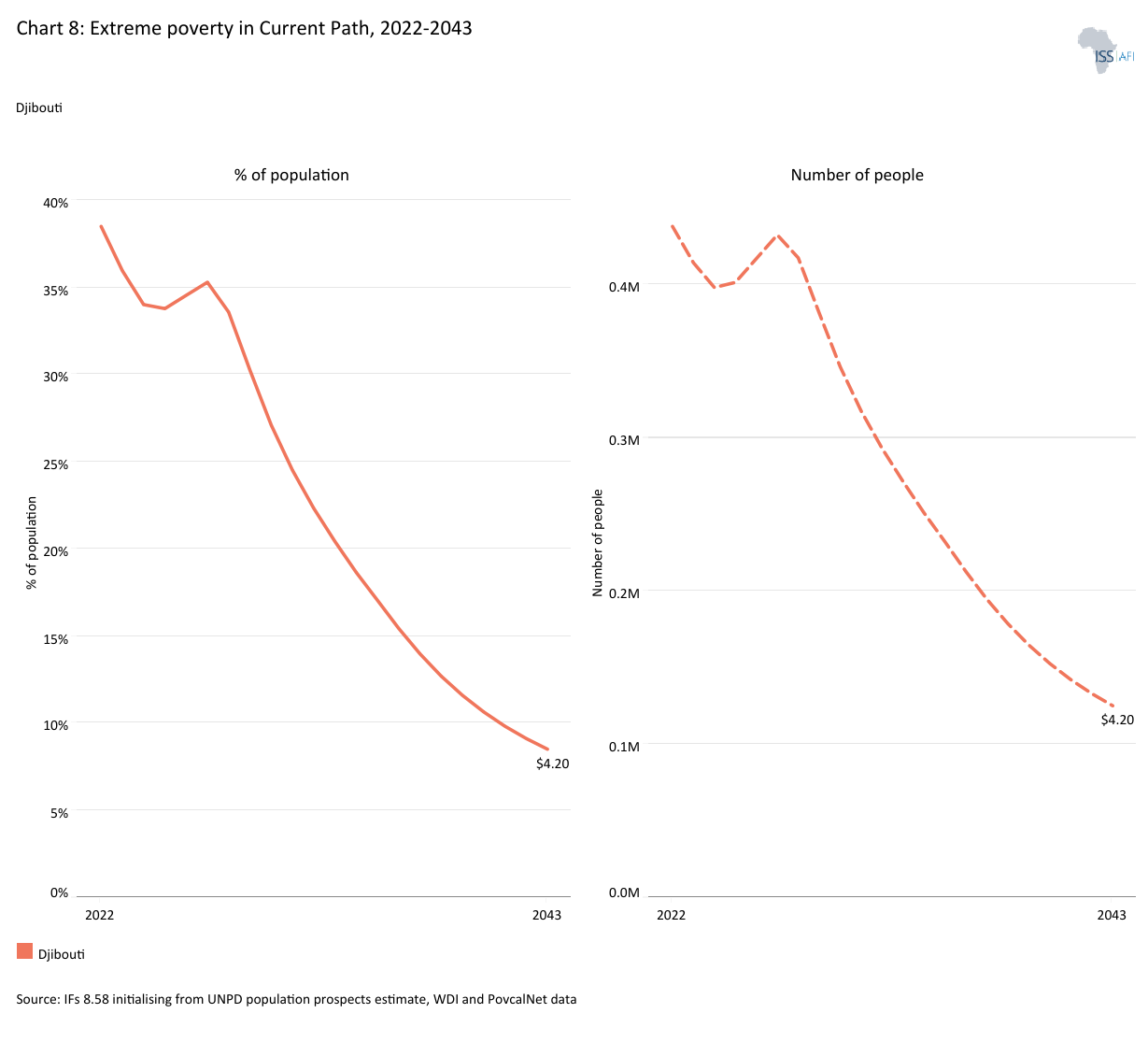
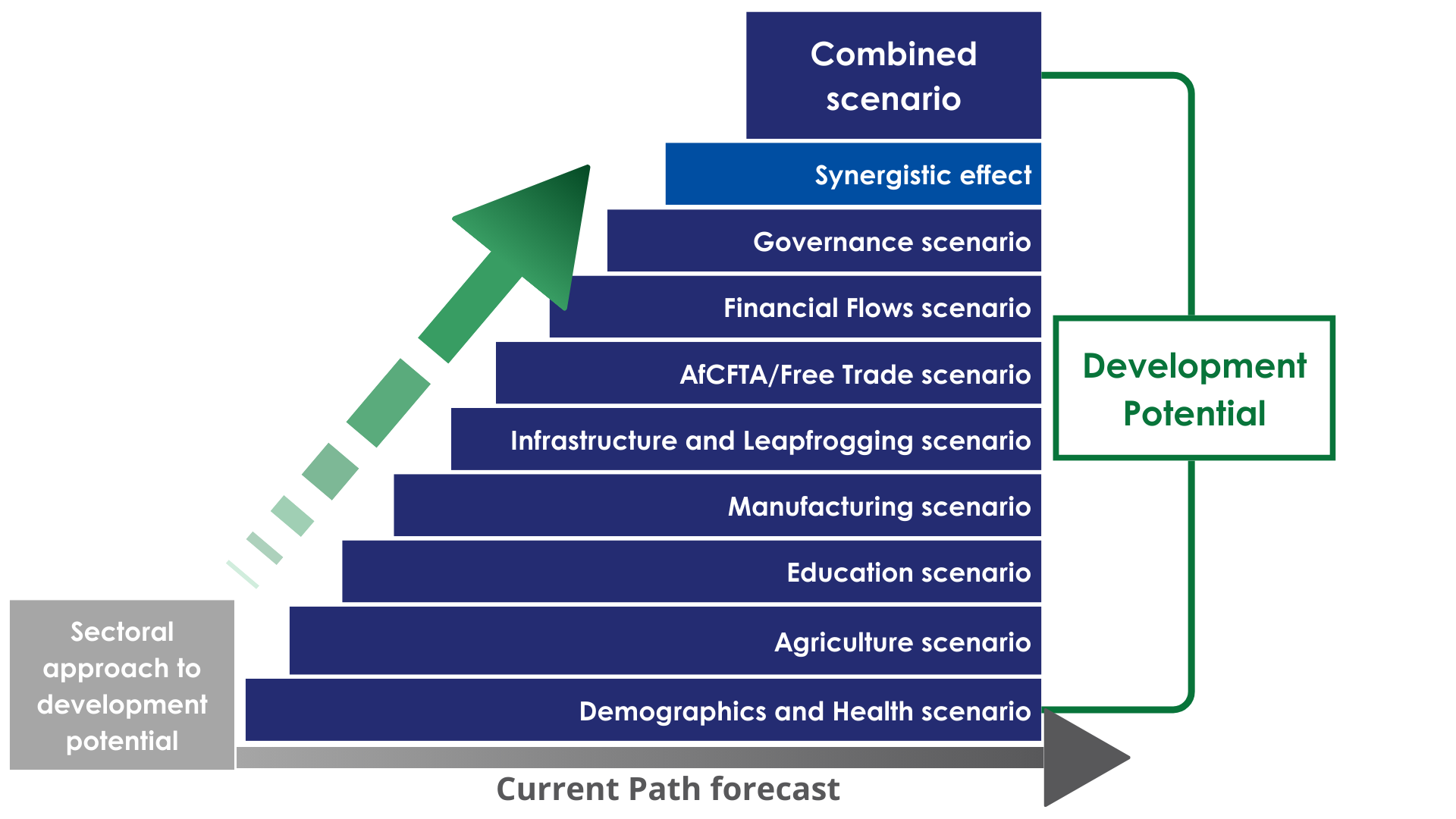
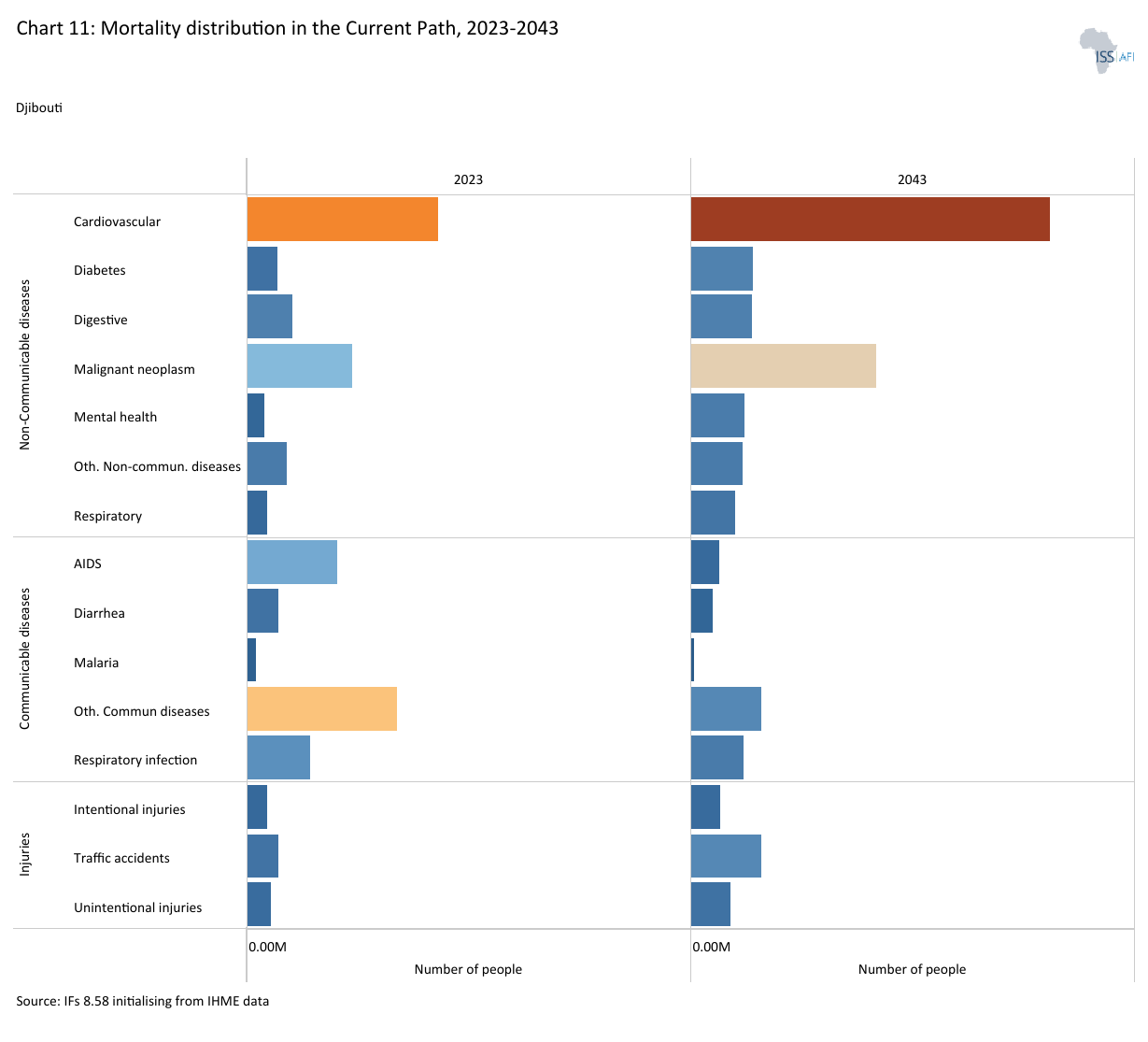
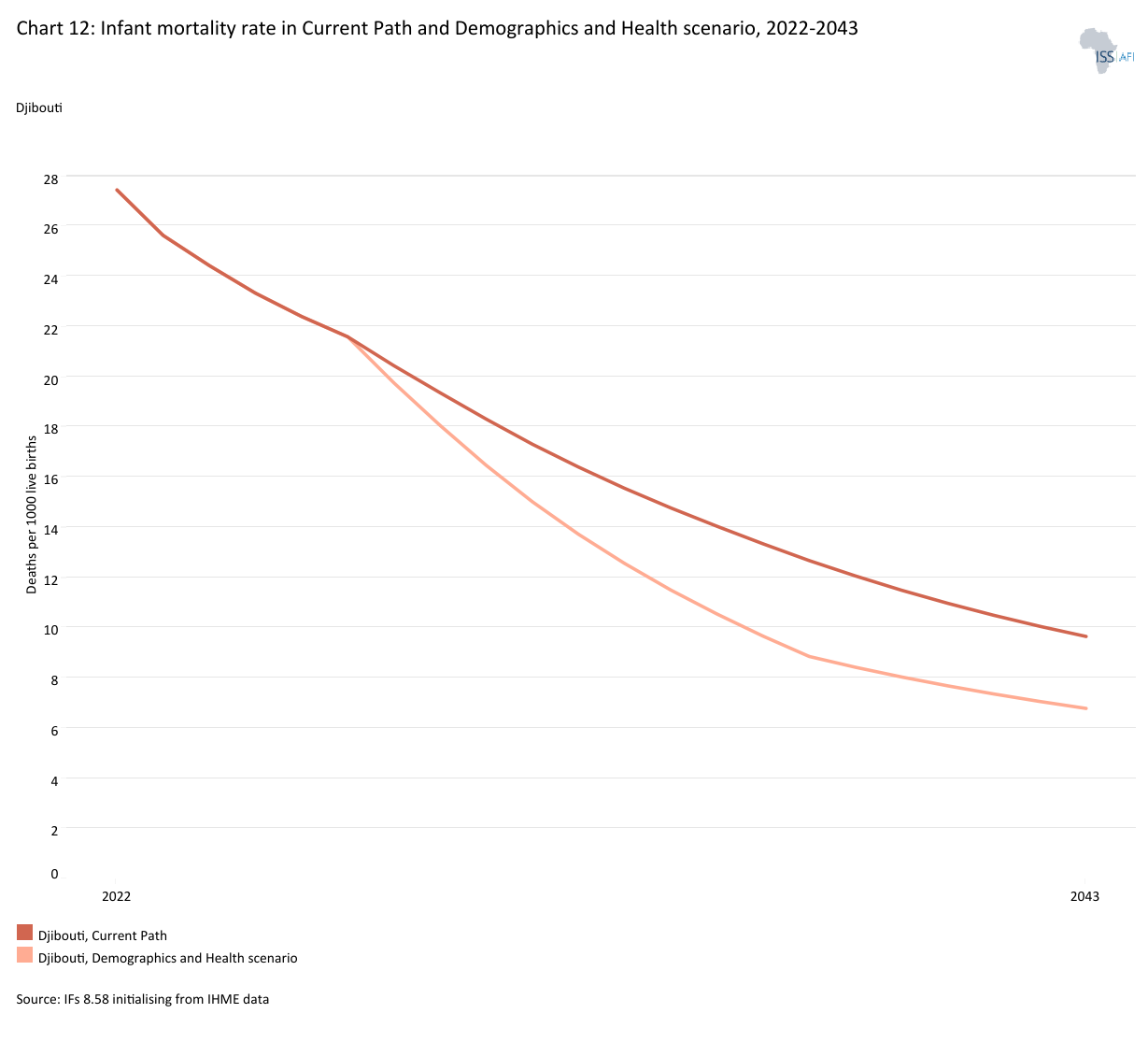
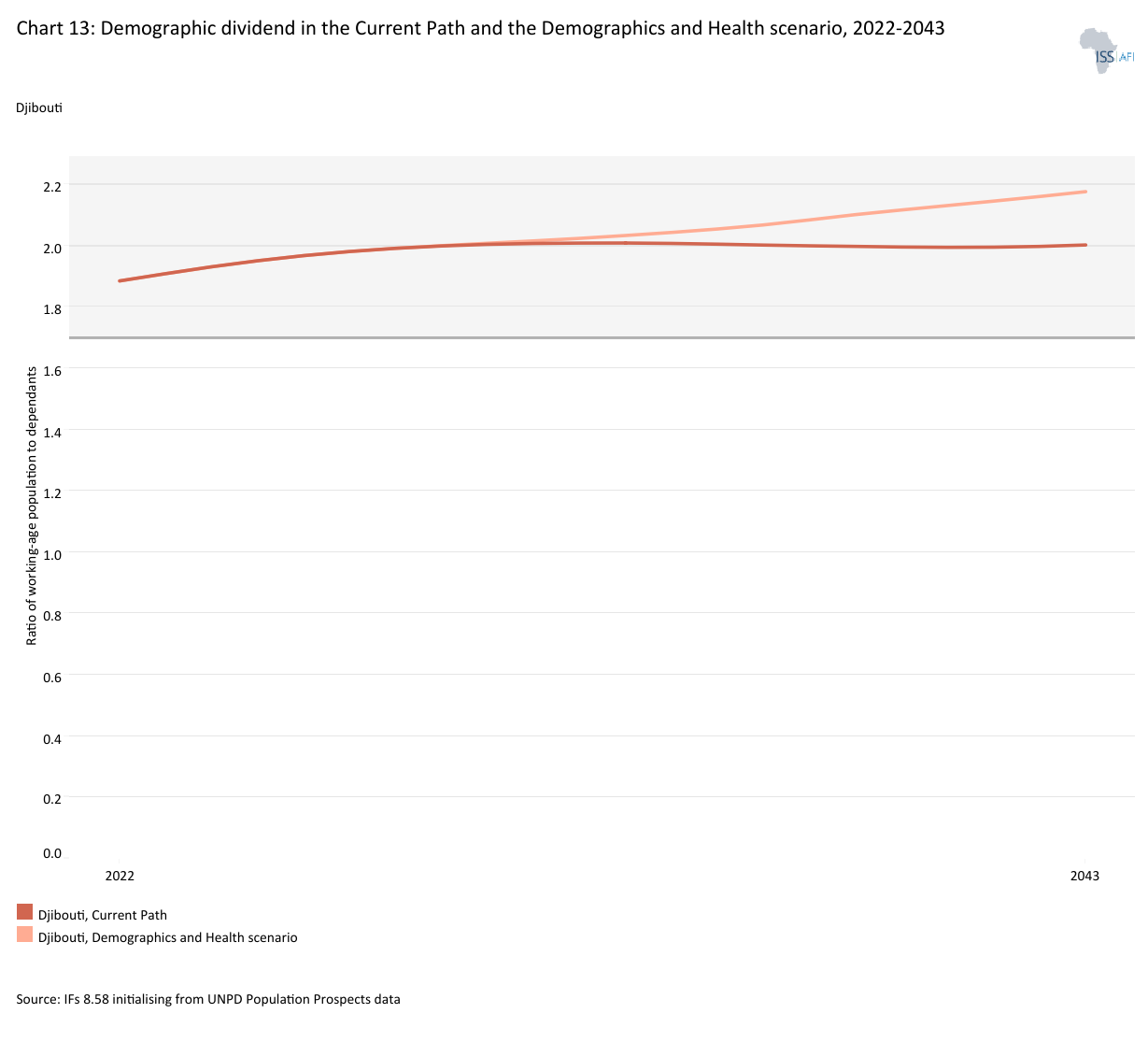
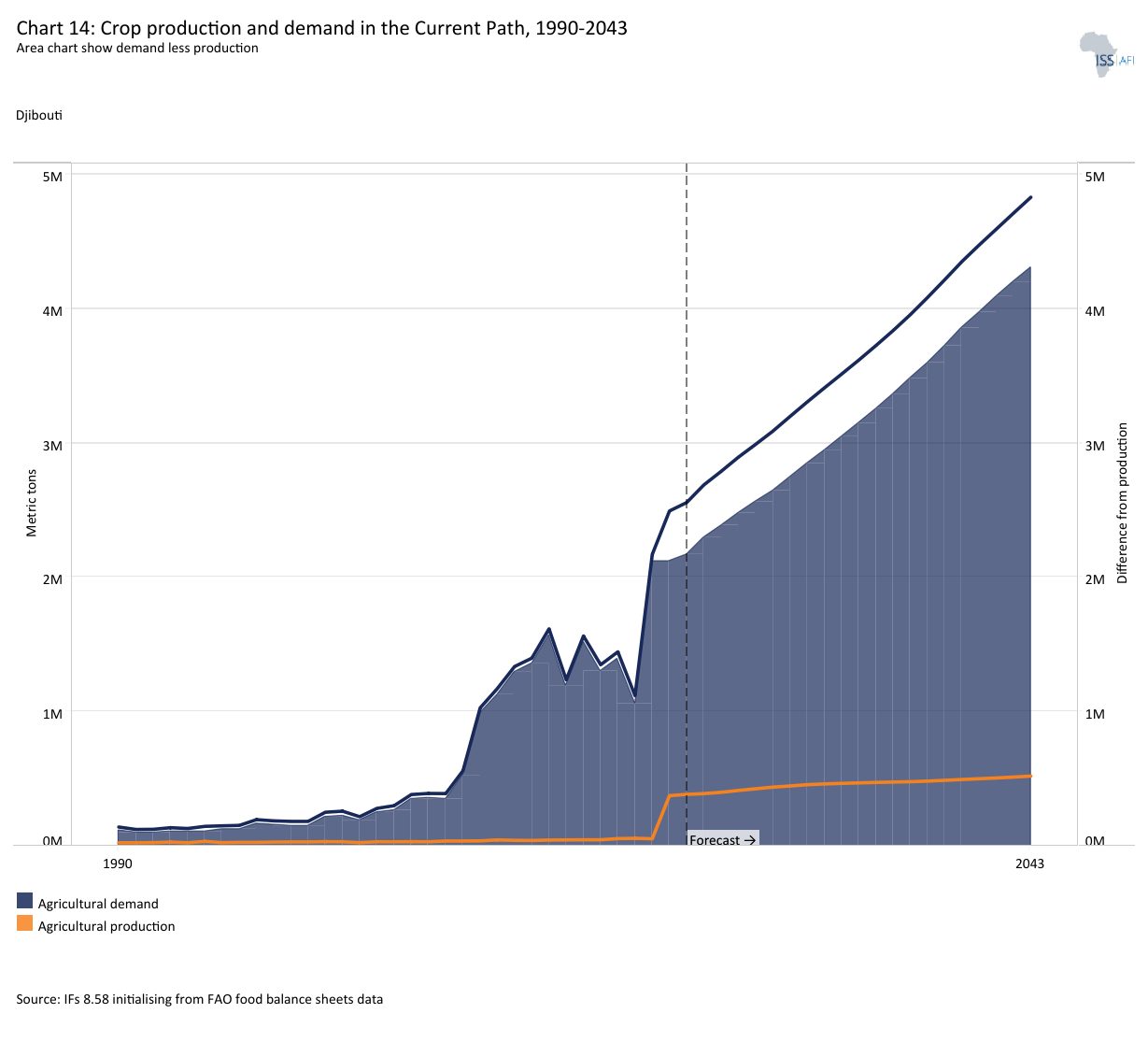
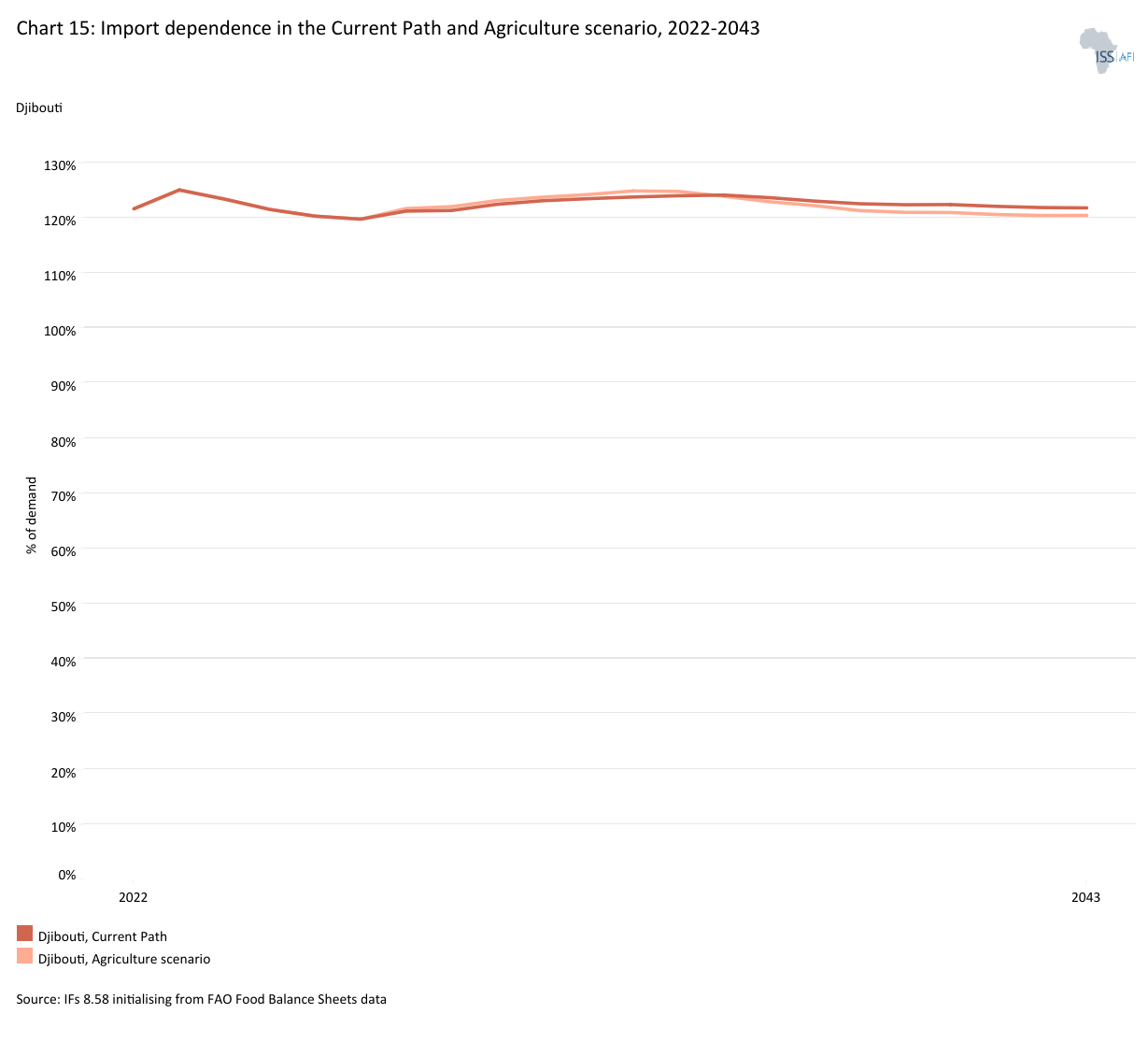
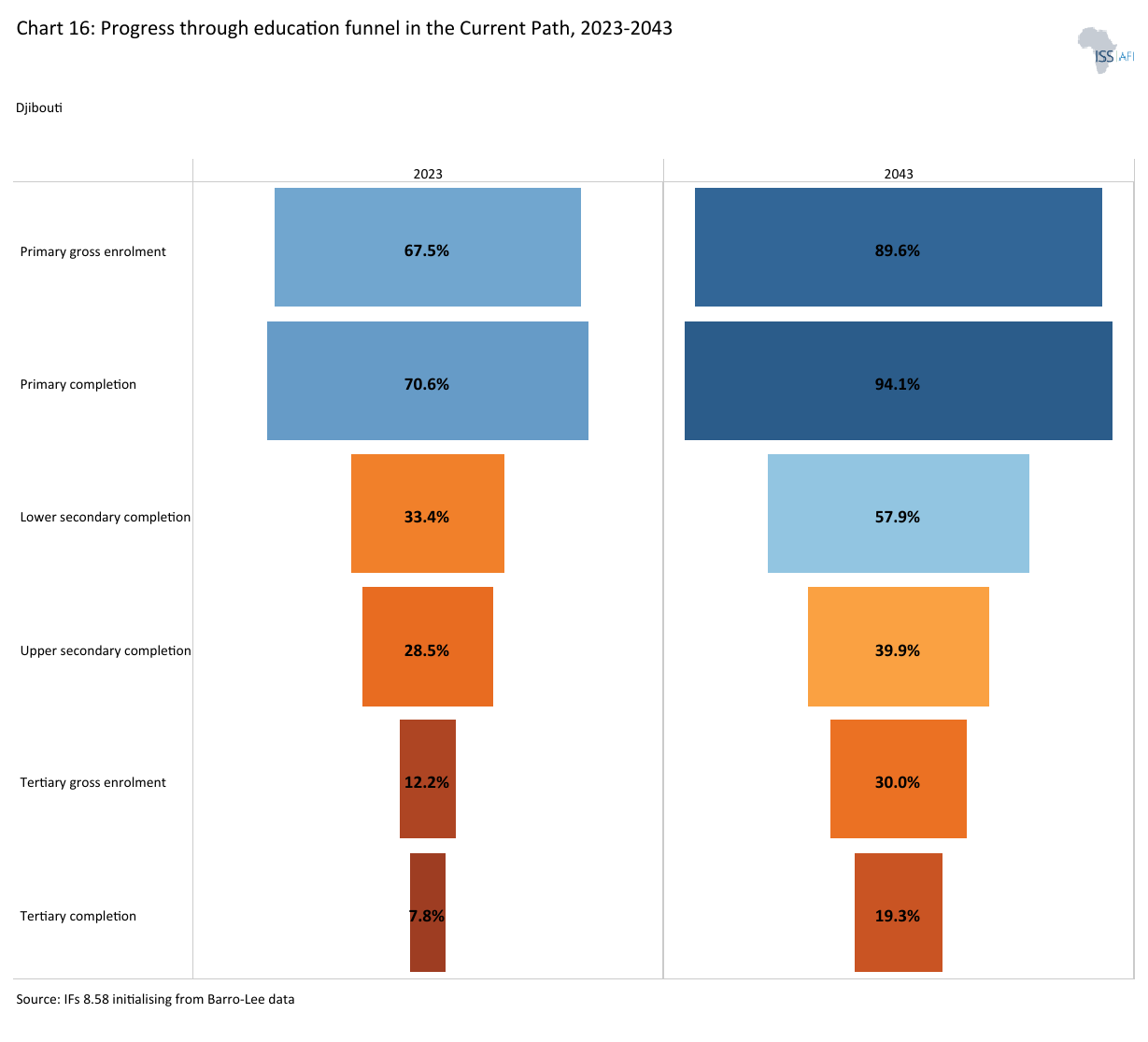
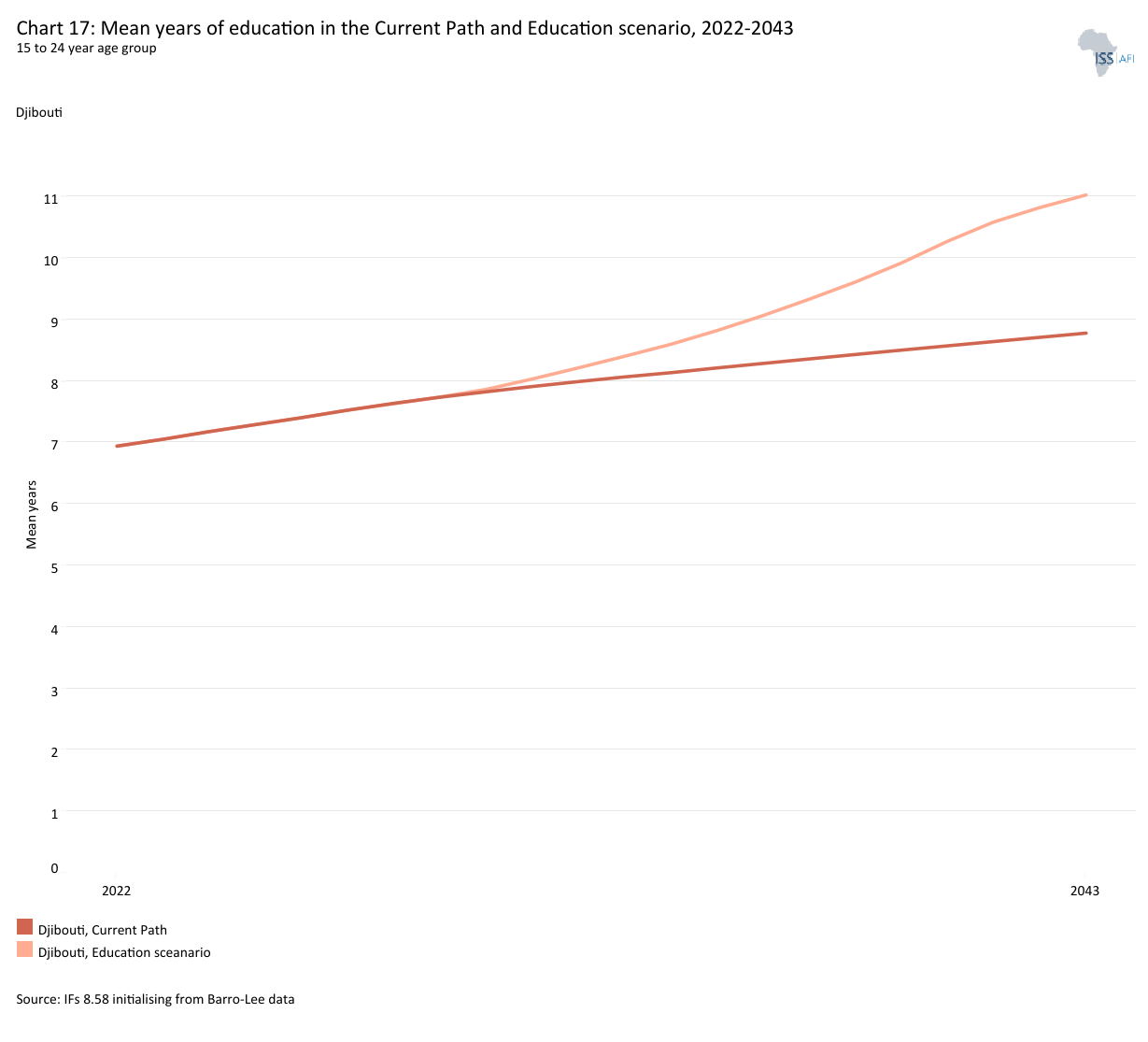
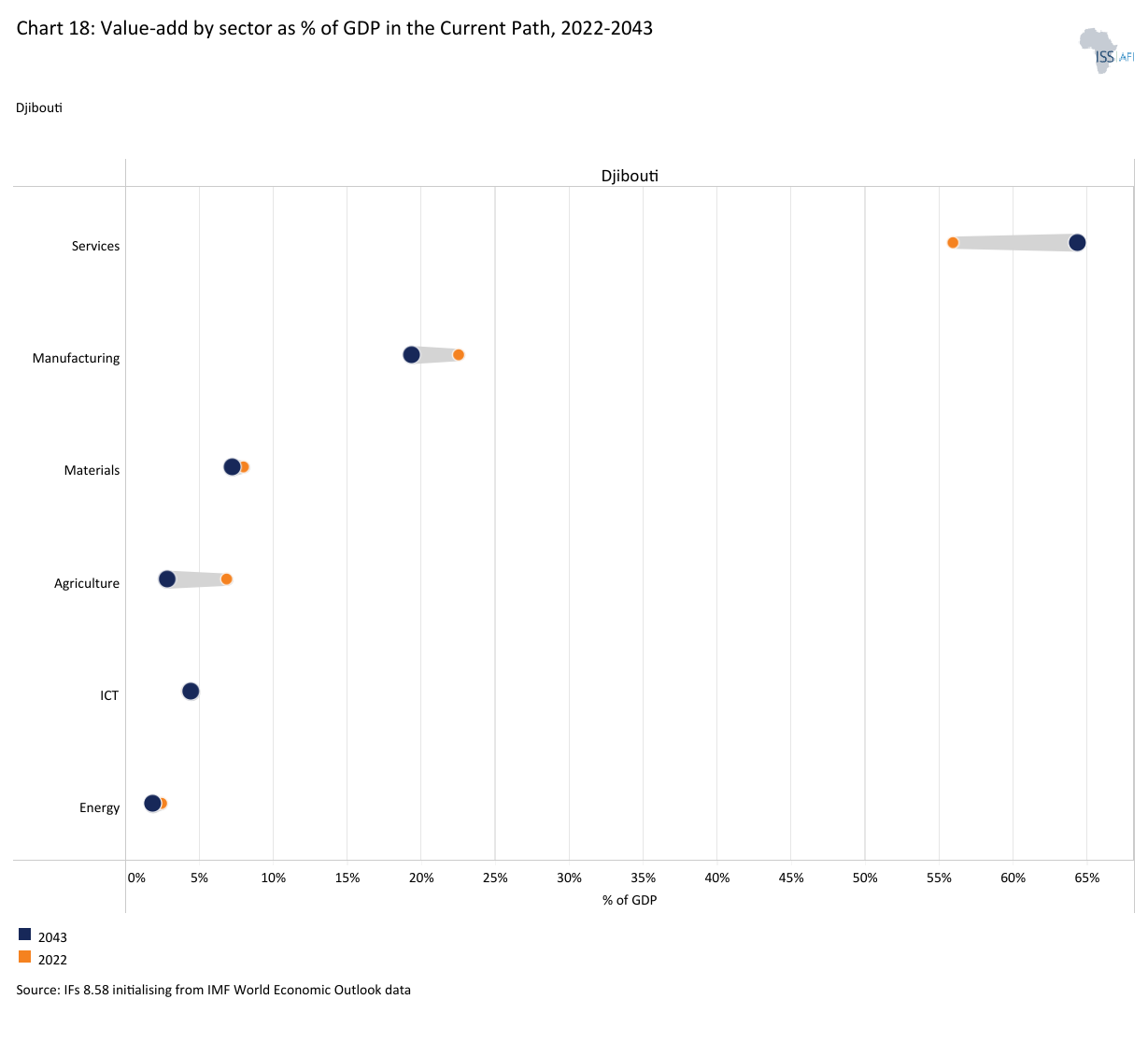
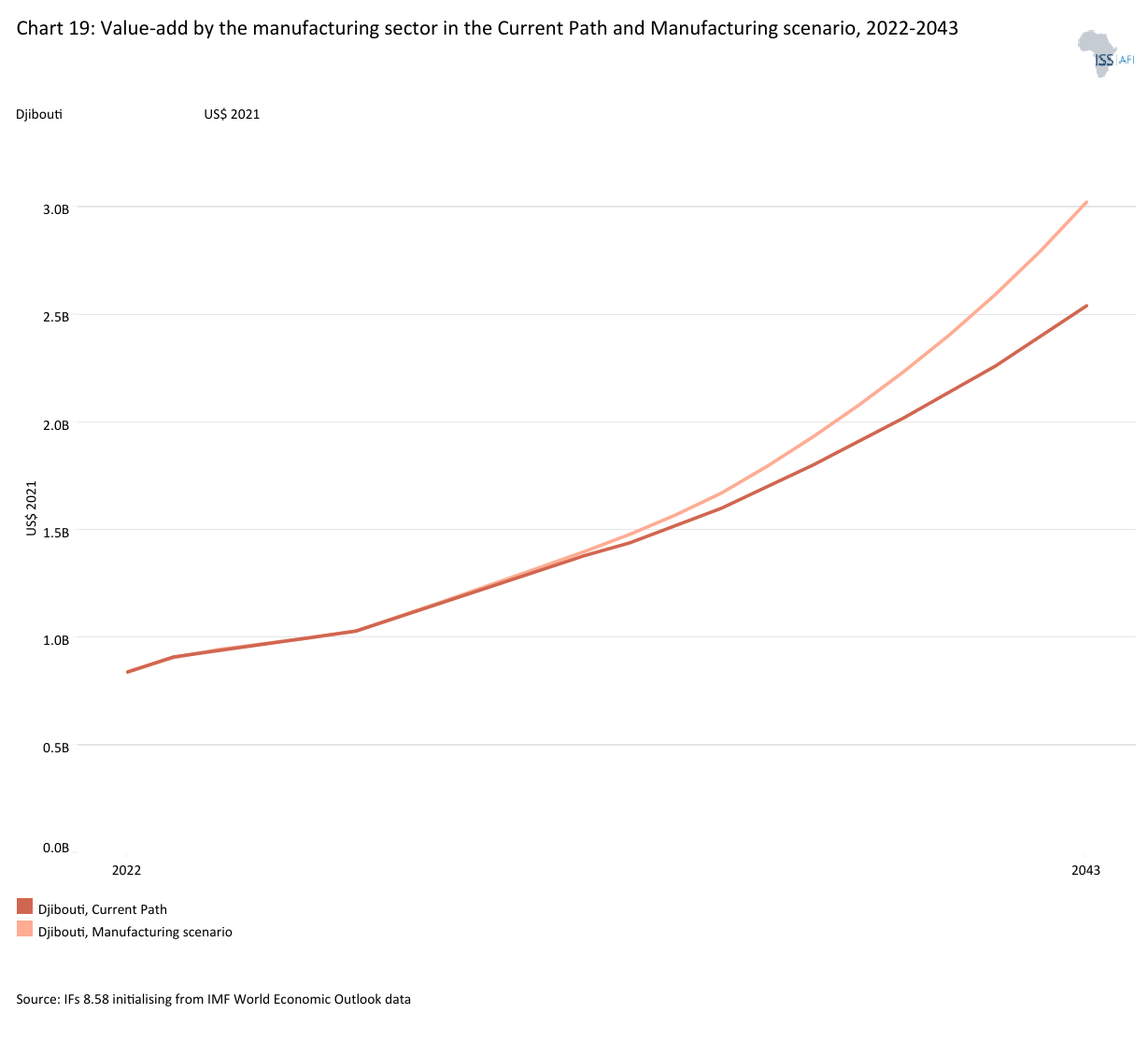
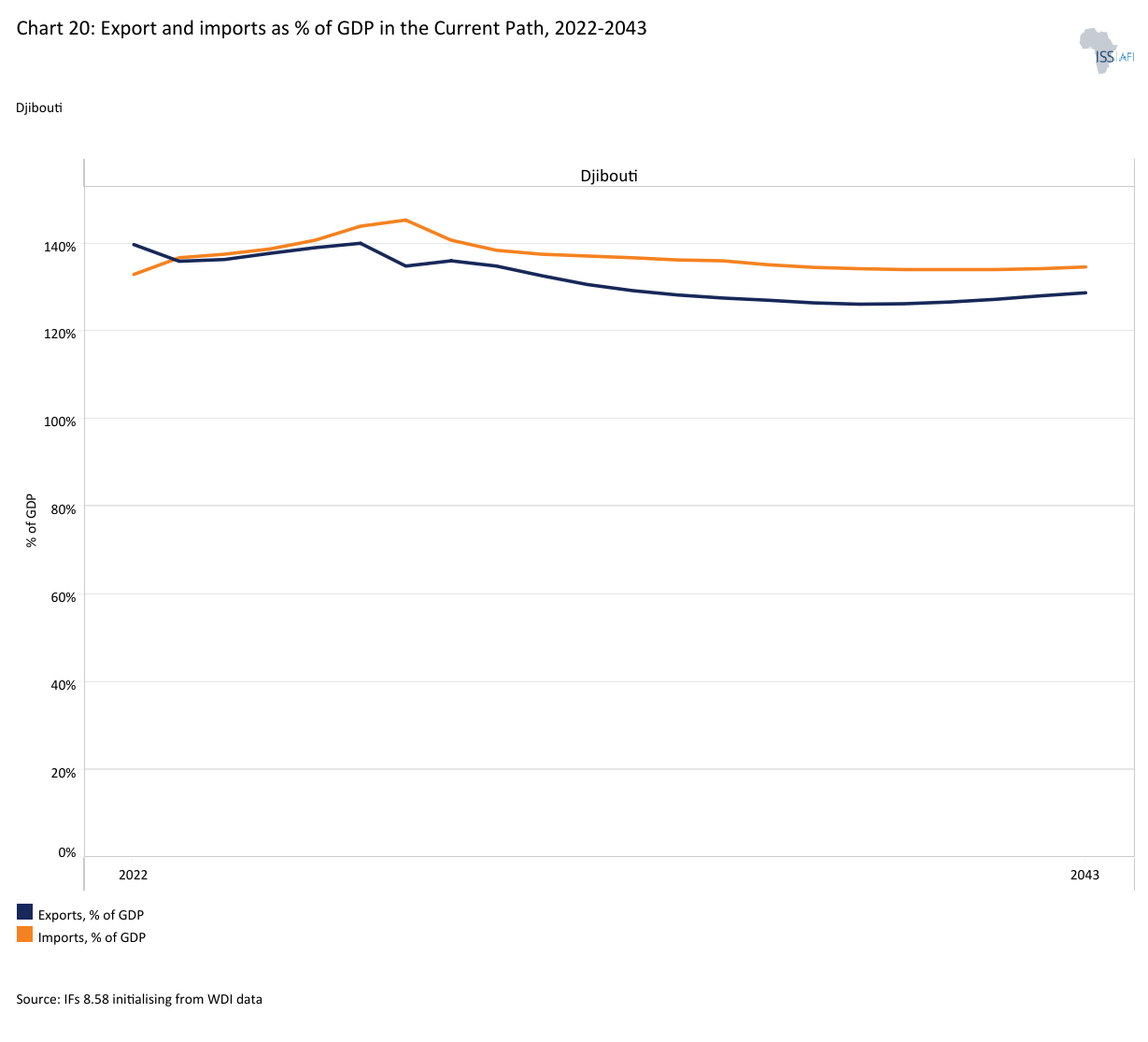
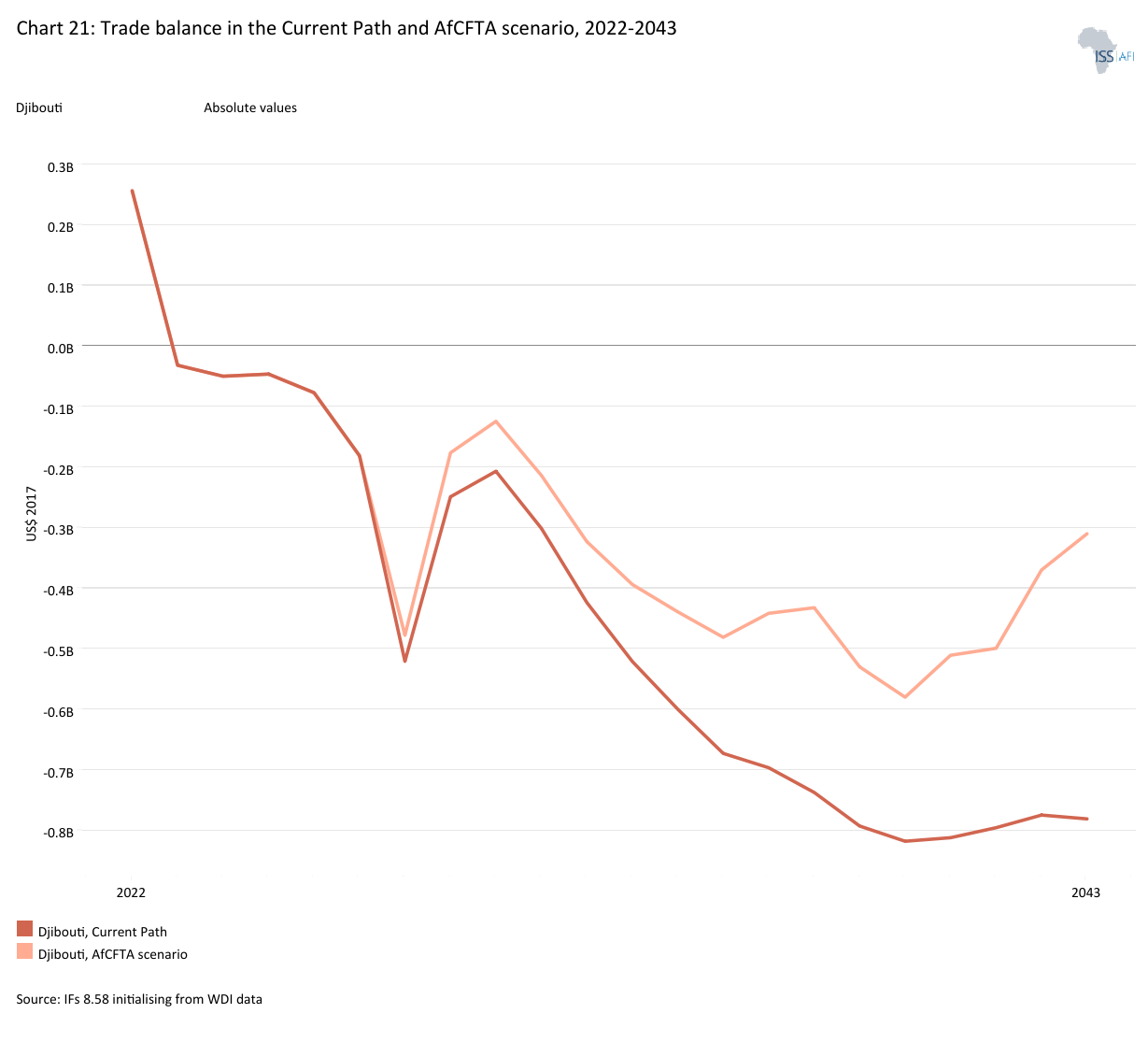
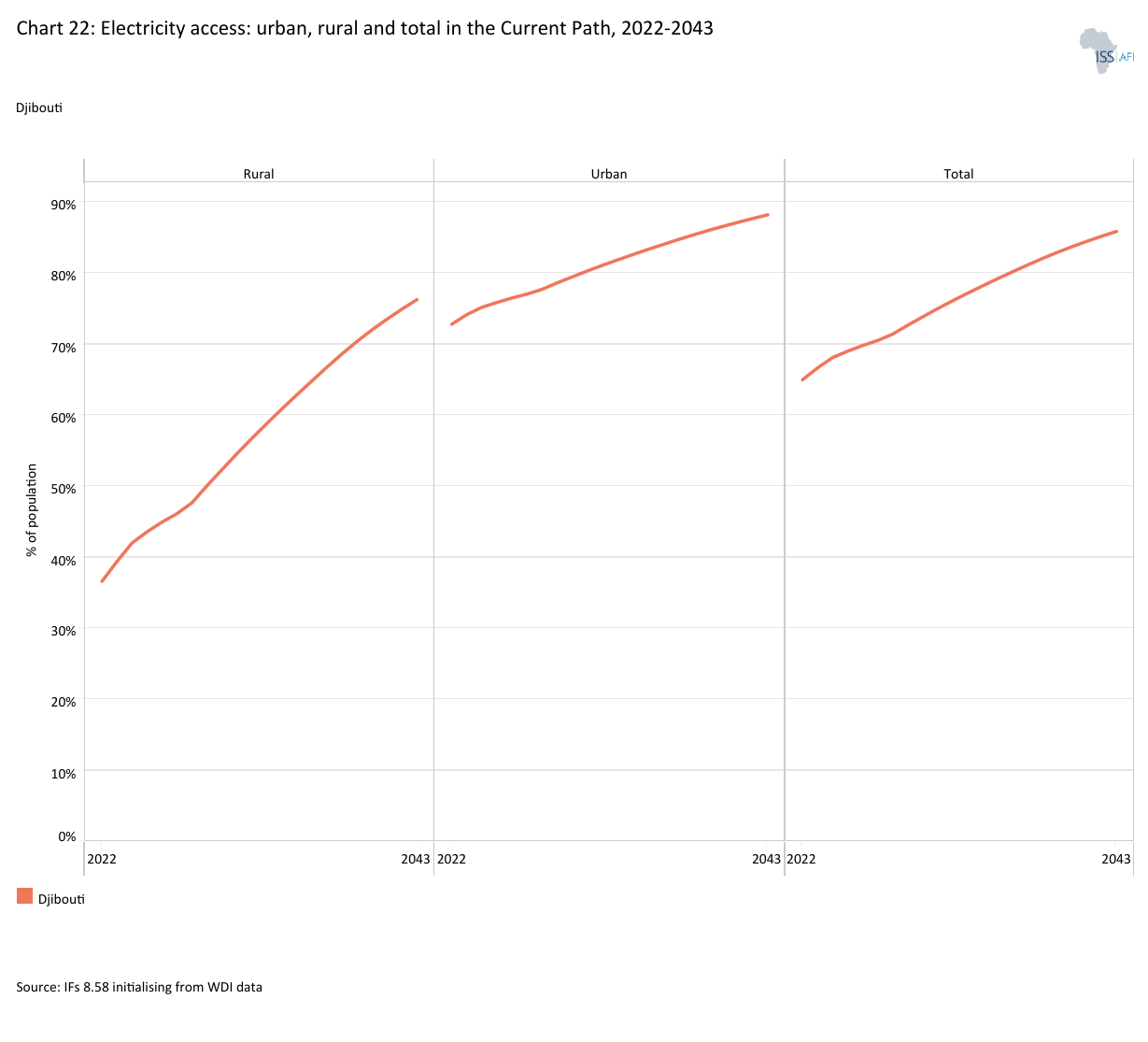
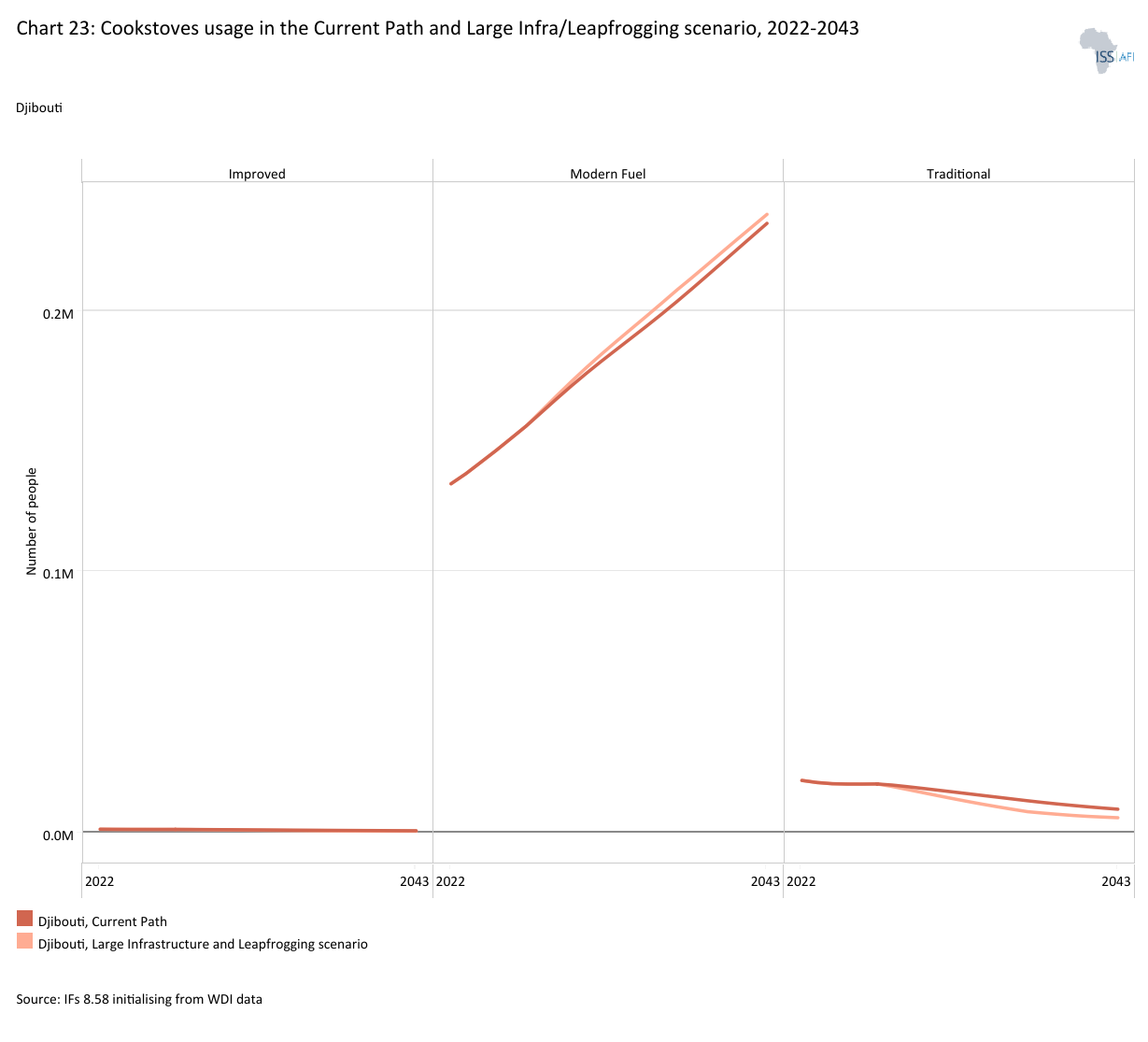
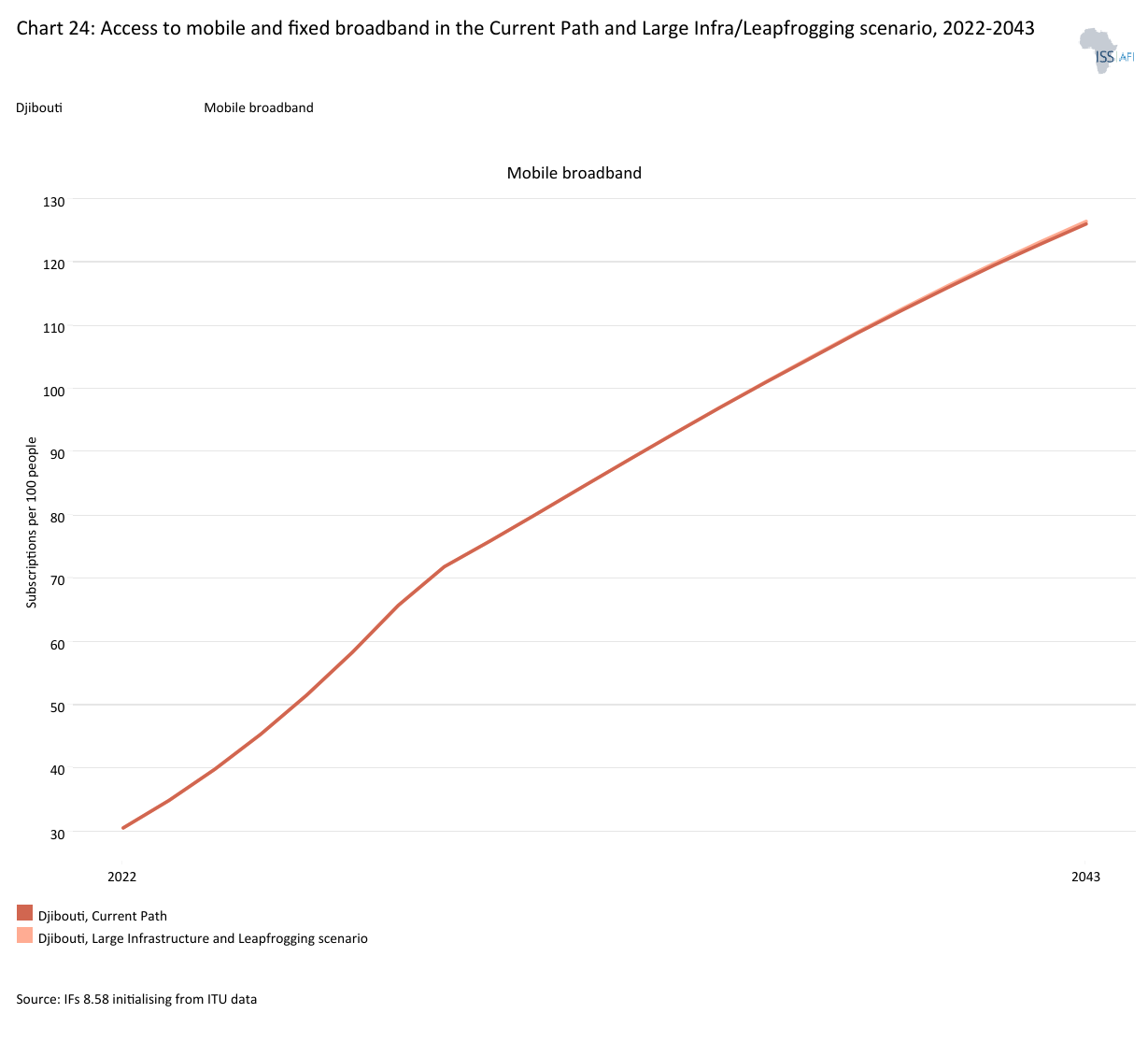
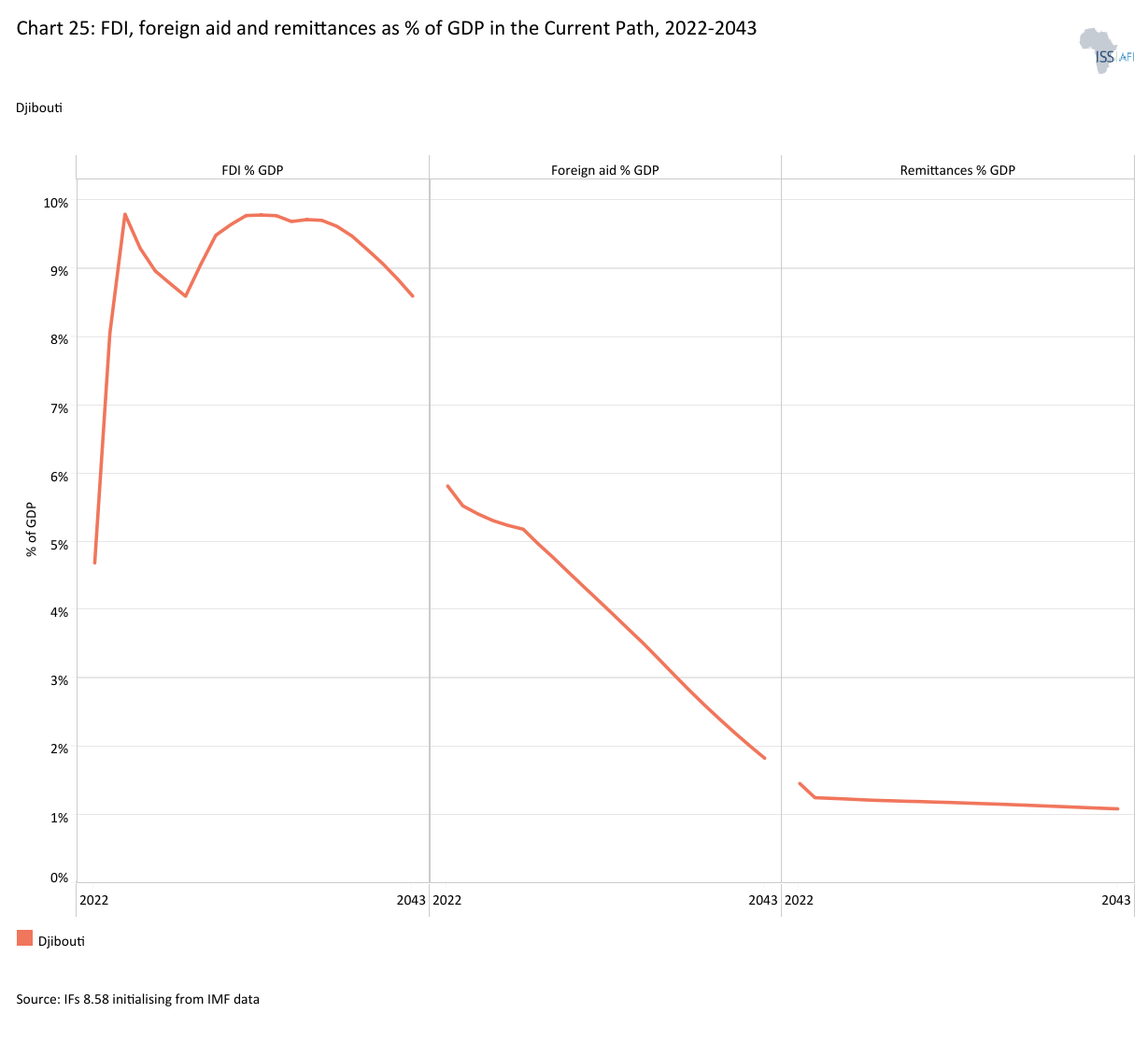
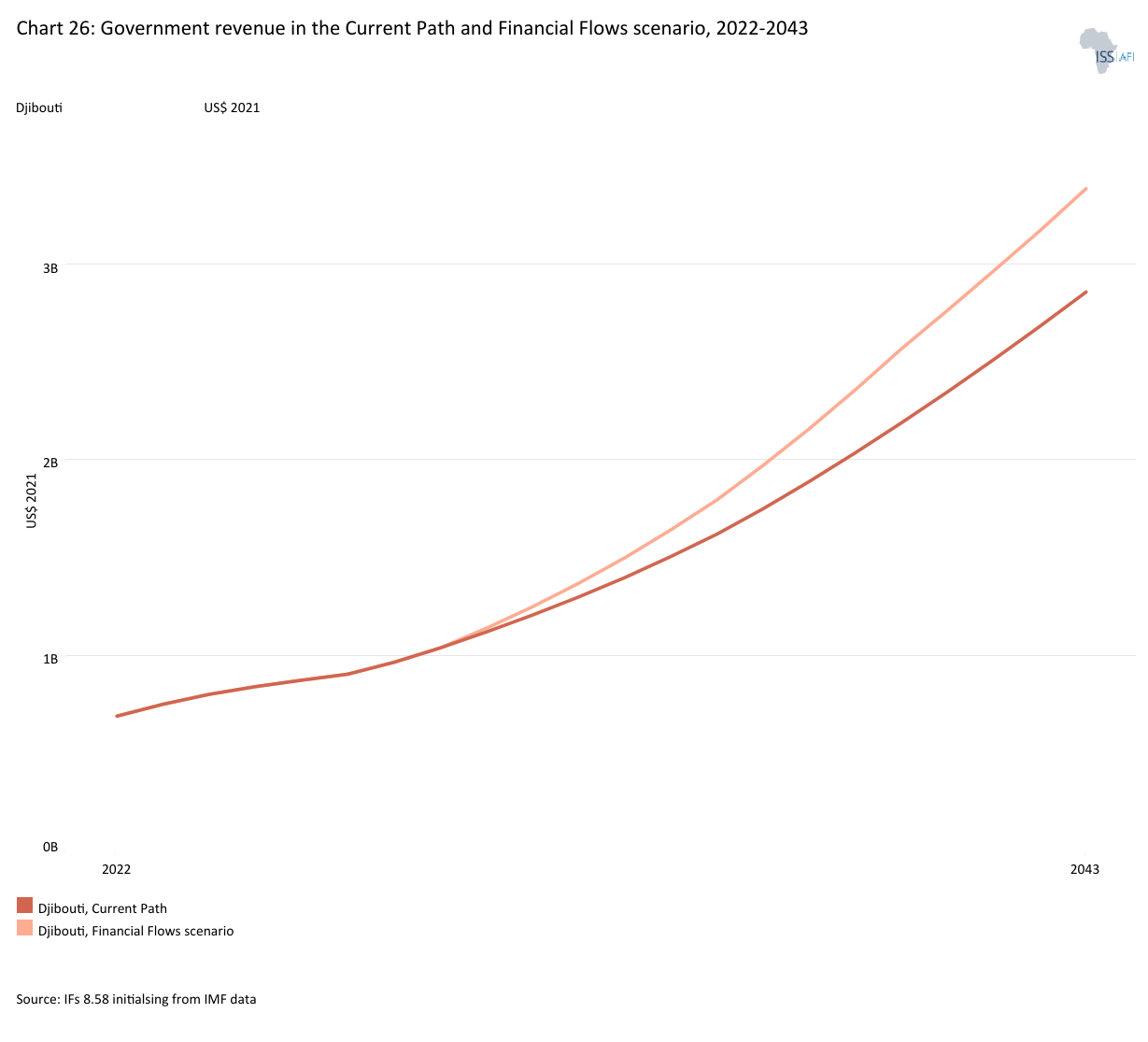
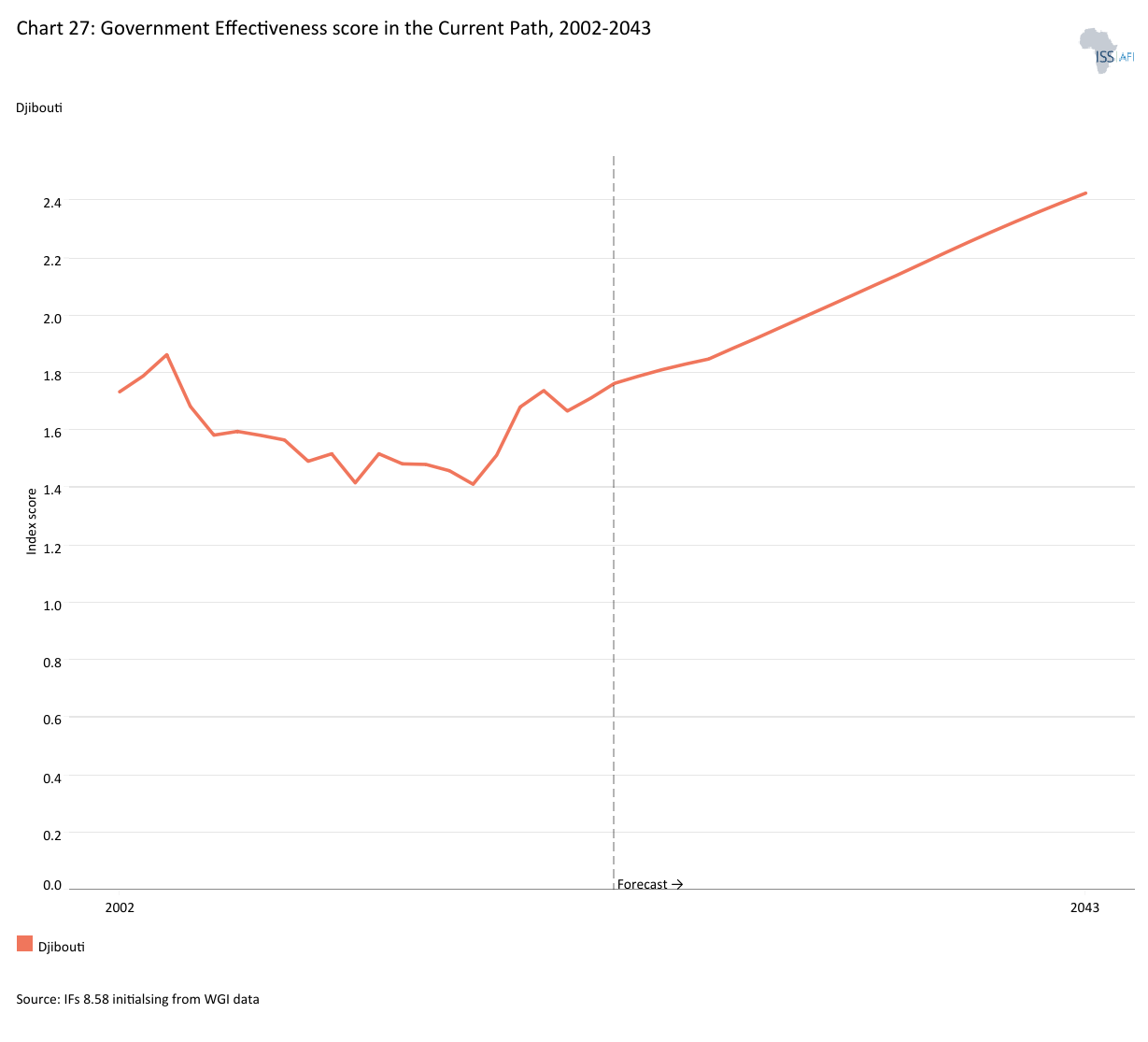
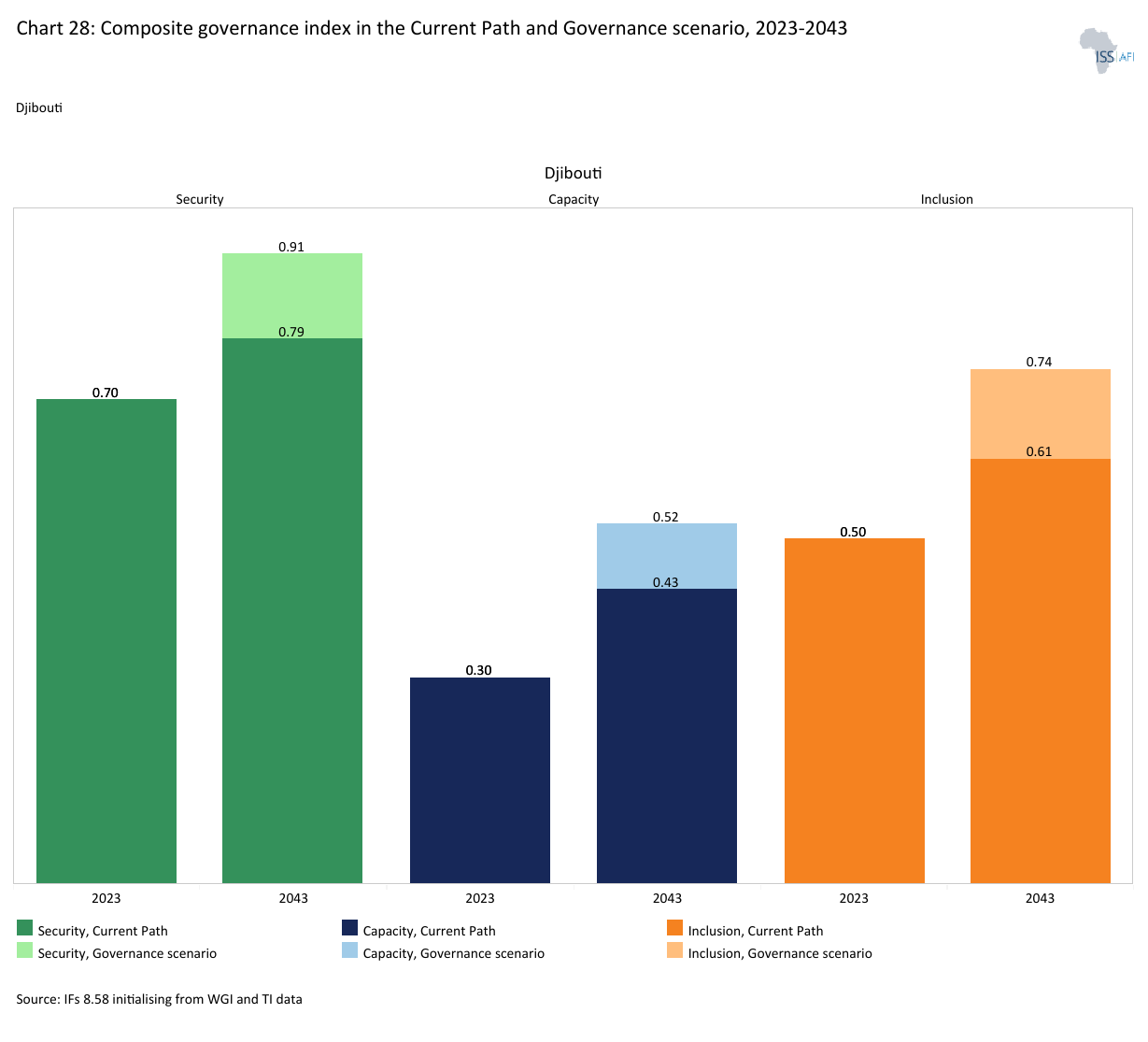
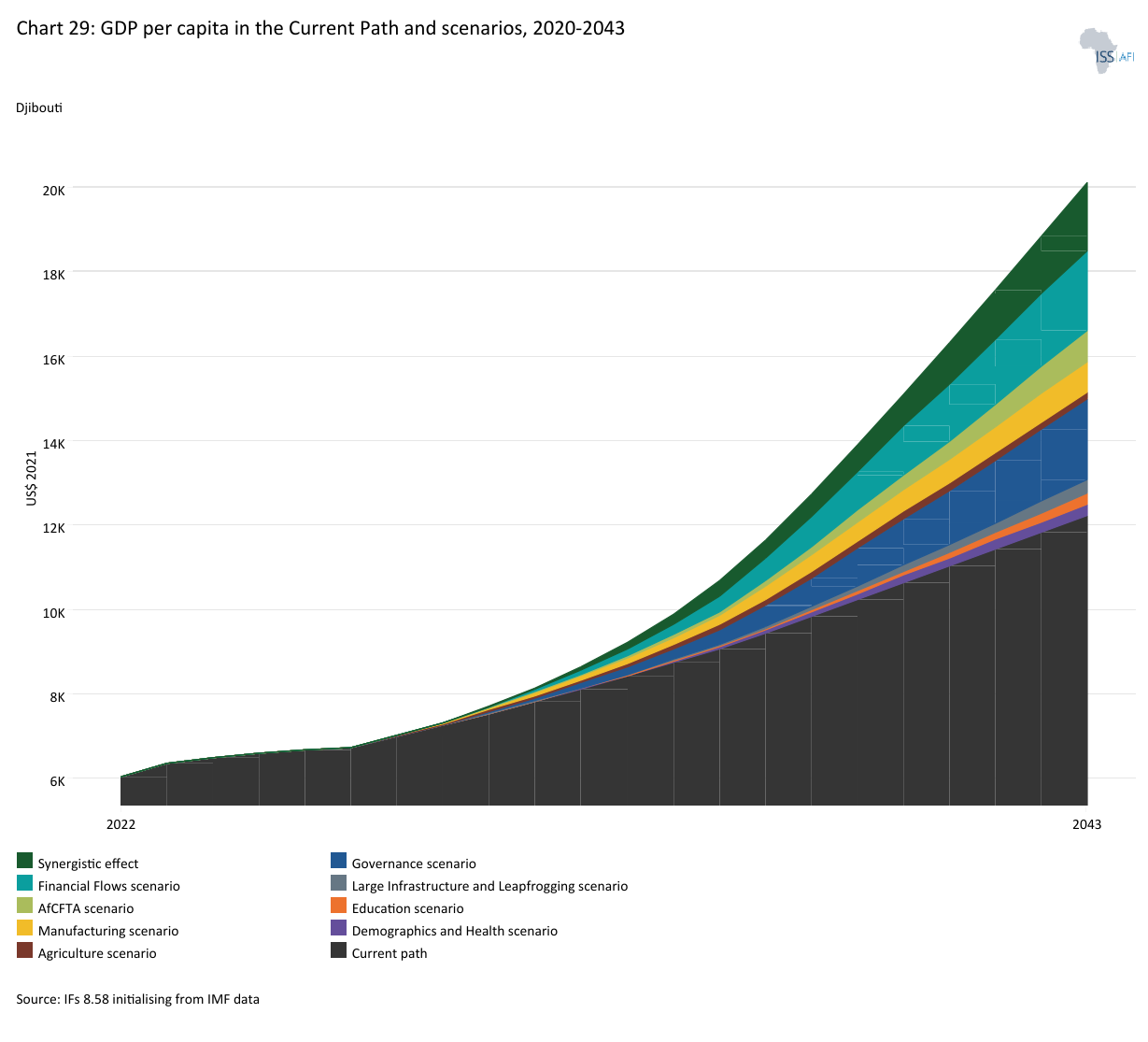
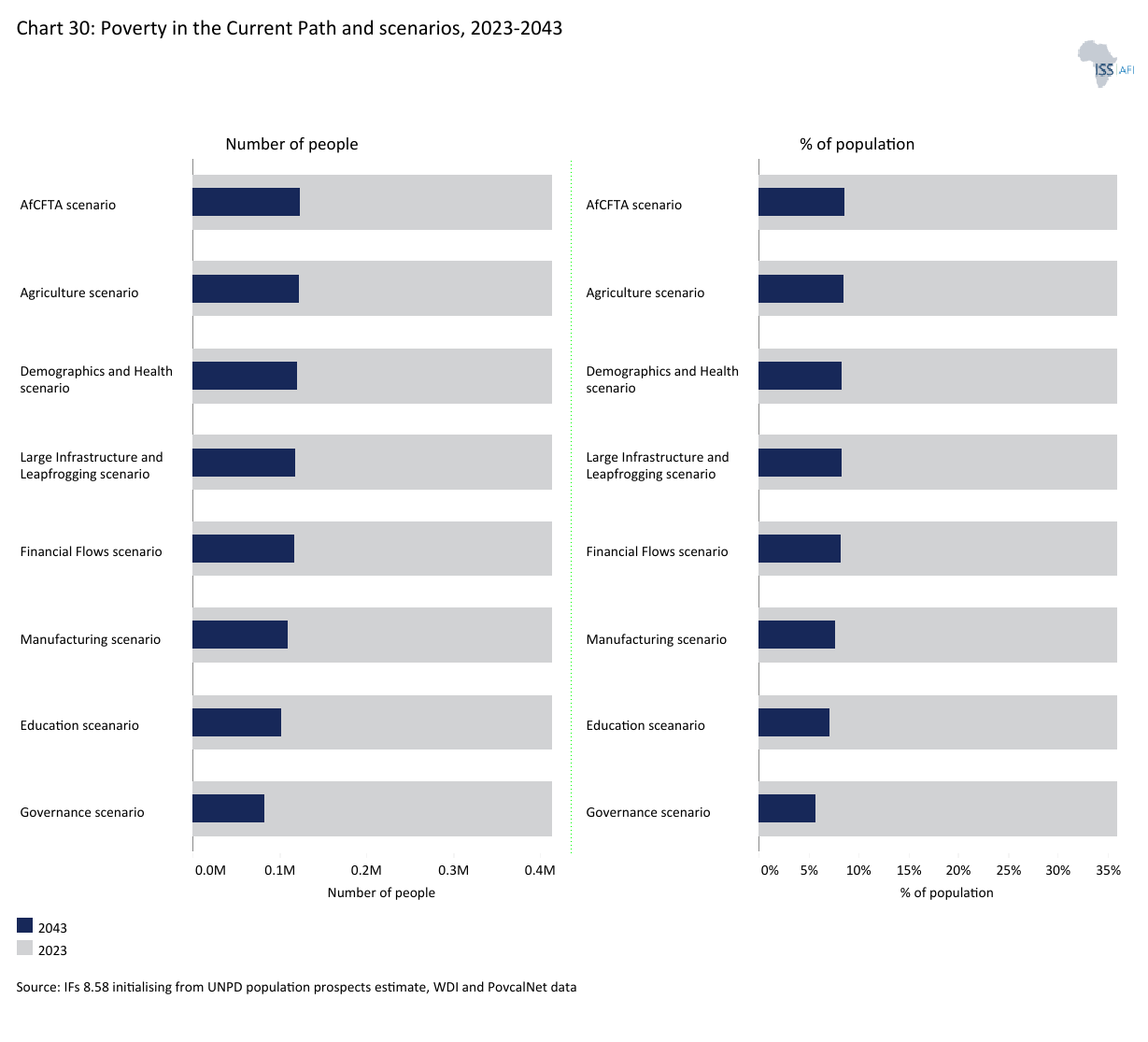
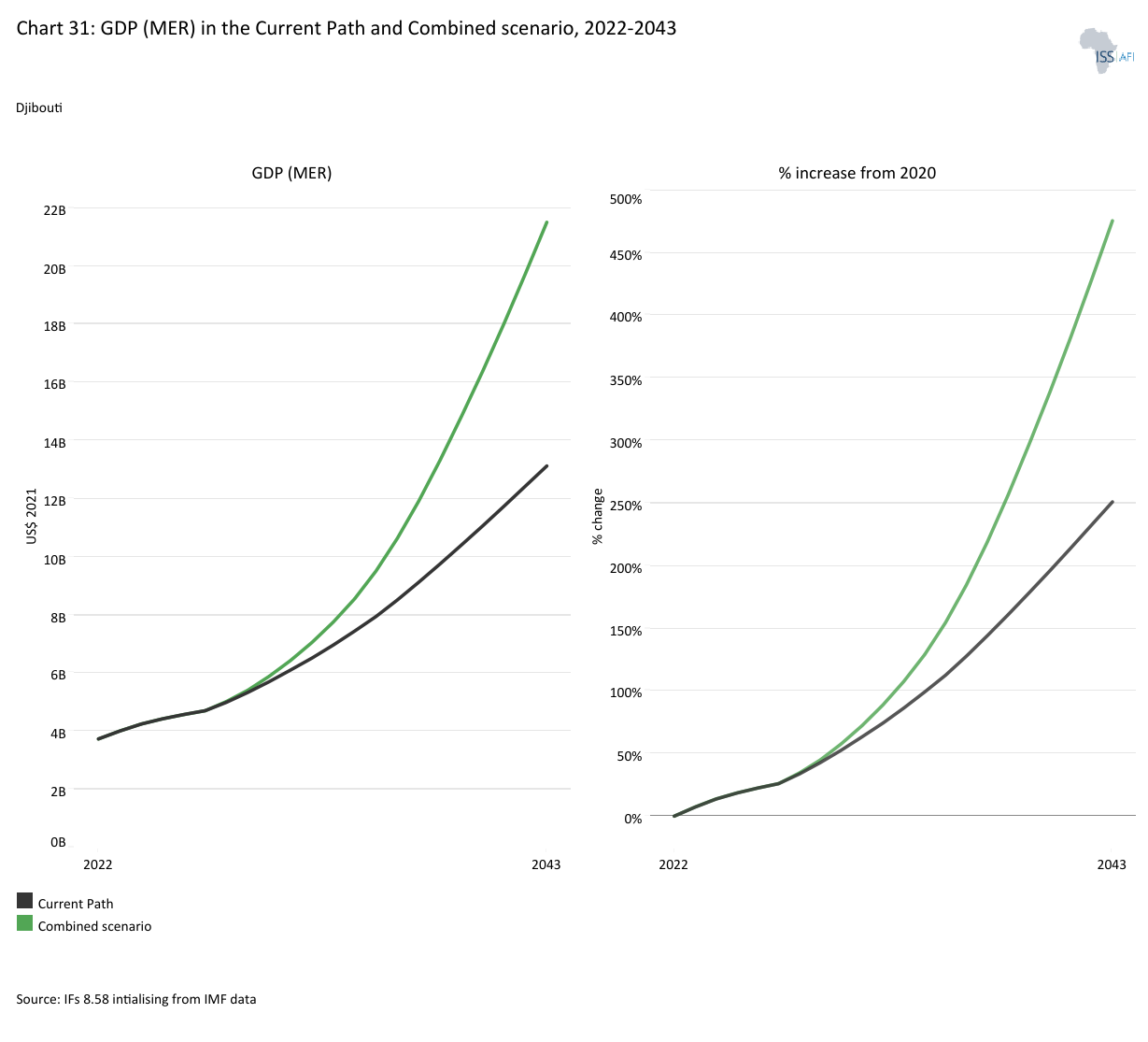
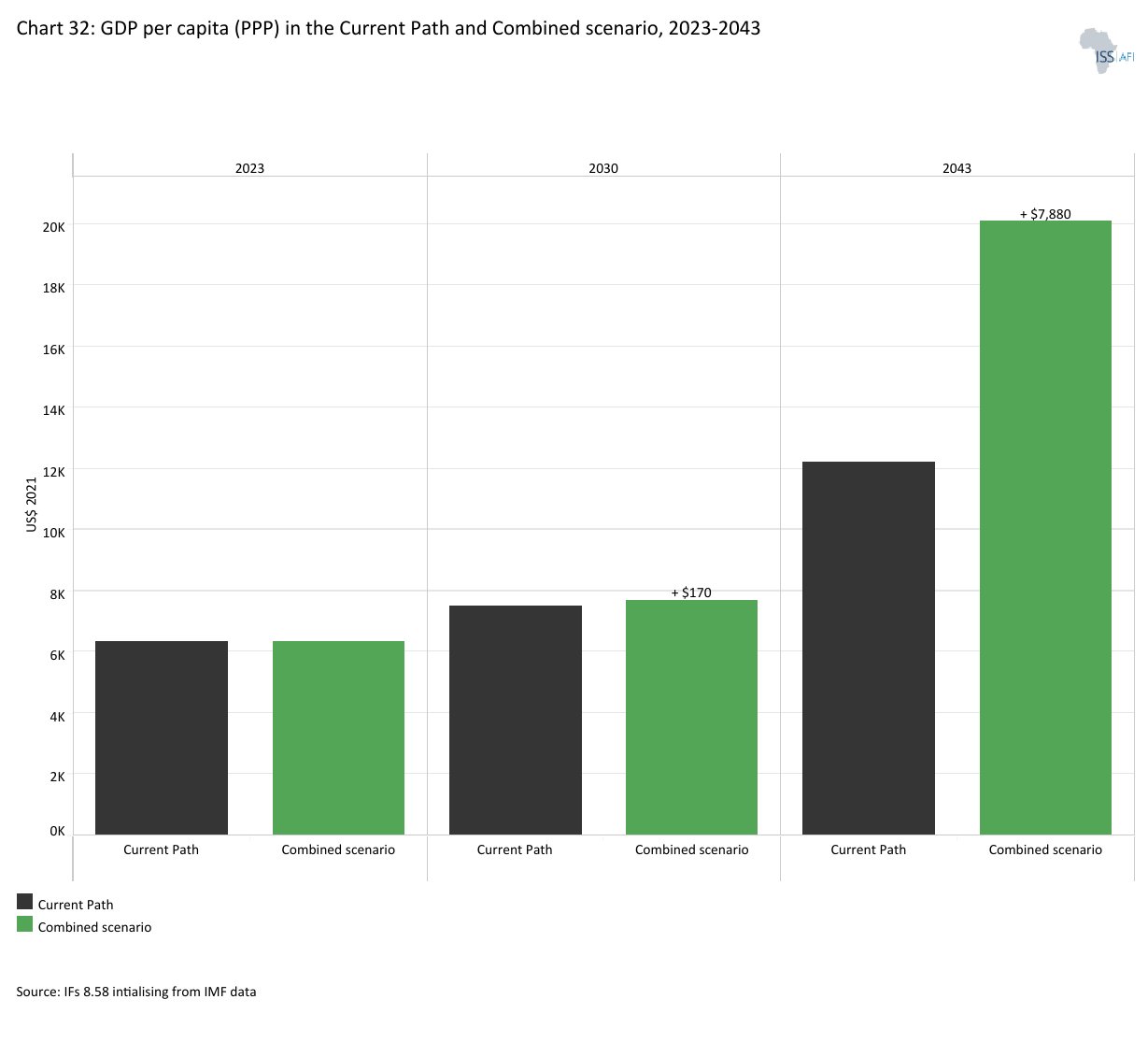
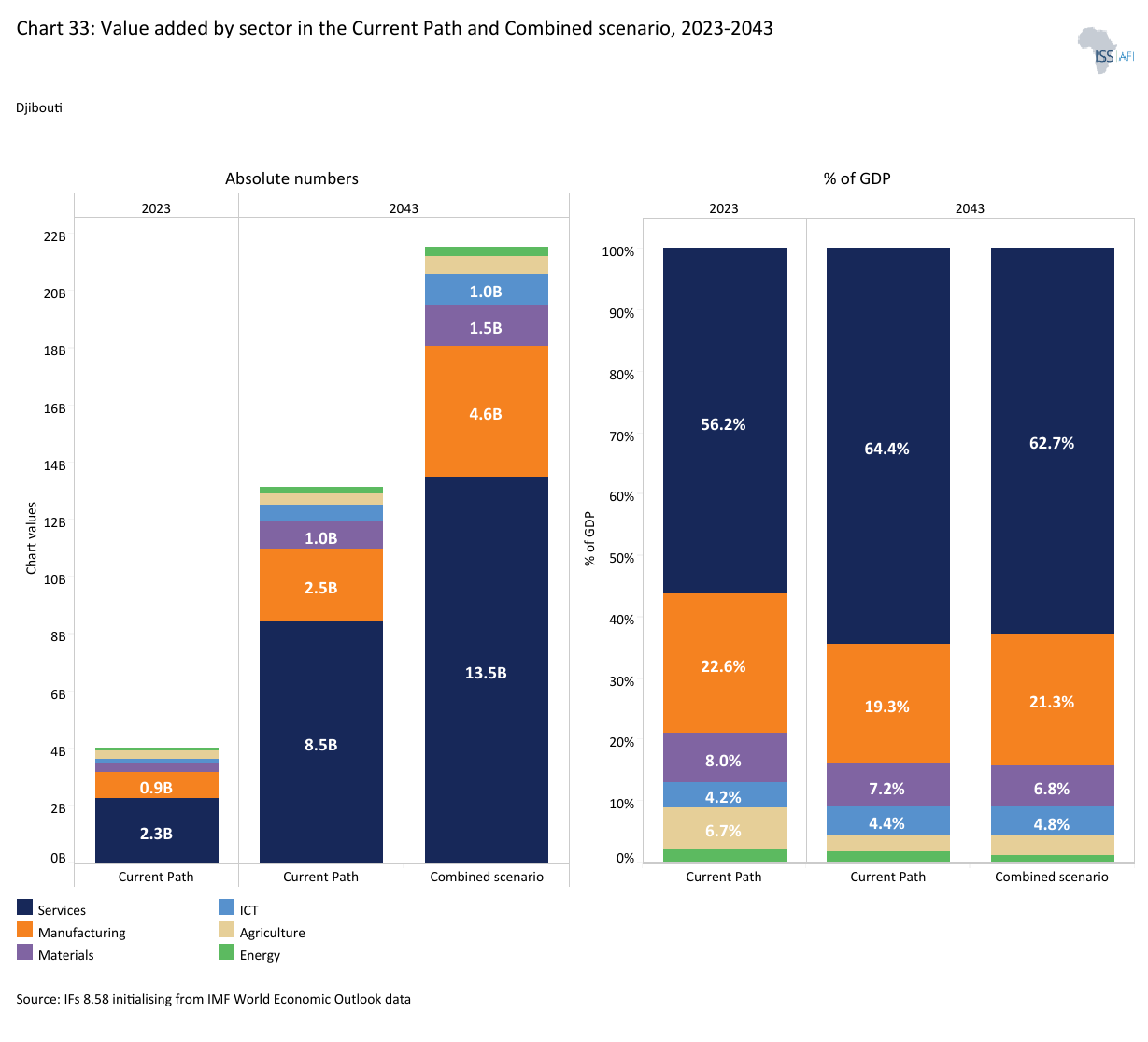
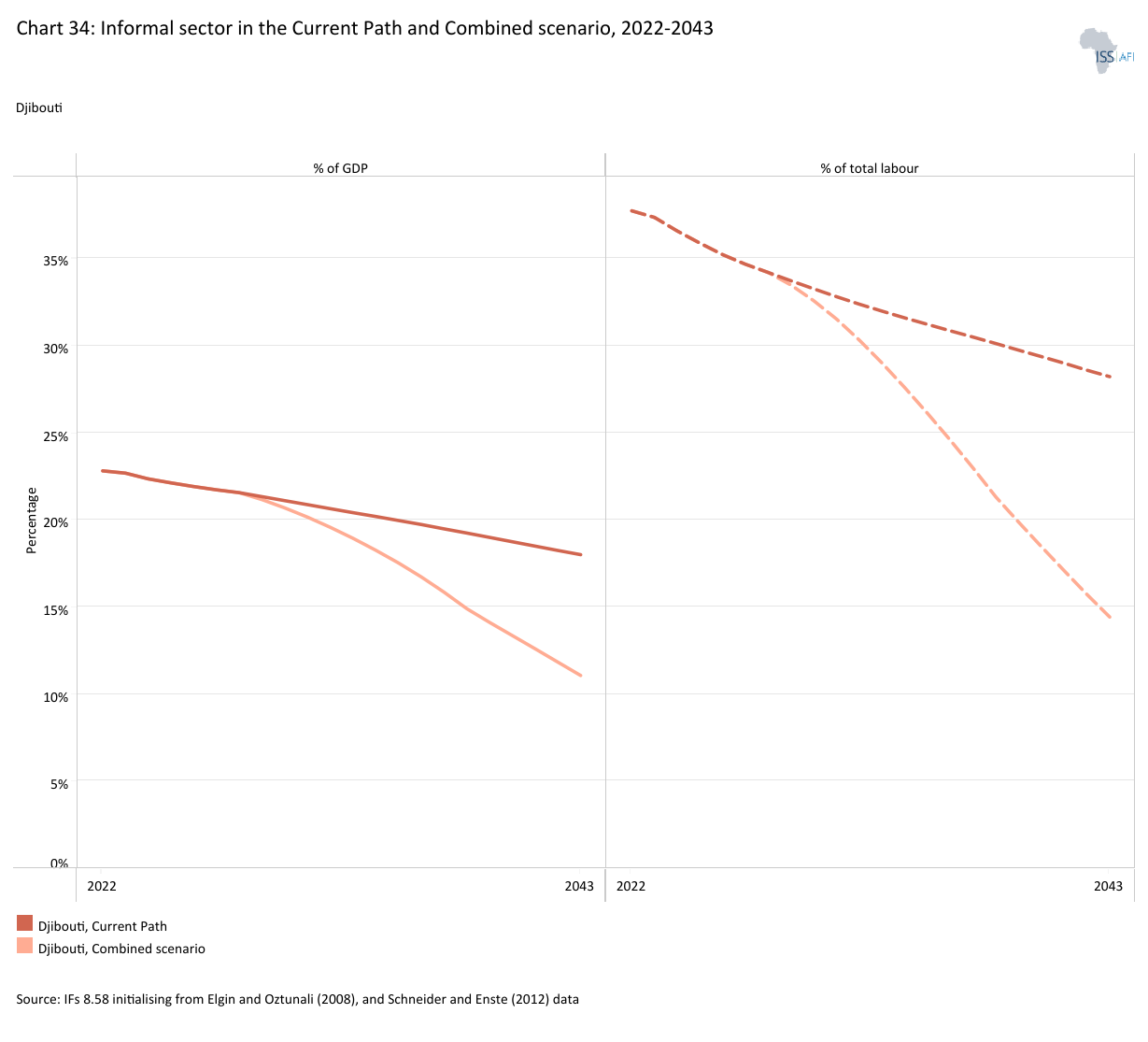
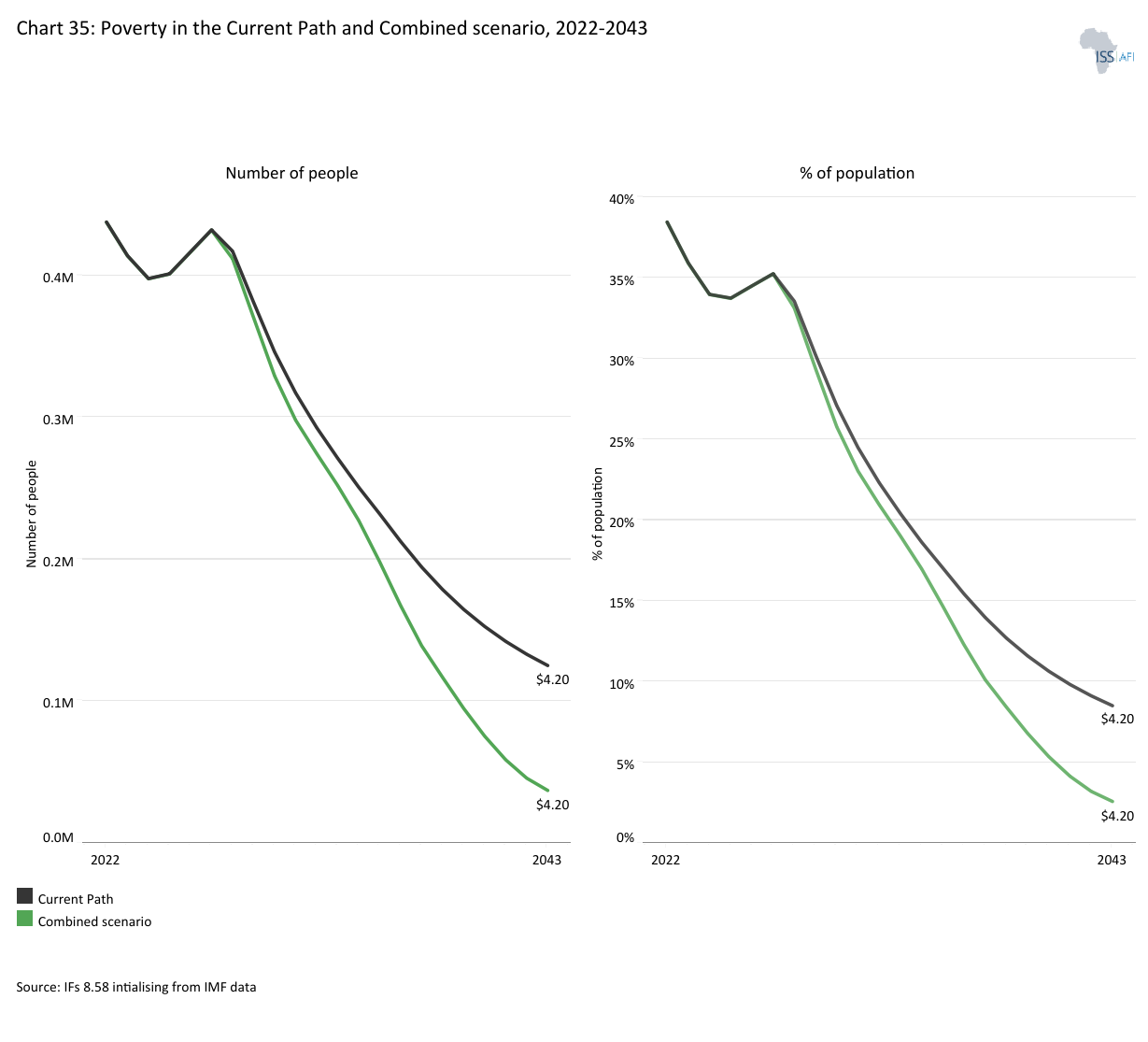
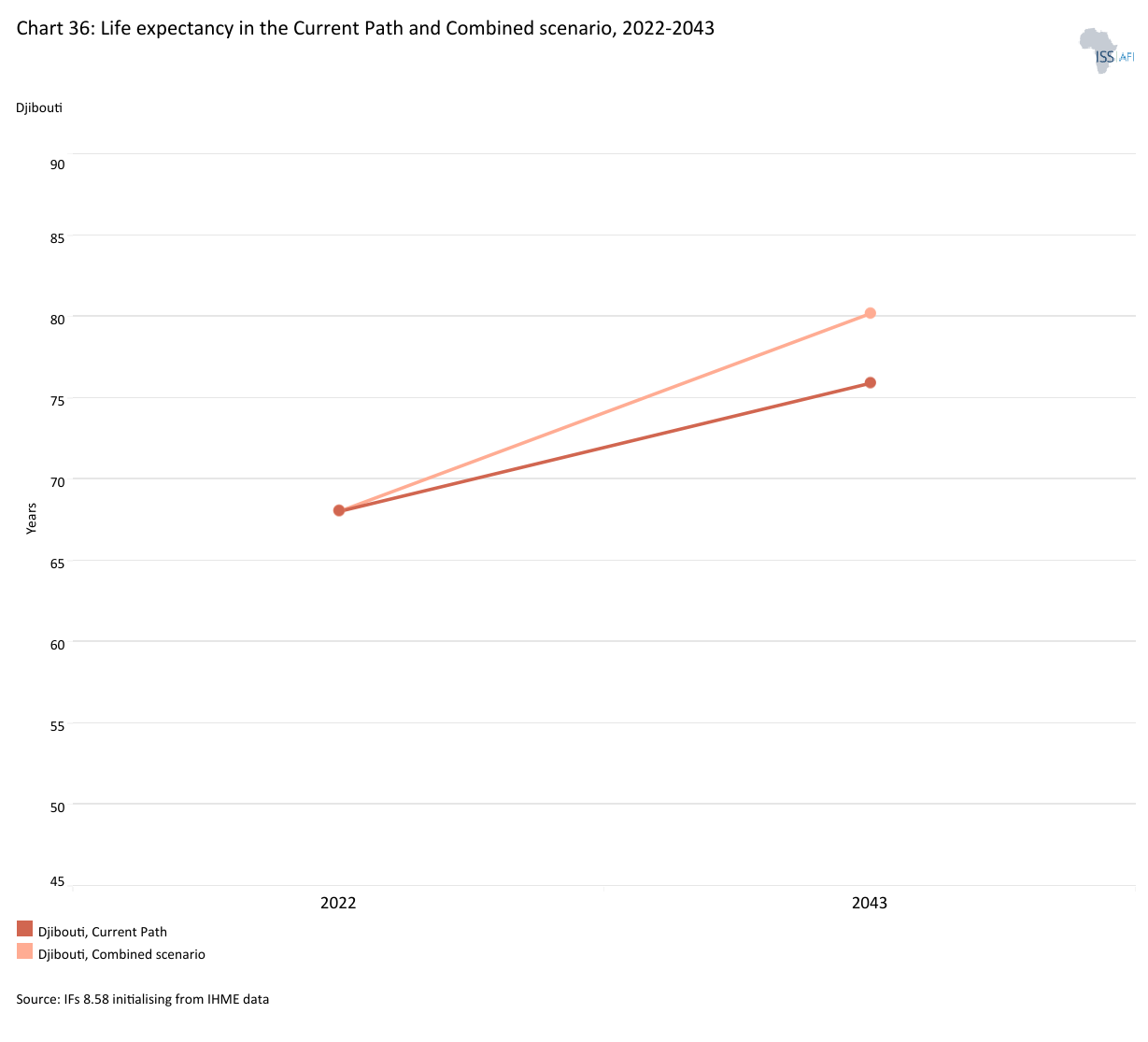
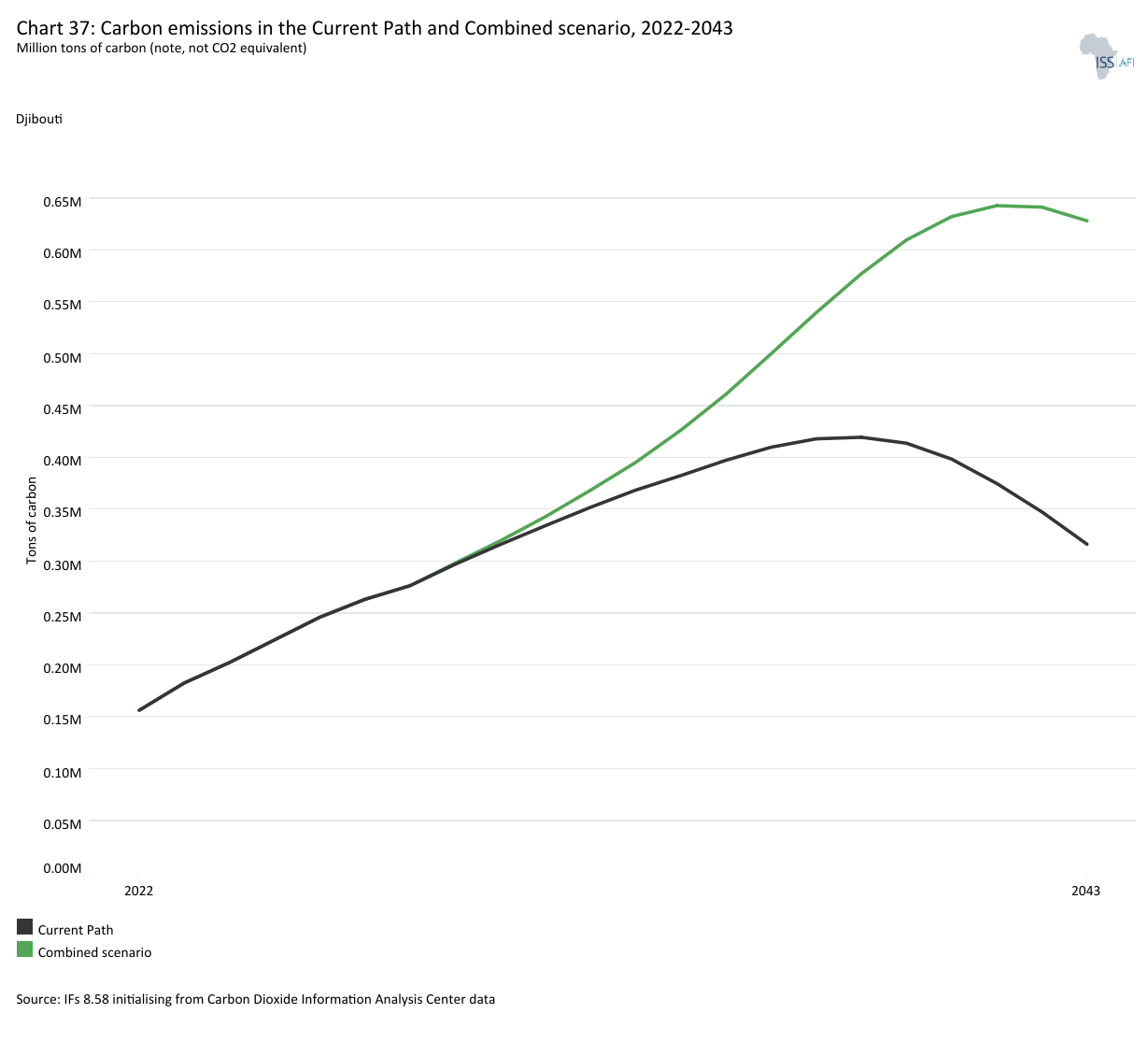
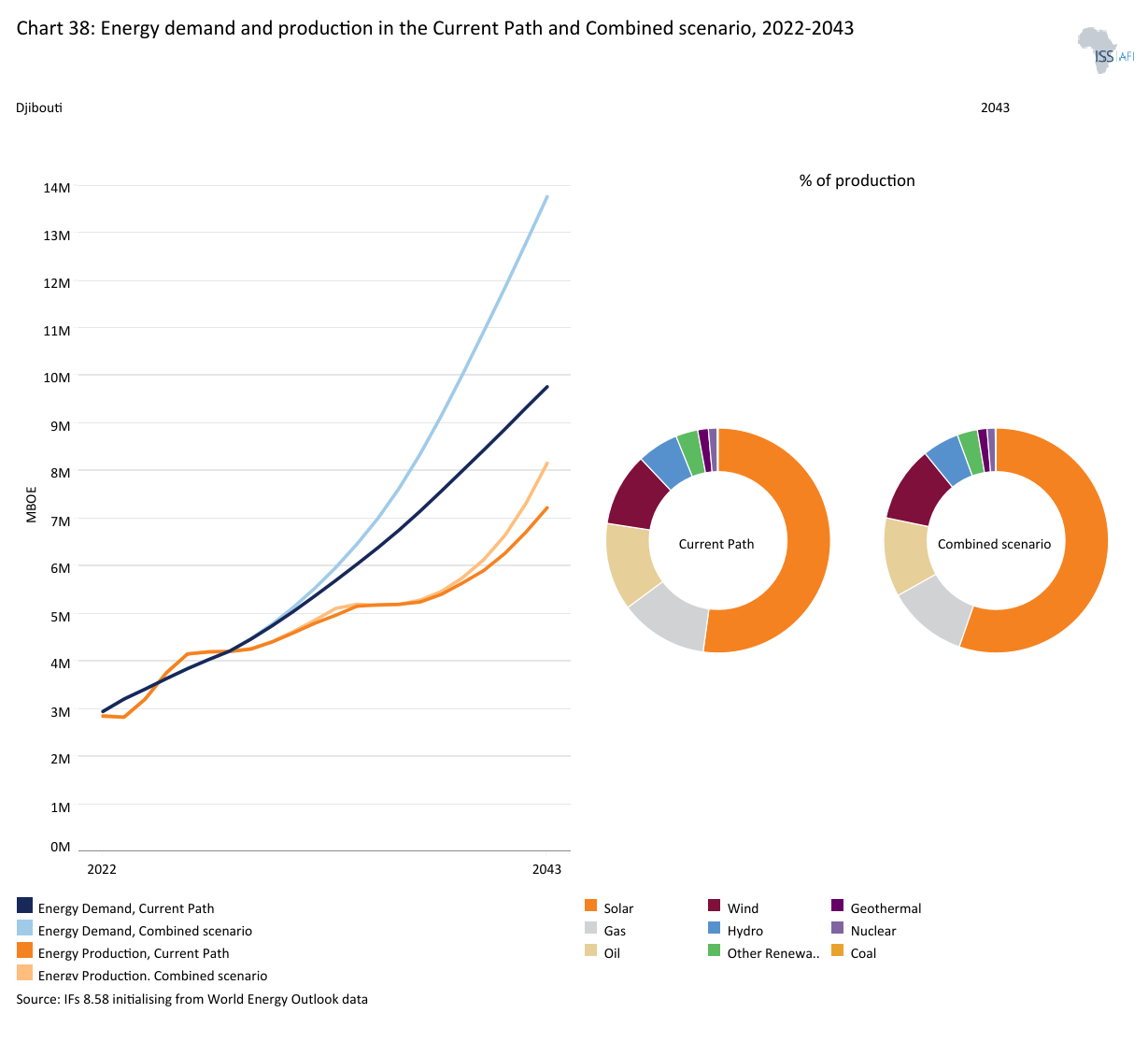

Chart 1 is a political map of Djibouti.
Djibouti is a small, lower-middle-income country at the Horn of Africa’s maritime choke point, located along the Gulf of Aden at the southern entrance to the Red Sea, bordering Eritrea, Ethiopia and Somalia. Its land area is approximately 23 180 km², with a coastline of around 370 km. This geography is the central driver of Djibouti’s development model; it is the structural foundation of Djibouti’s national development narrative. Vision Djibouti 2035 frames the country’s aspiration as becoming a regional hub (“Lighthouse of the Red Sea”) and a bridge across Africa and adjacent regions by leveraging port services, logistics and connectivity.
Djibouti is among the world’s most climate- and water-stressed settings. The 2021 World Bank’s Climate Risk Country Profile characterises the country as highly arid, with nearly 90% classified as desert and limited arable capacity. The same profile reports a historical climatology baseline (1901–2019) of a mean annual temperature of approximately 27.8°C and mean annual precipitation of approximately 244.6 mm, with high intra-annual variability and generally low rainfall outside short wet periods.
Topography and geology reinforce both risks and opportunities. The World Bank profile describes terrain comprising plateaus, plains, volcanic formations and mountain ranges reaching up to 2 000 m, with altitudes varying from 155 m below sea level at Lake Assal to over 2 000 m at Mount Moussa Ali. These physical characteristics shape settlement, transport costs, disaster risk exposure (including flash flooding in wadis and coastal hazards) and the feasibility of renewable energy development, particularly geothermal and wind.
Djibouti’s constitutional framework (Constitution of 4 September 1992) defines the state as a sovereign democratic republic, establishes Arabic and French as the official languages and identifies Djibouti City as the national capital. The constitution specifies the structure of state authority, including that executive power is exercised by the President of the Republic, who is also Head of Government. The preamble also states that Islam is the religion of the State, which matters for social policy and institutional context.
Administratively, Djibouti’s decentralisation architecture distinguishes between (i) five decentralised regional collectivities, Ali Sabieh, Dikhil, Tadjourah, Obock and Arta, and (ii) Djibouti City, which has a distinct special status. The Presidency’s official regional page states that these five regions have legal personality and financial autonomy and are administered through directly elected regional councillors, while Djibouti City has a special status under Law No. 122/AN/05/5èmeL. This law establishes “Djibouti-ville” as a territorial authority and specifies that the city comprises three communes: Ras-Dika, Boulaos and Balbala. These institutional arrangements matter for the scenario analysis that follows because many interventions (education expansion, rural electrification, social transfers, governance reforms, tariff implementation under AfCFTA) depend on multi-level implementation capacity and local service delivery.
Djibouti gained independence on 27 June 1977 following its transition from French colonial administration, and its early post-independence political development required balancing ethnopolitical cohesion and state-building in a complex regional environment. Djibouti also experienced internal conflict in the early 1990s; a key milestone in stabilisation was the 1994 Peace and National Reconciliation Accord, captured in peace agreement datasets as dated 26 December 1994, which is commonly referenced as a turning point in the conflict trajectory. In the Vision 2035 framing, peace and national unity are emphasised as prerequisites for economic transformation, reflecting the view that sustained stability is essential for investment, corridor performance and tourism, as well as for protecting the country’s role as a regional logistics hub.
The social geography of Djibouti is primarily centred around the capital region. Moreover, the country serves as a host for refugees and asylum seekers living in a fragile neighbourhood. According to the UN Refugee Agency (UNHCR) operational overview, as of 31 January 2025, Djibouti was providing international protection to 32 920 refugees and asylum seekers, which accounts for over 3% of the total population.
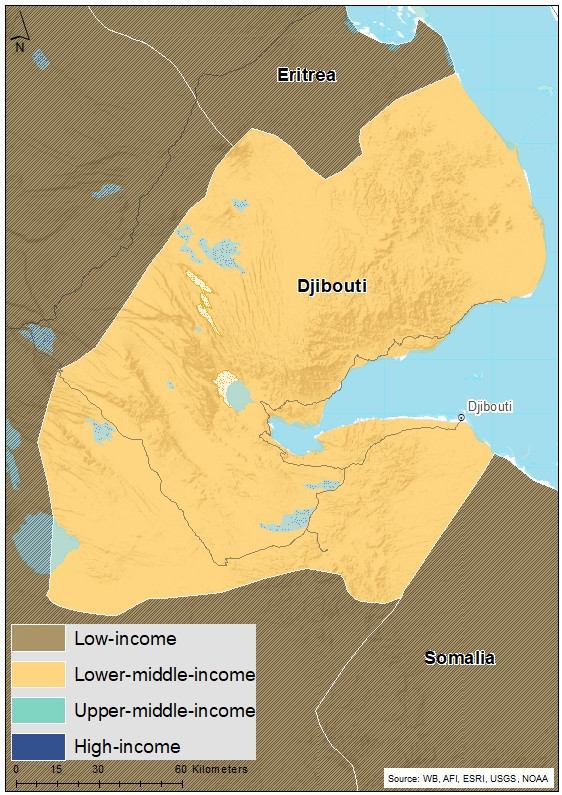
Chart 2 presents the Current Path of the population structure from 1990 to 2043.
Djibouti’s population structure shifted from a classic youth-heavy pyramid in 1990 toward a more working-age-dominant profile today and through 2043. The total population roughly doubled from 579 500 in 1990 to about 1 169 820 people in 2024. The Current Path indicates a further increase to almost 1.5 million people by 2043. In global comparative terms, Djibouti’s population remains a very small fraction (0.014%) of the world total, ranking around 160th globally by population size, with a median age of about 25 years.
The underlying demographic transition is visible in the changing shares of children (under 15 years), the working-age population (15-64 years) and the elderly (65+ years). The working-age population rose from about 53% in 1990 to 65.9% in 2024, and will edge up to 66.9% by 2043 under the Current Path. At the same time, the child share continued to narrow from 43.5% to 29.2% and then to 24%. The elderly share, while small, has risen from about 3% in 1990 to about 5% in 2024, and will reach 9.3% by 2043.
Conceptually, the population pyramid is thickening through the central age bands, indicating that Djibouti is already within a potentially favourable demographic window (detailed in Chart 13) where the working-age population dominates the age structure. The fiscal implications of Chart 2 follow directly from the shifting composition of dependency. The falling child share can gradually reduce cohort pressure on primary education and child health systems, enabling a rebalancing from access expansion toward quality and completion, provided policy and financing keep pace. But by 2043, the rising 65+ share (9.3% under the Current Path) will imply that Djibouti must also plan early for higher demand for chronic disease care and support for older adults.
Fertility decline is the primary driver of this structural shift. Djibouti’s total fertility rate fell from about 6 births per woman in 1990 to roughly 2.6 in 2024. The Current Path depicts a further decrease to 2 births per woman by 2043. This trajectory aligns with the standard dynamics of the demographic transition, as fertility approaches the replacement level of approximately 2.1 births per woman. At replacement level, each generation effectively replaces itself in the absence of migration. As Djibouti’s fertility rate will reach 2 births per woman by the early 2040s, population growth is therefore expected to gradually slow.
The dependency ratio summarises how these moving parts affect the economic balance between potential producers and dependants. The dependency ratio declined from 0.88 in 1990 to 0.52 in 2024, and will decline to 0.5 by 2043 under the Current Path. A dependency ratio close to 0.50 is generally considered favourable at the macroeconomic level, but this is true only if labour markets can effectively absorb the working-age population. Essentially, a ratio of about 50 dependants per 100 working-age individuals indicates a significant potential productive base relative to the non-working-age population.
However, it is critical to distinguish age dependency from economic dependency. The International Labour Organisation (ILO) and Worldometer explicitly caution that dependency ratios do not account for labour force participation and unemployment; some people counted as “working-age” may not be employed, while some “dependants” may be working. This distinction is central to interpreting economic implications under Djibouti’s Current Path.
Chart 3 presents a population distribution map for 2024.
Djibouti’s population distribution is characterised by extreme spatial concentration in and around Djibouti City and the coastal corridor. This pattern reflects both the country’s geographic constraints and a political economy centred on port and logistics activities. In 2024, Djibouti’s population density was approximately 50 people per square kilometre, based on a total land area of 23 180 square kilometres. Under the Current Path, density will increase to about 63 people per square kilometre by 2043.
As indicated in the introduction section, Djibouti’s social geography is highly urbanised. In 2025, Djibouti City accounted for more than 62% of the national population, followed by Ali Sabieh (7.5%), Tadjoura (5.4%) and Dikhil (4.7%). This pattern of concentration is consistent with broader urbanisation trends. According to the World Bank’s climate risk profile, around 78% of Djibouti’s population was already living in urban areas in 2019, and the urban share is forecast to increase further to approximately 85% by 2050.
Djibouti’s urban primacy has economic benefits and costs. On the upside, a dominant capital region can generate strong agglomeration economies: concentrated labour pools, denser consumer markets, lower per-capita cost of some infrastructure networks (for example, electricity distribution in dense neighbourhoods) and faster diffusion of services and innovation. This logic is consistent with Vision 2035, which explicitly frames the country’s objective as positioning itself as a hub for the regional and continental economy. The World Bank’s climate profile further highlights that the port complex is the principal economic driver, linking the spatial concentration of people and jobs to port-adjacent economic activity.
On the cost side, this same concentration amplifies the challenge of urban services keeping pace with urban growth. With the population rising to roughly 1.5 million by 2043, the demand surge is not abstract; it translates into higher requirements for housing, water supply, sanitation, electricity connections, urban mobility and broadband capacity, especially in dense and often informal peripheral settlements. Djibouti is among the world's most water-scarce countries. It faces compounding climate risks, including drought, heat waves, floods, earthquakes and sea-level rise, which raise the cost and complexity of servicing dense coastal populations. When land-use planning and drainage infrastructure lag, dense urbanisation can turn climate shocks into repeated economic losses through port disruption, damaged housing and roads and heightened public health risks. In effect, the spatial pattern intensifies the need for urban resilience investments, including flood control, coastal defences, heat mitigation and reliable water systems.
Spatial concentration also carries a distributional dimension. The Strategy of Accelerated Growth and Promotion of Employment (SCAPE) identifies the need for more balanced territorial development. It explicitly includes an axis on “poles of both regional development and sustainable development,” while also aiming to reduce social disparities and guarantee access to basic services. In a country where the capital concentrates most people and formal economic activity, peripheral regions risk being trapped in a low-access equilibrium characterised by weaker service delivery, higher transport costs, fewer formal jobs and greater vulnerability to shocks. This is not only a rural–urban issue but also a corridor dynamic, given Djibouti’s dependence on port and transit activities, particularly those linked to Ethiopia.
A further spatial dimension shaping Djibouti’s development is the distribution of displaced populations and refugee hosting, which extends beyond the capital into peripheral regions. According to UNHCR, Djibouti hosts approximately 32 000 forcibly displaced people, of whom around 85% reside in refugee settlements, with the remainder living in urban areas, including Djibouti City. These settlements are primarily located in border regions, Holl Holl and Ali Addeh in the Ali Sabieh region, and Markazi in the Obock prefecture, highlighting a distinct geography of displacement that places additional pressure on already underserved areas.
Refugee-hosting regions are not only sites of humanitarian response but also emerging nodes of service delivery and infrastructure demand. Operational updates consistently highlight the need to expand access to water, energy, transport and social services in settlements such as Ali Addeh and Holl Holl, underscoring persistent infrastructure gaps in peripheral areas.
The above trends suggest that regional development strategies should go beyond fostering secondary economic hubs to explicitly incorporate refugee-hosting areas into national planning frameworks. Investments in these regions can serve dual objectives: addressing humanitarian needs while strengthening local economies, improving social cohesion and reducing spatial inequalities. Integrating refugee populations into local service systems and labour markets, where feasible, can also support more inclusive and resilient growth, particularly in a country where geographic concentration and resource constraints already shape development outcomes.
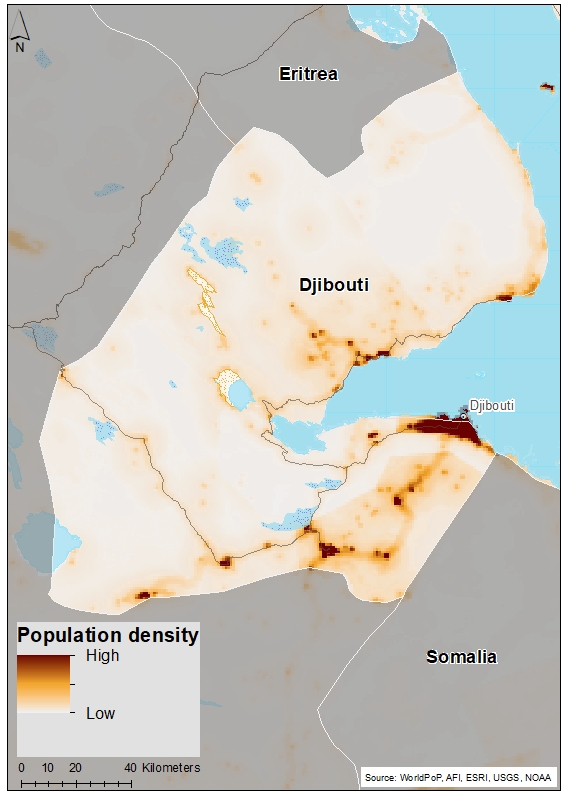
Chart 4 presents the urban and rural population in the Current Path, from 1990 to 2043.
Djibouti is already one of Africa’s most urbanised countries. Urban share rose rapidly between 1960 and 1983 (from 50.4% to 74.5%) and continued upward to 76% in 1990. Since then, the pace of change has slowed. The urban share reached 79% in 2024 and will increase modestly to 80.5% by 2043 under the Current Path. The Current Path is broadly consistent with the World Bank’s Climate Risk Country Profile Report forecast of an 85% urban rate by 2050, up from 78% in 2019. This flattening of the urbanisation trend is typical as a country approaches saturation, a point at which urban shares can still rise, but the dominant dynamic shifts to absolute urban population growth rather than sharp shifts in the urban–rural balance.
In absolute terms, the Current Path implies a large increase in the number of urban residents over the next two decades, even though the urban share changes only marginally. Djibouti’s urban population rose from roughly 440 200 in 1990 to about 920 690 in 2024, and will reach about 1.18 million by 2043. The rural population also grew in absolute terms, from roughly 139 300 to about 249 130 and around 285 930 in the same period, even as the rural share declined. The key planning implication is that rural service demand does not disappear; it remains material and grows, while the urban service burden grows faster.
The economic implications of Chart 4 hinge on the interaction between urban primacy, infrastructure capacity and labour-market absorption. Djibouti’s economy is anchored in the capital’s port–logistics complex; the World Bank profile describes the complex as the country’s economic driver, which explains why people and jobs concentrate in Djibouti-Ville and its peri-urban communes. High urban concentration can generate agglomeration economies, dense labour markets, proximity to customers and services, and lower per-capita costs for some network infrastructure (electricity distribution, broadband rollout) when density is high. Under the Current Path, this can support productivity in tradable services (logistics administration, transport services, ICT-enabled activities) if the business environment and human capital allow firms to scale.
At the same time, the costs of high urbanisation are visible: housing deficits, congestion and undersupplied basic services can push a large share of the population into informal settlements and vulnerable living conditions. Vision 2035 explicitly acknowledges that rapid urbanisation (especially between 1977 and 2010) contributed to the “rapid development of precarious districts” driven by rural exodus and commits to a policy for “cities without shantytowns,” including economic housing and sanitation of the built environment. This is not merely aspirational; Djibouti’s Integrated Slum Upgrading Project (launched in 2018) aims to improve living conditions in deprived urban areas of Djibouti City and to strengthen institutional capacity for the government’s Zero Slum Program (Programme Zéro Bidonville), explicitly targeting vulnerable groups, including refugees and displaced populations. Development partners also document acute service gaps in fast-growing peri-urban areas. For instance, AFD notes that Djibouti City hosts a very large share of the national population and that rapid urbanisation contributed to the explosive growth of Balbala, with water and sanitation networks described as “almost non-existent” in parts of the district.
Labour-market dynamics amplify these urban pressures. As Chart 2 shows, Djibouti’s working-age population increases sharply in absolute terms under the Current Path; Chart 4 suggests much of this additional labour supply will continue to concentrate in urban areas. If labour demand in higher-productivity sectors fails to expand, the likely outcomes include higher unemployment and informality. This risk is already visible: the World Bank’s modelled ILO estimates place total unemployment at 26% in 2025 for Djibouti. In such a context, high urbanisation can magnify social and fiscal strain (pressure for public employment, informal coping strategies) unless reforms accelerate private-sector job creation and skills development in line with national planning goals.
Urbanisation also intersects with displacement geography. As indicated in the previous section, UNHCR reports that 85% of the refugees hosted in Djibouti reside in refugee villages such as Ali Addeh, Holl-Holl and Markazi. At the same time, the remainder live in urban areas like Djibouti City. This means that even under a highly urbanised national profile, substantial service delivery needs exist in non-urban or peri-urban settings (camps and host communities), while urban systems must also plan for a share of refugees and asylum seekers integrated into city neighbourhoods. The urbanisation story is thus best understood as a two-track service challenge: scaling urban systems in the capital while ensuring infrastructure and basic services in refugee-hosting and rural areas keep pace with absolute population growth.
Finally, Djibouti’s environmental and spatial constraints intensify the stakes of urban planning. The World Bank climate profile characterises the country as highly arid, with most land classified as desert, resource scarce and vulnerable to hazards that can be exacerbated by water scarcity and weak land-use planning. For a predominantly coastal, capital-focused settlement pattern, this raises the premium on climate-resilient infrastructure: reliable water production and distribution, flood management during extreme rainfall, heat mitigation and coastal risk management (all essential for protecting households, ports and critical logistics infrastructure).
Chart 5 presents GDP in market exchange rates (MER) and growth rate in the Current Path, from 1990 to 2043.
Djibouti’s GDP (MER) expanded from US$1.47 billion in 1990 to US$4.25 billion in 2024, reflecting an average annual growth rate of 3.3%. Despite this growth, the country remained relatively small in terms of GDP, ranking 164th out of 193 countries in 2024. Looking ahead, GDP will reach approximately US$13.13 billion by 2043 under the Current Path, implying a significantly faster average annual growth rate of 6.1% over the 2025–2043 period. Overall, Djibouti’s growth trajectory since 1990 underscores its transformation into a capital-intensive, services-driven economy anchored in logistics and regional connectivity.
The historical pattern of GDP growth from 1990 to 2024 is consistent with the dominant narrative in official diagnostics. Djibouti’s growth has been strongly shaped by large-scale investment in port and transport infrastructure, conversion of its strategic geography into service activity, and renewed corridor linkages to Ethiopia, often financed by a mix of external borrowing and partner-supported investment. The Government’s National Development Plan 2020–2024 (Djibouti ICI) explicitly notes that the economy’s performance improved since 2000, with growth around 5–7% per year, especially starting 2010, and it attributes recent performance in part to the implementation of SCAPE (2015–2019) and the associated rollout of state-of-the-art infrastructure such as the Djibouti–Addis Ababa railway, ports and a Free Zone. This investment-led pattern is corroborated by the World Bank’s Systematic Country Diagnostic (SCD), which observes that Djibouti achieved “impressive growth,” averaging 8% in 2013–2016, driven by public and private investments in port and transport infrastructure, while warning that this inward-investment strategy also triggered large public borrowing and debt-financed capital accumulation with sustainability concerns.
Two implications from these primary sources are central to interpreting the 1990–2024 period. First, the growth model has been services-heavy and capital-intensive. The World Bank SCD notes that the recent investment wave has generated a predominantly capital-intensive, services-based economy, with services accounting for close to 80% of GDP, and that growth has been limited in its inclusiveness, with high unemployment and persistent poverty. Second, macroeconomic vulnerability and fiscal space constraints have been recurring issues. The World Bank SCD documents the rapid rise in public and publicly guaranteed external debt during the investment boom and emphasises Djibouti’s exposure to external shocks given its dependence on Ethiopia-linked port activities; it notes that Ethiopia’s trade accounts for more than 80% of Djibouti’s port activities and that any adverse shock or strategic reorientation could jeopardise Djibouti’s ability to service its debt and sustain growth. These constraints matter because GDP growth, even when strong, does not automatically translate into broad-based jobs and incomes unless complementary reforms raise productivity, lower input costs (notably electricity) and improve the business environment.
The 2025–2043 acceleration to an average 6.1% annual GDP (MER) growth under the Current Path will therefore be a meaningful shift. It implies that the economy will sustain a growth pace close to doubling in size about every 12 years (rule-of-72 logic), which is much faster than the 1990–2024 pace (doubling roughly every 22 years). Interpreting this forecast requires linking it to the country’s stated policy direction and to the kinds of drivers emphasised in IMF and World Bank diagnostics. Djibouti’s long-term strategy explicitly targets high growth. Precisely, Vision 2035 sets an objective to raise average real GDP growth to 8–10% per year over 2013–2035, with growth expected to be enabled by increased port-related services and expansion of transport, commerce and industry, alongside diversification into sectors such as logistics, ICT, finance, tourism, fisheries and manufacturing.
Meanwhile, the Government’s SCAPE framework sets goals that demonstrate the same logic, accelerating growth, modernising the economy, increasing the role of the private sector, promoting employment and reducing social and territorial disparities. Read against these targets, the Current Path forecast of 6.1% average GDP (MER) growth per annum will be below the Vision 2035 target. However, it represents a robust acceleration in the medium- to long-run relative to the past three decades.
From an economic perspective, the IMF 2025 Article IV helps explain the types of drivers that can plausibly support such an acceleration, as well as the conditions required for sustainability. The report notes that Djibouti’s investment-focused strategy has propelled average growth of about 6% over the past decade, and notes that 2024 growth was about 6.5%, driven by robust transhipment amid Red Sea maritime disruptions, showing how Djibouti’s hub role can translate geopolitical shocks into short-run trade and service gains. At the same time, it emphasises that high public investment and rising debt service have constrained fiscal space and calls for reforms to boost private investment, diversify the economy and create jobs, highlighting actions such as leveling the playing field between firms under special and general regimes, lowering electricity costs, improving small and medium enterprises (SMEs) financing and strengthening education and job training (aligned with the national Vision 2035 strategy).
The same diagnostics also clarify the downside risks. Debt sustainability and corridor dependence are structural constraints, not marginal issues. The World Bank SCD explicitly frames debt-financed growth as raising sustainability concerns and highlights the vulnerability created by reliance on Ethiopia-linked port activity and exposure to shocks (including adverse climate events) that can reduce fiscal space and undermine growth. In practical terms, this means that the Current Path trajectory to 2043 should be interpreted as achievable only if (i) corridor and transshipment services remain strong, (ii) Djibouti progressively broadens its service export base and reduces input costs (notably power and ICT costs, which the SCD and IMF treat as competitiveness constraints) and (iii) fiscal consolidation and improved public investment efficiency prevent debt service from crowding out human capital and resilience investment. Climate risk is also a material macro risk driver for Djibouti, especially given water scarcity and exposure of critical infrastructure to extreme heat and episodic flooding, risks that can raise operating costs and disrupt transport and logistics activity.
Chart 6 presents the size of the informal economy as a percentage of GDP and percentage of total labour (non-agriculture), from 2022 to 2043. The data in our modelling are largely estimates and therefore may differ from other sources.
Djibouti’s Current Path suggests a gradual but meaningful reduction in informality over the next two decades. Informality will already be lower than the African lower-middle-income (LMIC) average and will widen that gap by 2043. The informal economy's share of GDP will decline from 22.4% in 2024 to roughly 18% in 2043. Over the same period, the informal share of the non-agricultural labour force will decline from 36.6% to 28.2%. By comparison, the African LMIC average will decline from 30.3% to 26.3% of GDP and from 57% to 53% of the non-agricultural labour force. These trajectories imply that Djibouti’s Current Path will reduce informality at least as fast as the LMIC average in GDP terms, and substantially faster in labour-market terms, moving from one-third informal toward about one-quarter informal non-agricultural employment by 2043.
Before 2024, Djibouti’s informality is best understood as a structural feature of a services-led, urban economy in which highly capital-intensive logistics and port activity coexist with a large base of low-productivity urban services and trade. The World Bank’s SCD characterises Djibouti’s services dominance and notes that, outside the public sector, “most workers are engaged in low-value informal wholesale and retail trade,” and that a large share of the working-age population is unemployed, informally employed or out of the labour force. This diagnosis aligns with the classic informality dualism: a narrow modern sector (ports/State Owned Enterprises (SOEs)/public sector and some formal services) alongside a broad set of microenterprises and casual work in trade, transport, personal services and construction. Informality is therefore both a livelihood strategy and a sign of limited economic transformation, especially when it reflects survivalist self-employment rather than dynamic entrepreneurship.
Measurement and definition matter when interpreting any informality trajectory. The ILO distinguishes between the informal sector (enterprise-based) and informal employment (job-based) and provides the international statistical guidance used by many countries and datasets. The World Bank also emphasises that informality is measured using multiple approaches and has compiled a multi-method Informal Economy Database, reflecting how different estimation methods can yield different levels and trends. For this report, the critical interpretive task is not to claim a single true informal share but to explain what a declining trajectory implies for productivity, inclusion and fiscal space.
The Current Path decline in informality is consistent with Djibouti’s long-run policy intent to shift from a state-led, capital-accumulation model toward a more competitive, private-sector-driven economy with higher employment intensity. The Vision 2035 framework explicitly defines a pillar of “a diversified and competitive economy with the private sector as the engine,” alongside governance and human capital pillars that are essential for formal, productive job creation. SCAPE (2015–2019), positioned as a principal operational instrument of Vision 2035, targets large-scale job creation and emphasises private-sector-led economic growth, human capital development, strengthened governance and regional development poles. In this policy context, falling informality in the Current Path can be interpreted as the model’s assumption that a larger share of firms and jobs will become registered and regulated over time, particularly as infrastructure will improve, the business environment will reform, and formal services and value-adding activities will expand around the ports, free zones and corridor economy.
Economically, the payoff from reducing informality is substantial. Lower informality generally implies higher productivity (through better access to finance, technology adoption and scale), stronger worker protections and expanded participation in formal systems. The ILO frames transitions to formality as a core development challenge and highlights that policy packages for transition support sustainable development (SDG) progress and decent work. For the state, formalisation broadens the tax base and strengthens the contributory base for social protection, enabling more sustainable financing of service delivery and public investment. The IMF’s 2025 Article IV stresses that revenues are limited relative to spending needs and identifies priorities, including standardising tax regimes to broaden the tax base, narrowing exemptions and pursuing reforms that foster private-sector development and formal job creation, alongside energy-sector reforms and human capital investment. These recommendations are consistent with the Current Path, in which informality will decline as fiscal institutions improve, firms’ incentives to formalise strengthen, and the regulatory burden becomes more predictable.
Nonetheless, the persistence of informality, 18% of GDP and 28% of non-agricultural employment by 2043 under the Current Path, signals that structural constraints will remain. Djibouti’s corridor-dependent model is exposed to regional disruptions and geopolitical shocks that can move workers into informal coping strategies. Climate and water stress can also suppress productivity and raise the cost of formal operations, especially for small firms, reinforcing informality in low-margin activities. The Current Path improvement is therefore best read as gradual progress, not automatic transformation. To realise the forecast reductions, Djibouti must expand formal private-sector job creation faster than population growth and ensure that formalisation is not simply enforcement-driven but incentive-compatible (cheaper compliance, better services, better access to finance).
Chart 7 presents GDP per capita in the Current Path, from 1990 to 2043, compared with the average for the African income group.
Djibouti’s GDP per capita trajectory reflects three distinct phases: a sharp contraction in the 1990s, a strong recovery after 2000, and a forecast acceleration after 2024, with the country surpassing the African LMIC average around 2030/31. GDP per capita declined from about US$4 820 in 1990 to US$3 310 in 2000 before rising steadily to approximately US$6 840 in 2024. This recovery aligns with evidence from the World Bank’s SCD, which shows that average per capita GDP growth shifted from −4% in 1991–1999 to 2.6% during 2000–2014 and accelerated further to about 5.8% between 2015 and 2017, reflecting a broader structural turnaround after 2000. Under the Current Path, GDP per capita will nearly double to approximately US$12 220 by 2043, roughly US$2 600 above the African LMIC average forecast. However, the country is unlikely to achieve its Vision 2035 target of tripling GDP per capita by 2035.
The historical drivers of Djibouti’s post-2000 per-capita recovery are closely linked to services- and infrastructure-led growth stemming from its strategic location. The World Bank SCD notes that Djibouti's stable domestic political environment enabled it to leverage its strategic position to attract investors and highlights major investments, including port development and the electric railway connection to Ethiopia. As indicated in Chart 5, these investments helped fuel a predominantly capital-intensive, services-based economy. The same diagnostic emphasises that Ethiopia’s trade accounts for more than 80% of Djibouti’s port activities, clarifying both the scale of the opportunity and the vulnerability embedded in the corridor model. This structure helps explain why per-capita growth can be strong during periods of corridor expansion and transhipment booms, while also being exposed to external shocks and strategic competition from alternative routes.
Those vulnerabilities are central to interpreting the forecast period under the Current Path. The IMF’s 2025 Article IV notes that Djibouti’s “investment-focused strategy” has yielded average growth of about 6% over the past decade, and states that growth remained strong at about 6.5% in 2024, driven by “robust transhipment amid Red Sea maritime disruptions.” These dynamics, Djibouti capturing logistics and transhipment rents from regional disruptions, can temporarily lift GDP and, depending on inflation and population growth, can support higher GDP per capita. However, the report simultaneously warns that substantial public investment, declining revenues and rising debt service have constrained fiscal space and increased pressure on debt sustainability. The World Bank SCD echoes this risk, arguing that capital accumulation has been increasingly debt-financed and that debt service can constrain fiscal space and limit necessary spending in social sectors.
In short, the Current Path’s strong per-capita forecast to 2043 is consistent with ongoing expansion of services and corridor activity. Still, it is contingent on maintaining debt sustainability, strengthening institutions and improving the inclusiveness of growth.
Chart 8 presents the rate and number of extremely poor people in the Current Path from 2022 to 2043.
In June 2025, the World Bank updated its poverty lines to 2021 PPP terms, now using US$3.00 per person for extreme poverty, US$4.20 for lower-middle-income countries (LMICs) such as Djibouti, and US$8.30 for upper-middle-income countries (UMICs).
Djibouti’s poverty reduction story before 2022 is best described as growth with weak inclusiveness, shaped by a services-led, infrastructure-heavy development model that generated sizable output gains but did not consistently translate into low poverty and broad employment. The World Bank’s SCD emphasises that, despite strong growth during the 2013–2016 investment boom, “growth has not been inclusive,” and notes that a 2017 national household survey found that 20.8% of the population lived in extreme poverty. At the same time, the extreme poverty rate measured at the older World Bank’s US$1.90 line stood at 22.5%, worse than the average poverty rate of 16.4% for LMICs. The same SCD links persistent poverty to structural constraints: capital-intensive growth dominated by capital accumulation with limited labour contribution, high unemployment and informality and a narrow base of private formal job creation. This aligns with Djibouti’s own planning narrative in SCAPE (2015–2019), which frames accelerated growth as necessary but explicitly pairs it with job creation, improved access to basic services, and a commitment to reducing poverty as part of the Vision 2035 trajectory.
Recent World Bank macro and poverty monitoring indicates that poverty has been declining but remains widespread. Precisely, the Djibouti Macro Poverty Outlook reports that the share living below US$3.00 per day fell from 25.4% to 20% between 2017 and 2024, while the US$4.20 per day poverty rate dropped from 43.7% to 35.4% over the same period, with further decline forecasted through 2027. The Current Path, likewise, indicates that the downward momentum in poverty will continue and accelerate. At the US$3.00 line, extreme poverty will drop to 3.1% (45 440 people) by 2043. At the US$4.20 line, the Current Path shows poverty declining to roughly 9% (125 120 people) at the same time, substantially outperforming the Africa LMIC average and placing Djibouti within the targets of its National Development Plan (NDP) 2020–2024 (Djibouti ICI) to cut poverty by 28% in 2025. The headcount will fall by approximately 171 040 people and 272 630 people between 2004 and 2043, respectively.
This scale of poverty reduction (both at US$3.00 and US$4.20 lines) is consistent with an economy that continues expanding in high-value services (ports, logistics) while gradually improving access to basic services and human capital, drivers emphasised in official strategies (SCAPE/Vision 2035) and in partner diagnostics as necessary for inclusive outcomes. The IMF’s 2025 Article IV similarly acknowledges that Djibouti’s investment-focused strategy has produced robust growth, but stresses that rising debt service and constrained fiscal space increase the need for reforms that support private investment, job creation and sustained human capital spending. In poverty terms, the Current Path’s sharp decline at US$4.20 implies that growth is assumed to translate more effectively into household incomes than in the pre-2022 period, through some combination of (a) expanding employment and earnings in services linked to ports and logistics and ancillary urban services, (b) reduced informality and improved productivity that raise earnings per worker and (c) stronger social protection and service delivery that prevents households from falling into poverty during shocks.
The main risks to this poverty trajectory mirror Djibouti’s structural vulnerabilities. First, corridor dependence and regional instability can rapidly affect service revenues and employment. Second, climate and water stress can raise food and living costs, especially in dense urban areas, slowing poverty reduction or reversing gains during shocks. Third, macro-fiscal constraints can limit the state’s capacity to expand targeted transfers and human capital spending at the pace implied by these forecasts.
Chart 9 depicts the National Development Plan (NDP).
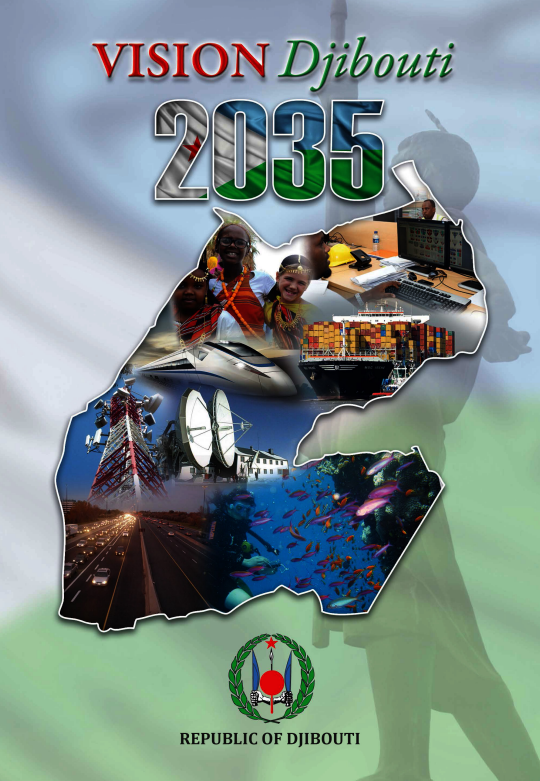
Djibouti’s national planning hierarchy is anchored in Vision Djibouti 2035, a long-term national vision intended to guide development toward “a desired future” by 2035. Vision 2035 is organised around five pillars. (1) Peace and National Unity, (2) Good Governance, (3) A diversified and competitive economy driven by the private sector, (4) Consolidation of Human Capital and (5) Regional Integration, explicitly linking national cohesion, institutional performance and economic transformation to inclusive development and international integration. Implementation is designed through five-year planning cycles: the Government describes SCAPE (2015–2019) as the first operational version of Vision 2035, implemented in these five-year cycles. SCAPE and Vision 2035 define a high-ambition development trajectory, tripling per capita income, creating more than 200 000 jobs, reducing unemployment to roughly 10% by 2035, reducing absolute poverty by more than one-third and achieving universal access to energy, water and basic services, providing a clear target framework for the Current Path and scenario interpretation in the rest of this report.
The second major operational plan is the National Development Plan (NDP) 2020–2024, “Djibouti ICI”, explicitly presented as consolidating SCAPE achievements and the COVID-era National Solidarity Pact, and developed within the Vision 2035 framework. Djibouti ICI is structured around three strategic axes, inclusion, connectivity and institutions, reinforced by intersecting themes including human capital development, environment and climate change and renewable energy. It also explicitly situates national planning within continental and global agendas, stating that it encompasses Djibouti’s international commitments, including the AU Agenda 2063 and the UN 2030 Agenda. Djibouti ICI includes explicit distributional targets and social objectives, for example, a stated target to reduce poverty by 28% and reduce the Gini index from 0.42 to 0.35 in 2025, while expanding access to schooling, basic health services and energy, water and sanitation. It also signals an intent to mobilise external resources (including Aid and diaspora engagement) and explicitly notes that measures to mobilise the diaspora would increase remittances.
The feasibility of this planning architecture hinges on three binding trade-offs repeatedly highlighted by development partners. First, the growth model has been investment-heavy and corridor-dependent. Second, fiscal space is constrained by the interaction of development needs and debt service. Third, environmental constraints increase delivery costs. These trade-offs shape how the report maps plan targets to the Current Path, sectoral scenarios and the Combined scenario forecasts.
The Technical Page explains the eight sectoral scenarios and their relationship to the Current Path and the Combined scenario. Chart 10 summarises the approach.
Chart 11 presents the mortality distribution in the Current Path for 2024 and 2043.
The Demographics and Health scenario envisions ambitious improvements in child and maternal mortality rates, enhanced access to modern contraception, and decreased mortality from communicable diseases (e.g., AIDS, diarrhoea, malaria, respiratory infections) and non-communicable diseases (e.g., diabetes), alongside advancements in safe water access and sanitation. This scenario assumes a swift demographic transition supported by heightened investments in health and water, sanitation, and hygiene (WaSH) infrastructure.
Visit the themes on Demographics and Health/WaSH for more details on the scenario structure and interventions.
Djibouti’s Current Path mortality distribution indicates that the country is now firmly in a double-burden phase of its epidemiological transition, where non-communicable diseases (NCDs) rise rapidly while communicable diseases continue to decline and injuries remain a persistent risk. WHO’s DataDot country profile for Djibouti shows that by 2021, an estimated 47% of deaths were from NCDs, 42% from communicable conditions and 9% from injuries, suggesting that Djibouti was at (or very near to) the point where NCD mortality became the largest share.
Under the Current Path, NCD mortality will become the dominant and fastest-growing pressure on the health system over the next two decades. Deaths from NCDs will rise from about 4 060 in 2024 to 7 110 by 2043, an increase of 3 050 deaths. Over the same period, deaths from communicable diseases will fall from about 2 910 to 1 530, a decline of 1 380 deaths. This is the classic signature of an epidemiological transition: as fertility declines and the population ages (as shown in Chart 2), chronic conditions become a larger share of avoidable mortality, while infectious disease burdens retreat but do not disappear.
Regarding mortality distribution, in 2024, the largest single cause was cardiovascular disease (approximately 1 700 deaths), followed by other communicable diseases (approximately 1 260), malignant neoplasms (approximately 950), AIDS (approximately 750) and respiratory infections (approximately 550). By 2043, the ranking will change further toward NCD dominance: cardiovascular deaths will rise to approximately 3 110 and malignant neoplasms will rise to roughly 1 610. At the same time, other communicable diseases will decline but remain material at about 622 deaths, indicating a persisting infectious burden even as the country transitions. AIDS and respiratory infections will become less threatening from the 2030s, while digestive diseases, diabetes and traffic accidents increase into the top-five causes.
The World Bank emphasises that NCDs pose a growing threat to health and development in LMICs, driven by ageing populations, urbanisation and lifestyle change, and that many countries face a double burden with unfinished communicable disease challenges alongside rising NCDs. For Djibouti, the growth in cardiovascular disease, cancers and diabetes implies greater demand for long-term, continuous care (hypertension screening, chronic medication, oncology pathways and dialysis and complication management) rather than episodic acute care. That raises recurrent operating costs for the health system and increases the risk of catastrophic household spending if service coverage is incomplete, particularly among poorer urban households and vulnerable groups. Policy guidance from the World Bank highlights that effective NCD response often requires a greater focus on publicly financed, primary-health-care-based services, underscoring the need to strengthen primary health care (PHC) platforms rather than relying only on hospitals.
At the same time, the decline in AIDS and respiratory infections in the Current Path implies continued gains from prevention, treatment and public health programs. Djibouti’s development partners nonetheless flag institutional constraints. A UNFPA/UNDP country program draft notes that the Ministry of Health has a National Health Development Plan (NHDP) 2020–2024 and a strategy to accelerate maternal and newborn mortality reduction, but that decentralisation, coordination and accountability remain key challenges, alongside limited high-functioning facilities and large urban–rural disparities in service coverage. These governance and capacity constraints matter because NCD care requires reliable follow-up systems, supply chains for essential medicines and consistent quality across districts.
Finally, the emergence of traffic accidents as a rising top-five threat by the 2030s will economically be important because road injuries disproportionately affect working-age adults, directly reducing labour productivity and raising health costs. Globally, the UN system frames road safety as a development priority, with commitments to reduce road traffic deaths by at least 50% by 2030 under the Decade of Action for Road Safety 2021–2030. If injuries will rise while NCDs accelerate, Djibouti risks a triple pressure on the health system: chronic disease management, still-meaningful infectious disease control and injury care, each with distinct infrastructure and workforce needs.
Chart 12 presents the infant mortality rate in the Current Path and the Demographics and Health scenario, from 2022 to 2043.
Infant mortality, defined as deaths between birth and 365 days per 1 000 live births, is a crucial indicator of maternal health, newborn care quality, nutrition, immunisation and water and sanitation conditions. Chart 12 should therefore be read as both a health-system performance signal and an inclusion signal. Historically, Djibouti has reduced infant mortality substantially since 1990, but entered the 2020s with a level still consistent with major preventable causes of newborn and early-childhood deaths. UN IGME’s Levels & Trends in Child Mortality statistical table reports that Djibouti’s infant mortality rate fell from 91 per 1 000 in 1990 to 44 per 1 000 in 2022. This long decline reflects progress in child survival. Still, the remaining burden points to persistent constraints in neonatal care, limited access to quality care outside the capital and vulnerability to shocks (drought, floods) that affect nutrition and service delivery, issues also flagged in recent UN program diagnostics that highlight institutional and service coverage gaps, particularly across the urban–rural divide.
The Current Path and the Demographics and Health scenario forecasts imply that Djibouti would achieve exceptionally rapid gains in child survival over the next two decades, well beyond the pace of other African LMICs. Under the Current Path, the infant mortality rate (IMR) will decline from 24.4 in 2024 to 9.6 per 1 000 live births by 2043. Under the Demographics and Health scenario, IMR will fall further to 6.8 per 1 000 by 2043, which is about 2.8 fewer infant deaths per 1 000 live births than the Current Path in 2043.
Globally, SDG 3.2 commits countries to ending preventable deaths of newborns and children under five, with benchmarks of neonatal mortality ≤12 and under-5 mortality ≤25 per 1 000 live births by 2030. Achieving such targets typically requires stronger antenatal care, skilled birth attendance, emergency obstetric and newborn care, postnatal follow-up and effective community health systems. In Djibouti, how these inputs are organised is shaped by constraints on health system capacity and equity. As indicated in the previous section, the Ministry of Health has an NHDP (2020–2024) and a strategy to accelerate reductions in maternal and newborn mortality, but UNFPA highlights persistent institutional constraints, including coordination and accountability as well as notable urban–rural disparities in service coverage. The Demographics and Health scenario assumes effective interventions to address these constraints, thereby achieving the SDG3.2 targets in the early 2030s, rather than in the later 2030s under the Current Path.
The economic and fiscal implications of achieving and sustaining reductions under the Demographics and Health scenario are substantial. Lower infant mortality improves human capital accumulation and long-run productivity (by enabling more surviving children to reach school age and adulthood). Still, it also requires reliable recurrent spending, especially for frontline services, supply chains for essential medicines and WaSH investments. UNICEF’s operations in Djibouti illustrate the continued importance of combined health–nutrition–WASH responses (under the Demographic and Health scenario) during shocks; for example, UNICEF programming priorities include access to safe water and nutrition assistance for children in affected areas, reflecting how drought and vulnerability intersect with child health outcomes.
Chart 13 presents the demographic dividend in the Current Path and in the Demographics and Health scenario, from 2020 to 2043.
UNFPA defines the demographic dividend as economic growth potential arising mainly when the share of the working-age population exceeds the non-working-age or dependants’ share (under 15 and 65+). This window emerges when the ratio of working-age individuals to dependants rises to about 1.7 to 1 or higher. The World Bank’s demographic dividend operational guidance emphasises that it is typically a 20–30 year period driven by fertility decline and age-structure change and that capturing it requires timely policies and investments, especially in health, education, governance and the economy, to ensure the bulge cohort finds well-paying jobs rather than unemployment or low-productivity work. Djibouti’s age structure, as depicted in Chart 2, is consistent with the conditions for a demographic dividend, but the economic payoff hinges on the country’s ability to translate that labour supply into productivity and earnings.
Djibouti crossed the demographic dividend threshold in 2018, and the ratio has since increased to roughly 1.9 in 2024. Under the Current Path, it will rise further to about 2 by 2043. In the Demographics and Health scenario, the ratio will increase more rapidly, reaching nearly 2.2 over the same period, suggesting a stronger potential boost to economic growth if supported by appropriate employment, education and health policies.
The most immediate implication is the scale of labour-market absorption required. If the working-age population rises from about 791 000 in 2024 to about 1 004 000 by 2043, Djibouti must create productive opportunities for a net increase on the order of approximately 213 000 additional working-age residents over two decades, through formal wage jobs, viable self-employment and productivity gains that raise incomes per worker. Today’s labour-market conditions sharpen this challenge: The World Bank modelled ILO estimates place total unemployment at 26% in 2025 and youth unemployment (ages 15–24) at 76.8% in the same year. If these conditions persist under the Current Path, the demographic window will not translate fully into faster per-capita growth; instead, it can manifest as higher pressure on public employment, household coping strategies and low-productivity informal work, exactly the risk highlighted by the World Bank’s demographic dividend guidance if job creation lags.
Human capital is a second binding condition for realising the dividend. The World Bank’s Djibouti Human Capital Review states that, based on a Human Capital Index (HCI) simulation, a child born in Djibouti in 2022 would achieve only 41% (HCI of 0.41) of full human capital potential by age 18, leaving 59% of potential untapped, an explicit productivity constraint. In a population structure where two-thirds of citizens are of working age, low learning outcomes, health burdens and limited skills formation directly reduce the return from favourable demography. Accordingly, human capital improvements are not just social goals, but fundamental economic requirements for converting a large working-age cohort into higher output and wages.
Female labour force participation is a third decisive lever. The World Bank’s demographic dividend note links stalled demographic transition to “lower levels of women entering the labour market” and weaker women’s empowerment, alongside higher youth unemployment and instability risks. In Djibouti’s context, raising women’s participation is not merely an equity agenda; it is a mechanism to expand the effective labour supply, increase household incomes and raise savings and investment, but only if labour demand expands and constraints (safety, childcare, skills, norms) are addressed. The demographic structure can therefore amplify the payoff from gender-inclusive growth strategies, especially those that increase women’s access to higher-productivity sectors (services, ICT, logistics administration and formal SMEs).
The World Bank demographic dividend framework emphasises a potential second dividend later in the transition, driven by the savings and investment behaviour of the bulge cohort as it ages. Capturing that second dividend typically requires financial deepening and credible long-term policy (pensions, savings vehicles, stable macro-fiscal conditions). Without such preparation, ageing can instead raise fiscal stress.
Djibouti’s national development plans directly frame the demographic transition as an opportunity that must be matched by economic transformation. Vision 2035’s overarching aim is to position the country as a hub for the regional and continental economy, and it emphasises a “diversified and competitive economy, driven by the private sector,” with growth anchored in port-linked services, transport, industry and ICT. It also includes a pillar on “Consolidation of Human Capital,” explicitly linking well-being and development to needs in health, education and training, jobs and the promotion of women and young people. The SCAPE reflects this same logic: it sets explicit objectives to accelerate growth, modernise the economy, assert the role of the private sector, promote employment and reduce social and territorial disparities. In other words, Djibouti’s planning architecture is aligned with the conditions the demographic dividend literature identifies as essential: jobs, human capital and institutional capability.
Chart 14 presents crop production and demand in the Current Path from 1990 to 2043.
The Agriculture scenario envisions an agricultural revolution that ensures food security through ambitious yet feasible increases in yields per hectare, driven by improved management, seed and fertiliser technologies, and expanded irrigation. Efforts to reduce food loss and waste are emphasised, with increased calorie consumption as an indicator of self-sufficiency and prioritising it over food exports. Additionally, enhanced forest protection demonstrates a commitment to sustainable land-use practices.
Visit the theme on Agriculture for our conceptualisation and details on the scenario structure and interventions.
Djibouti’s agricultural sector remains structurally constrained, reflecting the country’s arid climate, limited arable land and acute water scarcity. Of the roughly 1 010 hectares equipped for irrigation, only about 38.6% (approximately 390 hectares) were actually irrigated in 2024, pointing to significant underutilisation of existing infrastructure. Under the Current Path, the area effectively irrigated is forecasted to decline slightly to around 360 hectares by 2043, suggesting persistent constraints in water access, maintenance and agricultural investment.
Productivity challenges further underscore the sector’s limitations. Average crop yields have remained relatively stagnant at around 17 metric tons per hectare from the early 1990s to 2024, well below the country’s historical potential. Between 1980 and 1990, Djibouti achieved a notable 47.1% increase in yields, from 18.7 to 27.5 metric tons per hectare, indicating that improvements are possible under favourable conditions. The subsequent stagnation reflects structural bottlenecks, including limited irrigation, low input use and weak extension services.
Water scarcity remains the binding constraint. Djibouti’s desert environment and highly variable rainfall severely limit agricultural expansion and productivity. In response, the government and its partners have prioritised water infrastructure and climate-resilient agriculture. Key initiatives include the Saday dam, which enhances water storage capacity for irrigation and livestock, and the Ethiopia–Djibouti water pipeline, designed to improve water supply to urban and peri-urban areas while easing pressure on scarce groundwater resources. At the regional level, the Intergovernmental Authority on Development (IGAD) strategy on drought resilience and sustainable water management promotes more efficient water use and climate-smart irrigation practices. Recently, the World Bank approved a US$35 million grant to the Government of Djibouti to expand access to safe, reliable water resources for rural communities.
Additional climate adaptation efforts enshrined in the IGAD climate adaptation strategy (2023-2030), such as investments in desalination, groundwater development and agricultural mechanisation, are aimed at improving water availability and raising productivity. These interventions are expected to support moderate gains in agricultural output. Under the Current Path, crop production will increase from about 390 860 metric tons in 2024 to approximately 520 000 metric tons by 2043. Despite this progress, Djibouti will continue to face a substantial and widening food production deficit. Agricultural demand will rise sharply from 2.69 million metric tons in 2024 to 4.83 million metric tons by 2043, far outpacing domestic production.
These trends highlight the structural limits of domestic agriculture in ensuring food security. While investments in irrigation, water infrastructure and climate-smart agriculture are essential to maximise local production, Djibouti will remain heavily reliant on food imports. Strengthening trade logistics, regional food supply chains and strategic food reserves, alongside targeted support for niche, high-value or water-efficient crops, will therefore be critical to ensuring food security in a context of growing demand and environmental constraints.
Chart 15 presents the import dependence in the Current Path and the Agriculture scenario, from 2022 to 2043.
In the Agriculture scenario, Djibouti’s agricultural performance will improve significantly relative to the Current Path, although structural constraints remain. Crop production will increase to approximately 750 000 metric tons by 2043, about 230 000 metric tons higher than the Current Path forecast. At the same time, total demand will rise slowly relative to the Current Path, reaching 4.7 million metric tons, around 130 000 metric tons below the baseline forecast. As a result, the agricultural trade deficit will narrow from 11.8% of GDP in 2024 to 7.1% by 2043, compared to 7.2% under the Current Path.
These gains are underpinned by improved water management, increased investment in irrigation and the adoption of climate-smart agricultural practices. Ongoing and planned initiatives, such as expanding water infrastructure through projects like the Saday dam and the Ethiopia–Djibouti water pipeline, are expected to play a central role in enhancing water availability for agriculture. In parallel, regional frameworks such as the IGAD Drought Disaster Resilience and Sustainability Initiative (IDDRSI) promote efficient water use, rangeland management and climate-resilient farming systems across the Horn of Africa, directly supporting Djibouti’s agricultural adaptation efforts.
Further improvements are likely to come from policies aimed at strengthening agricultural productivity and value chains. Government strategies emphasise irrigation expansion, greenhouse farming, hydroponics and the use of drought-resistant crops, which are better suited to Djibouti’s arid conditions. Investments in agricultural mechanisation, extension services and access to inputs are also critical for raising yields, reversing historical stagnation and improving the utilisation of existing irrigable land. In addition, donor-supported programs, particularly the World Bank’s Agri-Food Value Chain Development Project, IFAD’s water and climate resilience initiatives and FAO-led agrifood system interventions, have focused on strengthening value chains, expanding rural infrastructure and building institutional capacity. These programs reflect a shift from subsistence support to market-oriented, climate-resilient agriculture, with a strong emphasis on water management, private-sector participation, and livelihood diversification.
On the demand side, the modest reduction relative to the Current Path reflects efficiency improvements, reduced post-harvest losses and gradual dietary shifts supported by better market functioning and food systems management. This is in line with the Malabo Declaration commitment to halve post-harvest losses by farming practices, storage and rural roads to reduce wastage.
The Agriculture scenario demonstrates that while Djibouti cannot eliminate its dependence on food imports, it can meaningfully reduce its vulnerability. Achieving these gains will require scaling up investment in water-efficient technologies, strengthening the link between infrastructure and on-farm productivity and prioritising high-value, low-water-intensity crops. At the same time, integrating domestic production with efficient import systems and regional trade will remain essential to ensuring long-term food security in a resource-constrained environment.
Chart 16 depicts the progress through the educational system in the Current Path, for 2024 and 2043.
The Education scenario represents reasonable but ambitious improvements in intake, transition and graduation rates from primary to tertiary levels, and in the quality of education at primary and secondary levels. It also models substantive progress towards gender parity at all levels, additional vocational training at the secondary school level, and increases in the share of science and engineering graduates.
Visit the theme on Education for our conceptualisation and details on the scenario structure and interventions.
In the Current Path, Djibouti will make significant gains in primary enrolment and completion. Still, the system will remain constrained by (i) incomplete universal access at primary, (ii) transition bottlenecks at lower and upper-secondary education that do not return to historical peaks, (iii) stagnant vocational enrolment in lower secondary and persistent gender gaps in TVET at upper secondary, and (iv) a declining science-and-engineering share among tertiary graduates, even as tertiary enrolment expands. This matters economically because Djibouti’s long-term strategy is to become a regional services and logistics hub, which will require a larger and more skilled workforce than the current education pipeline can deliver. Vision 2035 explicitly frames national transformation around a diversified, competitive, private-sector-driven economy and consolidation of human capital, linking education and skills formation directly to the development model.
At the continental level, the Agenda 2063 Second Ten-Year Implementation Plan (2024–2033) sets an explicit target to raise net enrolment rates to 100% in primary and 80% in secondary, while also setting targets for minimum proficiency and teacher ratios; it also includes a tertiary enrolment target (at least 50%) as part of the skills revolution agenda. Globally, SDG 4.1 calls for all girls and boys to complete free, equitable and quality primary and secondary education by 2030, emphasising that access gains must be matched with learning and completion. These frameworks provide the benchmark for interpreting Djibouti’s Current Path progress: great improvement, but not yet full alignment with universal enrolment ambitions.
The Current Path shows that primary net enrolment will rise from 61.2% of the primary-age cohort in 2024 to 87.7% by 2043. By sex, males will remain ahead, but the gap will narrow. The male net enrolment rate (NER) will increase from 63.9% to 88.0%, while the female NER will rise from 58.4% to 87.5%. The male–female gap will fall from 5.5 percentage points to 0.5 percentage points in the same period, implying near parity by the early-to-mid 2040s. This convergence aligns with the partners’ and the government's emphasis on reducing gender disparities. Still, it also underscores a key policy challenge: even by 2043, net primary enrolment in the Current Path will remain below the 100% objective embedded in continental targets, meaning that out-of-school children remain a central issue rather than grade progression alone.
Completion dynamics improve faster than access. The Current Path indicates that the primary survival rate will reach 100% by 2034, suggesting that once children enter primary school, they persist through the cycle. That is a powerful quality-of-flow result for the pipeline's quality of flow. It shifts the binding constraint from drop-out during primary toward (i) getting all children into school (especially the hardest-to-reach) and (ii) strengthening transitions and learning outcomes, both priorities echoed by SDG 4 framing.
At the transition points, the Current Path will improve, but does not fully recover earlier performance. The transition and progression into lower secondary will rise from approximately 89% in 2024 to roughly 93% by 2043. This is commendable, but it will remain below the historical peak of 99.4% recorded in 2013. The persistence of a gap versus historical peaks matters because lower secondary is where many systems lose learners, particularly disadvantaged groups. The May 2025 World Bank press release on Djibouti emphasises persistent gender inequality along the pipeline, noting gaps in completion and transition to lower secondary (with boys outperforming girls in transition metrics cited in that release), reinforcing the interpretation that equity and progression remain live constraints despite improvement. The transition into upper secondary will rise from approximately 88% in 2024 to approximately 90% by 2043, but will remain below the 99% historical peak recorded in 2006. Males will lead females slightly in the lower-secondary transition (with convergence toward the 2040s), while females will lead males in the upper-secondary transition with a widening margin toward the 2040s. The key policy implication is that Djibouti’s pipeline gradually equalises gender gaps, but the system never returns to near-perfect transitions consistent with universal basic education ambitions.
The most binding structural weakness in the Current Path is the lack of participation in technical and vocational education and training (TVET). In the Current Path, the share of lower-secondary vocational enrolment will remain stagnant at 0.6% for males and 0.36% for females from 2024 to 2043. At upper secondary, vocational shares will also remain static at 22% (males) and 17.1% (females). This stagnation is important because both Agenda 2063’s skills revolution and SDG 4 targets emphasise the development of relevant skills and vocational pathways for employment and entrepreneurship. Djibouti’s own education strategy reinforces this: the official SDEF 2021–2035 includes a strategic emphasis on expanding access to professional formation and widening participation, including for vulnerable groups and girls. A flat TVET share in the Current Path suggests that the economy may struggle to supply mid-level technicians required for logistics, construction, energy systems, ICT infrastructure and port-linked maintenance, roles that are essential if growth is to translate into jobs and productivity.
At the tertiary level, the pipeline will expand in volume but tilt away from Science, Technology, Engineering, and Mathematics (STEM). On the Current Path, the science and engineering share of tertiary graduates will decline from 46.4% in 2024 to 41.6% by 2043, while tertiary gross enrolment will rise sharply from 13.4% to 30% of the age cohort. This combination implies a system that produces more graduates overall but proportionally fewer in science and engineering. For a country seeking to build competitiveness in ICT-enabled services and renewable energy, both of which are repeatedly highlighted in partner diagnostics, this could become a strategic constraint unless policy actively protects STEM quality and relevance.
In summary, stronger lower-level progression, laying the groundwork for tertiary growth, is consistent with a typical education transition. Still, without an intentional skills strategy, the output mix may not align with the country’s hub development model (logistics, digital infrastructure, energy transition) that requires technicians and applied STEM graduates.
Chart 17 presents the mean years of education in the Current Path and in the Education scenario, from 2022 to 2043, for the 15 to 24-year-old age group.
The mean years of education for the 15–24-year-old cohort is a useful early indicator of human capital stock. It summarises how much schooling the next generation of workers has accumulated and therefore signals how quickly national human capital is improving. UNESCO’s metadata for mean years of schooling (in its standard adult indicator) emphasises that the measure reflects the stock of schooling and human capital accumulated by a population and can be used to gauge development needs and the accumulated impact of the education system on human capital formation. Focusing on ages 15–24 makes the indicator even more forward-looking. It approximates the schooling attainment of entrants into the labour market and the near-term pipeline for technical skills, productivity growth and employability.
In the Current Path, mean years of education among 15–24-year-olds will rise from 7.2 years in 2024 to 8.8 years by 2043. In the Education scenario, the same cohort will reach about 11 years old by 2043, roughly 2.2 additional years beyond the Current Path. This is a large structural shift. Conceptually, a rise to approximately 11 years indicates that the average young adult is approaching completion of upper secondary, with a growing share entering tertiary; roughly 9 years indicates progress beyond primary and lower secondary but leaves a larger fraction short of full senior secondary completion, consistent with the pipeline constraints highlighted in Chart 16.
The economic value of a 2.2-year attainment gain is substantial, even before accounting for broader social benefits. A World Bank review of the global returns-to-education literature estimates an overall private return near 9–10% per additional year of schooling (world average about 8.8%; sub-Saharan Africa even higher), and finds that returns to female education exceed male returns by about two percentage points. Interpreted mechanically, 2.2 extra years of schooling could be associated with roughly 22–25% higher earnings potential for the average worker (compounded), other things equal. However, realised gains depend on the quality of education, skills relevance and labour demand. This aligns with Djibouti’s long-term development logic: Vision Djibouti 2035 is anchored in building a diversified, competitive economy and includes human capital development as a core pillar. The Government frames Vision 2035 as a long-term strategy to position Djibouti as a regional and continental economic hub, a goal that requires a steadily rising stock of educated youth.
Gender dynamics are central to the story. The Education scenario will narrow the male–female attainment gap from 0.4 years (2024) to 0.1 years by 2043, while under the Current Path, the gap will remain 0.4 years in favour of males in 2043. This is not merely a distributional improvement; it is an efficiency gain. The World Bank returns review finds that returns to female education tend to be higher than returns to male education, implying that closing the gender attainment gap can yield outsized household and macroeconomic payoffs. Djibouti’s own education planning architecture explicitly targets girls’ schooling constraints through practical measures, female hygiene and separate school latrines, prevention of gender-based violence, teacher training and curricular adaptation, and financial measures to reduce the indirect costs of girls’ schooling, illustrating that parity is expected to be policy-driven, not automatic. The SDEF 2021–2035 (adopted by law and implemented through three five-year action plans) explicitly frames universal primary and lower-secondary education as sequential goals aligned to SDG 4.1, reinforcing the policy credibility of the Education scenario’s faster attainment gains.
The main risk to realising the Education scenario’s attainment gains is that higher schooling does not automatically translate into higher productivity and incomes if labour markets cannot absorb the growing pool of educated youth. This is why the report treats mean years of education as a necessary but not sufficient condition for inclusive growth. It must be matched by reforms that create skilled jobs in logistics-linked services, ICT, energy, and higher-productivity SMEs, consistent with Vision 2035’s private-sector-driven diversification pillar and later scenarios on governance, infrastructure and trade.
Chart 18 presents the value-added by sector as a share of GDP in the Current Path, for 2024 and 2043.
In the Manufacturing scenario, reasonable but ambitious growth in manufacturing is envisaged through increased investment in the sector, research and development (R&D), and improved government regulation of businesses. This aims to enhance total factor productivity and labour absorption.
Visit the theme on Manufacturing for our conceptualisation and details on the scenario structure and interventions.
Djibouti’s Current Path sector composition confirms a services-led economy that will become even more services-intensive over time. In 2024, services accounted for 56.8% of GDP and will rise to 64.3% by 2043. This aligns with Djibouti’s core development narrative. The government’s long-term Vision 2035 positions Djibouti as a hub for the regional and continental economy, a model that tends to expand transport, trade, logistics, and related services faster than the primary sectors. It is also consistent with the recent IMF analysis, which reports that 2024 growth was strong (about 6.5%) and was driven by “robust transhipment” amid Red Sea disruptions, an explicitly services-linked growth channel.
Manufacturing is the second-largest sector in the Current Path, but its share will decline over the forecast period. In 2024, the share of manufacturing value added in GDP stood at 22.2%, which is double the African average of roughly 10.4%, but will fall to 19% by 2043. This is a classic relative decline story where the economy becomes more services-weighted, even though manufacturing output can still rise in absolute terms. The World Bank’s Djibouti SCD emphasises that recent growth has been driven by major infrastructure investments (ports, transport corridors, free zones) and that the resulting growth pattern has been capital-intensive and not fully inclusive, strengthening the case that sectoral shares alone must be interpreted alongside jobs, informality and productivity. A declining manufacturing share under the Current Path can therefore signal at least three dynamics: (i) continued fast growth of services around the corridor economy, (ii) a tapering of construction and capital-formation intensity if large project cycles mature, and/or (iii) limited competitiveness gains in tradable manufacturing relative to services growth. The IMF’s warnings about constrained fiscal space from rising debt service amplify this: if public investment and concessional financing become tighter, sustaining an investment-driven industrial expansion becomes harder, increasing the risk that structural change remains slow and services-heavy.
The materials sector (third) will remain essentially flat at 7% throughout the forecast horizon, implying limited diversification into mining and commodities or construction-materials upgrading under the Current Path. Agriculture, while it was still meaningful in 2024 (6.5%), will decline to 2.8% by 2043, a shift consistent with Djibouti’s binding climate, land and water constraints. The World Bank’s climate risk profile notes that Djibouti receives little precipitation, is largely unsuitable for agriculture and consequently imports nearly all its food, structural conditions that tend to reduce agriculture’s GDP share over time unless high-productivity irrigated niches expand.
ICT will edge upward only slightly, from 4.2% in 2024 to 4.4% by 2043, suggesting modest baseline digital deepening rather than a rapid leap. Energy will remain the smallest sector and decline from 2.4% to 1.8%, which may reflect faster growth of other sectors relative to energy value-added (or efficiency and pricing effects) rather than a fall in energy output.
Despite a decrease in the relative contribution of some sectors to the country’s GDP, all sectors will grow in absolute size by 2043. In this regard, the Current Path implies greater service dominance and slow structural transformation without necessarily implying deindustrialisation in absolute terms.
Chart 19 presents the contribution of the manufacturing sector to GDP in the Current Path and in the Manufacturing scenario, from 2020 to 2043. The data is in US$ and % of GDP.
Under the Manufacturing scenario, the economy’s structure will slightly shift toward industry at the expense of services. By 2043, only the manufacturing and materials sectors will have higher GDP shares than in the Current Path. Manufacturing’s share will be up by 2.2 percentage points relative to the baseline, and materials by 0.1 percentage points. In contrast, services will fall by 2 percentage points, ICT by 0.15, agriculture by 0.13 and energy by 0.1. In absolute terms, every sector will be larger under the Manufacturing scenario by 2043 relative to the Current Path, but manufacturing will grow the most. Manufacturing value added will be about US$480 million larger in 2043 than the baseline. In contrast, the service sector will be larger by approximately US$280 million, followed by materials (+US$80 million), ICT (+US$20 million), agriculture (+US$10 million) and energy (+US$3 million).
This outcome reflects the intent of the Manufacturing scenario. Targeted policies, for example, trade liberalisation for industry and industrial parks, export promotion, skills for manufacturing, boost industrial output faster than in the baseline. The service sector will still grow in absolute terms but less rapidly than before, as some resources shift to industry. The AfDB and IMF note that Djibouti’s baseline growth is driven by capital-intensive services and infrastructure, so a scenario that reallocates some investment toward manufacturing can meaningfully change the structure. The small boost in materials (e.g. local inputs, logistics supplies) also signals the scenario’s emphasis on domestic value-added. Meanwhile, the slight decline in agriculture’s share is consistent with Djibouti’s harsh environment (agriculture is virtually absent from national accounts) and with Vision 2035’s limited emphasis on expanding farming, given climate constraints.
In sum, Chart 19 shows that the Manufacturing scenario will achieve its goal of shifting Djibouti’s production toward industry. Manufacturing captures a larger gain by 2043 relative to the Current Path forecasts. However, this implies slower relative growth in services and ICT compared to the baseline. Economic theory suggests trade-offs: expanding industry can raise wages and export revenue, but may crowd out some high-margin service sectors. The policy implication is that such structural reallocation must be supported by ensuring services that serve industry (finance, transport) also remain competitive, and careful management of employment, since manufacturing is more capital-intensive per worker in Djibouti’s context.
Chart 20 depicts exports and imports as a percentage of GDP, from 2000 to 2043, in the Current Path and in the AfCFTA scenario.
The AfCFTA scenario represents the impact of fully implementing the African Continental Free Trade Agreement by 2034. The scenario increases exports in manufacturing, agriculture, services, ICT, materials and energy exports. It also includes improved multifactor productivity growth from trade and reduced tariffs for all sectors.
Visit the theme on AfCFTA for our conceptualisation and details on the scenario structure and interventions.
Djibouti ratified the AfCFTA in February 2019 and launched its National Implementation Strategy in May 2022, with support from the UN Economic Commission for Africa. The strategy outlines tariff schedules and prioritises capacity building to facilitate integration into continental markets. However, Djibouti’s trade patterns remain largely oriented towards non-African partners, reflecting its role as a logistics and re-export hub rather than a diversified production economy. Its main export destinations include Saudi Arabia, China, Egypt, Israel and Slovakia, while imports are sourced primarily from China, India, Morocco, Turkey and Indonesia. The country’s export basket remains narrow and dominated by low-value primary goods such as livestock, chlorides, coffee and oilseeds. At the same time, imports are concentrated in higher-value products including fertilisers, refined petroleum, palm oil and sugar.
This structure highlights a key policy challenge for AfCFTA implementation: Djibouti’s limited productive base constrains its ability to fully leverage preferential access to African markets. At the same time, its strategic location and advanced port infrastructure position it as a critical gateway for regional trade, particularly for landlocked neighbours such as Ethiopia.
Djibouti’s trade profile underscores the highly open and trade-intensive nature of its economy, with import growth consistently outpacing exports. In 2024, exports were valued at approximately US$5.80 billion, while imports reached US$5.85 billion, resulting in a trade-to-GDP ratio of about 274%. In the same year, Djibouti ranked 94th globally and 8th in Africa in terms of economic globalisation, reflecting its strong integration into global trade and logistics networks.
This high degree of openness is closely linked to Djibouti’s role as a regional logistics and transhipment hub, particularly for Ethiopia, as well as its reliance on imported goods to meet domestic demand. However, it also highlights structural vulnerabilities, including limited export diversification and a persistent trade imbalance.
Looking ahead, under the Current Path, both exports and imports will grow significantly, reaching US$16.91 billion and US$17.69 billion, respectively, by 2043. Despite this expansion, trade openness will decline slightly to around 264%, as import growth continues to outpace exports.
Sustaining the benefits of openness while reducing vulnerabilities will require strengthening export diversification, enhancing domestic productive capacity and leveraging regional integration frameworks such as the AfCFTA. This includes moving beyond a re-export model towards greater value addition and deeper participation in regional value chains, particularly in sectors linked to logistics, trade facilitation and light manufacturing.
Chart 21 presents the trade balance in the Current Path and in the AfCFTA scenario, from 2022 to 2043, as a percentage of GDP.
Djibouti’s trade deficit stood at about US$50 million in 2024 (around 1.2% of GDP). On the Current Path, this deficit will widen significantly to approximately US$781 million (about 5.9% of GDP) by 2043. Under the AfCFTA scenario, however, the deficit in 2043 will increase to roughly US$310 million (around 2.2% of GDP), representing an improvement of about US$470 million relative to the baseline forecast.
This improvement is driven by stronger export growth under AfCFTA. By lowering tariffs and reducing non-tariff barriers, the agreement will expand intra-African market access and facilitate trade, increasing exports to approximately US$24.12 billion by 2043. While imports will also grow, reaching about US$24.43 billion, this reflects Djibouti’s structural dependence on imported consumption and capital goods. Crucially, exports will grow at a faster pace than imports under the AfCFTA scenario, narrowing the trade gap from 5.9% of GDP under the Current Path to around 2.2%.
From a macroeconomic perspective, a smaller trade deficit reduces pressure on foreign exchange reserves and lowers the external financing requirement. However, a deficit of 2.2% of GDP remains non-negligible for a small, highly open economy such as Djibouti. Financing this gap will still require a combination of external borrowing and reserve drawdowns, reinforcing existing vulnerabilities highlighted in IMF assessments, particularly high external debt service and limited fiscal buffers.
Overall, the AfCFTA scenario will deliver a meaningful, though moderate, improvement in Djibouti’s trade balance and aligns with the objectives of Vision 2035 and SCAPE, which emphasise export diversification and deeper regional integration. However, the scale of gains remains contingent on complementary domestic reforms. In particular, realising the full benefits of AfCFTA will require three initiatives. First, accelerating tariff liberalisation and regulatory alignment with regional partners. Second, diversifying exports beyond re-exports towards higher value-added products, including agro-processing and light manufacturing. Last but not least, strengthening trade facilitation systems, such as digital customs platforms and single-window mechanisms, to efficiently handle increased trade volumes. Together, these measures would help translate improved market access into sustained export growth and greater structural transformation.
Chart 22 presents the Current Path of access to electricity for urban, rural and the total population from 2000 to 2043.
The Large Infrastructure and Leapfrogging scenario involves ambitious investments in road and renewable energy infrastructure, improved electricity access and accelerated broadband connectivity. It emphasises adopting modern technologies to enhance government efficiency. It incorporates significant investments in major infrastructure projects like rail, ports, and airports (other infra) while highlighting the positive impacts of renewables and ICT.
Visit the themes on Large Infrastructure and Leapfrogging for our conceptualisation and details on the scenario structure and interventions.
Djibouti’s total electricity access rate increased from 56% in 2000 to 68.1% in 2024, reflecting gradual but uneven progress in expanding energy infrastructure. This improvement has been driven primarily by urban electrification, which rose from 56.5% to 75.2% over the same period, consistent with the country’s highly urbanised settlement pattern and infrastructure concentration around Djibouti City. In contrast, rural electrification declined sharply from 54% in 2000 to 29.1% in 2015 before recovering to 50% by 2024, underscoring persistent spatial inequalities in access.
Past improvements in electricity access have been closely linked to large-scale infrastructure investments and regional energy integration. A key milestone was the 2011 Ethiopia–Djibouti electricity interconnection, which enabled the import of relatively low-cost hydropower (estimated at 180–300 GWh annually), significantly expanding supply and stabilising the grid. This was complemented by subsequent grid-strengthening projects, including the second Ethiopia–Djibouti interconnection (230 kV line), supported by the World Bank and African Development Bank, aimed at increasing supply reliability and reducing dependence on expensive fossil fuel generation. These regional projects have been instrumental in lowering generation costs and enabling wider electrification.
Djibouti is accelerating efforts to diversify its energy mix and expand access through renewable energy investments. Flagship projects include the 60 MW Ghoubet Wind Power Plant (commissioned in September 2023), the country’s first utility-scale renewable energy facility, and planned solar developments such as the 25 MW Grand Bara solar plant, which will further expand domestic generation capacity. Donor-financed solar mini-grids projects in rural areas have also expanded access. These initiatives form part of a broader strategy to transition towards renewable energy and reduce reliance on imported electricity and fossil fuels.
At the policy level, Vision 2035 explicitly targets universal energy access, and the World Bank SCD note that the lack of rural power has long constrained development. Supporting programs such as the 2017 World Bank-backed Sustainable Electrification Program and earlier power access and diversification projects have focused explicitly on expanding access, particularly in underserved and rural areas, while strengthening institutional capacity and grid infrastructure.
Looking ahead, under the Current Path, total access will rise to 85.9% by 2043, with urban nearly universal (88.2%) and rural catching up to 76.3%. Achieving universal access will depend on sustaining investments in grid expansion, scaling up off-grid and mini-grid solutions and fully leveraging Djibouti’s renewable energy potential (solar, wind and geothermal). These efforts align with Vision 2035’s pillar of green infrastructure and SDG 7 on affordable clean energy. In addition, continued regional power integration, particularly with Ethiopia, will remain critical for ensuring affordability and reliability. Bridging the urban–rural access gap is therefore central to supporting inclusive growth and enabling broader participation in Djibouti’s services-led economy.
Chart 23 presents the number of people using cookstoves in the Current Path and in the Large Infrastructure and Leapfrogging scenario, from 2022 to 2043.
Djibouti already stands out as one of the African countries with the highest adoption of modern fuel cookstoves, reflecting its urbanised population, small geographic size and relatively advanced energy distribution systems. In 2024, about 88% of households (approximately 141 850 people) were using modern fuel cookstoves, while 11.5% (18 500 people) relied on traditional biomass-based methods and only 0.6% (around 970 people) used improved cookstoves.
This high level of adoption is closely linked to Djibouti’s structural and policy context. The country’s heavy reliance on imported liquefied petroleum gas (LPG), combined with urban energy access and government efforts to promote cleaner fuels, has significantly reduced dependence on biomass. Policies under Vision 2035 and energy sector reforms have prioritised access to modern energy services, while donor-supported programs have facilitated LPG distribution and affordability, particularly in urban areas. In addition, Djibouti’s limited forest resources and high cost of biomass have further incentivised a transition towards cleaner cooking solutions.
Looking ahead, adoption is expected to increase further under both scenarios, but more rapidly under the Large Infrastructure and Leapfrogging pathway. By 2043, the share of households using modern cookstoves will reach 97.6% (236 290 people), slightly above the Current Path forecast of 96.2% (233 370 people). This acceleration reflects the combined effects of expanded energy infrastructure, improved fuel distribution systems and continued urbanisation.
At the same time, reliance on traditional cookstoves is expected to decline sharply. Under the Large Infrastructure and Leapfrogging scenario, the share of households using traditional methods will fall to 2.4% (5 890 people), compared to 3.2% (8 720 people) under the Current Path. The use of improved cookstoves will also decline marginally to 0.1% (310 people), relative to 0.2% (460 people) in the baseline, as households transition directly to modern fuels rather than intermediate technologies.
Achieving near-universal adoption of clean cooking will depend on sustaining investments in energy infrastructure, particularly LPG supply chains and electricity access, while ensuring affordability for low-income households. Recent and ongoing initiatives will be critical in consolidating these gains, including efforts to scale up renewable energy generation, strengthen electricity access and promote clean cooking solutions (under regional and global frameworks such as Sustainable Energy for All (SEforALL)). Ensuring that the remaining pockets of traditional fuel use, primarily in rural and peri-urban areas, are addressed through targeted subsidies, distribution networks and behavioural interventions will be essential for achieving universal access to clean cooking and maximising associated health and environmental benefits.
Chart 24 presents the percentage of the population and number of people with access to mobile and fixed broadband in the Current Path and in the Large Infrastructure and Leapfrogging scenario, from 2022 to 2043. The user can toggle between mobile and fixed broadband.
Under the Large Infrastructure and Leapfrogging scenario, access to fixed broadband will increase from 3.3 subscriptions per 100 people in 2024 to 34.7 by 2043, compared to 30.3 under the Current Path. This suggests that targeted infrastructure investments and digital leapfrogging can accelerate the expansion of high-speed internet access, particularly in a context where baseline penetration remains relatively low.
In contrast, mobile broadband subscriptions will show no significant deviation from the Current Path in either the short or long term. Subscription rates are already near saturation, reaching approximately 126 subscriptions per 100 people by 2043, closely aligned with the estimated demand of 126 per 100 people. This indicates a mature mobile market where further growth is constrained and where policy focus may need to shift from expanding access to improving quality, affordability and service reliability.
These trends highlight the importance of prioritising fixed broadband infrastructure, such as fibre-optic networks and international connectivity, to complement an already saturated mobile market. In Djibouti’s case, ongoing investments in submarine cable systems and its positioning as a regional digital connectivity hub provide a strong foundation for expanding fixed broadband access. Leveraging these assets, alongside regulatory reforms to encourage competition and reduce costs, will be critical to unlocking the full benefits of digitalisation for economic diversification and service sector growth.
Chart 25 presents the trends in FDI, aid and remittances in the Current Path and in the Financial Flows scenario as a percentage of GDP, from 1990 to 2043.
The Financial Flows scenario represents a reasonable but ambitious increase in inward flows of worker remittances, aid to poor countries and an increase in the stock of foreign direct investment (FDI) and additional portfolio investment inflows. We reduce outward financial flows to emulate a reduction in illicit financial outflows.
Visit the theme on Financial Flows for our conceptualisation and details on the scenario structure and interventions.
Djibouti’s financial landscape is shaped by its strategic ambition to position itself as a regional logistics, trade and services hub, as articulated in Vision 2035 and operationalised through the SCAPE. Both frameworks emphasise a shift towards a diversified, private sector-led economy anchored in port-linked services, transport, industry and ICT. This model has relied heavily on external financial inflows, particularly foreign direct investment (FDI) and external debt, while domestic resource mobilisation remains comparatively constrained.
FDI has been the dominant driver of capital formation in Djibouti, reflecting large-scale infrastructure investments in ports, free economic zones, rail and energy. Much of this investment has been concentrated in capital-intensive, enclave-type sectors linked to logistics and connectivity, often financed through bilateral partnerships, most notably with China, and public–private partnerships. As a result, Djibouti exhibits exceptionally high FDI stocks relative to the size of its economy. In the Financial Flows scenario, this trend will intensify significantly, with FDI stock increasing from US$4.49 billion (105.5% of GDP) in 2024 to US$23.43 billion (153.2% of GDP) by 2043, compared to US$12.79 billion (97.4%) under the Current Path. This suggests a deepening of Djibouti’s capital-intensive growth model, with continued reliance on external investment to finance infrastructure and economic transformation.
Official development assistance (ODA) also plays an important, albeit secondary, role, particularly in financing social sectors, capacity building and infrastructure gaps not covered by private investment. Under the Financial Flows scenario, net aid receipts will increase modestly from US$0.23 billion in 2024 to US$0.25 billion by 2043, broadly in line with the Current Path, while aid dependency will drop significantly from 5.4% of GDP to almost 1.7% (versus 1.8% under the Current Path) in the same period. However, the scenario assumes a temporary scaling up of concessional financing in the medium term, with net aid receipts rising to approximately US$0.37 billion (around 4% of GDP) by 2037, compared to US$0.28 billion (3%) under the baseline. This reflects the continued importance of development partners in supporting Djibouti’s structural transformation, particularly in areas such as energy, water, sanitation and human development.
Remittance inflows, while relatively small compared to FDI and aid, represent a stable supplementary source of external finance. Under the Financial Flows scenario, remittances will increase from US$0.05 billion in 2024 to US$0.18 billion by 2043, exceeding the Current Path forecast of US$0.14 billion. Although modest in scale, remittances can play an important role in supporting household consumption, reducing vulnerability and, if effectively leveraged, contributing to local investment and infrastructure development.
On the domestic side, resource mobilisation remains a structural constraint. Djibouti’s narrow production base, limited industrial sector and high reliance on trade-related revenues constrain tax collection. In contrast, the dominance of capital-intensive sectors limits broad-based job creation and the potential for income tax revenue. Strengthening domestic revenue mobilisation, through tax administration reforms, broadening the tax base and improving the efficiency of public expenditure, remains critical to reducing dependence on external financing and enhancing fiscal sustainability.
The Financial Flows scenario underscores both opportunities and risks. Increased FDI can accelerate infrastructure development, manufacturing and reinforce Djibouti’s role as a regional hub. Still, it also raises concerns around debt sustainability, enclave development and limited spillovers to the wider economy. Maximising the developmental impact of these flows will require stronger linkages between foreign investment and domestic firms, targeted industrial policies and continued reforms to improve the business environment. At the same time, effectively leveraging aid and remittances, while strengthening domestic resource mobilisation, will be essential to ensuring that financial inflows translate into inclusive and sustainable growth.
Chart 26 presents government revenue in the Current Path and in the Financial Flows scenario, from 2020 to 2043. The data is in US$ 2017 and % of GDP.
Wagner's law, or the law of increasing state activity, states that public expenditure increases as national income rises. In the Financial Flows scenario, it is reasonable to expect government revenues to increase as a percentage of GDP relative to the Current Path.
In line with Wagner’s Law, the principle that public expenditure tends to expand as economies grow, Djibouti’s fiscal trajectory reflects the increasing role of the state in supporting economic transformation. As national income rises, demand for infrastructure, public services and regulatory capacity intensifies, placing upward pressure on both government spending and revenue mobilisation.
In Djibouti’s case, this dynamic is closely tied to its development model. The country’s growth has been driven by large-scale, capital-intensive investments in ports, logistics and related services, which have expanded the tax base primarily through trade-related revenues, fees and service charges. At the same time, fiscal reforms aimed at strengthening revenue administration and improving public financial management have supported gradual gains in domestic resource mobilisation.
In the Financial Flows scenario, government revenue will increase significantly from approximately US$802 million (18.9% of GDP) in 2024 to US$3.39 billion (22.1% of GDP) by 2043, approximately US$530 million higher than the Current Path forecast of US$2.86 billion (21.8%). This reflects the combined effects of stronger economic growth, increased foreign investment and enhanced fiscal capacity. Notably, the rise in revenue as a share of GDP suggests modest but meaningful improvements in tax effort and efficiency, rather than growth alone.
While rising revenues signal improved fiscal space, Djibouti’s revenue base remains relatively narrow and heavily dependent on external trade and logistics-related activities. Strengthening domestic resource mobilisation will therefore require broadening the tax base beyond enclave sectors, enhancing compliance and deepening reforms in tax administration. In addition, improving the link between revenue generation and inclusive service delivery, particularly in underserved and peripheral regions, will be critical to ensuring that fiscal expansion translates into equitable and sustainable development outcomes.
Chart 27 presents the Current Path of government effectiveness, comparing the country to the average for the African income group, from 2002 to 2043.
The World Bank’s Government Effectiveness Index captures perceptions of the quality of public services, the competence and independence of the civil service, the quality of policy formulation and implementation, and the credibility of government commitments. The index ranges from −2.5 (weak effectiveness) to +2.5 (strong effectiveness), providing a useful benchmark for assessing state capacity and institutional performance.
Djibouti’s governance ambitions are clearly articulated in Vision 2035, which seeks to build “an effective, efficient and competitive public administration, with strong capacities for anticipation, coordination and management.” Reforms under the governance pillar, including civil service training, digitalisation through e-government platforms and the decentralisation of service delivery, are intended to strengthen bureaucratic capacity and improve public-sector performance. These efforts are complemented by broader public financial management and administrative reforms supported by development partners.
Historically, however, progress has been gradual. Djibouti’s average government effectiveness score between 1996 and 2024 stood at −0.8, with a minimum of −1.32 in 1998 and an improvement to −0.49 in 2024. In 2024, the country ranked 131st globally and 19th in Africa, indicating persistent institutional constraints despite recent gains.
Looking ahead, the Current Path suggests a continued improvement in government effectiveness to −0.07 (equivalent to a score of 2.43) by 2043. While this represents meaningful progress, Djibouti would still lag behind stronger reformers on the continent. For example, Rwanda, currently ranked among the top five African countries on government effectiveness, improved its score by more than 50% between 2005 and 2015 through sustained governance reforms focused on public sector performance, accountability and service delivery.
This comparison underscores the importance of implementation capacity and the depth of reform. For Djibouti, accelerating improvements in government effectiveness will require not only continued investment in administrative capacity and digital governance but also stronger accountability mechanisms, enhanced coordination across institutions and a clearer alignment between policy commitments and execution. Strengthening these areas will be critical to ensuring that broader development strategies, particularly those linked to infrastructure, private-sector development and service delivery, translate into tangible and inclusive outcomes.
Chart 28 presents the security, capacity and inclusion index for the Current Path versus the Governance scenario, for 2024 and 2043.
This scenario assumes better governance: stability, capacity and inclusion. It measures a state’s progress by averaging these three indices. To this end, it includes an index (0 to 1) for each dimension, with higher scores indicating improved outcome rticipation rates, particularly among females, where appropriate.
Furthermore, the scenario includes increased welfare transfers to unskilled workers, funded by taxes on skilled workers. These two amounts should roughly balance each other out in US dollar terms. In the context of high poverty levels and inequality, social transfers have proven to be the most effective short- to medium-term measures for alleviating both issues.
Visit the theme on Governance for a full conceptualisation and details on the scenario structure and interventions.
According to the Ibrahim Index of African Governance (IIAG), Djibouti scored 43.1 out of 100 in overall governance in 2023, reflecting an improvement of 3.9 points since 2014 and ranking 38th out of 54 countries in Africa. This progress has been driven primarily by gains in economic opportunity, human development and participation, rights and inclusion. However, these improvements have been partially offset by a deterioration in security and the rule of law. Despite recent gains, Djibouti’s governance performance remains below both the African average (49.3) and the Eastern Africa regional average (46.8), indicating continued structural governance challenges and the need for sustained reform.
Under the Governance scenario, Djibouti’s overall governance index will improve from 0.50 in 2024 to 0.73 by 2043, compared to 0.61 under the Current Path. This accelerated progress would bring Djibouti closer to the governance levels of stronger performers such as Botswana, which will reach 0.77 by 2043 (from 0.71 in 2024).
The forecasted gains are driven primarily by improvements in the security cluster, which will increase from 0.70 in 2024 to 0.91 under the Governance scenario, compared to 0.79 under the Current Path, suggesting a significant strengthening of stability, rule of law and institutional security. This is followed by progress in inclusion, which will rise from 0.50 to 0.74, compared to 0.61 under the baseline, reflecting improvements in participation, rights and social equity.
Capacity will remain the weakest performing governance dimension, although it will also improve, from 0.30 in 2024 to 0.52 under the Governance scenario, compared to 0.43 under the Current Path. This highlights persistent constraints in state capability, including public sector effectiveness, administrative capacity and service delivery.
These trends underscore that while improvements in security and inclusion can be accelerated through targeted reforms, strengthening state capacity remains the most binding constraint to governance transformation in Djibouti. Addressing this will require sustained investment in public administration, institutional coordination and accountability mechanisms to ensure that gains in governance translate into effective policy implementation and improved development outcomes.
Chart 29 presents GDP per capita in purchasing power parity (PPP) in the Current Path and each of the eight sectoral scenarios. The data is from 2022 with a forecast to 2043.
As illustrated in Chart 7, under the Current Path, Djibouti’s GDP per capita (PPP) will rise from US$6 840 in 2024 to approximately US$12 220 by 2043. Among the sectoral scenarios, the Governance scenario will contribute the largest gain by 2043, at about US$1 910 above the Current Path, followed closely by Financial Flows (US$1 870) and AfCFTA (US$750). These are followed by Manufacturing (US$690), Large Infrastructure and Leapfrogging (US$310), Demographics and Health (US$270), Education (US$240) and, as expected, Agriculture (US$160) will record the smallest gains.
This ordering reflects Djibouti’s underlying economic structure. The largest gains arise from scenarios that will improve the quality of institutions, efficiency of capital allocation and integration into regional and global markets, rather than those that primarily expand physical capital. Djibouti already operates an infrastructure-heavy growth model centred on ports, corridors, free economic zones and connectivity services. As highlighted in the World Bank’s SCD, the core constraint is not the absence of infrastructure, but the limited extent to which this model generates broad-based productivity gains, employment and inclusion. In this context, governance reforms will deliver the highest returns by strengthening state capability, policy implementation and the business environment. Financial Flows and AfCFTA will also perform strongly because they enhance capital utilisation and market access, helping to unlock spillovers from existing infrastructure rather than adding to the capital stock alone. This is consistent with Vision 2035, which emphasises a transition toward a more diversified, private sector-led economy.
In practical terms, the relatively modest gains under the Large Infrastructure and Leapfrogging scenario must be understood in the context of Djibouti’s financing model. While the scenario supports strategic investments, particularly in green energy, ICT and transport networks, its returns are constrained by diminishing marginal productivity of capital and a heavy reliance on external debt. Djibouti’s major infrastructure projects, such as ports, railways and water infrastructure, have been financed through borrowing from external creditors, notably China. Loans from China Exim Bank amount to roughly US$1.2 billion (around 30% of the country’s 2023 GDP), contributing to Djibouti’s classification as being in debt distress, despite restructuring efforts and temporary relief measures.
As a result, additional infrastructure investment generates mixed outcomes. While it will expand productive capacity, its impact on GDP per capita will be moderated by debt servicing obligations, fiscal constraints and the import-intensive nature of construction. Moreover, the capital-intensive and enclave characteristics of Djibouti’s infrastructure sectors limit job creation and income transmission to households. This explains why the scenario delivers only modest gains relative to the Current Path, rather than the large improvements that might be expected in less infrastructure-saturated economies.
At the lower end, the Agriculture scenario will record the smallest gains, reflecting the structural limitations of the sector in Djibouti. Agriculture contributes only marginally to GDP and employment due to severe water scarcity, limited arable land and desert climatic conditions. Even with improvements in irrigation, climate-smart agriculture and water infrastructure, the sector’s capacity to drive broad-based economic growth remains constrained. As such, gains in agriculture, while important for food security and resilience, will translate into relatively limited improvements in aggregate income compared to sectors such as governance, finance or trade.
In sum, the results highlight a clear shift in Djibouti’s growth strategy. The highest returns now lie less in expanding infrastructure further and more in maximising the efficiency and inclusiveness of existing assets. This includes strengthening governance, improving the investment climate, deepening regional integration and enhancing linkages between infrastructure, domestic firms and labour markets. At the same time, managing the public debt burden, particularly from externally financed infrastructure, remains critical to ensuring that future growth translates into sustainable and inclusive increases in living standards.
Chart 30 presents poverty in the Current Path and for each scenario, from 2022 to 2043. The user can select the number of extremely poor people or the percentage of the population.
At the US$4.20 poverty line for LMICs, poverty in Djibouti will decline significantly under the Current Path, from 34% (approximately 397 750 people) in 2024 to about 8.5% (125 120 people) by 2043. This reflects the overall growth trajectory of the economy, particularly driven by the expansion of the services and logistics sectors. However, the variation across scenarios highlights that the quality and inclusiveness of growth, not just its pace, are critical for poverty reduction.
The Governance scenario will deliver the largest poverty reduction, lowering the rate to 5.6% (around 82 750 people) by 2043, lifting an additional 42 370 people out of poverty compared to the Current Path. This strong performance reflects the central role of state capacity in translating growth into improved service delivery, better targeting of social programs and more inclusive access to economic opportunities. In Djibouti’s context, where growth has historically been capital-intensive and spatially concentrated, improvements in governance are particularly effective in bridging gaps between growth and household welfare.
The Education scenario follows, reducing poverty to 6.9% (about 101 460 people), highlighting the importance of human capital in enabling labour market participation and income mobility. This is especially relevant in Djibouti, where high unemployment and skills mismatches limit the extent to which the population benefits from growth in logistics, ICT and services. Similarly, the Manufacturing scenario (7.4%, approximately 109 170 people) performs relatively well by promoting more labour-intensive sectors, which are better suited to generating employment and broad-based income gains than the dominant capital-intensive industries.
A second tier of scenarios delivers more modest but still meaningful reductions. The Financial Flows scenario will lower poverty to 8% (approximately 117 430 people), while the Large Infrastructure and Leapfrogging scenario will reache 8.1% (around 119 060 people). The Demographics and Health scenario will reduce poverty to 8.4% (approximately 120 330 people), followed closely by the Agriculture scenario (8.4%, about 122 940 people) and the AfCFTA scenario (8.4%, approximately 123 730 people).
The relatively limited gains under these scenarios reflect structural features of Djibouti’s economy. Under the Financial Flows scenario, increased investment and remittances will support growth. Still, the poverty impact will be constrained by the enclave nature of FDI-driven sectors and limited transmission to low-income households. Similarly, while the Large Infrastructure and Leapfrogging scenario will expand productive capacity, its capital-intensive nature will generate relatively few jobs, limiting its effect on poverty reduction, consistent with Djibouti’s infrastructure-led growth model.
The Agriculture and AfCFTA scenarios will also yield modest poverty gains, albeit for different reasons. In the case of agriculture, the sector’s small economic role, due to severe water scarcity, limited arable land and a small rural population, constrains its ability to drive large-scale poverty reduction, even with productivity improvements. For AfCFTA, while trade integration boosts aggregate growth, its poverty impact depends on the country’s ability to diversify production and participate in regional value chains. In these areas, Djibouti currently faces structural constraints.
These results underscore that poverty reduction in Djibouti is most responsive to interventions that enhance inclusiveness, particularly governance reforms, human capital development and labour-intensive sectors. By contrast, strategies that primarily expand capital stock or trade volumes, without strengthening linkages to the domestic economy, deliver more limited welfare gains. To maximise poverty reduction, policy efforts should therefore focus on strengthening state capacity, improving education and skills and fostering sectors that generate broad-based employment, while ensuring that existing growth engines translate more effectively into household-level income gains.
Chart 31 presents GDP in the Current Path and in the Combined scenario from 2022 to 2043. The data is in US$ 2017 and at market exchange rates (MER).
The Combined scenario combines all eight sectoral scenarios: Governance, Demographics and Health, Education, Large Infrastructure and Leapfrogging, Agriculture, Manufacturing, AfCFTA and Financial Flows. The Combined scenario effectively represents a coordinated reform pathway rather than a simple aggregation of interventions.
As illustrated in Chart 5, Djibouti’s GDP (MER) will increase from US$4.25 billion in 2024 to approximately US$13.13 billion by 2043 under the Current Path, implying an average annual growth rate of 6.1% over the 2025–2043 period. Under the Combined scenario, GDP will expand much more rapidly, reaching about US$21.46 billion by 2043. This represents an increase of approximately US$8.33 billion above the Current Path forecast. As a result, the average annual growth rate will rise to 8.9%, about 2.8 percentage points higher than the baseline, placing Djibouti firmly within its Vision 2035 target range of 8–10% economic growth.
This acceleration is driven by strong complementarities across sectors. Governance reforms remain the primary driver, improving state capacity, policy implementation and the overall efficiency of public and private investment. This enables gains from other sectors to translate more effectively into sustained economic expansion. The next-largest contributions come from Financial Flows and Manufacturing scenarios, which will deepen capital formation and promote structural transformation towards more productive activities, and, in the case of manufacturing, more employment-generating activities.
The contribution of AfCFTA will further reinforce growth by expanding market access and strengthening regional integration, helping Djibouti move beyond its traditional re-export and logistics model. The Large Infrastructure and Leapfrogging scenario will also play an important enabling role by supporting investments in green energy and transport networks. While infrastructure alone delivers limited returns due to high debt burdens and diminishing marginal productivity, within the Combined scenario, its effectiveness will be enhanced by better governance, improved investment efficiency and stronger linkages to the domestic economy.
The contributions from the Education, Agriculture and Demographics and Health scenarios will be comparatively smaller but remain important for long-term sustainability. Education and health improvements will gradually enhance labour productivity and workforce participation, while agriculture, despite structural constraints, will support food security and resilience. However, these sectors have a more indirect and slower impact on aggregate GDP growth compared to governance, investment and trade-related interventions.
The Combined scenario underscores a key insight that sustained high growth in Djibouti requires a coordinated, multi-sectoral approach rather than isolated interventions. The largest gains emerge when institutional reforms, investment flows, trade integration and human capital development reinforce one another. This integrated pathway not only accelerates growth but also increases the likelihood that Djibouti’s infrastructure-led model evolves into a more diversified, efficient and inclusive economy.
Chart 32 presents GDP per capita in purchasing power parity (PPP) in the Current Path and the Combined scenario. The data is from 2022 with a forecast to 2043.
GDP per capita (PPP) will triple to approximately US$20 090 by 2043 under the Combined scenario, about US$7 870 higher than the Current Path forecast. This will mark a substantial improvement in average living standards, driven not only by faster economic growth but also by more efficient and inclusive transmission of gains to households. Under this scenario, Djibouti will achieve its Vision 2035 goal of tripling per capita income, albeit with a delay, reaching the target by 2043 rather than 2035.
The magnitude of this gain underscores the importance of sectoral complementarity. As observed in the individual scenarios (Chart 29), governance reforms play a central role by improving state effectiveness, policy implementation and the overall investment climate. This, in turn, will enhance the productivity of capital inflows under the Financial Flows scenario and support structural transformation through Manufacturing and AfCFTA. Together, these dynamics will increase both the scale and quality of growth, translating more effectively into higher per capita incomes.
Unlike in the individual Large Infrastructure and Leapfrogging scenario, where debt-financed investments and limited spillovers constrain per capita gains, the Combined scenario mitigates these effects. Improved governance, better fiscal management and stronger private-sector linkages will increase the returns on infrastructure investments, particularly in green energy and connectivity. This allows infrastructure to play a more enabling role rather than acting as a drag on income growth.
At the same time, investments in education, health and demographics will enhance labour productivity and workforce participation, ensuring that a more capable and healthier population supports growth. Although agriculture will contribute less directly to per capita income growth, its role in improving food security and resilience supports broader welfare gains.
The Combined scenario demonstrates that sustained improvements in living standards in Djibouti depend on aligning growth with inclusiveness and efficiency. High GDP growth alone is insufficient; what matters is the extent to which institutional quality, human capital and economic diversification allow that growth to translate into higher incomes for the population. The results, therefore, reinforce the need for a coordinated reform agenda that strengthens governance, manages public debt and maximises the returns from both infrastructure and external financial flows.
Chart 33 presents the value added by sector in the Current Path and in the Combined scenario, from 2024 to 2043. The data is in US$ 2017 and as a percentage of GDP.
Our modelling provides forecasts in six economic sectors, namely agriculture, energy, materials (including mining), manufacturing, services and ICTech.
Djibouti’s sectoral composition under the Combined scenario will shift modestly but meaningfully relative to the Current Path, indicating early signs of structural transformation. The manufacturing sector will record the largest gain, increasing its share of GDP by two percentage points above the Current Path forecast for 2043. This is followed by ICT (+0.34 percentage points) and agriculture (+0.23 percentage points). By contrast, the contribution of traditionally dominant sectors will decline: services will fall by 1.6 percentage points, while energy (-0.54) and materials (-0.39) will also register small relative declines.
This represents an important deviation from the Current Path, where services continue to expand their dominance. Under the Combined scenario, the slight rebalancing away from services suggests a partial shift from a purely services-led, corridor-based model toward a more diversified production structure. In particular, the expansion of manufacturing reflects the combined effects of improved governance, increased investment flows and deeper trade integration under AfCFTA, all of which enhance competitiveness and support the development of tradable sectors.
At the same time, it is important to emphasise that this transformation is relative rather than absolute. All sectors will expand in size by 2043, reflecting the overall acceleration in economic growth. The services sector will remain the largest and fastest-growing in absolute terms, increasing by approximately US$5.04 billion, followed by manufacturing (US$2.05 billion), materials (US$520 million), ICT (US$450 million), agriculture (US$290 million) and energy (US$40 million). This confirms that Djibouti’s growth model continues to be anchored in services, even as other sectors gain modest ground.
The increase in manufacturing’s share, alongside gains in ICT, points to emerging forward and backward linkages within the economy. Manufacturing expansion can stimulate demand for inputs (e.g. materials, logistics, energy) while also supporting downstream activities such as trade and services. Similarly, growth in ICT reflects gradual digital deepening, which can enhance productivity across sectors, particularly in logistics, trade facilitation and public administration.
However, the scale of structural change remains limited. The relatively small increase in agriculture’s share, despite targeted interventions, reinforces the sector’s structural constraints related to water scarcity and land availability. Likewise, the decline in services’ share does not imply contraction, but rather that other sectors are growing slightly faster in relative terms.
The Combined scenario suggests that diversification in Djibouti is possible but incremental. Achieving deeper structural transformation will require sustained efforts to strengthen industrial capabilities, improve competitiveness and build stronger linkages between sectors. In particular, leveraging existing infrastructure more effectively, through governance reforms, private-sector development and regional integration, will be key to shifting the economy from an enclave, services-dominated model toward a more balanced and inclusive growth path.
Chart 34 presents the size of the informal sector in the Current Path and the Combined scenario, from 2022 to 2043.
Djibouti will experience a substantially faster and deeper reduction in informality under the Combined scenario compared to the gradual decline observed under the Current Path (Chart 6). The size of the informal sector will shrink significantly in both output and labour market terms, reflecting improvements in the business environment, stronger institutions and more inclusive economic transformation. By 2043, the informal sector’s contribution to GDP will decline to 11.1%, which is about 6.9 percentage points lower than the Current Path forecast. Over the same period, the share of informal employment in the non-agricultural labour force will fall to 14.4%, approximately 13.8 percentage points below the baseline.
This represents a qualitative shift, not just an acceleration of existing trends. While the Current Path suggests gradual formalisation within a still dualistic economy, the Combined scenario points to a more fundamental transformation of the labour market structure, moving from roughly one in three workers being informal toward closer to one in seven by 2043.
The drivers of this shift are rooted in the complementarities across scenarios. Governance reforms play a central role by improving regulatory quality, reducing the cost of formalisation, and strengthening enforcement more predictably and transparently. At the same time, manufacturing expansion creates more labour-intensive and formal job opportunities, helping absorb workers currently engaged in low-productivity informal activities. Improvements in education and health enhance workforce skills and employability, enabling workers to transition into formal employment. In parallel, AfCFTA and Financial Flows scenarios support firm growth, market access and investment, which, when combined with better governance, encourage business registration and scaling.
Importantly, the Combined scenario also addresses a key limitation of the Current Path: the coexistence of a modern, capital-intensive enclave economy with a large informal services base. By strengthening linkages between sectors, particularly between infrastructure, manufacturing and services, the scenario enables more productive spillovers into the domestic economy, reducing reliance on survivalist informal activities. Unlike in the standalone infrastructure scenario, where growth will remain capital-intensive and weakly transmitted to jobs, the Combined scenario ensures that infrastructure investments are complemented by institutional reforms and private sector development, thereby enhancing their employment impact.
Lower informality is associated with higher productivity, better job quality and expanded fiscal space, as more firms and workers enter the formal system. This supports broader development objectives, including increased tax revenues, improved social protection coverage and more sustainable public service delivery. However, achieving such a transition requires that formalisation is incentive-driven rather than enforcement-led. This includes reducing compliance costs, improving access to finance, strengthening property and contract rights and ensuring that formal status provides tangible benefits to firms and workers. Given Djibouti’s structural constraints, particularly its reliance on capital-intensive sectors and exposure to external shocks, sustaining this trajectory will depend on continued progress in governance, human capital and private sector development.
Overall, the Combined scenario demonstrates that a meaningful reduction in informality in Djibouti is achievable, but only through a coordinated, multi-sectoral reform agenda that simultaneously addresses the structural drivers of informality and expands opportunities in the formal economy.
Chart 35 presents poverty in the Current Path and the Combined scenario, 2024 to 2043.
At the US$4.20 poverty line for LMICs, the poverty rate will fall to approximately 2.6% (about 37 150 people) by 2043 under the Combined scenario. This is 5.9 percentage points lower than the Current Path forecast and will translate into an additional 87 970 people lifted out of poverty by 2043. At the same time, the Gini coefficient, which measures income inequality, will decline from a stagnant level of 0.41 under the Current Path (2024–2043) to 0.37 by 2043, moving closer to the Djibouti ICI target of 0.35.
This combined reduction in poverty and inequality reflects not only faster growth, but more importantly, more inclusive growth dynamics. As shown in the individual scenarios (Chart 30), governance improvements play a central role by strengthening service delivery, improving the targeting of social programs and enhancing the overall effectiveness of public policy. At the same time, expansion in manufacturing and improved education outcomes support job creation and labour market participation, enabling a larger share of the population to benefit directly from economic growth.
The Combined scenario also addresses a key limitation observed under the Current Path: the disconnect between strong aggregate growth and limited poverty reduction, driven by Djibouti’s capital-intensive economy. By strengthening linkages between sectors, particularly through AfCFTA integration, improved investment flows and better utilisation of infrastructure, growth becomes more employment-intensive and better transmitted to household incomes. This is further reinforced by the significant reduction in informality, which improves job quality, earnings stability and access to social protection.
Importantly, the simultaneous decline in poverty and the Gini coefficient indicates that growth is not only reducing poverty but also narrowing income disparities, a critical condition for sustainable and socially stable development. This suggests a shift away from enclave-driven growth toward a more broad-based economic model.
The scale of poverty reduction implies a transition from moderate to very low poverty levels, placing Djibouti on a trajectory closer to upper-middle-income welfare outcomes. However, the remaining 2.6% (around 37 150 people) indicates that poverty is not fully eliminated and is likely to become increasingly concentrated among structurally vulnerable groups, including those in informal or low-productivity activities and in underserved regions.
Sustaining the Combined scenario trajectory will require continued focus on inclusive growth drivers. This includes strengthening governance, expanding access to quality education and health services and promoting labour-intensive sectors that generate broad-based employment. At the same time, targeted social protection and regional development policies will be essential to reach the remaining pockets of poverty and ensure that no groups are left behind.
Chart 36 compares life expectancy in the Current Path with the Combined scenario from 2022 to 2043.
Under the Current Path, life expectancy in Djibouti will rise from 69.6 years in 2024 to 75.9 years by 2043. Under the Combined scenario, it will increase further to 80.2 years, indicating a substantial improvement in survival outcomes and overall population health. This would represent a major improvement for Djibouti in comparative terms. For context, the World Bank estimates put life expectancy at birth at 73.3 years for the world in 2023, 63 years for sub-Saharan Africa, and 65 years for Eastern and Southern Africa. Djibouti’s projected 2043 outcome under the Combined scenario would therefore place it well above today’s African peer-group averages.
The improvement also aligns with the direction of major global, continental and national policy commitments. At the global level, SDG 3 aims to “ensure healthy lives and promote well-being for all at all ages,” with targets focused on reducing maternal mortality, ending preventable child deaths, combating communicable diseases and lowering premature mortality from non-communicable diseases. At the continental level, Agenda 2063 identifies “healthy and well-nourished citizens” as a core aspiration of Africa’s long-term development agenda. Nationally, Djibouti’s health policy architecture points in the same direction: the National Health Development Plan (PNDS) 2020–2024 seeks to strengthen the health system and accelerate progress toward universal health coverage, with priorities including equitable access, primary healthcare, stronger governance, sustainable financing and better health information systems. In 2023, Djibouti adopted a National Community Health Policy and a related 2024–2028 strategic plan to deepen community-level service delivery and decentralised health governance.
In Djibouti’s case, these gains would likely be driven by the combined effect of better governance, higher incomes, improved education, lower poverty, expanded infrastructure and stronger access to health and basic services. The fact that women are expected to continue living longer than men is consistent with global demographic patterns, although the projected gap remains relatively modest at under five years.
Overall, the Combined scenario suggests that Djibouti can move beyond incremental health gains and achieve a more accelerated improvement in longevity, provided that health-system reforms, universal coverage efforts and broader socio-economic transformation reinforce one another.
Chart 37 compares carbon emissions in the Current Path with the Combined scenario from 2022 to 2043. Note that the data is in million tons of carbon, not CO2 equivalent.
Djibouti’s carbon dioxide (CO2) emissions from fossil fuels remained very low in comparative terms in 2024, at about 740 000 tons, equivalent to roughly 0.65 tons per person. This is far below the global average of 4.7 tons per person in 2024 and remains broadly in line with the averages for sub-Saharan Africa (0.7) and Eastern and Southern Africa (0.8), confirming that Djibouti’s direct contribution to global emissions is negligible.
In the Combined scenario, fossil-fuel CO2 emissions will increase to 2.31 million tons by 2043, which is about 1.14 million tons above the Current Path forecast. This increase should be interpreted primarily as a reflection of faster economic growth, industrial activity, transport demand and rising energy use, rather than a shift toward a highly carbon-intensive development model. In Djibouti’s case, even higher emissions under the Combined scenario would remain small in absolute and global terms, especially when set against the much larger emissions profiles of advanced and upper-middle-income economies. At the same time, the increase is a reminder that structural transformation, if not carefully managed, can raise fossil-fuel dependence in the short to medium term.
At the global level, the Paris Agreement and SDG 13 call for development pathways that are compatible with climate mitigation and resilience. At the continental level, Agenda 2063 emphasises environmentally sustainable and climate-resilient growth. Nationally, Djibouti has adopted an ambitious low-carbon direction: its climate and development frameworks emphasise scaling up solar, wind and geothermal energy. At the same time, Vision 2035 explicitly aspires to make Djibouti a “100% green” country in its energy supply. Djibouti’s NDC also links mitigation to the expansion of renewable energy and greener infrastructure, even while recognising that adaptation remains the more immediate national priority.
The Combined scenario, therefore, conveys a dual message. On the one hand, higher emissions are consistent with stronger economic activity and faster structural transformation. On the other hand, they reinforce the importance of decoupling growth from fossil-fuel use. For Djibouti, this means accelerating renewable energy deployment, improving energy efficiency, electrifying transport and industry where feasible, and ensuring that new infrastructure investments are aligned with the country’s green transition objectives. If these policies are implemented effectively, Djibouti can sustain higher growth while keeping emissions low by international standards and moving closer to its long-term green development ambitions.
Chart 38 compares energy demand and production in the Current Path with the Combined scenario from 2022 to 2043. Production is done in nine types, namely oil, gas, coal, hydro, nuclear, solar, wind, geothermal and other renewables. The data is converted into billion barrels of oil equivalent (BBOE) to allow for comparisons. Note that energy production could be for domestic use or for export.
Djibouti’s energy sector is undergoing a significant transition, shaped by its heavy reliance on imports and its strategic ambition to become a renewable energy hub. Under the Combined scenario, total energy production will increase from 3.21 million barrels of oil equivalent (BOE) in 2024 to 8.16 million BOE by 2043, which is about 940 000 BOE above the Current Path forecast. This expansion will be overwhelmingly driven by renewables: approximately 79% (740 000 BOE) of the additional production will come from solar energy, while about 13% (120 000 BOE) will come from wind, with the remainder (8%) contributed by oil and gas.
As a result, the share of renewable energy in total production will rise sharply from 7.3% in 2024 to 75.8% by 2043 under the Combined scenario, slightly higher than 73.3% under the Current Path. This will mark a profound structural shift in Djibouti’s energy mix, from one historically dominated by imported fossil fuels and electricity to one increasingly anchored in domestic renewable generation
Currently, Djibouti’s energy system is characterised by high import dependence. The country imports over 80% of its electricity from Ethiopia, primarily hydropower, through cross-border interconnections that have helped reduce generation costs and improve supply reliability. At the same time, Djibouti relies heavily on imported petroleum products to meet domestic energy needs, particularly for transport and thermal power generation. This dual dependence exposes the country to external price shocks and supply risks, while also contributing to fiscal and current account pressures.
In response, Djibouti has prioritised a transition toward energy self-sufficiency and renewable energy development, consistent with Vision 2035, which aspires to position the country as a 100% green energy economy. Several major projects underpin this transition. These include the Ghoubet Wind Power Plant (60 MW), the country’s first large-scale wind project; planned solar projects such as the Grand Bara solar plant (25–30 MW); and ongoing efforts to develop geothermal energy in the Lake Assal region, which holds significant baseload potential. In addition, continued expansion of electricity interconnections with Ethiopia remains central to ensuring an affordable and stable supply in the medium term.
Despite these gains in production, energy demand is projected to grow even faster, rising from 3.42 million BOE in 2024 to 13.76 million BOE by 2043 under the Combined scenario, compared to 9.77 million under the Current Path. This surge will be driven by rapid economic growth, industrialisation, urbanisation and population expansion, as well as increased electrification and digitalisation. The widening gap between domestic production and demand suggests that Djibouti will remain a net energy importer in the medium term, even as its renewable capacity expands.
From a comparative perspective, Djibouti’s transition aligns with broader continental and global trends. Under SDG 7 (Affordable and Clean Energy) and Agenda 2063, African countries are encouraged to expand renewable energy access while improving energy security. Djibouti’s strategy is particularly ambitious given its size and resource constraints, positioning it as a potential renewable energy and connectivity hub in the Horn of Africa.
The Combined scenario highlights both opportunities and challenges. The rapid expansion of renewables can reduce import dependence, lower energy costs and support decarbonisation, while also enabling growth in sectors such as manufacturing and ICT. However, the persistent gap between supply and demand underscores the need for continued investment in generation capacity, grid infrastructure and energy efficiency. Strengthening regional energy integration, scaling up private-sector participation and ensuring financially sustainable energy pricing will be critical to meeting rising demand while maintaining progress toward Djibouti’s green energy ambitions.
Chart 39: Summarises the policy recommendations for Djibouti
Djibouti’s long-term development trajectory to 2043 reflects a transition from a capital-intensive, infrastructure-driven growth model toward a more diversified and inclusive economy. Under the Current Path, the country will achieve steady economic expansion, with GDP growing at an average of 6.1% annually and poverty declining significantly. However, this trajectory will remain insufficient to meet the ambitions of Vision Djibouti 2035, particularly in terms of income growth, job creation, and inclusiveness.
The analysis shows that Djibouti’s structural constraints are not primarily related to infrastructure gaps, but rather to the efficiency, inclusiveness and connectivity of its existing economic model. Governance, financial flows and regional integration emerge as the most impactful levers for accelerating growth and improving welfare outcomes. In contrast, sectors such as agriculture and infrastructure, while important for resilience and enabling conditions, deliver comparatively smaller returns individually.
The Combined scenario demonstrates that a coordinated, multi-sectoral reform agenda can significantly alter Djibouti’s development trajectory. Under this pathway, economic growth will accelerate to nearly 9% annually, GDP per capita will triple, poverty will fall to very low levels and informality will decline substantially. At the same time, structural transformation begins to take shape, with modest but meaningful expansion in manufacturing and ICT sectors.
A central insight from the analysis is that the quality of growth matters more than its scale. Improvements in governance, human capital and private-sector development are critical for ensuring that economic expansion translates into jobs, incomes and reduced inequality. Without these complementary reforms, Djibouti risks continuing along a path of enclave-driven growth with limited spillovers to the broader population.
Looking ahead, Djibouti’s ability to achieve its long-term development objectives will depend on its capacity to strengthen institutions, manage debt sustainably, diversify its economic base and build resilience to climate and external shocks. The country’s strategic location remains a major asset, but unlocking its full potential requires shifting from a model based on infrastructure accumulation to one focused on productivity, inclusion and efficiency.
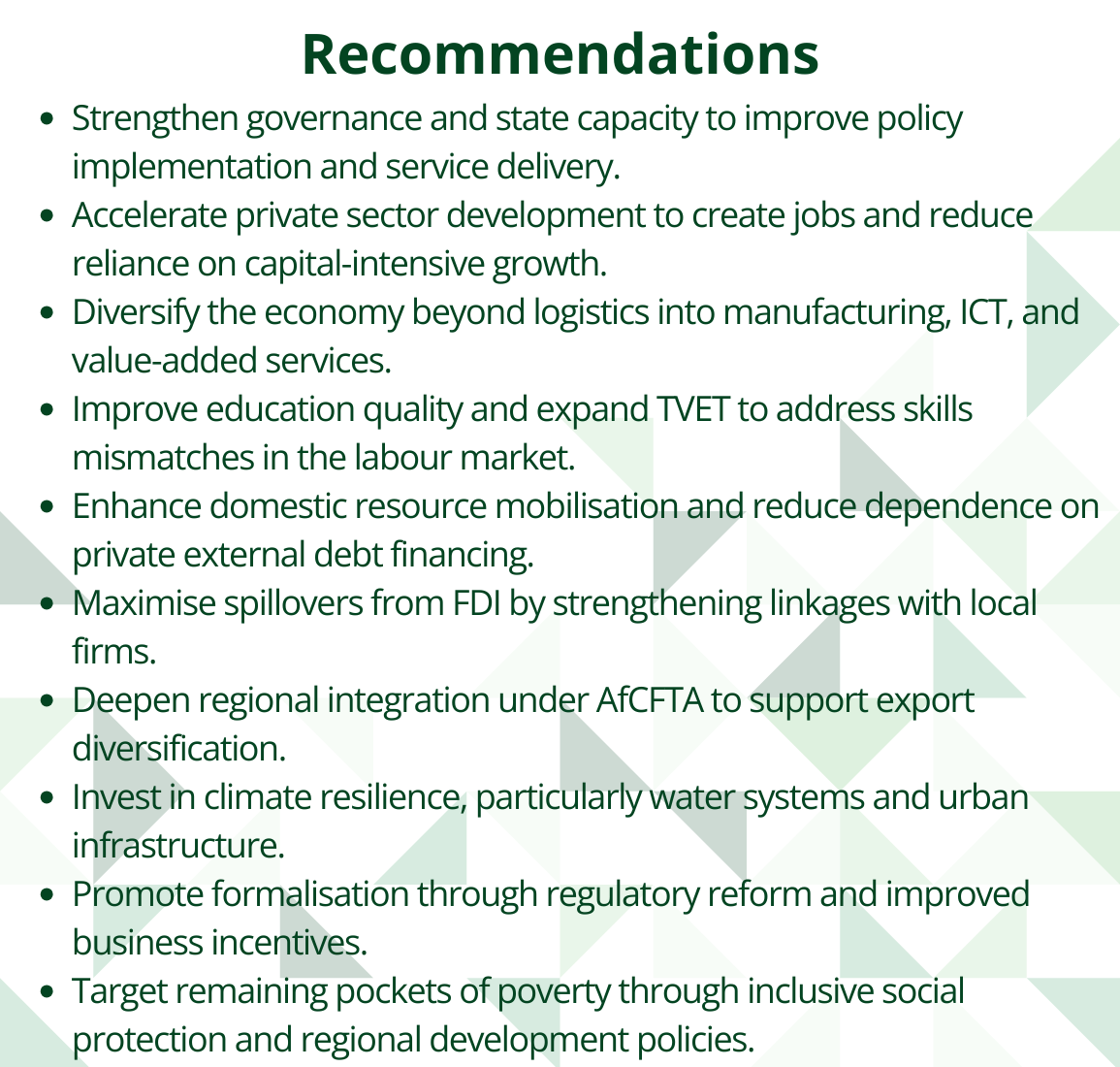
Page information
Contact at AFI team is Marvellous Ngundu
This entry was last updated on 22 May 2026 using IFs v8.58.
Donors and sponsors


Reuse our work
- All visualizations, data, and text produced by African Futures are completely open access under the Creative Commons BY license. You have the permission to use, distribute, and reproduce these in any medium, provided the source and authors are credited.
- The data produced by third parties and made available by African Futures is subject to the license terms from the original third-party authors. We will always indicate the original source of the data in our documentation, so you should always check the license of any such third-party data before use and redistribution.
- All of our charts can be embedded in any site.
Cite this research
Marvellous Ngundu (2026) Djibouti. Published online at futures.issafrica.org. Retrieved from https://futures.issafrica.org/geographic/countries/djibouti/ [Online Resource] Updated 22 May 2026.